
.jpg)
How to Sell an AI Business: A Step-by-Step Guide for Founders
Most of what is written about AI companies and acquisitions is about price. What the market is paying, which categories carry a premium, how the multiples compare to conventional software. Those are reasonable things to want to know, and we cover them elsewhere: our analysis of how to value an AI business sets out the metrics buyers weigh, the AI business valuation model walks through the methods, and our review of AI M&A trends in 2026 covers where capital is flowing.
This guide is about something different and considerably less discussed: what actually happens when you sell one. The sequence of a sale, the evidence an AI business has to assemble that a conventional software business does not, what technical diligence asks and when, which structures turn up on the table, and where processes tend to lose time. Founders who have sold a SaaS company before are often surprised by how much of the AI-specific work sits at the front, months before a buyer sees anything.
The underlying process is not unique. It follows the same arc as how to sell a SaaS business, and much of that guide applies directly. What differs is a parallel track of work running alongside it, covering models, data rights, inference economics and technical defensibility, which has to be ready before it is asked for rather than assembled under deal pressure.
A note on how to read this. What follows describes how these processes commonly run; it is not a description of any particular engagement, and nothing here predicts what a given business will achieve. Sequence, duration and terms vary by deal size, by readiness and by who is at the table. Where the page touches legal or accounting matters, it is general information rather than advice, and your own counsel and accountant should be the ones who apply it.
The Short Answer
Selling an AI business follows the same eight stages as any software sale: preparation, valuation view, marketing documents, buyer outreach, management meetings, offers, diligence and close. What changes is a second track of evidence running alongside it from day one. Buyers want to know which models you depend on and under what licence, where your training data came from and what rights attach to it, what your margins look like with inference fully loaded, and whether the advantage survives the next model generation. The businesses that transact well are the ones that had those answers written down before anyone asked.
The rest of this guide takes each stage in turn. If you are at the very start and want the market context first, our review of AI M&A trends in 2026 is the better place to begin, and this guide picks up from the point where a sale becomes a live intention.
Before Anything Else: What Are You Actually Selling?
This sounds like a philosophical question and it is a practical one. AI businesses carry four distinguishable assets, and different buyers want different combinations of them. Being clear about which of yours is doing the work changes who you approach, what you prepare, and what structures you are likely to be offered.
The product and its revenue. A working application with customers paying for it, which is the asset a conventional software buyer understands and underwrites in a conventional way.
The data. A proprietary corpus that improves the product and that a competitor cannot assemble quickly. This is frequently the most valuable asset and the one most often documented worst.
The models and technical IP. Trained weights, architectures, fine-tuning pipelines, evaluation harnesses, and whatever patents or trade secrets sit around them.
The team. The people who built it. Bain's software M&A work puts talent among the determining factors in whether an AI acquisition creates value, noting that acquiring AI talent is expensive and compensation alone is insufficient to retain it. Buyers price that risk, and it shapes structure more than founders expect.
The team asset is the one that most changes a seller's own position, and it cuts both ways. Where the people are a material part of what is being bought, the buyer's interest and the founder's are aligned on retention and can diverge sharply on timing: an acquirer may want commitments measured in years from people who were expecting an exit. Working out early what each key person actually wants, and what they would need to stay, is less comfortable than leaving it until the structure is on the table, and considerably more useful.
Most businesses have all four in some proportion. The question is which one a buyer is really paying for, because the answer determines everything downstream. A buyer acquiring revenue runs a commercial process. A buyer acquiring data runs a rights and provenance investigation. A buyer acquiring a team structures around retention. McKinsey's read of technology M&A describes acquirers pursuing infrastructure, platform capability and talent through different instruments, and notes that premium valuations attach to targets with differentiated computing efficiency, proprietary data pipelines, or model optimisation capabilities. Those are three different assets and three different conversations.
Work this out before you start, honestly. A business whose genuine asset is a capable team and a promising prototype should not run a process designed to sell recurring revenue, and vice versa.
Step 1: Establish a Defensible View of Value
Everything in a sale process anchors to a number, and the quality of that number determines whether the process runs forwards or in circles. The goal at this stage is not the highest figure you can justify. It is the figure you can defend line by line when someone sceptical rebuilds it.
Three things make this harder in AI than in conventional software. The published comparables are dominated by venture rounds and mega-cap transactions that have little in common with a lower-middle-market business. The revenue is often young, so the usual retention evidence is thin. And the cost base behaves differently, because inference and infrastructure costs scale with usage in a way that classical software costs do not.
Start with the mechanics rather than the headline. Which basis applies to a business of your size and profile is a question our guide to ARR vs revenue vs SDE vs EBITDA answers directly, and the general drivers are set out in our note on the SaaS metrics that drive a valuation. For the AI-specific weighting of intellectual property, data assets and model defensibility, the AI business valuation model covers the methods in detail, and how to value an AI business covers the metrics buyers tend to look for.
Be particularly careful with headline multiples. The figures that circulate about AI valuations come overwhelmingly from venture financings and from very large public companies, and a funding round prices a minority stake with preferences and information rights attached while an acquisition prices the whole business in cash with the buyer taking execution risk. The same company can carry two very different numbers at the same moment and both can be accurate. Our note on why some SaaS companies sell for 10x ARR works through why headline outcomes are a poor planning anchor generally, and the point applies with more force in AI than anywhere else.
The distinction between funding and exit markets is worth holding onto, because the two have diverged. Fenwick's read of venture conditions records AI taking 61 percent of venture dollars in the first quarter of 2026, while the PitchBook and NVCA Venture Monitor notes that everyday exit paths remain thin for the broader market and that many venture-backed companies without a route to a marquee listing may need to accept exit prices below peak-era expectations. A category can be extremely well funded and still be a difficult place to sell a particular business, and those are separate facts about separate markets.
The useful output of this stage is a range with the reasoning attached, plus an honest view of where your business sits inside it and what would move it. If that range is materially below what you had in mind, the time to discover it is now rather than after three months of outreach.
Step 2: Build the AI Evidence File

This is the stage that distinguishes an AI sale, and the chart above shows why it starts early. The AI-specific workstreams are not quick, they depend on records that may not exist yet, and they are the things most likely to surface a problem that takes months rather than weeks to resolve.
The file has four parts.
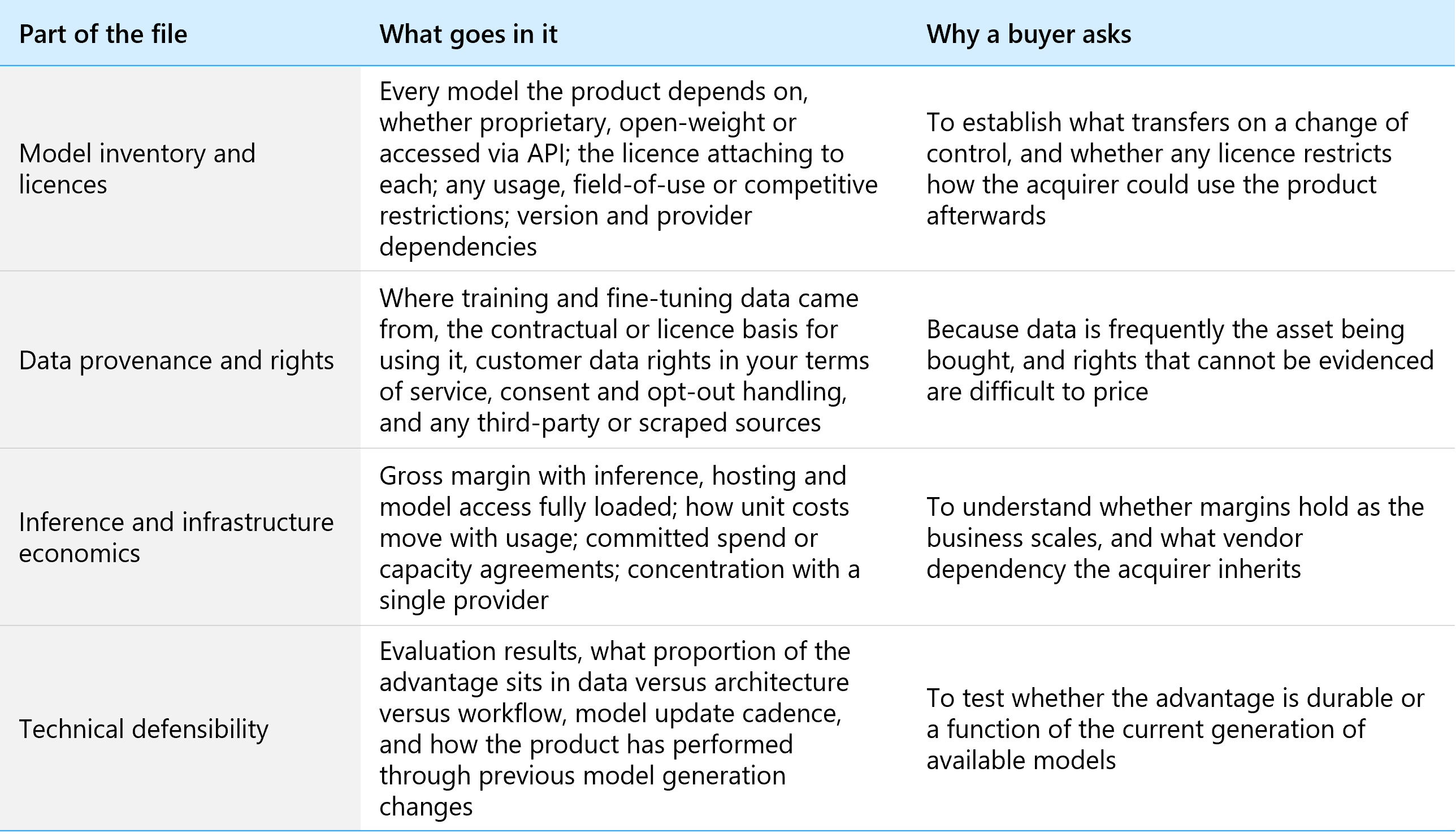
Licensing deserves particular attention because it is the item founders most often assume is simple. Open-weight models come with customised rather than standardised terms. Cooley's review of the area notes that such licences commonly impose commercial-use limitations, acceptable-use restrictions, attribution requirements and, notably, restrictions on using the model, its outputs or derivative works to train, develop or improve a competing AI model. The same review observes that self-hosted deployments may lack provider indemnification that a managed service would carry, and that copyleft-style provisions can require derivatives to be shared on identical terms. Any of those can matter a great deal to an acquirer, and all of them are better identified by you than by their counsel.
Data provenance is the second recurring problem. A corpus assembled over several years by a small team often has no single document describing where it came from. Reconstructing that under a diligence deadline is unpleasant and sometimes impossible, which is the main argument for documenting training data provenance as an ongoing discipline rather than a pre-sale project. Where you cannot evidence the basis for a dataset, expect it to be valued conservatively or carved out.
The third part, margin with inference loaded, is where a lot of AI businesses discover something uncomfortable. A gross margin that looks like software at low volume can look quite different at scale once model access and compute are counted properly. Working out how inference costs change gross margin before a buyer does is straightforwardly in your interest, and it connects to the earnings questions covered in our guides to EBITDA add-backs and quality of earnings in tech M&A.
Step 3: Fix What Diligence Will Find

Assembling the evidence usually surfaces problems. Dealing with them now is cheaper than negotiating about them later, and the single most common one is retention.
The baseline is worth seeing plainly. ChartMogul's analysis of roughly 3,500 software companies puts median net revenue retention for AI-native businesses at 48 percent against 82 percent for B2B SaaS on 2025 data, with gross retention for the AI-native group improving over the year from 27 percent in January to 40 percent in September. That is a market in motion rather than a settled picture, but it is the baseline a buyer has in mind. A seller claiming durable retention is making a claim that sits well above the median of their own category, and it has to be evidenced rather than asserted.
Cohort retention by signup period is the evidence that does it. Blended averages are easy to produce and tell a buyer very little, particularly in a fast-growing business where new customers mask churn in older ones. Our guides to net revenue retention and SaaS valuation and SaaS churn rate benchmarks set out what that evidence looks like when it is assembled properly, and our note on the LTV to CAC ratio benchmark buyers expect covers the related unit-economics questions.
The second recurring issue is what might be called wrapper risk. Buyers have become notably better at distinguishing a product with a genuine data or workflow advantage from a conventional product with a model called behind it. Bain's software M&A work puts validating differentiated IP and proprietary data assets at the centre of AI diligence. If your advantage is primarily that you integrated an available model earlier than competitors, that is a real but time-limited position, and it is better to present it honestly with evidence of what you have built on top than to have the question asked for you.
A related point is worth making about evaluation evidence, because it is the thing most AI businesses have least of in a form a buyer can use. Internal benchmarks run informally during development rarely survive scrutiny: the question is not whether the model performed well but whether the test was fair, repeatable and representative of what customers actually do. A documented evaluation methodology, held stable across model versions so results can be compared over time, is unusual enough that having one is itself a signal. It also answers the durability question more convincingly than any assertion about moats, because it shows what happened the last time the ground moved.
The third is concentration, in two forms. Customer concentration is priced in any software business and is covered in our note on what buyers look for in a SaaS acquisition in 2026. Provider concentration is more specific to AI: a business whose product depends entirely on one model provider carries a dependency the acquirer inherits, including pricing and availability risk. Demonstrating that the product can run on more than one model, or that switching has been tested, addresses a question that would otherwise sit unresolved.
Finally, the ordinary financial hygiene that applies to any sale applies here too, and tends to remove discounts rather than add premiums. Accrual accounts that reconcile to the billing system, clean separation of software and services revenue, and a defensible treatment of deferred revenue in acquisitions all sit in the same category. Our preparation checklist covers the general ground, and most of it applies unchanged.
Step 4: Decide the Route to Market

The buyer pool for AI businesses has widened quickly. Bain reports that the share of technology deals carrying an AI component moved from around a quarter in 2024 to nearly half in 2025, and Stanford's AI Index puts total corporate AI investment at $252.3 billion in 2024, with private investment up 44.5 percent year on year. What that means for a seller is that there are more credible buyers than there were, and also that those buyers have seen a great many AI businesses and have become harder to impress.
Route to market is largely a function of size. Smaller businesses, broadly those below the point where a full advisory process is economic, are often better served by a marketplace that connects vetted buyers and sellers directly. Larger or more complex businesses, particularly those where several categories of acquirer might compete, generally warrant a managed process. FE International operates both, and our note on how to choose an M&A advisor sets out what to look for either way.
Buyer type matters more in AI than in most categories, because the four assets described earlier appeal to different parties. A strategic acquirer may be buying capability and distribution and can justify a price a financial model would not support. A private equity platform is usually underwriting recurring revenue and a path to a larger exit. An operator or individual buyer is buying a business they intend to run. Our comparison of private equity, strategic and individual buyers sets out how those motivations diverge.
One structural point is worth knowing before outreach begins. Whatever the route, a process with several credible parties in it behaves very differently from a conversation with one. A single interested acquirer, however enthusiastic, is negotiating against nothing, and that shows up in both price and terms. Competitive tension is also the main reason to run a process properly rather than respond to an approach, which is a separate question from whether the approach is attractive.
Step 5: Go to Market Without Losing Control of the Story
The marketing phase is where the evidence file becomes a narrative. Two documents usually carry it: a short anonymous teaser that goes out broadly, and a fuller memorandum released after a non-disclosure agreement is in place. Our guide to what a CIM is in M&A covers what the longer document contains and how it is structured.
For an AI business the memorandum has to do something extra. It has to explain the technology to a reader who may be commercially sophisticated and technically general, without either overstating the moat or burying it in detail. The version that tends to work describes what the product does for a customer, what makes that difficult to replicate, and what evidence supports the claim, in that order. Claims about model performance are more persuasive with an evaluation methodology attached than without one.
Confidentiality is a live constraint throughout, and arguably a sharper one in AI because teams are small, specialised and actively recruited. A process that leaks can cost you the people the buyer is partly paying for. Our guide to how to keep a business sale confidential sets out the mechanics, and the short version is that the circle widens deliberately at defined points rather than drifting outwards.
Management meetings follow outreach, and they are where technical credibility is established or lost. Expect questions about what happens when the next model generation arrives, how much of the advantage is data versus engineering, and what the team would do with more resources. Those are not trick questions; they are the buyer working out what they are buying. Answering them with specifics, including the parts that are uncertain, generally lands better than confidence.
Step 6: Offers, and the Structures That Appear in AI Deals
AI transactions have developed a wider range of structures than conventional software deals, which is worth understanding before offers arrive rather than afterwards.
The familiar one is a full acquisition of the business for cash, sometimes with deferred consideration or an earnout attached. Alongside it, the market has seen arrangements that achieve some of the same ends differently: transactions weighted heavily toward retaining the team, licensing arrangements that give a buyer access to technology without a change of control, and hybrids combining elements of both. Our review of AI M&A trends in 2026 describes several of these patterns as they have appeared at the larger end of the market.
For a founder the practical question is not which structure is best in the abstract but which one fits what you want. A structure weighted toward retention and future performance implies you are staying and that a meaningful part of the outcome depends on what happens next. A clean acquisition implies a shorter involvement and more certainty. Neither is better; they are different trades, and the time to work out which you want is before you are choosing between two offers that express them differently.
Earnouts deserve a specific caution. Where consideration depends on future performance, the metric it is measured against becomes one of the most consequential definitions in the agreement, because it determines what you are paid for and what the buyer can change afterwards. That is a conversation for your transaction attorney, and the question of whether an acqui-hire, a licence or a full acquisition fits is worth having with an advisor early rather than at the letter of intent.
Whatever the shape, the letter of intent typically marks the point where exclusivity begins. From there the process is about confirming what has been represented rather than discovering it, which is why the preparation stages matter as much as they do.
Step 7: Diligence, Including the Technical Track
Diligence in an AI sale runs on two tracks in parallel, and the technical one is where processes most often slow down.
The commercial and financial track is familiar. A buyer rebuilds the revenue, tests the retention evidence, examines the contracts and generally commissions an independent view of earnings. Our guides to SaaS due diligence and the buyer-side due diligence checklist cover that ground, and FE International's due diligence services exist partly because sellers who have been through the exercise internally find the real thing less disruptive.
The technical track is where an AI due diligence checklist for sellers diverges from a software one. Expect a review of the codebase and model pipeline, validation that results are reproducible, examination of the licence position on every dependency, a provenance review of training data, and an assessment of how the cost structure behaves as volume grows. Where regulated data is involved, expect a compliance review alongside it.
Two things make this track slower than sellers anticipate. The first is that it often involves people who are not full-time on the transaction, on both sides. The second is that findings tend to generate follow-up questions rather than resolving cleanly, particularly on data rights, where an incomplete answer invites a deeper look. A seller who has the file ready moves through this in weeks; a seller assembling it under exclusivity can spend considerably longer, and the question of how long it takes to sell an AI business is answered more by this stage than by any other.
It is worth saying plainly that findings are normal. Almost every process surfaces something. What determines whether a finding costs you money is whether it was disclosed early with context or discovered late without it.
Step 8: Signing, Closing and What Comes After
The final stage converts a negotiated position into documents. The purchase agreement sets out what is being sold, what you are representing about it and what happens if those representations turn out to be wrong. For an AI business the representations around intellectual property, data rights and third-party licences tend to receive particular attention, which is another reason the evidence file pays for itself.
Several mechanics commonly appear between signing and completion: a working capital adjustment, an escrow or holdback against post-closing claims, and where consideration is deferred, the machinery for measuring and paying it. Where third-party consents are needed, including from model or infrastructure providers whose terms may restrict assignment, those take calendar time and are worth identifying early.
Purchase price adjustments are now close to universal rather than exceptional. SRS Acquiom's study of more than 1,500 private-target acquisitions reports that they are present in more than 90 percent of transactions, against around half a decade ago. The practical consequence for a seller is that the number agreed in the letter of intent is a starting point for the number that settles, and the mechanics that bridge the two are worth understanding before signing rather than after.
Transition is usually more involved than in a conventional software deal. Where the team is part of what is being acquired, retention arrangements and the practicalities of integration matter to both sides, and Bain's work notes that integration requires significant and swift reprioritisation of an acquirer's roadmap. A founder who has thought about what they want their own role to be after close is in a better position than one deciding it during negotiation.
What Tends to Move the Outcome
Across processes, a short list of things recurs. None of them is a guarantee and all of them are within a founder's control.
Evidence beats positioning. A claim about defensibility supported by evaluation results and cohort data is a different asset from the same claim asserted in a deck. Preparation time converts directly into process speed, and speed reduces the number of opportunities for a deal to lose momentum. Several credible buyers produce a different negotiation from one. Honest disclosure of weak points early costs less than their discovery late. And the structural work, retention, margin clarity, reduced provider and customer concentration, belongs in exit planning a year or more ahead rather than in the weeks before a process.
The market backdrop matters less than most founders assume, though it is worth knowing. Our mid-year 2026 tech M&A report covers volumes and conditions across technology verticals, and FE International's AI market report covers the AI sector specifically. Conditions set the weather; preparation determines how you sail in it.
One final observation. Businesses that combine AI with deep workflow ownership in a specific industry have been attracting particular attention, which our case study on selling a vertical SaaS business illustrates in a related context. If that describes your business, the vertical depth may be as much of the story as the AI, and presenting it that way is often more persuasive.
Where This Leaves You
Knowing how to sell an AI business comes down to accepting that the familiar process has a second track running beside it, and that the second track starts earlier than the first. Models, data rights, inference economics and technical defensibility are not diligence items to be handled when they arrive. They are the evidence the whole argument rests on, and the businesses that transact well are the ones where that evidence already existed.
The rest is the ordinary discipline of any good process: a defensible view of value, honest preparation, enough credible buyers to make the negotiation real, and early disclosure of the things that will come out anyway.
If you want to understand where your business sits before deciding anything, you can request a confidential valuation. For context on the practice, FE International's AI industry team works across AI, data and software transactions, the firm has appointed a partner to lead software, data and AI deal execution, and larger or more complex mandates are handled by the investment banking team. FE International has advised on more than 1,500 completed transactions since 2010 with a 94.1% success rate. You can also read how the firm sells SaaS and technology businesses end to end.
