
.jpg)
How Do I Keep a Business Sale Confidential?
You keep a business sale confidential by controlling who learns what, and when, rather than by relying on people to stay quiet. That means an anonymised approach to the market, an NDA before anything identifying is shared, information released in stages rather than all at once, and a deliberate decision about every person added to the circle.
There is a legal dimension most sellers miss. Under 18 U.S.C. § 1839, information only qualifies as a trade secret if its owner "has taken reasonable measures to keep such information secret" and it derives value from not being generally known. A sale process that sprays confidential material across a dozen prospects without controls does not just create commercial awkwardness. It can undermine the protected status of the very assets you are selling.
The commercial stakes are more immediate. Staff update their CVs, competitors call your customers, and a renewal conversation that was routine last week becomes a negotiation. None of that is inevitable, and none of it is a reason to avoid selling. It is a reason to run the process properly. This page covers how, stage by stage, as a companion to our guide on how to sell a SaaS business.
What you are protecting, and from whom
Confidentiality in a sale is not one problem. It is four audiences with different interests, different information needs, and different moments at which telling them becomes the right decision.
Employees are the group most affected and the most likely to hear a rumour before they hear from you. The risk is not gossip; it is a key engineer accepting another offer during diligence, which is a genuine valuation event.
Customers worry about continuity, support and pricing under a new owner. Enterprise accounts with change-of-control clauses will find out eventually because their consent is required, but the moment of telling should be chosen rather than forced.
Competitors are the audience with an active interest in the information. A competitor who learns you are selling can approach your customers with the argument that your roadmap is uncertain.
Suppliers and partners matter where a contract is material or carries its own consent requirement. Deciding early which of these groups needs to know, and at what stage, is part of the preparation work covered in our SaaS exit planning overview.
Confidentiality is a legal prerequisite, not just good practice
Trade secret protection is not automatic. It is conditional on behaviour, and the condition is ongoing.
The federal definition requires reasonable measures to keep information secret, and the equivalent European standard requires that information be subject to reasonable steps under the circumstances. WIPO's guidance notes that the standard is proportionate: a large pharmaceutical company is expected to take more robust protective steps than a medium-sized business. What counts as reasonable for a $5 million SaaS company is not what counts for a multinational, which is a relief rather than a burden.
WIPO sets out the categories that satisfy the test, and they map almost exactly onto a well-run sale process: identify and mark what is confidential, apply technical and access controls, cover confidentiality in employment terms, and handle third parties carefully. On that last point the guidance is specific that NDAs deserve more than boilerplate and should be drafted in line with the actual risk, and that conducting due diligence on a counterparty's trustworthiness is itself part of meeting the standard.
The practical reading for a seller is encouraging. The controls that protect your commercial position during a sale are the same controls that preserve trade secret status, so the work counts twice. This is general information rather than legal advice, and the position varies by jurisdiction, so have your counsel confirm what applies to you.
Staged disclosure: the mechanism that does the work
The core technique is simple. Information is released in tranches, each one unlocked by something the buyer gives in return: interest, then a signature, then evidence of funding, then an offer.
It starts with an anonymised teaser, typically one or two pages, that describes the business without naming it: sector, revenue band, growth rate, business model, and the reason it is attractive. A buyer can decide whether to engage without ever learning who you are. Only once an NDA is signed does the confidential information memorandum follow, which names the company and carries the full argument. Financial Edge Training notes that a full memorandum runs anywhere from 30 to over 150 pages, so the gap in disclosure between those two documents is enormous, and the NDA sits precisely in it.
The teaser is also where the metric discipline pays off. Describing a business as "B2B SaaS, $4m ARR, 22% growth, 108% net revenue retention" is specific enough to attract the right buyer and generic enough to protect you, which is only possible if those figures are already defined and defensible. Our guide to the metrics that drive SaaS valuations covers how each is calculated.
What the NDA actually has to do
A generic mutual NDA downloaded from a template site covers roughly half of what a sale process needs. The clauses below are the ones that matter, and the third column is why they matter to you specifically.
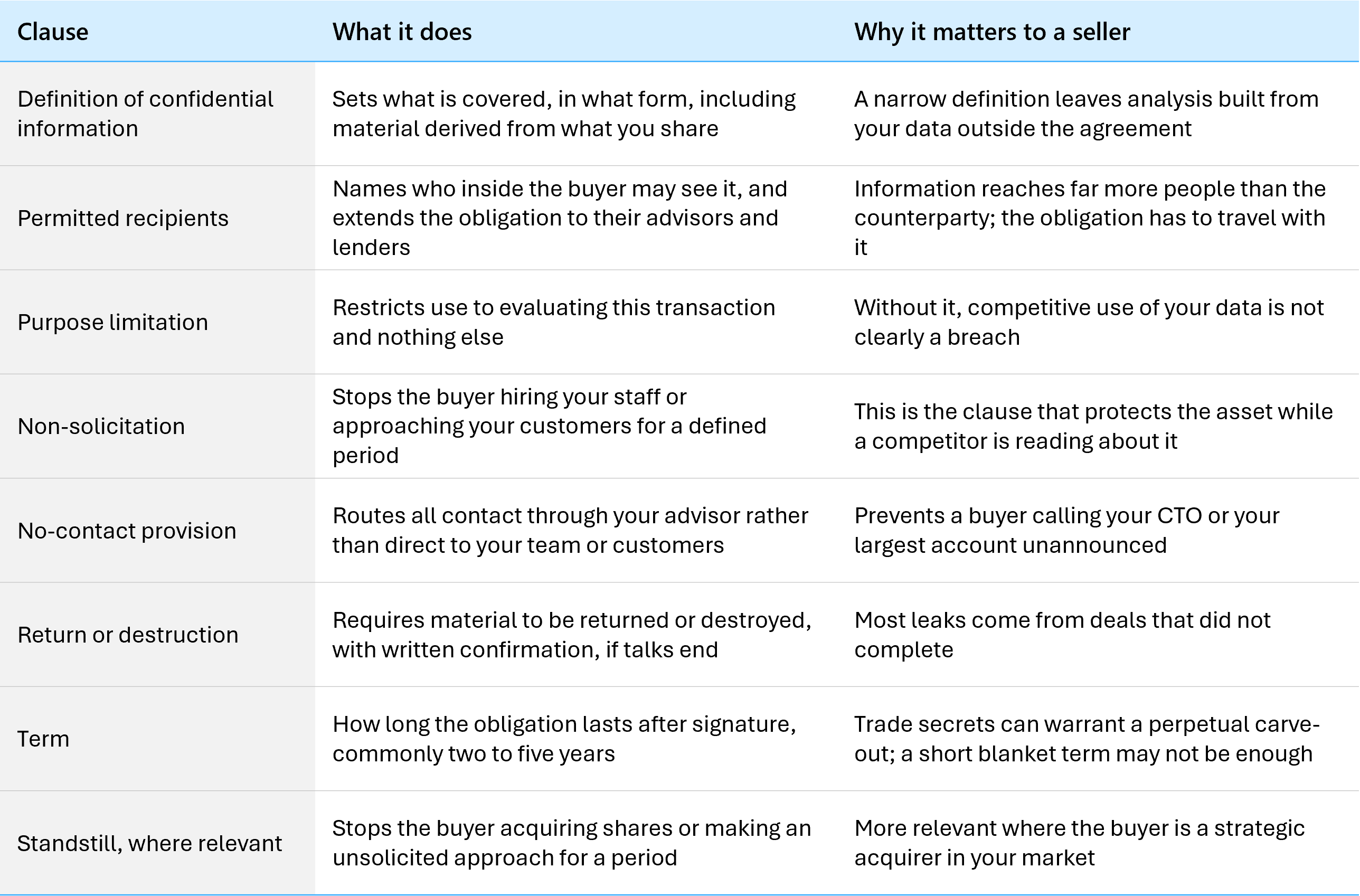
Have counsel draft or review this. WIPO's guidance is explicit that boilerplate is not enough to meet the reasonable steps standard.
Data room discipline
The data room is where confidentiality is won or lost, because it holds everything and it stays open for months. Datasite's 1H26 data puts the median time a deal spends in diligence at 181 days, and Deloitte puts the median gap from signing to closing at about three months on transactions of $100 million or more. Your material sits with other people for a long time.
Four controls do most of the work. Permission by group rather than by individual, so a buyer's lawyers see the contracts and not the customer pricing. Staged folders, where the most sensitive material opens only after an LOI. Watermarking with the recipient's identity on every page, which changes behaviour more than it prevents copying. And redaction of what a buyer does not yet need: customer names before exclusivity, individual salaries, and security findings not yet remediated.
Personal data deserves separate thought. The UK regulator's guidance on due diligence when sharing data in a merger or acquisition asks organisations to establish what data is being transferred, identify the purposes for which it was originally obtained, establish a lawful basis for sharing it, and document that decision. In practice that usually means pseudonymising customer lists until late in the process: a buyer evaluating concentration needs the shape of your customer base, not the names and email addresses. Our guides to the documents you need to sell a SaaS company and quality of earnings in tech M&A cover what belongs in the room, and the buyer-side due diligence checklist shows what will be requested. FE International's due diligence services team manages this end of the process.
When the best buyer is a competitor
This is the hardest case, and avoiding it entirely is usually the wrong answer. Strategic acquirers in your own category often pay the most precisely because they understand what they are buying, and our comparison of PE, strategic and individual buyers for SaaS sets out why. The task is to capture that value without handing over a competitive briefing.
Four techniques, in order of use. Approach competitors later than financial buyers, so you enter those conversations with momentum and a benchmark. Hold back the crown jewels, meaning the specific material a competitor could act on immediately: customer-by-customer pricing, the product roadmap, named account plans and churn reasons by account. Use a clean team arrangement, where named individuals at the buyer who are walled off from their operating business review the sensitive material and report only conclusions upward. And make the non-solicit and purpose-limitation clauses materially stronger for this category of buyer than for a financial one.
Timing matters too. Going to market when your sector has active buyers gives you more than one competitor at the table, which converts a risky conversation into a competitive one. Our mid-year 2026 tech M&A report tracks where that demand currently sits, and our breakdown of SaaS valuation multiples covers what the premium for strategic fit actually looks like.
Telling your team, and when
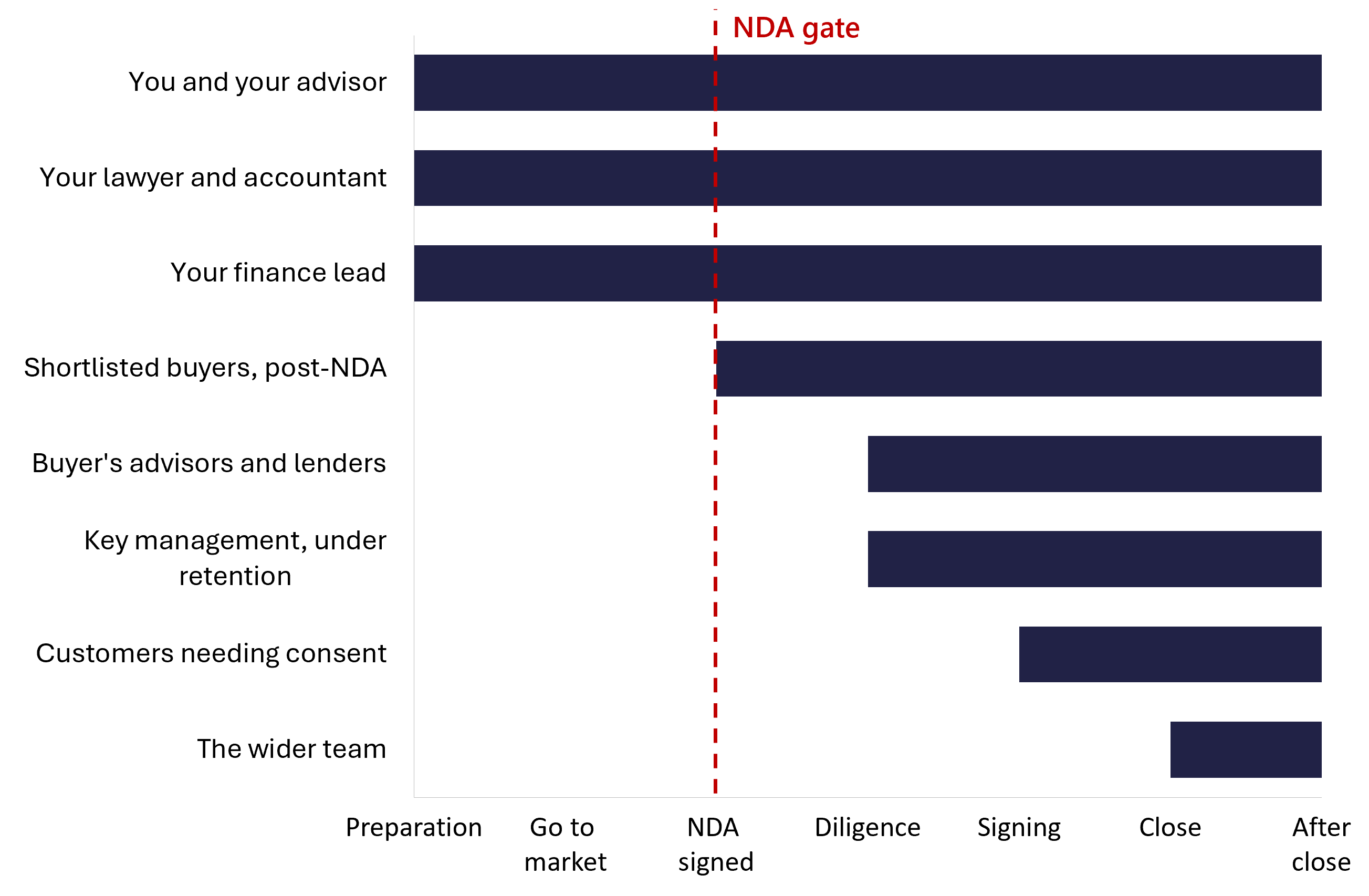
Most founders tell their team later than feels comfortable and earlier than is optimal. The usual sequence is a finance lead early, because the numbers cannot be produced without one, then key management once a deal is credible and retention arrangements are ready to discuss, then the wider team at or just after signing.
The reason for holding the wider announcement until signing is not secrecy for its own sake. It is that roughly half of processes end without a completed transaction for perfectly ordinary reasons, and having told a whole company about a sale that then does not happen costs more trust than waiting did. Telling people at signing means telling them something certain.
Where a key person is genuinely load-bearing, bring them in earlier and pair the conversation with a retention arrangement so the news arrives with an answer attached. Our notes on planning the timing of a business exit and on when it is the right time to sell a SaaS business cover how this fits the wider schedule.

If word gets out anyway
Prepare for this before it happens, because the quality of the response depends almost entirely on whether a plan existed. Draft a short holding statement at the start of the process and keep it ready.
Three principles govern the response. Move quickly, because a vacuum fills with worse information than the truth. Tell your team before your customers, since employees hearing it from a customer is the version that damages trust most. And be accurate without being complete: confirming that you regularly review strategic options is true, calm and non-committal, whereas denying a process that is genuinely underway creates a much larger problem later.
Security posture is part of this too. In SRS Acquiom's 2026 survey of 150 senior dealmakers, 84% expect greater scrutiny of cybersecurity diligence, and a buyer who sees careless handling of your own confidential material will reasonably wonder how you handle theirs. Running a tight process is itself a signal. FE International's investment banking team runs the outreach so that your name reaches only the buyers you have approved.
Running a confidential process
So how do I keep a business sale confidential? By designing the information flow rather than policing it. Anonymised at the top of the funnel, gated by a properly drafted NDA, staged through the data room, tightened further where the buyer competes with you, and communicated internally on a schedule you chose. Those controls protect your commercial position and, under both the US and European standards, help preserve the trade secret status of what you are selling.
FE International has completed more than 1,500 transactions since 2010 with a 94.1% success rate on private sales and acquisitions, and we handle SaaS sales end to end, including running a confidential process from anonymised approach through to close. If you want to sell without the market finding out before you are ready, that is the conversation to start with.
