
.jpg)
Why Do Some SaaS Companies Sell for 10x ARR?
The headline numbers travel further than the median ones. A founder reads that a software company changed hands at ten times recurring revenue, looks at their own business, and reasonably wants to know what the difference is. It is a good question with an answer that is more specific, and more conditional, than the usual list of value drivers suggests.
The short version is that 10x is not the top of a ladder most businesses are climbing. It is a different population, produced by a handful of conditions holding at the same time, usually with a buyer who is pricing something other than the standalone business. Our analysis of SaaS valuation multiples by ARR band sets out the ranges most private transactions actually clear, and this page is about what sits above them and why.
A note on how to read this. Nothing here describes an outcome available on request, and none of it predicts what any particular business will achieve. The conditions below are observations about where high multiples have tended to appear, not a specification a seller can work towards and expect a result.
The short answer
Ten times ARR is uncommon even among public software companies, and sits above the range most private SaaS transactions clear. Where it happens, several things are usually true at once: strong growth alongside real profitability, retention that expands rather than erodes, something the buyer cannot easily build, and more than one party that wants it. The multiple is an output of that specific situation rather than a rating the business carries into every conversation.
That last point is the one worth holding onto. The same business can be worth very different multiples to different acquirers on the same day, because they are underwriting different things. A number is not a property of the company alone.
Where 10x Actually Sits
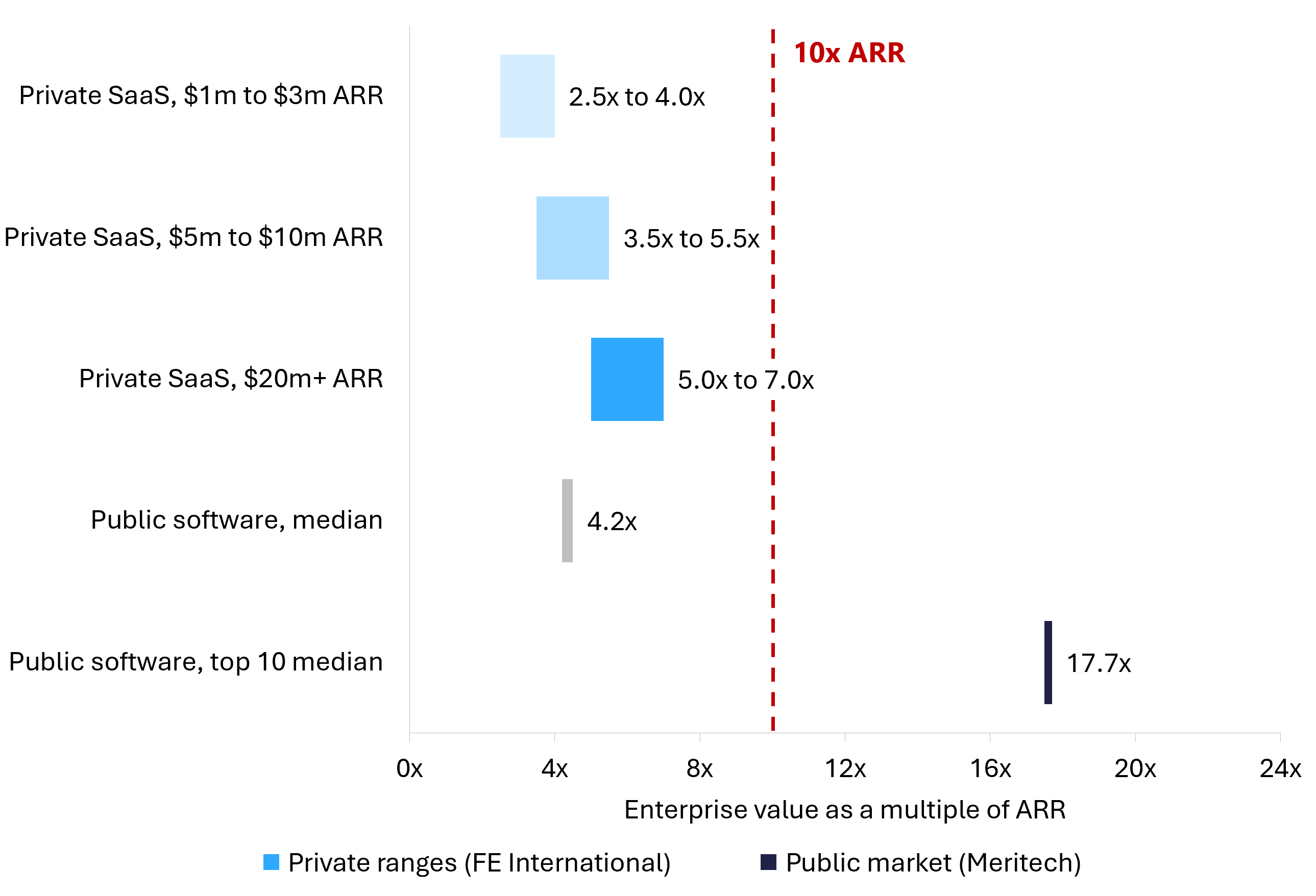
It helps to see the number in context before explaining it. Among public software companies, where multiples are systematically higher than private ones because the shares are liquid and the businesses are larger, Meritech counted only nine companies trading above 10x forward revenue in September 2026, against a median of around 4.2x and a top-ten median near 17.7x. Ten times is not the upper-middle of that distribution. It is close to the entrance of the top decile.
Private transactions generally clear below public comparables, which is why the bands in our SaaS valuation multiples analysis sit where they do. The venture-backed end of the private market is a separate population again: Bessemer's Cloud 100, a list of the most highly regarded private cloud companies, averaged around 20x ARR in its 2025 report, down from 23x the prior year. Those are not companies being sold; they are companies being funded, on growth profiles that have very little in common with the typical business coming to market.
So when a 10x figure appears in the press, the first useful question is which of these populations it came from.
Condition One: Growth and Profitability Together
The companies sitting at the top of the public distribution share a profile that is harder to achieve than either half of it alone. Meritech describes the businesses above 10x as both highly profitable and growing quickly, with free cash flow margins above 20 percent alongside ARR growth above 20 percent.
Either one on its own is comparatively common. Fast growth funded by heavy spending is a familiar profile, and so is a mature business generating cash slowly. Doing both simultaneously is what is scarce, because it implies the growth is not being bought at a price that consumes it. Our note on the metrics that drive a SaaS valuation covers how those two halves are usually assessed, and the question of how they are weighted against each other is where most of the disagreement in valuation sits.
For a business in the size range most private transactions occupy, this condition is worth reading carefully rather than aspirationally. The profile is descriptive of a specific cohort of large software companies. It is not a threshold that, once met, transfers a public multiple onto a private business.
Condition Two: Revenue That Grows Without Being Replaced
High multiples tend to attach to revenue bases that expand on their own. That is a different claim from low churn, and the distinction does most of the work.
A business where existing customers spend more each year is compounding without acquisition spend, which is the closest thing software has to an annuity. One where existing customers spend less is running to stand still, and every point of growth has to be bought. ChartMogul's analysis of around 3,500 software companies, published in December 2025, puts median B2B net revenue retention at roughly 82 percent, with the top quartile near 97 percent. Both of those are below the level at which a cohort holds its value, which indicates how uncommon genuine expansion is.
The compounding is what earns the multiple rather than the retention figure itself. A business holding net revenue retention above 120 percent adds a fifth to its existing base every year before a single new customer is signed, which means a buyer modelling forward revenue can lean on the installed base rather than on an assumption about future sales execution. That shifts risk out of the model, and risk coming out of a model is a large part of what a higher multiple represents.
This is why net revenue retention tends to be the first metric a sophisticated buyer asks for, and why gross churn is examined alongside it rather than instead of it. A high headline retention figure produced by a handful of large expansions sitting on top of meaningful logo loss is a different business from one where the base is broadly stable, and cohort data is what separates them.
Condition Three: Something the Buyer Cannot Easily Build

The financial conditions explain why a business is worth a good multiple. They do not on their own explain a great one. The gap is usually filled by scarcity: the buyer wants a capability, a dataset, a customer base or a market position that they cannot assemble quickly themselves, and the alternative to buying is building slowly or not at all.
Where that scarcity currently sits is visible in the data. Bain reports that nearly half of strategic technology deal value in deals above $500 million in 2025 involved AI natives, or deals that cited AI benefits in the rationale, with Alphabet's acquisition of Wiz and Palo Alto Networks' purchase of CyberArk among the largest. Scarcity is not a permanent property of a category, though. What is difficult to replicate in one cycle is often commoditised in the next, which is part of why our notes on valuing AI businesses and how valuation models are adapting keep moving.
Sector matters here more than size does. A specialised position in a regulated or technically demanding market can be harder to replicate than a larger business in a crowded one, which is one reason cybersecurity and fintech businesses are often assessed on different reference points from general-purpose software.
Condition Four: A Buyer Paying for Something Beyond the Business
A financial buyer generally underwrites a business on what it produces standing alone. A strategic buyer can underwrite it on what it produces inside their own organisation, and those are different numbers.
McKinsey's work on synergy capture puts some scale on the difference. Announced revenue synergies have run at a median of around 17 percent of the target company's revenues from 2020 onward, with announced cost synergies for 2024 and 2025 significantly exceeding the historical average of roughly 16 percent of the target's cost base. Where a buyer believes those numbers, part of the price is being paid against their own future performance rather than against the target's current financials.
That is the mechanism behind most multiples that look impossible on a standalone basis. It also explains why the same business attracts materially different offers, a dynamic our comparison of private equity, strategic and individual buyers sets out in more detail. Notably, the gap between the two buyer types is not fixed: McKinsey records financial sponsors paying around 5 percent higher EBITDA multiples than strategic acquirers in 2025, narrowed from an 18 percent gap in 2023, so the assumption that strategics always pay more does not hold in every period.
Condition Five: More Than One Party That Wants It
A price is set by what a buyer will pay when they might not get it. A single interested party, however enthusiastic, is negotiating against nothing.
This condition is the most process-dependent of the five and the least discussed, partly because it is uncomfortable. The same asset presented to one acquirer and presented properly to a field of credible acquirers is not the same transaction, and competitive tension is a large part of what separates the top of a range from the middle of it. It is also why a process is generally run rather than simply responded to, and why keeping a sale confidential while still reaching enough of the market is a genuine constraint rather than a formality.
Competitive tension is also what makes the other four conditions pay. A business can hold every financial characteristic on this page and still transact at an ordinary multiple if only one acquirer ever sees it, because nothing obliges that acquirer to price in what the asset would be worth to somebody else. Scarcity only becomes visible as value when more than one party is competing for it.
Market conditions decide how much tension is available. PitchBook's April 2026 read of the market described a selective environment, with US middle-market deal count down roughly 20 percent year on year in the opening months and median enterprise value to EBITDA on corporate deals at about 9.8 times, up from 8.3 times in 2024. The same piece notes that buyers find the impact of AI on earnings hard to underwrite in software specifically, which tends to widen the gap between assets buyers are confident about and everything else. Our mid-year 2026 tech M&A report covers the wider backdrop.
Why the Conditions Have to Co-occur
Reading the five separately makes them look like a checklist. They are better understood as a joint requirement, which is why high multiples are rare even though each individual condition is not.
Strong growth without profitability leaves a buyer funding the growth. Expansion revenue without scarcity means a good business a buyer can substitute. Scarcity without a credible process means one buyer setting the price on their own terms. And every one of them is contingent on the numbers surviving examination, because a multiple quoted on figures that do not hold up in a quality of earnings analysis is a headline rather than a price. Where ARR has been calculated generously, or where deferred revenue and add-backs have been treated optimistically, the multiple moves during diligence rather than before it.
The rarity is arithmetic rather than rhetorical. If each condition held independently in one business in four, all five holding together would describe roughly one in a thousand. The real conditions are correlated rather than independent, so the true frequency is higher than that, but the shape of the point survives: the conditions are individually unremarkable and jointly uncommon. It is also why the businesses that clear a headline multiple tend to look obvious afterwards and are rarely identified in advance.
It is also worth saying plainly that a high multiple on a small revenue base and a lower multiple on a larger one can produce the same cheque. The multiple is a ratio, and the number founders actually care about is the product, which is the question our note on how much a business is worth addresses directly.
What This Means If You Are Preparing to Sell
The practical reading is not to chase the headline. Most of what moves a specific business within its own range is more prosaic than the five conditions above, and considerably more actionable.
Retention and revenue quality generally do more work than anything else, and both are improved slowly rather than before a process. Financial hygiene tends to remove discounts rather than add premiums, and is usually the most fixable thing on the list, which is why it sits early in any preparation checklist and why the supporting documents matter as much as the numbers they support. Reducing owner dependence and customer concentration addresses two of the risk factors buyers most consistently price, both of which appear in our note on what buyers look for in a SaaS acquisition and on most buyer-side diligence checklists.
Structural work of this kind belongs in exit planning a year or more out rather than in the months before going to market, and the process itself is set out in our guide to how to sell a SaaS business. For businesses at the larger end, where a strategic buyer and a competitive field are both realistic, FE International's investment banking team handles that kind of mandate.
Where This Leaves You
A business sells at 10x ARR when several uncommon things are true at the same time and a particular buyer has a reason that goes beyond the financial statements. Reading that as a target tends to lead founders towards the conditions they cannot control and away from the ones they can. The more useful question is not what the best multiple in the market was, but what this business looks like to the buyers who would realistically want it, and what would change that view.
If you want a view of where your own business sits rather than where the headlines do, you can request a confidential valuation, or read how FE International handles SaaS sales end to end.
