
.jpg)
.jpg)
To choose an M&A advisor, verify four things before you sign: proven specialisation in your sector, closed transactions at your size in the last 24 to 36 months, a named senior lead who runs your deal day to day. The eleven questions below test each one.
Most founders interview two or three firms, hear broadly similar pitches, and pick the one that quotes the highest number. That is the single most expensive habit in private company M&A, because the headline range in a pitch deck carries no obligation. The signature on the engagement letter does.
The evidence that this decision moves money is unusually strong. A study of 4,468 acquisitions of private sellers, published through the Harvard Law School Forum on Corporate Governance, found that private sellers receive significantly higher valuations when they retain an M&A adviser, with a further improvement when that adviser is top tier. The same research found no evidence that the stronger firms charge more. The mechanism is competition: a seller's bargaining power rises with the number of credible bids, and running a process that produces those bids is the work you are actually buying.
This guide sets out the eleven questions that separate firms, what a strong answer sounds like in each case, the red flag hiding behind each one, and a scorecard you can run across every firm you meet.
Why does choosing the right M&A advisor matter more in 2026?
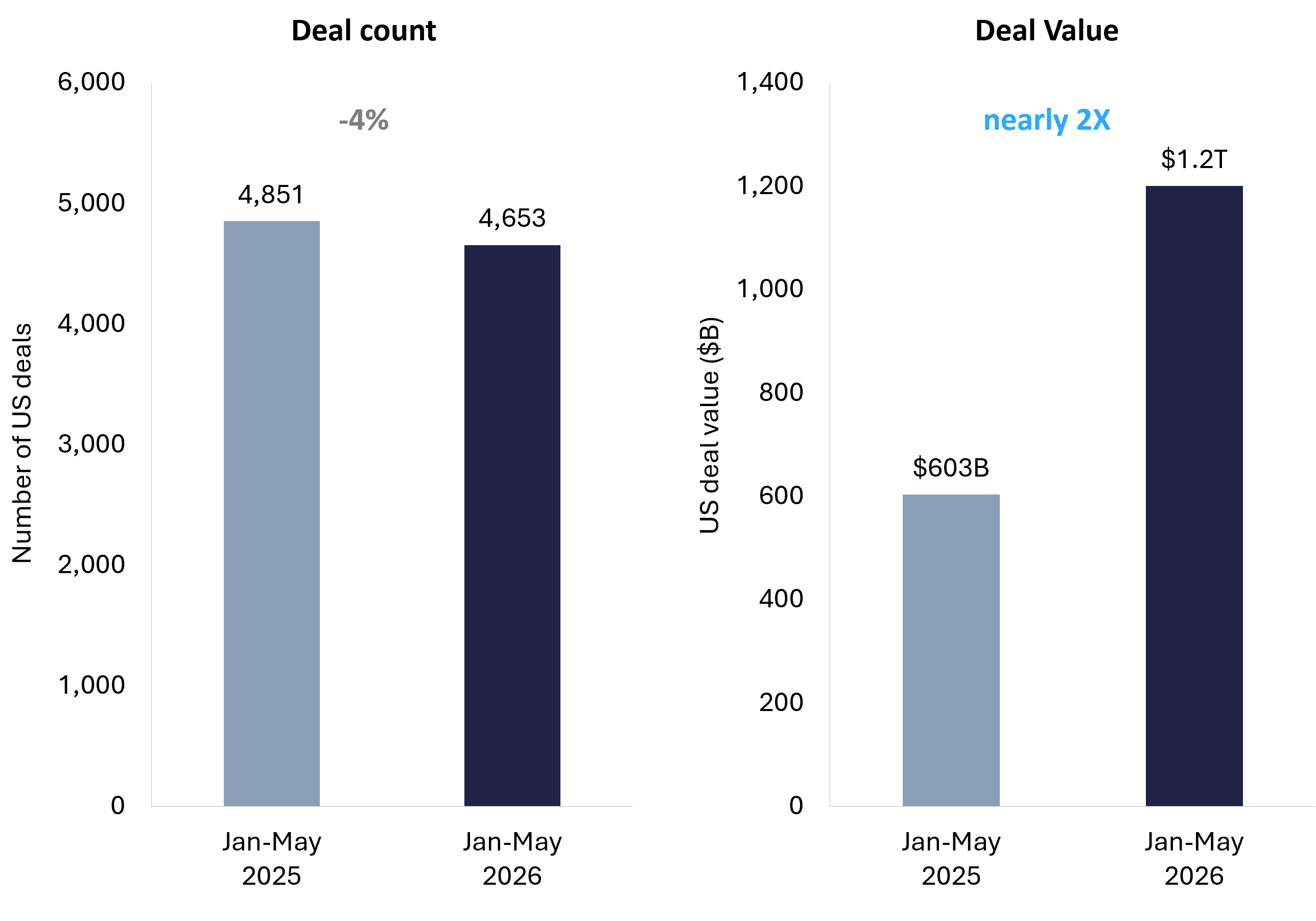
Because the market has split into two lanes, and which lane your business lands in depends heavily on how it is taken to market. PwC recorded 4,653 US deals worth $1.2 trillion in the first five months of 2026, against 4,851 deals worth $603 billion in the same period a year earlier. Deal value nearly doubled while deal count stayed flat. Capital is concentrating in fewer, better-prepared processes.
The wider picture is strongly favourable for sellers who prepare. Bain reports global M&A rose 40% to $4.9 trillion in 2025, the second-highest total on record, with 80% of the 300 M&A executives it surveyed expecting to sustain or increase deal activity this year. Momentum carried forward: deal value climbed a further 41% year over year to $2.4 trillion through the first five months of 2026. S&P Global put Q1 2026 volumes at $861.1 billion, the strongest start since 2021.
Technology sits at the centre of it. Almost half of all deals in the technology industry now carry an AI angle, and buyers are underwriting differently as a result. PwC notes that diligence has shifted toward monetisation, infrastructure access, and defensible workflows. That is a good market for a well-run business with clean numbers and a story that survives scrutiny. It is a demanding one for a seller whose advisor cannot answer technical questions on their behalf.
The practical takeaway: buyers are more selective, so well-prepared businesses stand out and command premium attention. Selection of the advisor is the first decision that determines whether yours is one of them. Our mid-year 2026 tech M&A report covers the market data by vertical in full.
The 11 questions to ask an M&A advisor before you sign
Use this table in the meeting. The middle column is the benchmark: if the answer you get is thinner than what is written there, you have learned something useful. The right-hand column is what that thin answer usually means.
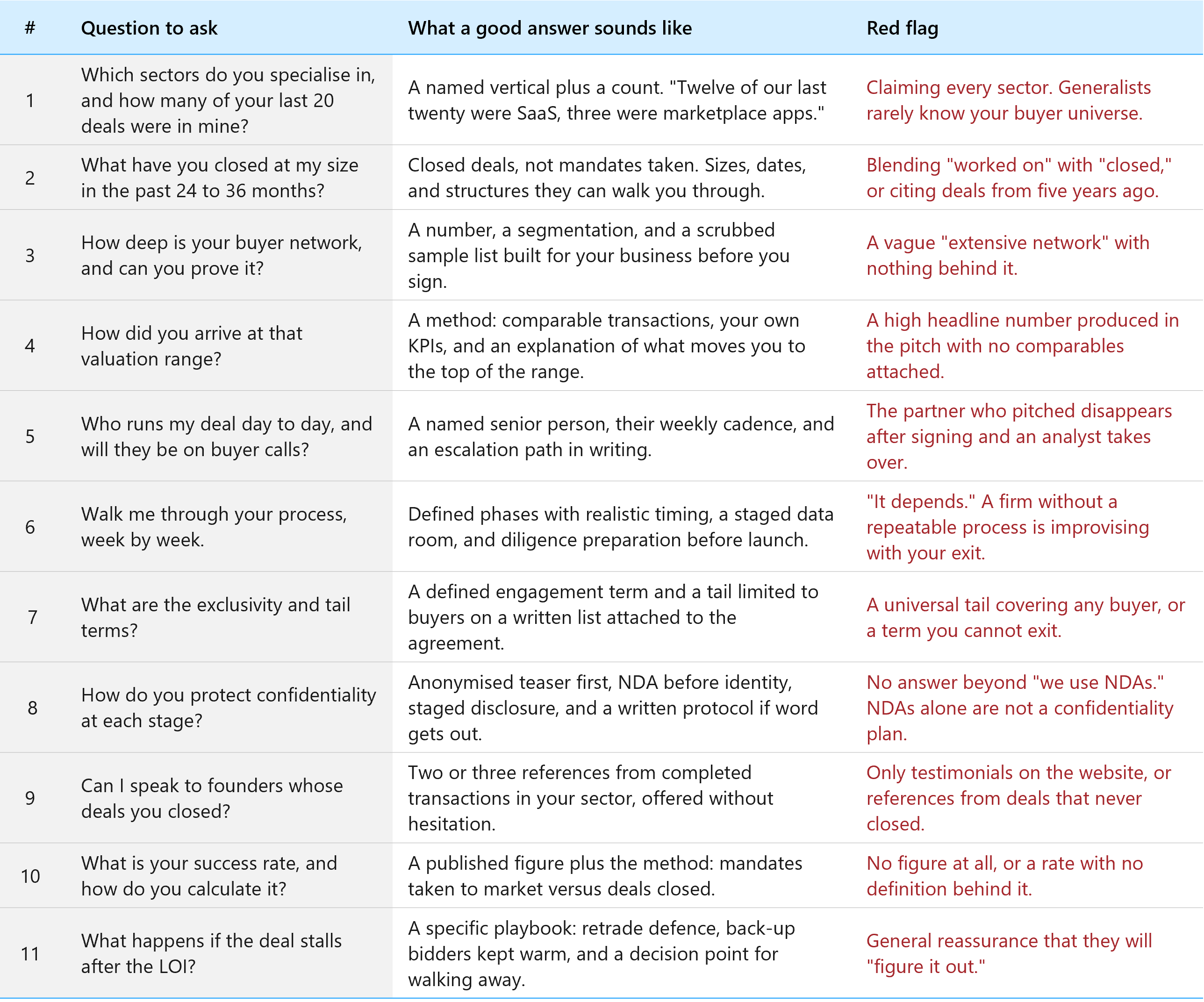
A pattern runs through all eleven. Strong firms answer with specifics, numbers, and documents. Weaker ones answer with adjectives. The sections that follow explain why each question earns its place.
Questions 1 to 3: Does this advisor know your sector and your buyers?
Question 1: Sector specialisation
Ask which verticals the firm covers and how many of its last twenty transactions were in yours. A firm that claims equal depth in SaaS, industrials, healthcare, and hospitality is describing a sales pitch, not a practice. Sector knowledge is what lets an advisor explain why your net revenue retention justifies a premium, or why your customer concentration is less risky than it looks on a spreadsheet.
The red flag is the generalist claiming every sector. Buyers notice immediately. An advisor who cannot hold a technical conversation about your business hands that conversation back to you, at the exact moment you most need a buffer.
For reference, FE International has specialised in technology since 2010 across SaaS, ecommerce, agencies, AI, cybersecurity, edtech, fintech, and marketplace apps.
Question 2: Relevant transaction history
Ask what the firm has closed at your size in the last 24 to 36 months. Two words matter: "closed" and "recent." Firms often blend deals they worked on with deals that completed, and a mandate that never closed teaches an advisor very little. Recency matters just as much, because the buyer set and the diligence standard both moved in the last two years.
FE International has completed more than 1,500 transactions representing over $50 billion in deal experience, which is the kind of figure you should be able to ask any firm for and receive without a pause.
Question 3: Buyer network depth, with proof
Every firm says its network is extensive. Ask for the number, the segmentation, and a scrubbed sample list built for your business before you sign anything. A real answer distinguishes strategics from sponsors from individual acquirers, and explains which of them is buying businesses like yours right now.
This question matters more than it appears, because the academic evidence points directly at it. The research published in the Quarterly Journal of Finance identifies the number of competing bids as the key determinant of a private seller's bargaining power. Network depth is what produces competing bids. Everything else in the process is downstream of it.
Ask about reach beyond your home market too. Deloitte found 65% of dealmakers expect cross-border activity to increase over the next twelve months, with growth and capability expansion the leading motivations. FE International's network spans more than 80,000 pre-vetted investors across North America, Europe, and Asia.
Questions 4 and 5: Who sets the valuation, and who runs your deal?
Question 4: Valuation methodology and honesty
Sellers get hurt here more often than anywhere else in the process, and it is the least discussed question of the eleven. Ask how the firm arrived at its range, which comparable transactions it used, and what specifically would move your business to the top of that range rather than the bottom.
The inflated teaser valuation is a well-worn tactic: quote a number high enough to win the mandate, then spend months managing expectations downward until the seller accepts something closer to reality. By then the exclusivity clause has done its work. An honest advisor will tell you things you do not want to hear in the first meeting, and will show you the comparables behind the number.
Current conditions make the discipline especially valuable. BCG describes a widening divide between infrastructure-layer assets commanding premium valuations and application-layer companies seeing valuations correct, with technology leading all sectors in first-half deal value. Buyers are committing capital at pace while examining the multiples they pay closely. A grounded range holds up in that environment. A wishful one gets repriced in diligence. Our guide to what most owners get wrong about valuation covers the methods in detail, and a free valuation gives you an independent read before any firm quotes you a number.
Question 5: Who works the deal day to day
Ask for a name. Then ask whether that person will be on buyer calls, lead negotiations, and hold the weekly cadence, and get the escalation path in writing.
The junior handoff is the most common disappointment in sell-side M&A. A senior partner runs the pitch, wins the mandate, and is replaced by an analyst once the engagement letter is signed. The seller discovers this in month three, usually during the first difficult negotiation. Sector experience is worth little if the person holding it is not in the room when a buyer attempts a retrade.
There is research support for this instinct. A study summarised on the Columbia Law School Blue Sky Blog surveyed M&A professionals across 117 firms and found that the advisers a company engages contribute significantly to perceived deal success. Who advises matters, which means who specifically is assigned to you matters.
Questions 6 and 7: How is the process designed ?
Question 6: Process design
Ask the firm to walk you through the process week by week, from preparation to close. Strong answers include defined phases, a staged data room, quality of earnings preparation before launch rather than after a buyer asks, and realistic timing for each stage. A firm without a repeatable process is improvising with the largest financial event of your life.
Preparation has become the differentiator. Deloitte's 2026 M&A Trends Survey of 1,500 corporate and private equity leaders found that more than 80% expect both deal volume and deal value to rise over the next twelve months, with 29% naming market conditions and 26% naming a more competitive deal environment as their main challenges. Competitive environments reward the prepared seller. That preparation is the advisor's job, and it happens before your business ever reaches a buyer.
Ask specifically what the firm does before going to market. Reconciling financials, verifying traffic, auditing metrics, and resolving profit and loss questions in advance all remove the friction that causes renegotiation later.
Questions 7 and 8: What do the exclusivity and confidentiality terms actually say?
Question 7: Exclusivity and tail terms
Exclusivity is standard and reasonable. A firm investing months of senior time needs to know you are not running a parallel process. What deserves scrutiny is the length of the term, how you exit it if the relationship is not working, and the tail provision that follows it.
A tail entitles the advisor to a fee if you sell after the engagement ends to a buyer they introduced. The fair version limits that to buyers on a written list attached to the agreement, delivered to you during the engagement. The version to push back on covers any buyer at all, whether or not the advisor ever contacted them. Ask for the buyer list as an exhibit. A firm confident in its own outreach has no reason to refuse.
Read this section with a transaction attorney, not alone. The terms are negotiable more often than sellers assume, and the negotiation itself tells you a great deal about how the firm will behave when the stakes rise.
Question 8: Confidentiality practices
This question is asked far less often than it should be. A leak reaches employees, customers, suppliers, and competitors, and each of those conversations can cost real value while you are still negotiating.
The exposure is not hypothetical. Morgan Lewis notes that more than 50% of deals are leaked before announcement and points to the misuse of confidential information during the preliminary deal process as a significant risk on both sides of a transaction.
A strong answer describes a sequence, not a document. An anonymised teaser goes out first, carrying no identifying detail. Identity is disclosed only after an NDA is signed and the buyer is screened for capital and intent. Sensitive material is staged, so customer names and contract terms arrive late rather than early. Direct competitors sit on a hold list. And there is a written plan for what happens if word gets out anyway.
"We use NDAs" is not a confidentiality plan. It is one clause inside one.
Questions 9 to 10: How do you verify what an advisor claims?
Question 9: References from closed deals
Ask to speak with two or three founders whose transactions the firm actually completed, ideally in your sector. Website testimonials are marketing. A twenty-minute call with someone who sat through diligence with this team is evidence. Ask those founders what went wrong during the process, because every deal has a difficult week, and how the advisor behaved in it.
Question 10: Success rate, and how it is calculated
Ask for the number and the method behind it. A success rate only means something when you know the denominator: mandates taken to market, or something narrower that flatters the figure. FE International publishes a 94.1% success rate, and any firm you speak to should be able to state its own figure and explain how it is derived.
A firm that has never measured this is telling you something about how it runs. A firm that measures it and will not share it is telling you more.
Question 11: Verify credentials independently
This step takes ten minutes and almost no seller takes it. Advisor claims can be checked against public records before you sign anything.
Start with FINRA BrokerCheck, which shows instantly whether a firm or individual is registered, along with firm history, active licences and registrations, and any disciplinary events or arbitration awards on record. The SEC's Investment Adviser Public Disclosure system and the Investor.gov lookup cover advisers registered on that side, and FINRA recommends checking with your state securities regulator as well.
Some M&A firms are legitimately not SEC-registered. A federal exemption at Section 15(b)(13) of the Securities Exchange Act exempts qualifying M&A brokers from broker-dealer registration when the target is an eligible privately held company, defined as one with prior-year EBITDA below $25 million or gross revenues below $250 million. The exemption is federal only and does not pre-empt state requirements, and it excludes brokers who take custody of transaction funds or who represent both sides without disclosure.
So the point is not that every advisor must be registered. The point is that you should know which category yours falls into, and be able to say why. An advisor who can explain their regulatory position clearly has thought about it. One who is evasive has given you your answer.
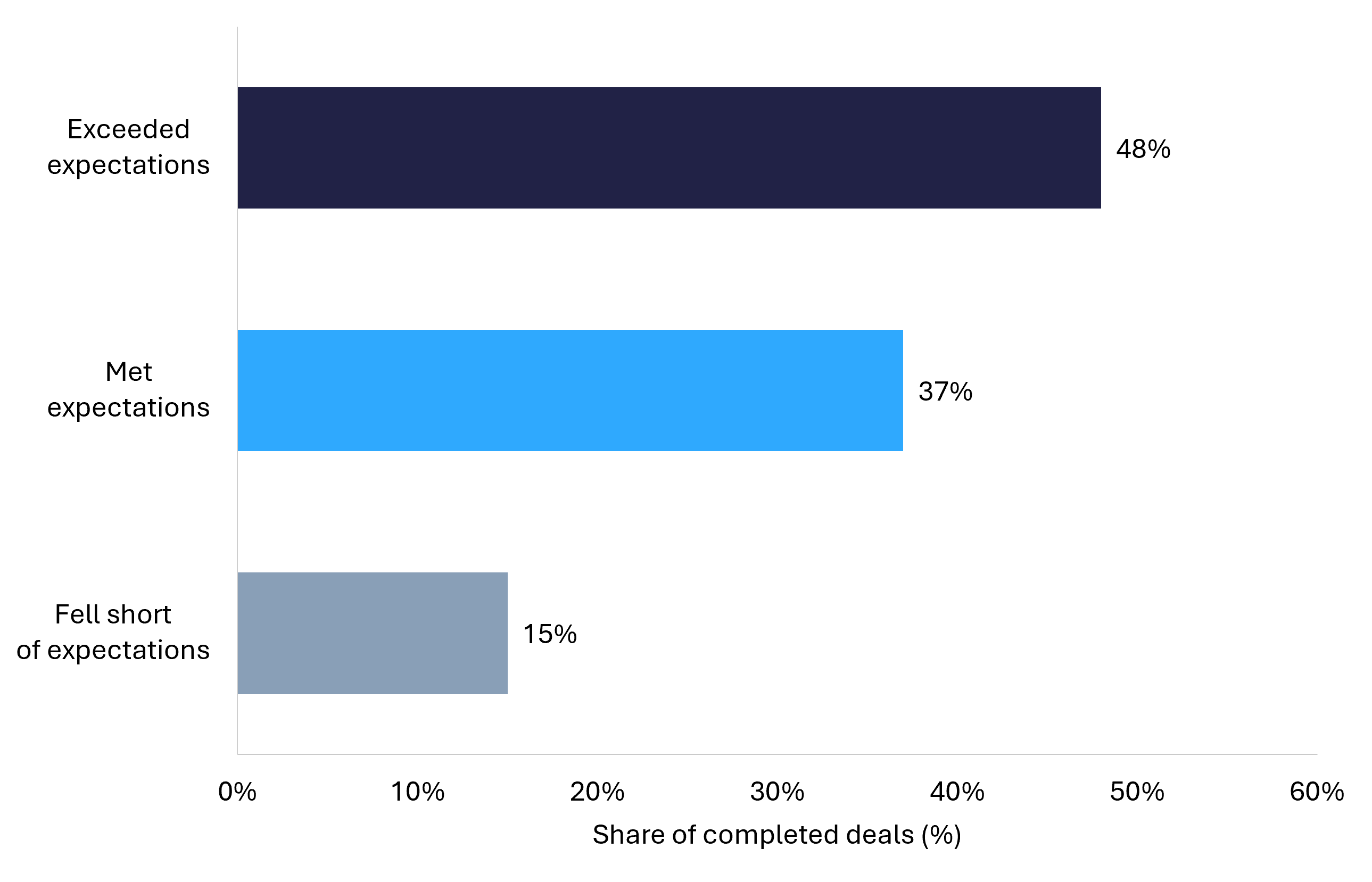
The distribution above is the argument for asking all eleven questions. Deloitte reports that 48% of completed deals exceeded expectations and 37% met them, a combined 85%, and attributes the spread to whether execution risk was pressure-tested during diligence. Preparation and process design are what put a deal in the top band, and both are chosen the day you sign an engagement letter.
What are the biggest M&A advisor red flags?
Three patterns account for most seller regret, and each one is visible in the first meeting if you know what you are listening for.
- The inflated teaser valuation. A number quoted without comparables, higher than every other firm you met. It wins mandates and loses deals, because a range that cannot be defended in diligence gets repriced once exclusivity has removed your alternatives.
- The generalist claiming every sector. Depth in eight unrelated industries usually means depth in none. It shows up as a buyer list assembled from a database rather than from relationships, and as an advisor who cannot answer technical questions without turning to you.
- The junior handoff. The senior banker who pitched is gone by month two. Ask for the name, the cadence, and the escalation path in writing before you sign, because it is unenforceable afterwards.
Two quieter signals are worth adding. A firm that will not share its engagement letter early in the conversation is managing what you see. And a firm that agrees with everything you say about your own valuation is selling to you rather than advising you. The advisor who tells you your customer concentration will be a problem is the one doing the job.
The reverse also holds. Firms worth hiring tend to turn business away. An advisor confident enough to say your business is not ready, or that waiting twelve months would produce a materially better outcome, is demonstrating exactly the judgement you want in the room when a buyer pushes back.
How to pick a business broker or advisor using a scorecard
Interviewing three firms across eleven questions produces a lot of impressions and very little comparability. Scoring fixes that. Rate each firm 1 to 5 on every criterion immediately after the meeting, while the answers are fresh, then apply the weights below.
The weighting is deliberate. Sector fit, transaction history, and buyer network carry the most because they determine who shows up to bid, and the number of competing bids is what drives price. Fee structure matters, but a point of fee difference is small next to a turn of multiple.
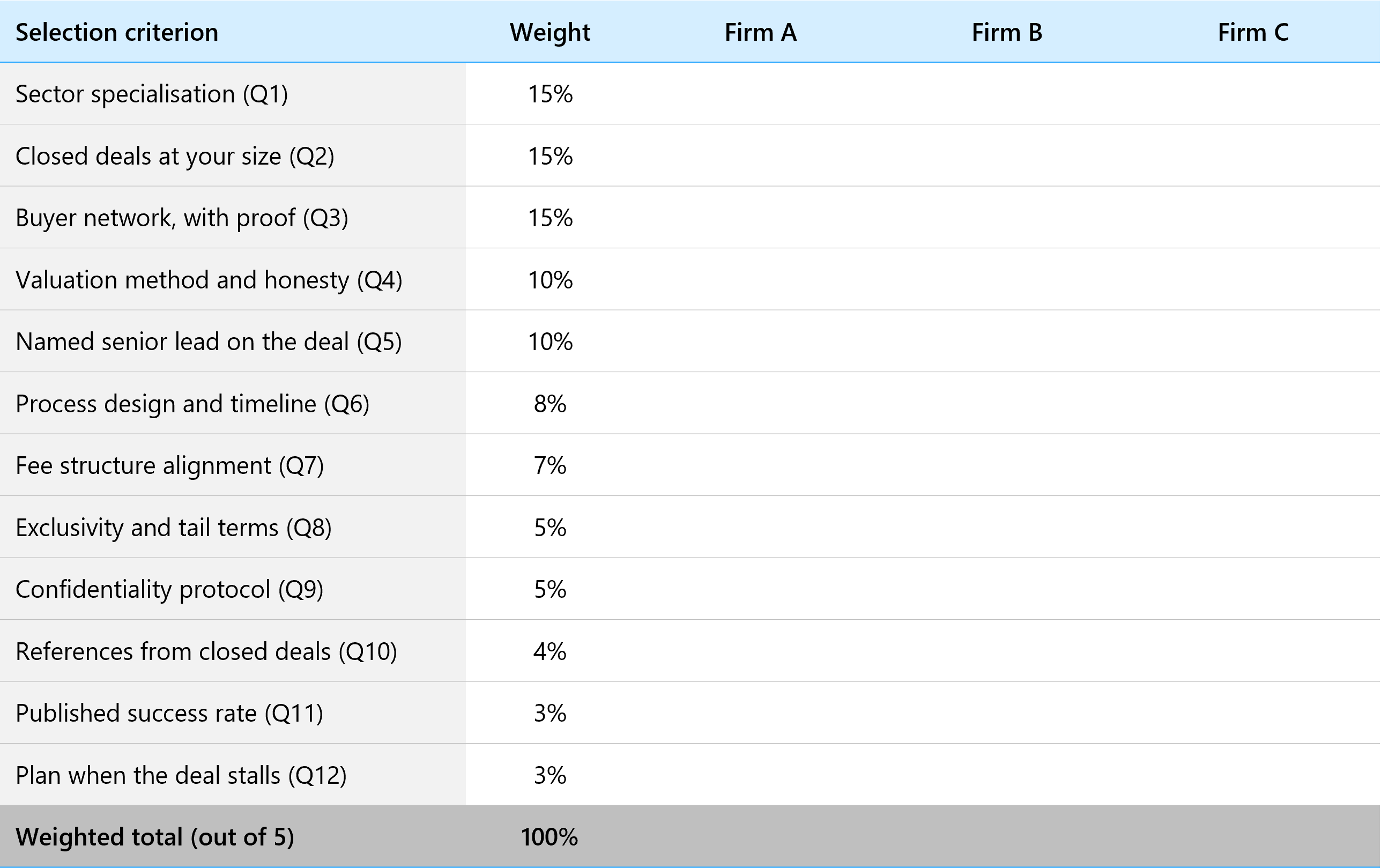
Two rules make the scorecard work. Score the answer you actually received, not the impression the meeting left. And treat any criterion scoring 2 or below as disqualifying regardless of the total, because a firm can be excellent on eleven counts and still be wrong for you if nobody senior is running your deal.
Deal size shapes the shortlist as well. Businesses valued above roughly $1 million are usually best served by a full sell-side advisory process, where a senior advisor runs valuation, positioning, a competitive process, and negotiation through to close. Below that threshold, a full advisory engagement often does not make economic sense, and the FE International M&A Platform connects vetted buyers and sellers directly with verified financials. Larger and more complex mandates run through investment banking. The two routes are complementary, matching each business to the process its size and profile deserve.
Choosing the right advisor for your exit
The eleven questions all test the same thing from different angles: whether this firm can produce competing bids for your specific business, and whether it will still be in the room when a buyer pushes back. Sector depth, closed transactions at your size, a buyer network with proof behind it, and a named senior lead are the four that carry the most weight. The rest protect you from the terms you sign and the surprises that follow.
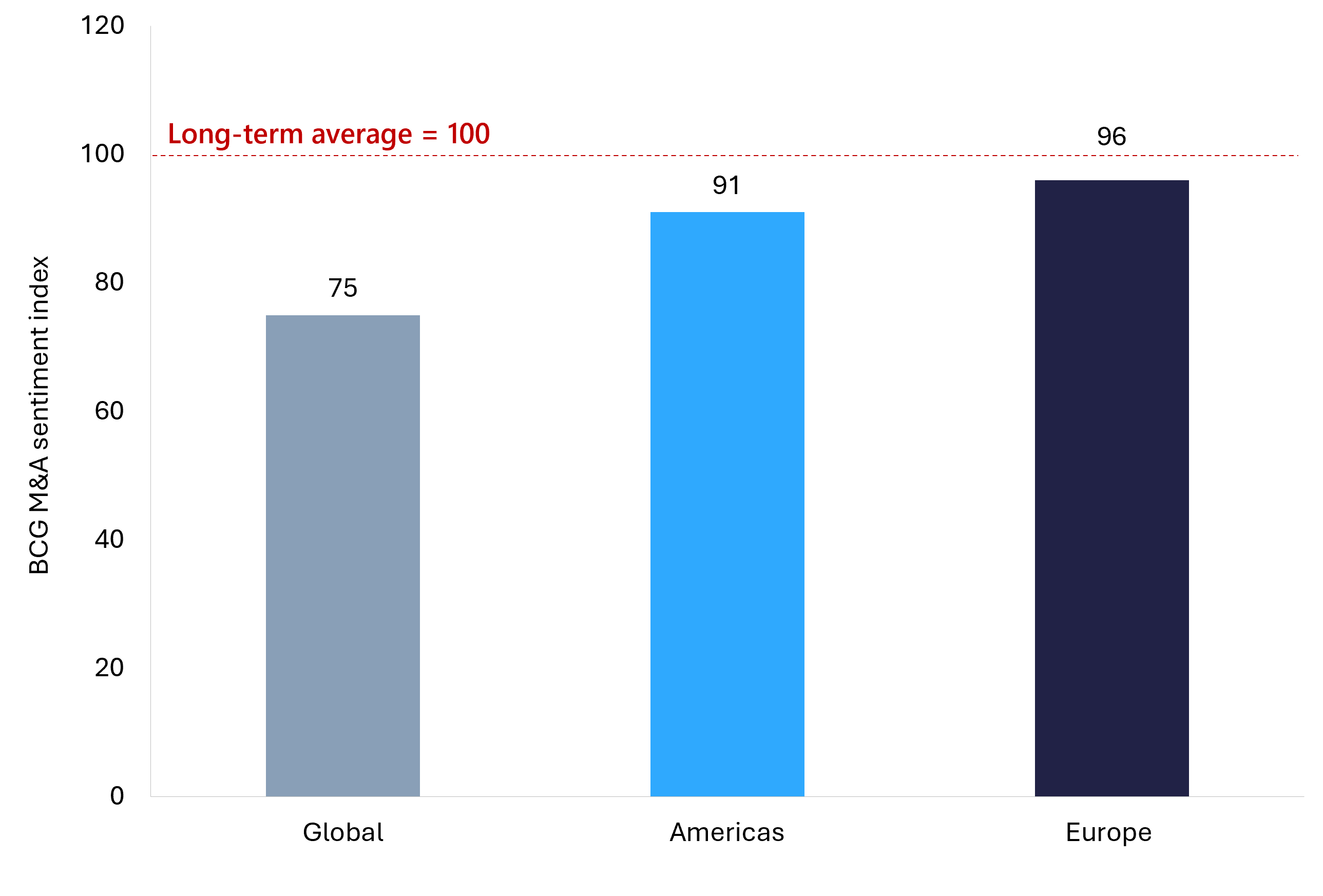
Market conditions favour sellers who prepare. McKinsey recorded divestiture value growing 30% to $1.6 trillion in 2025, the highest level since 2021, and dealmaker confidence in the Americas and Europe has returned close to historical norms. Capital is available, buyers are active across strategics, private equity, and individual acquirers, and well-prepared technology businesses are attracting premium attention.
For context on what a track record looks like when it is stated plainly: FE International has specialised in technology M&A since 2010, has completed more than 1,500 transactions representing over $50 billion in deal experience, and publishes a 94.1% success rate. Ask every firm you meet for the same four numbers.
The best next step is a valuation you did not have to commission from the firm hoping to win your mandate. Get a free valuation from FE International, with no obligation, and use it as the benchmark against which every other number you are quoted gets measured.