
.jpg)
How to Prepare a SaaS Business for Sale: A Stage-by-Stage Checklist
Knowing how to prepare a SaaS business for sale shapes an exit more than almost any other decision, because preparation is the one stage that runs entirely on your own schedule. Price, timeline, and how demanding diligence feels all trace back to work done before a single buyer sees the business.
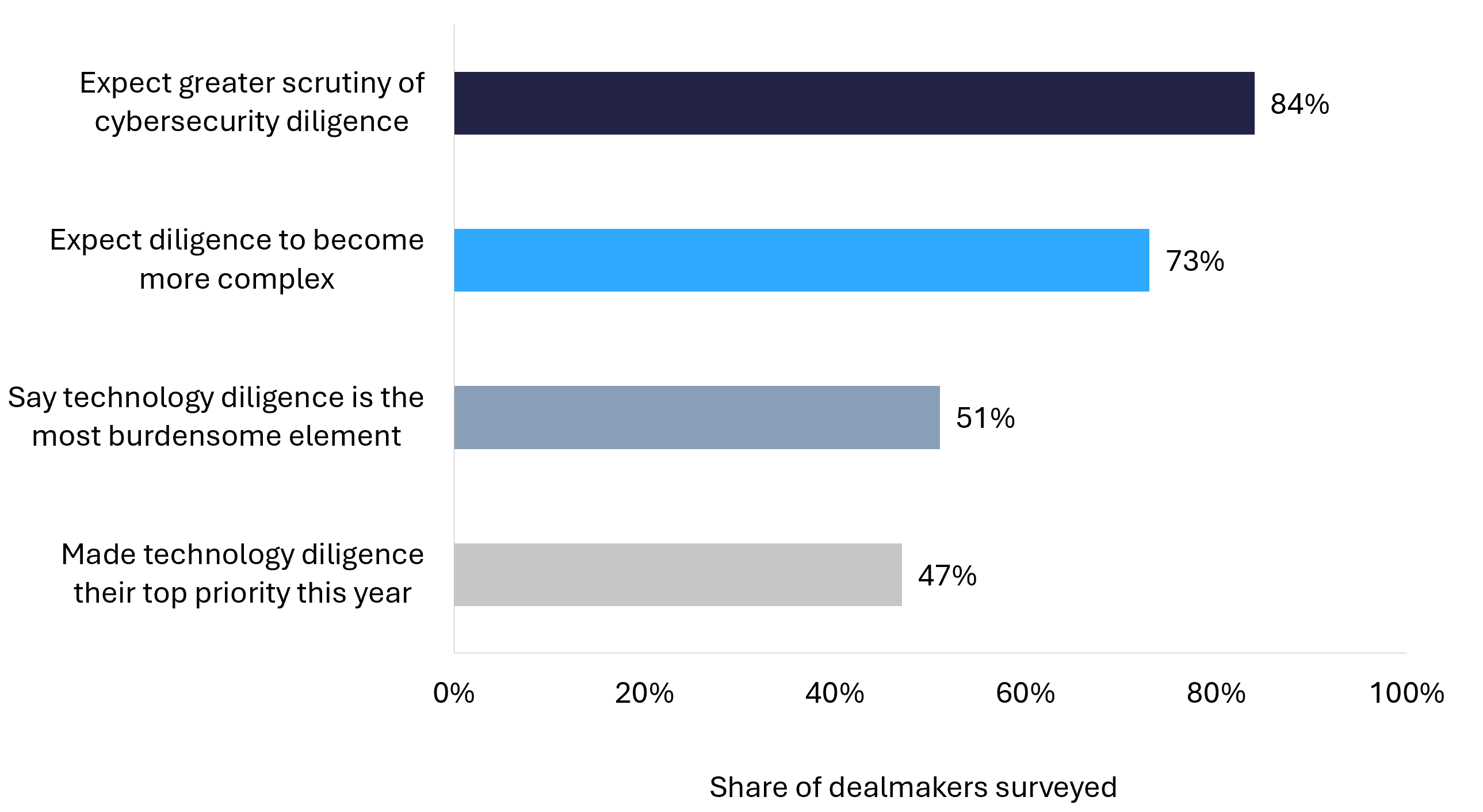
Buyers have made that work more valuable. In SRS Acquiom's 2026 survey of 150 senior US dealmakers, 84% expect greater scrutiny of cybersecurity diligence over the next one to two years, and 47% say technology diligence was their single biggest focus this year. Those questions are answerable in advance. A seller who has the answers ready converts the most demanding stage of the process into the fastest one.
It shows up in outcomes. Deloitte's 2026 Global Divestiture Survey, covering 908 transactions of $100 million or more, found that by the end of 2025 nearly half of sellers were meeting their own expectations for both timing and proceeds, up from roughly one third the year before. Preparation is what moved that number.
This page is the checklist, in the order the work is best done, with a note on what finished looks like for each item. For the full sale process around it, start with our guide on how to sell a SaaS business. For the strategic question of why and when to exit, our SaaS exit planning overview covers the thinking that comes before any of this.
Start the clock: how far ahead preparation really begins
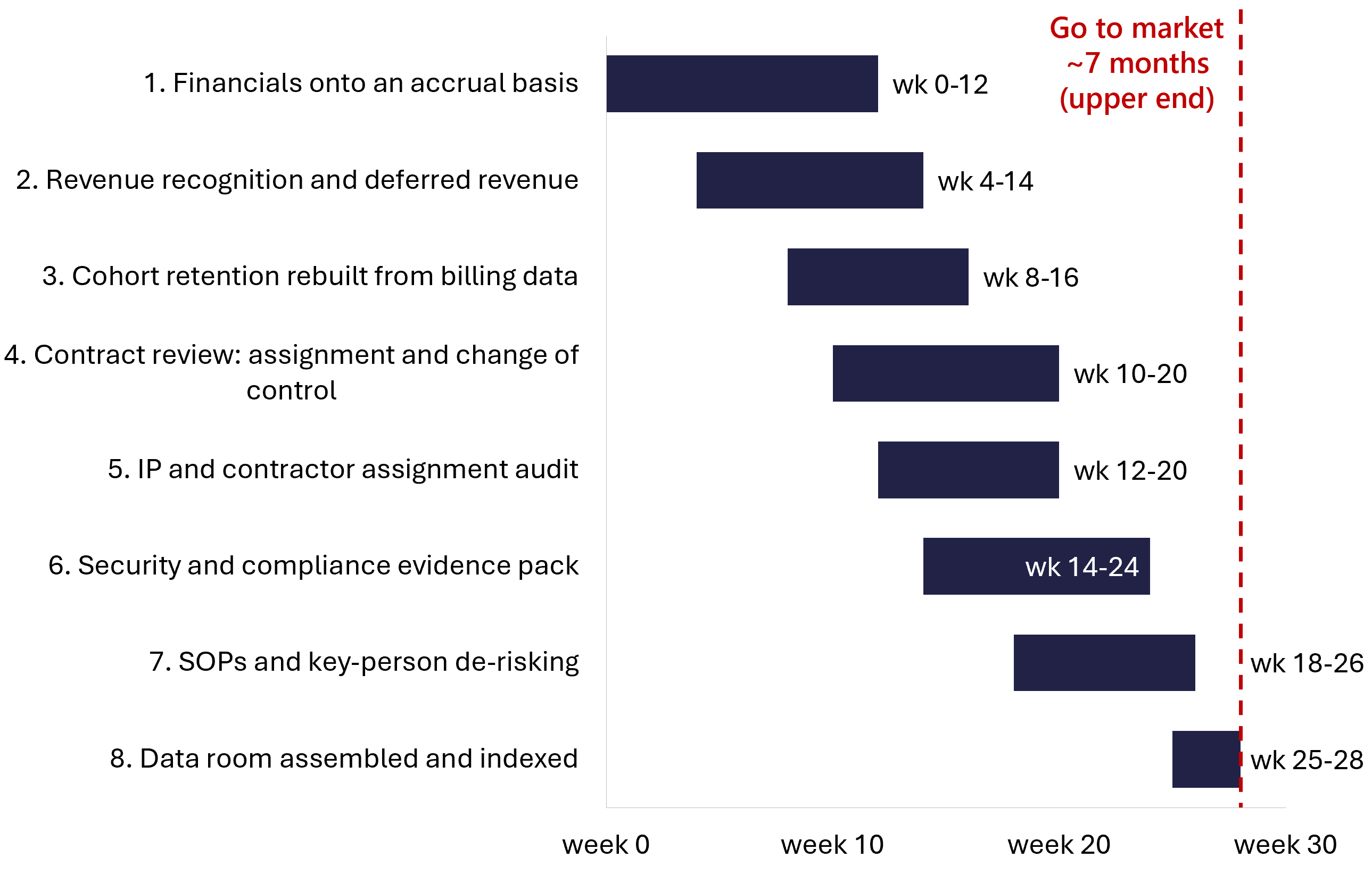
Preparation runs two to five months on a smaller SaaS business and up to seven on a larger one. It sits inside a total sale timeline of eight to sixteen months, and it is the only stage a seller controls completely.
The size of the business sets the length. At $1 million to $5 million in enterprise value, two months of focused work is usually enough. At $50 million to $100 million, seven is realistic, because there are more contracts to review, more shareholders to coordinate, and three years of history to reconstruct rather than one.
What surprises people is which part takes the time. Datasite's 1H26 data shows the median time to prepare a data room fell to 12 days from 14 year on year. Assembling and uploading documents is a two-week job. Converting cash-basis books to accrual, restating deferred revenue correctly, and rebuilding cohort retention from raw billing records is the work that fills the months, and none of it can be done quickly under a buyer's deadline.
The practical implication is that the decision to prepare and the decision to sell are separate decisions, and the first one should come much earlier. Our piece on planning the timing of a business exit covers how to sequence them.
Stage one: financials a buyer can rely on
Nothing else in the process moves until the numbers hold. Most SaaS businesses under $10 million in revenue keep their books on a cash basis because it is simpler and it satisfies the tax filing. No institutional buyer will underwrite from it.
Three specific conversions matter. Revenue recognised in the period it is earned rather than when the payment arrived. Deferred revenue stated as the liability it is, so an annual prepayment collected in January is not counted as January performance. And a clean split between recurring and non-recurring revenue, because setup fees, professional services and one-off migrations are valued very differently from subscription revenue. Our guide to the metrics that drive SaaS valuations sets out how each line is treated.
A sell-side quality of earnings review is worth considering above roughly $10 million in enterprise value. The point is not to produce a favourable number. It is to find the adjustments a buyer's accountants would find, and to find them while you still have months to explain or fix them rather than days.
One habit pays for itself repeatedly: keep a short written definition of every metric you report, stating exactly how it is calculated. When a buyer's number differs from yours, the conversation becomes a reconciliation of two clear methods instead of a question about whether your reporting can be trusted.
Stage two: the retention story, calculated before someone else calculates it
Retention is the metric that moves a SaaS valuation most, and it is the one buyers rebuild from source data rather than accepting from a deck.
Two numbers, defined precisely. Gross revenue retention measures how much of the starting revenue base remains after churn and downgrades, ignoring any expansion. Net revenue retention includes upsell and expansion, so it can exceed 100%. Report both, because a strong net figure sitting on a weak gross figure tells a buyer that expansion from a few accounts is masking churn underneath.
For context, ChartMogul's analysis of roughly 3,500 software companies puts median net revenue retention for B2B SaaS at 82%, with the upper quartile at 97%. The same study found annual plans run 10 to 20 percentage points higher on net retention than monthly equivalents, which means contract mix moves this number as much as product stickiness does. Shifting customers to annual terms before a sale is legitimate value creation, not window dressing, provided the pricing is real and the renewals are genuine.
Cohort-level data is what makes the story credible: revenue by signup month, tracked forward, so a buyer can see whether retention is improving. Aggregate churn percentages hide the shape. Our breakdown of SaaS valuation multiples by ARR, growth and retention shows how far apart the top and bottom quartiles price on exactly this.

Stage three: technology and security, where the questions have moved
This is the biggest change in SaaS diligence, and it is the stage most sellers underprepare. In the SRS Acquiom survey, 51% of dealmakers named technology diligence the most demanding element of the entire review, and 73% expect diligence overall to go deeper over the next one to two years.
Four documents answer most of it. A short architecture overview a technical reviewer can read in ten minutes. A dependency list covering third-party services, licences and anything open source with obligations attached. A record of how customer data is stored, encrypted and separated between tenants. And current security evidence, which increasingly means a SOC 2 report, the AICPA's framework for controls at service organisations. A SOC 2 takes months of observation to earn, so this is decided early or not at all.
AI has added a new line. Bain's 2026 software M&A report found that almost half of technology deals in 2025 had some AI component, up from one in four in 2024. Buyers now ask what a product depends on: which models, under what commercial terms, with what fallback if pricing or availability changes, and whether customer data trains anything. Document those honestly. A clear dependency with a stated mitigation reads as competence; an unexplained one reads as risk.
The best way to see the shape of this is from the other side of the table. Our SaaS due diligence checklist for buyers is the list your future buyer is likely working from.
Stage four: contracts, consents, and the IP question most sellers get wrong
Two contract issues decide whether a closing runs to schedule.
The first is assignability. Enterprise customer agreements often contain change-of-control clauses requiring consent before the contract transfers to a new owner. Each one is a signature on somebody else's calendar. Reading every material contract during preparation, listing which need consent, and sequencing those conversations is worth several weeks at closing.
The second is quieter and more consequential. Founders routinely assume that a contractor who was paid to write code produced a work made for hire, so the company owns the copyright. The US Copyright Office sets out a narrower rule: outside the employment relationship, a commissioned work counts as made for hire only if it falls within one of nine listed categories and the parties expressly agree so in a signed written instrument. Those nine categories are things like translations, compilations, tests, instructional texts and audiovisual components. Software is not among them.
So for contractor-written code, a clause calling it a work made for hire does not by itself move ownership. What does is a written assignment of copyright. Audit every contractor and agency who has touched the codebase, confirm a signed assignment exists for each, and obtain one now where it does not. Chasing a signature from someone who left three years ago is materially harder once a buyer is waiting on it. This is a point to confirm with your own counsel rather than treat as settled by an article, and it is exactly the kind of item that is cheap to fix early and expensive to discover late.
Stage five: de-risking the business away from you
Buyers price the business they can run, not the one you can run. Every process that exists only in the founder's head is a discount, and every one that is written down is not.
The practical scope is smaller than it sounds: documented procedures for deployment, support escalation, billing and onboarding; a named second person for anything only one person can currently do; and a support function that does not route to the founder's inbox. Two or three weeks of writing covers most of it.
There is a compounding reason to make the documentation clean rather than merely complete. McKinsey's February 2026 M&A report finds deal cycles running 10 to 30 percent faster where AI tooling is applied to diligence and document review. That speed only reaches sellers whose material is well organised and machine-readable. A tidy, indexed, consistently named data room now converts directly into weeks saved.
Demand is there to meet it. Gartner forecasts worldwide software spending of $1.47 trillion in 2026, growing 15.5%, and our mid-year 2026 tech M&A report covers where that buyer appetite is concentrated.
The SaaS pre-sale preparation checklist
Everything above, in one place. The third column is the part worth reading closely: an item is only finished when a stranger could verify it without asking you a question.
.png)
An item on this checklist is finished when a stranger can verify it without asking you a question. That is also the standard a data room is judged against.
Turning preparation into a shorter, stronger process
How to prepare a SaaS business for sale comes down to a single standard applied fourteen times: could someone who has never met you verify this without asking? Financials on an accrual basis, retention defensible at cohort level, technology and security documented, IP ownership complete with signatures, and the business running without you in the middle of it. Buyers are active and going deeper on exactly these areas, which is precisely why arriving prepared stands out.
FE International has completed more than 1,500 transactions since 2010 with a 94.1% success rate on private sales and acquisitions, and we handle SaaS sales end to end, starting with preparation. If you are working through this checklist and want to know which items matter most for your business, that is the conversation to begin with.
