


EBITDA add-backs are expenses removed from reported earnings because they will not continue under new ownership. Sellers use them to recast profit into adjusted EBITDA, the figure buyers apply a multiple to. Accepted add-backs raise the sale price. Challenged ones cost credibility and price at the same time.
A technology company with $1.84 million of reported EBITDA and $2.17 million of defensible adjusted EBITDA is the same business, on the same day, with the same customers. At the median multiple paid for information technology companies in that earnings band, the second number is worth roughly $2.3 million more at closing.
That gap is the entire point of EBITDA add-backs, and it is why buyers read the add-back schedule line by line before they read anything else.
The timing works in a prepared seller’s favor. Global deal value climbed 41% year over year through the first five months of 2026 to reach $2.4 trillion, with valuations holding at a median 11.6 times EV/EBITDA in Bain & Company’s 2026 M&A Midyear Report. Buyers are concentrating capital on fewer, better-prepared targets, which means a business that arrives with documented earnings stands out immediately.
This guide covers what add-backs actually are, which categories buyers accept, which ones they push back on and why, the adjustments unique to technology businesses, and a full worked recast that shows exactly how the multiple math changes.
What Are EBITDA Add-Backs?
An add-back is an expense sitting in your profit and loss statement that a buyer agrees will not exist in the business after closing. You add it back to reported EBITDA to show what the company really earns as an ongoing operation. The result is adjusted EBITDA, sometimes called recast or normalized EBITDA.
Three terms get used interchangeably and should not be. EBITDA means earnings before interest, taxes, depreciation and amortization, calculated from net income with nothing else touched. Adjusted EBITDA is that figure after your add-back schedule. The distinction is not cosmetic: under the SEC staff position on EBIT and EBITDA, a measure calculated differently from the standard definition should not be labeled EBITDA at all, and its title must be distinguished, for example as adjusted EBITDA. Sophisticated buyers apply that discipline whether or not you are a public filer.
Add-backs matter because recast earnings, not reported earnings, are what the market prices against. Business appraisers give recast EBITDA multiples a 48% average weighting when valuing a company using multiples, the heaviest of any method, and private equity groups weight them at 33%, ahead of unadjusted EBITDA at 30%, in the 2026 Private Capital Markets Report from Pepperdine Graziadio Business School.
The short version: your add-back schedule sets the denominator that everything else in the deal multiplies.

How seller discretionary earnings adjustments differ
Smaller, owner-operated technology businesses are usually priced on seller discretionary earnings rather than EBITDA. Seller discretionary earnings adjustments pull the owner’s entire compensation package back into earnings, because the buyer is stepping into that role personally. EBITDA add-backs do the opposite: they leave a market-rate salary in the cost base and add back only the excess, because the buyer will hire someone to do the job.
Mixing the two is the most expensive arithmetic error in a sale process. A business with $600,000 of seller discretionary earnings where the founder draws $150,000 has roughly $450,000 of EBITDA, and applying an EBITDA multiple to the larger figure overstates value by a third. FE International’s guide to how to sell a SaaS business works through which metric applies at which deal size.
Why Do Add-Backs Change What a Buyer Pays?
Because earnings get multiplied and expenses do not. Every dollar a buyer accepts into adjusted EBITDA is a dollar multiplied by the deal multiple, so a $100,000 adjustment on a business trading at 7.0x is worth $700,000 of enterprise value. The same $100,000 at the 11.6 times median for larger transactions is worth $1.16 million.
Median deal multiples for information technology companies in 2026 run from 5.0x for companies below $1 million of EBITDA to 7.5x above $25 million, with the $1 million to $4.99 million band at 7.0x, in the Pepperdine investment banker survey. Multiples vary by growth rate, retention, concentration and buyer type, and FE International’s current SaaS valuation multiples benchmarks break down where individual businesses land within those ranges.

There is a second reason the number carries weight. Buyers finance acquisitions against adjusted EBITDA, and so do their lenders. Senior debt capacity, covenant headroom and any earn-out threshold all reference the same figure. Quality of earnings sits alongside debt load as the leading reason lenders decline loans in the Pepperdine bank lending data, so an earnings number that cannot be traced to source documents narrows the pool of buyers who can actually fund a bid.
A crowded, well-capitalized buyer pool rewards preparation. Deal flow reported by investment bankers rose a net 28.5% year over year, and a net 51.5% expect it to rise again over the next twelve months. FE International’s mid-year 2026 technology M&A report covers how that demand is distributed across SaaS, AI, cybersecurity, ecommerce, fintech and agencies.
Which Add-Backs Do Buyers Accept?
Four categories clear diligence consistently. What they share is a clean answer to one question: why will this cost not exist under new ownership?
Owner compensation normalization
If you pay yourself above what the role is worth, the excess comes back. The adjustment is the gap between what you draw and what a hired replacement would cost, including payroll taxes and benefits, not the whole salary.
Most sellers give value away here, because they assert a market rate instead of evidencing one. Published federal wage data settles it. The May 2025 Occupational Employment and Wage Statistics release puts the mean annual wage for computer and information systems managers at $192,160 and for chief executives at $269,630, with separate figures for software developers, marketing managers and sales managers. Pull the occupation that matches the work you actually do, adjust for company size and location, and attach the source page to the schedule. A buyer can verify it in thirty seconds, which is precisely the point.
Genuinely one-time costs
A concluded legal matter, a single office relocation, a first-time security certification, a restructuring charge that is finished. These are accepted where the underlying event is closed and documented with invoices and a short written rationale.
Owner personal expenses
Vehicle leases, family phone plans, personal travel booked through the company, a health plan covering only the owner’s household. Buyers accept these readily when the supporting detail separates the personal portion cleanly. Where employees share the same plan, only the owner’s share is adjustable.
Discontinued products and exited lines
A legacy module you retired, a customer segment you exited, a marketing channel you shut down. The costs that disappear with the decision come back, provided the associated revenue comes out too. A buyer who sees the cost removed and the revenue left in will re-examine the entire schedule.
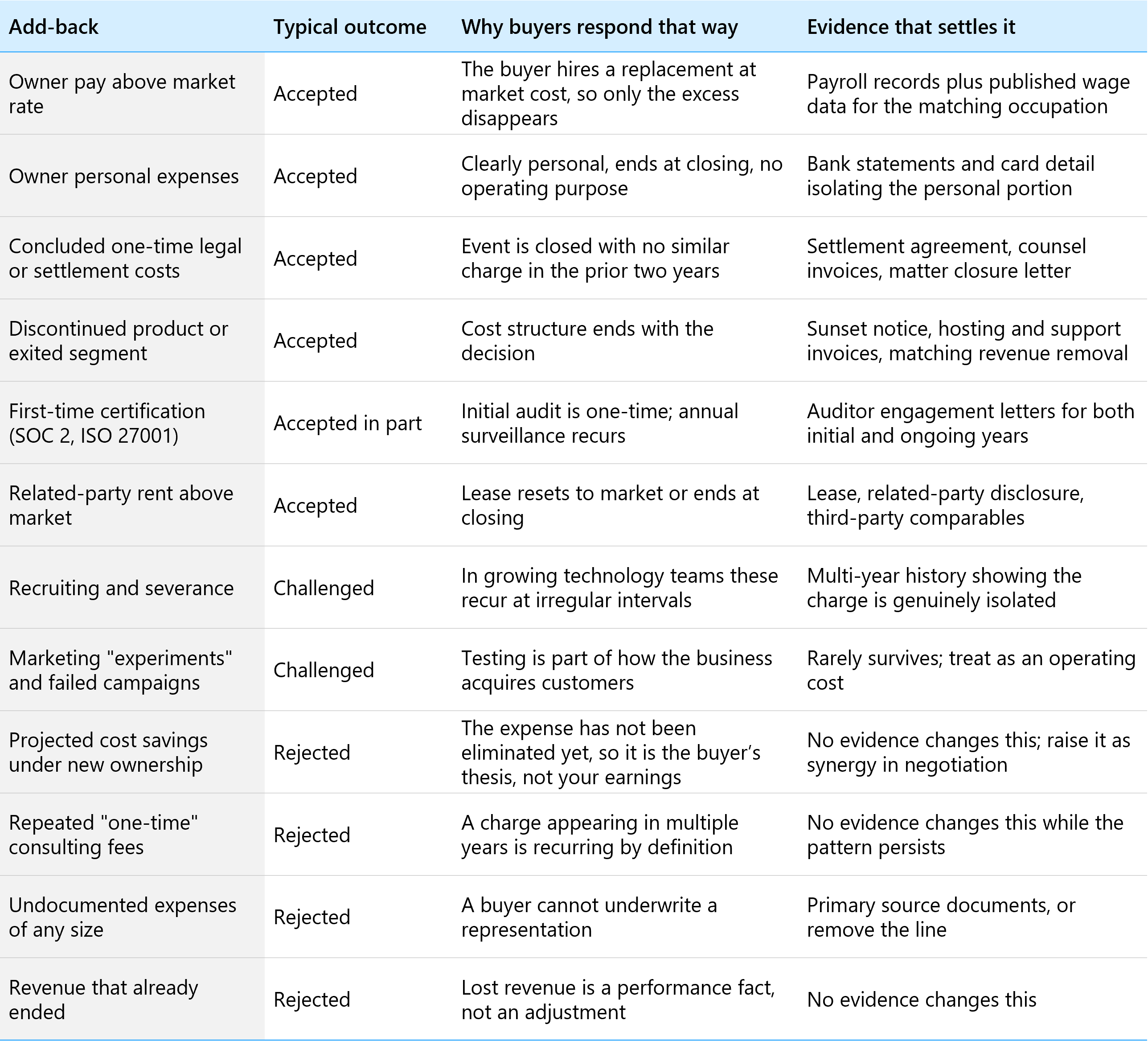
The table below separates what clears diligence from what draws challenge, and what evidence moves an item from the second column to the first.
Which Add-Backs Do Buyers Challenge?
Most rejected add-backs fail one specific test, and it is written down. Securities rules prohibit describing a charge as non-recurring, infrequent or unusual when it is reasonably likely to recur within two years, or when a similar charge occurred in the prior two years. That two-year window, set out in the SEC guidance on non-GAAP measures, has become the working standard buyers and their accountants apply to private deals as well.
The same guidance closes the obvious workaround. Staff treat an operating expense that occurs repeatedly or occasionally, including at irregular intervals, as recurring. A legal bill that shows up in three of the last five years is recurring even though it skipped two. So is executive recruitment in a company that has grown its engineering team every year.
Four other patterns draw immediate pushback:
- Projected savings. Cost reductions that have not happened are not earnings. An expense that is still being paid stays in the cost base, and the saving belongs in the buyer’s own model. Presenting it as an add-back invites a discount somewhere else.
- Charges without matching gains. Adjusting only for non-recurring costs while leaving non-recurring income untouched is a documented way to make a measure misleading. If you strip a one-time expense, strip the one-time windfall in the same period.
- Deferred investment. Under-spending on infrastructure, security or product maintenance lifts near-term EBITDA. Buyers reverse it, adjusting earnings down to a normalized spend level. Flagging it yourself preserves credibility on the rest of the schedule.
- Anything undocumented. A legitimate adjustment with no invoice behind it becomes a negotiating problem regardless of how valid it is. Buyers do not accept add-backs on a seller’s word.
The working test on every line: if the same expense could plausibly appear next year under a new owner, it is an operating cost, not an add-back.
Which Add-Backs Are Specific to Technology Businesses?
Generic add-back advice misses the three adjustments that move technology deals the most, and all three work against the seller if they are not handled openly.
Capitalized software development
This is the largest hidden distortion in software company earnings. Engineering payroll that gets capitalized moves off the income statement onto the balance sheet, and the amortization that replaces it sits below the EBITDA line. The cash goes out either way, but reported EBITDA never sees it. Capitalize aggressively and EBITDA rises without the business earning a cent more.
Buyers normalize this by deducting capitalized development spend to get to a cash view of earnings. Whether costs are capitalized under the internal-use software rules or the rules for software to be sold depends on whether customers can take possession of the software, a distinction explained in Deloitte’s guidance on software development cost accounting. Most hosted SaaS platforms fall under the internal-use model, which permits earlier capitalization and therefore produces the larger distortion.
The rules are also changing. ASU 2025-06, issued by the FASB in September 2025, removes the old stage-based framework and ties capitalization to management authorization and the absence of significant development uncertainty. It takes effect for annual periods beginning after 15 December 2027, with early adoption permitted, and is expected to reduce how much software cost gets capitalized. Sellers transacting between now and then should expect buyers to test the policy rather than accept it.
Deferred revenue adjustments
Subscription businesses sometimes present earnings on a billings basis, adding back movements in deferred revenue to show cash collected rather than revenue earned. Buyers reject this, and there is a public precedent worth knowing. In an SEC comment letter to Barracuda Networks, the company was told to remove adjustments for changes in deferred revenue and deferred costs from its adjusted EBITDA on the basis that they substituted individually tailored accounting for the standard treatment. Billings is a useful operating metric and belongs in your data room. It does not belong inside adjusted EBITDA.
One-time platform and infrastructure migrations
Re-platforming from one cloud provider to another, migrating off a monolith, or rebuilding a billing system produces a genuine spike in contractor spend and duplicate hosting fees while both environments run in parallel. Buyers accept the duplicate running costs and the specific migration labor, because both end when the cutover completes. They do not accept the engineering time itself if those people stayed on payroll afterward, since that cost continues.
The evidence that carries this line is a dated migration plan, the vendor contracts for both environments showing the overlap period and its end date, and the hosting bill returning to a single provider in the months after cutover. Where the cutover is recent, expect a buyer to want at least one clean quarter of post-migration run rate before crediting the full adjustment.
Contractor and offshore team conversions
Founders often run engineering through contractors, then convert to employees, or the reverse. Each transition produces one-off costs that look like clean add-backs and rarely are, because the underlying function continues. What buyers will accept is the transition cost itself, such as a recruitment fee or a redundancy payment, supported by the new cost structure holding steady for at least two subsequent quarters.
What Does a Clean Add-Back Schedule Look Like?
An add-back schedule is a working document, not a summary. It runs every period the buyer will review, usually three years plus the trailing twelve months, and carries one row per adjustment with these columns: expense category, general ledger account, amount by period, the reason it ends at closing, the supporting document, and where that document sits in the data room.
Four principles separate a schedule that holds up from one that unravels.
Apply it consistently across every period. Adjusting a charge in the current year while leaving similar charges in prior years untouched is treated as misleading unless the change is disclosed and explained. Recast every year on the same basis so the trend is comparable.
Include the downward adjustments. A schedule containing only positive numbers tells a buyer the work was done to reach a price rather than a figure. Capitalized development, deferred maintenance, non-recurring revenue and any one-time gain all belong in the schedule. Sellers who surface these first are almost always trusted on the rest.
Attach a document to every line. Invoices for professional fees, payroll records and wage benchmarks for compensation, bank detail for personal expenses, sunset notices for retired products. The test buyers apply is whether each line traces back to a primary source.
Keep it short. A tight schedule of well-supported adjustments carries further than a long one that invites scrutiny. Removing a marginal $20,000 line protects the $200,000 line sitting above it.
A single row done properly reads something like this: category, one-time legal; account, 6420 Professional Fees; FY2024 $0, FY2025 $185,000, TTM $185,000; reason, trademark opposition filed by a third party, settled March 2025, no further exposure and no similar matter in the prior two years; support, settlement agreement and three counsel invoices; location, Data Room 4.2. A buyer’s analyst can clear that line without sending you a question, and every question you prevent is a day you keep off the timetable.
The rows worth the most attention are the ones you are least sure about. Where you genuinely cannot decide whether an expense recurs, write both the case for and against in the reason column and let the buyer reach their own conclusion. Sellers who do this are treated as reliable narrators on every other line, which is worth considerably more than the single adjustment in dispute.
A Worked Recast Example: How the Multiple Math Changes
Consider a founder-led B2B SaaS company with $6.2 million of revenue and $1.84 million of reported EBITDA, being sold in 2026. The founder runs the company as CEO, the team is twelve people, and the accounts are clean but have never been prepared for a transaction.
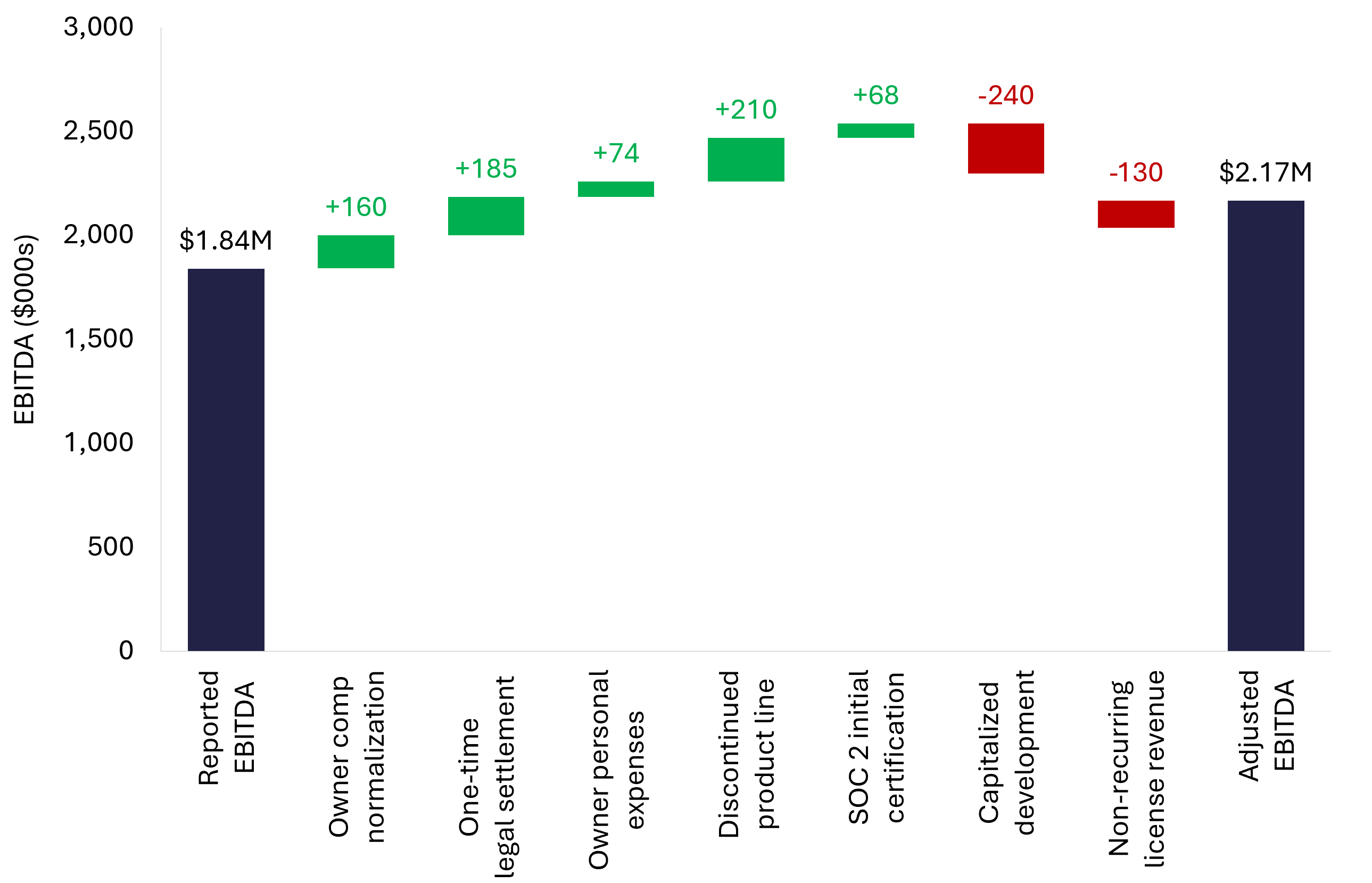
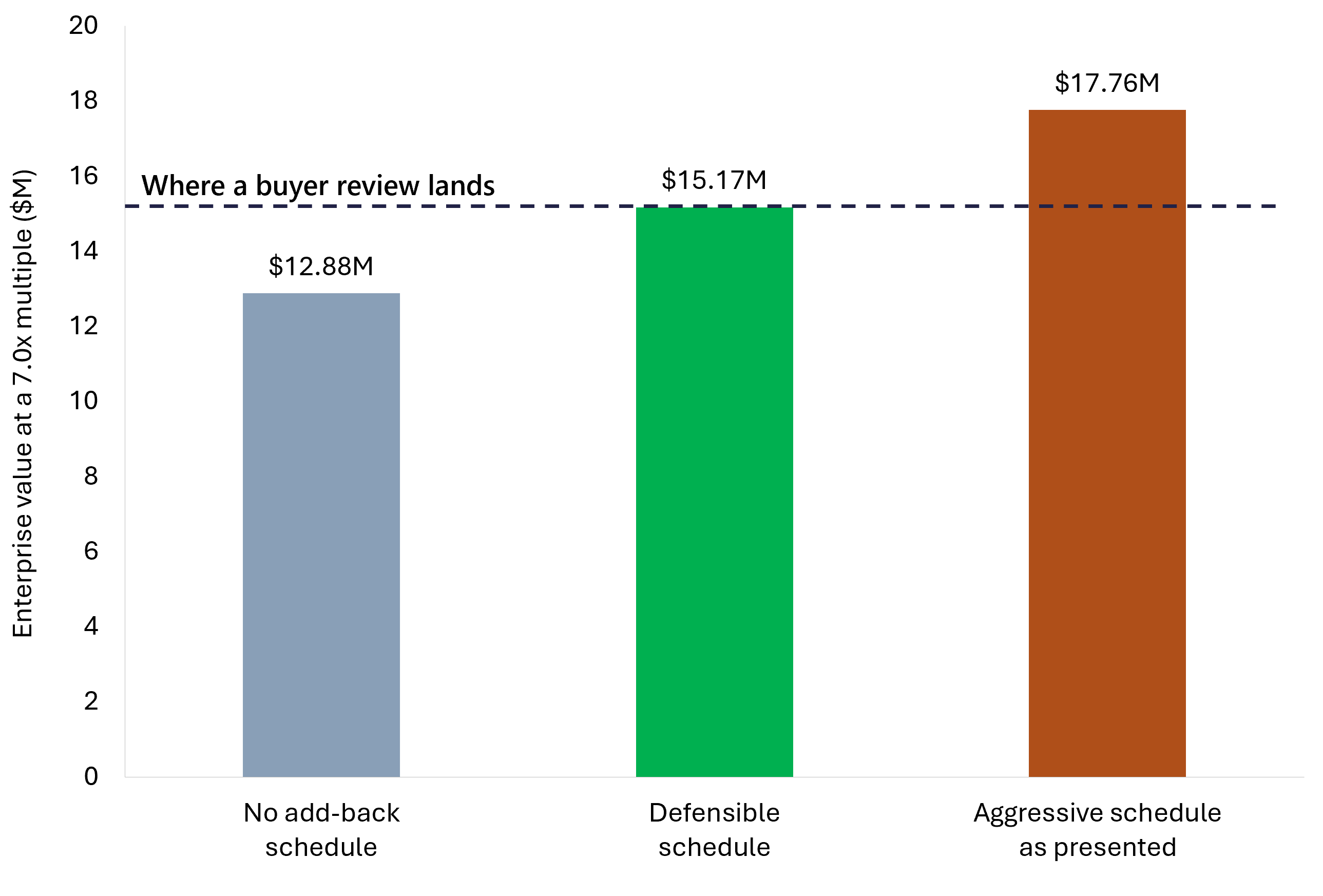
Now apply the 7.0x median for information technology companies in the $1 million to $4.99 million EBITDA band. Priced on reported EBITDA, the business is worth $12.88 million. Priced on defensible adjusted EBITDA, it is worth $15.17 million. The schedule is worth $2.29 million, and the underlying business did not change.
Run the aggressive version to see the other side. A seller who claims all $697,000 of upward adjustments and omits the two downward ones presents $2.537 million of adjusted EBITDA, implying $17.76 million. A buyer’s accountants find the capitalized development and the one-off license revenue in the first week of diligence. Earnings correct back to $2.167 million, the implied price falls $2.59 million, and the seller now negotiates from a position where every remaining line is suspect.
Both sellers own the same business. The one who submitted the shorter, honest schedule holds the higher price.
How Do Buyers Test Your Add-Backs in Diligence?
Through a quality of earnings review. An independent accounting firm rebuilds your adjusted EBITDA from source data: two to three years of monthly financials plus the trailing twelve months, bank statements, the general ledger, contracts and payroll records. Each add-back is traced to a primary document, tested against the two-year recurrence standard, and either sustained or removed. FE International’s guide to quality of earnings in technology M&A sets out the five areas the analysis concentrates on.
The review runs wider than the add-back schedule alone, and sellers who prepare only for the earnings question get caught by the rest. Analysts test how revenue is recognized against contract terms, whether monthly cut-off has been applied consistently, how much of trailing revenue sits with the largest handful of customers, and whether working capital has been managed to flatter a period. An add-back schedule that survives on its own merits still gets discounted if the revenue underneath it turns out to be lumpier than the presentation implied.
Sellers who commission their own review before going to market arrive with the argument already settled. The alternative is discovering a problem in week three of exclusivity, when the negotiating position has shifted and the timetable is fixed.
The consequences of getting this wrong show up in the aggregate data. Roughly two-thirds of sale processes run by investment bankers reach a closing, and the single most common reason the remainder do not is a valuation gap between buyer and seller, most often in the 11% to 20% range. A gap of that size is frequently just the distance between a seller’s add-back schedule and what a buyer will underwrite, which makes it one of the most fixable reasons a deal stalls.
Timing helps. Building the schedule six to twelve months before going to market gives you room to separate personal spending from operating costs, settle the capitalization policy, gather documents while the people who can explain them are still around, and let a clean cost structure show up in two or three quarters of trading history before a buyer ever sees it.
Build the Schedule Before You Go to Market
EBITDA add-backs are not a pricing tactic. They are the argument that your reported earnings understate what the business produces, and that argument is won with documents rather than assertions. The sellers who capture the full value of their adjustments do three things: they normalize owner compensation against published wage data instead of opinion, they apply the two-year recurrence test to their own schedule before a buyer does, and they include the downward adjustments that prove the work was done honestly.
A market where deal value is running 41% ahead of last year and buyers are competing for well-prepared technology businesses rewards that discipline directly. A schedule built six months early, with a document behind every line, is one of the highest-return pieces of work available to any founder planning an exit.
Want to know what your adjusted earnings support in today’s market? Get a free valuation from FE International and see where your business prices with the add-backs a buyer will actually accept.