

How Long Does It Take to Sell a SaaS Business? A Stage-by-Stage Timeline
Most SaaS businesses take eight to sixteen months to sell, measured from the day a founder decides to exit to the day the money lands in the bank. That range is wide for a good reason. Where you land inside it has much less to do with the market than with how ready the business was on the morning you went out to buyers.
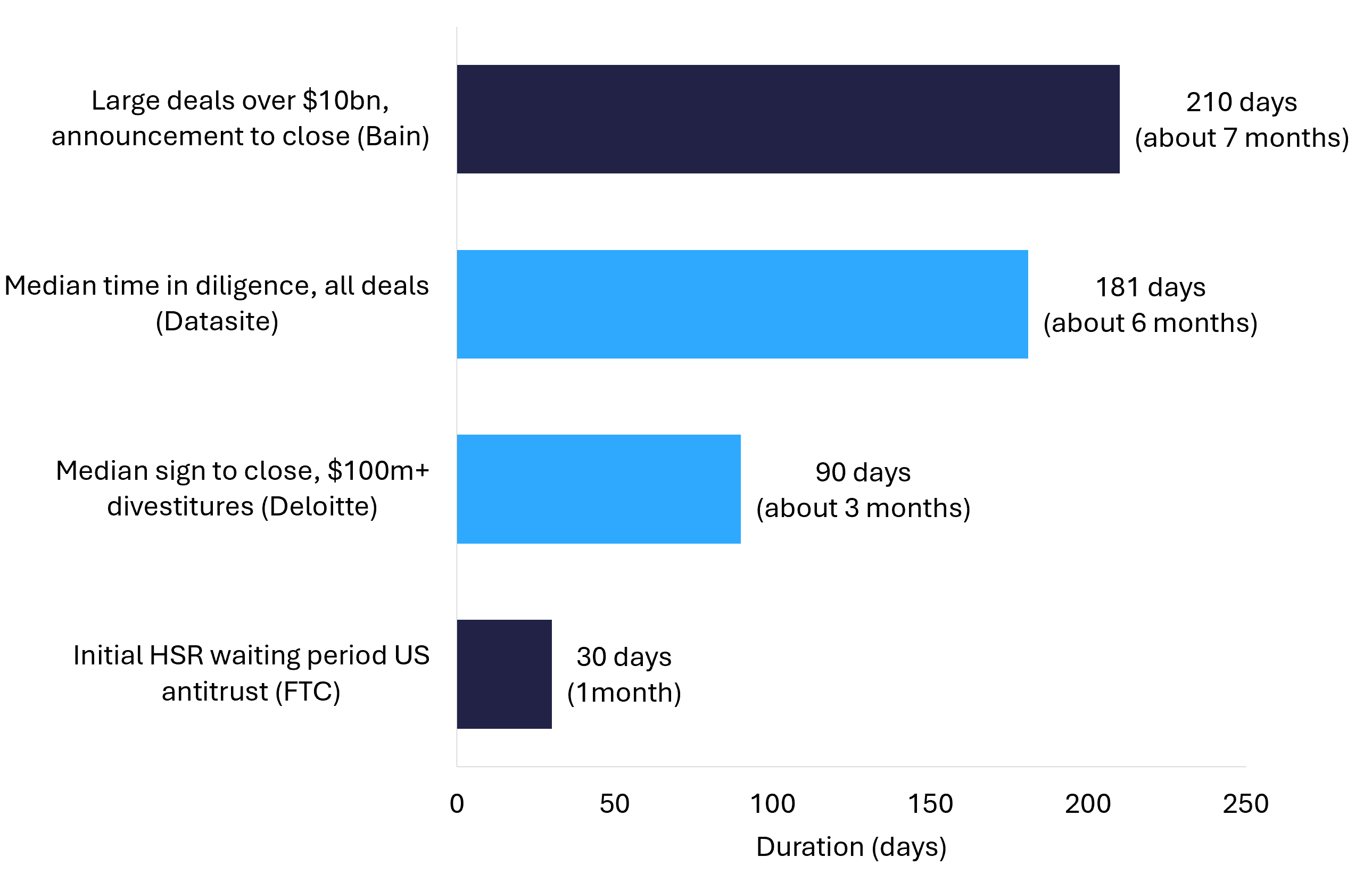
Here is the figure that surprises founders most. Across deals run on Datasite's platform in the first half of 2026, median time spent in diligence was 181 days, roughly six months for that single phase. Datasite facilitates about 16,000 new deals a year, so the sample is not thin. Diligence, not price negotiation, is usually what sets the length of a sale.
The encouraging part is that most of the calendar sits under your control. Deloitte's 2026 Global Divestiture Survey, which examined 908 transactions valued at $100 million or more between 2020 and 2025, found sellers are getting measurably better at hitting their own timing targets. By the end of 2025 nearly half met expectations for both timing and proceeds, up from roughly one third the year before. Preparation is what moved that number.
This page breaks the timeline into stages so you can see where the months actually go, and which of them you can shorten. For the full process end to end, start with our guide on how to sell a SaaS business.
The short answer: eight to sixteen months
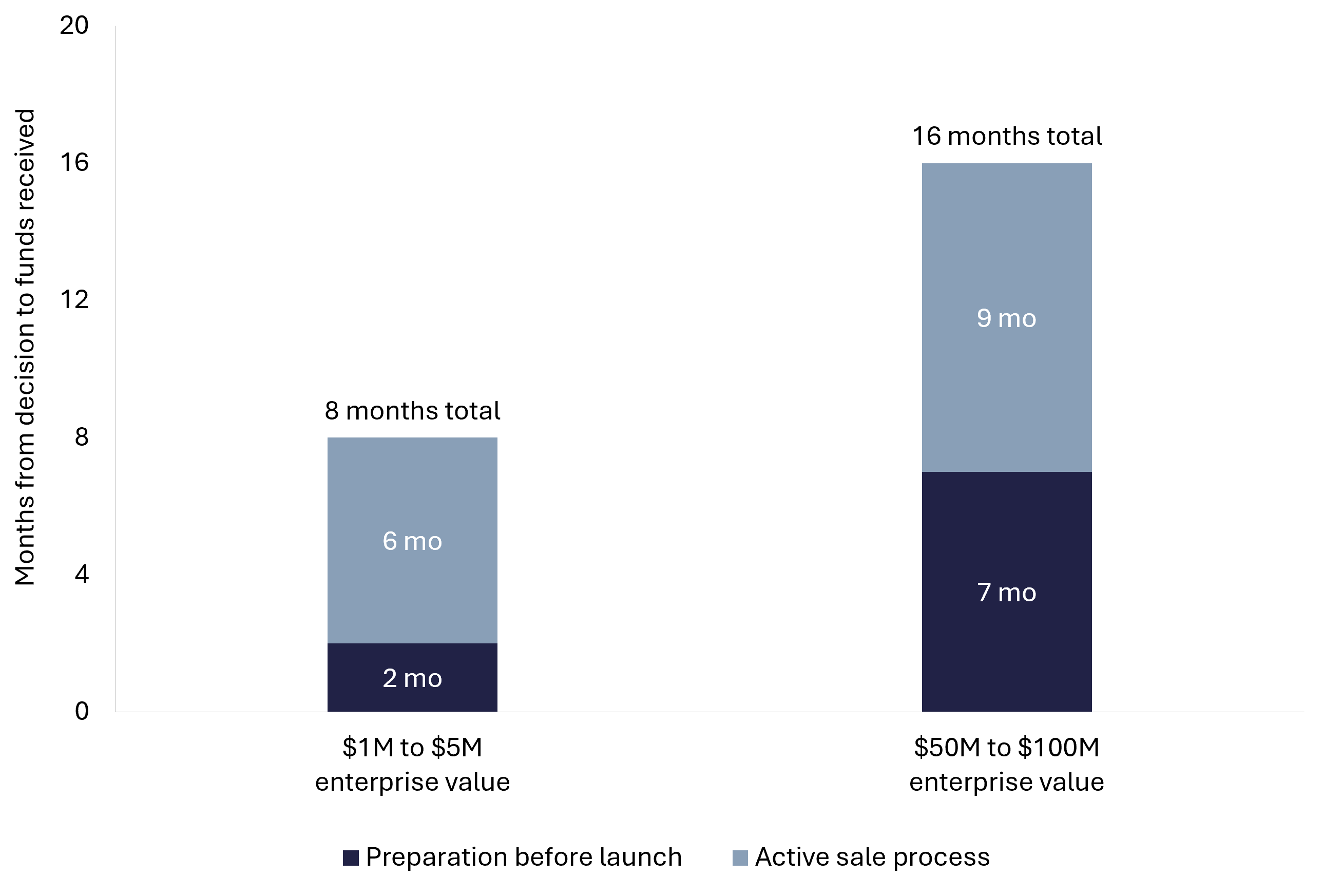
A SaaS business typically sells in eight to sixteen months from the decision to exit to funds received. The active sale process accounts for six to nine months of that, and preparation accounts for the balance.
Deal size is the single best predictor of where you fall. A business at $1 million to $5 million in enterprise value tends to run about eight months from decision to funds received. At $50 million to $100 million, sixteen months is the realistic planning number.
The extra eight months on a larger deal are not spent waiting. They are spent on work that a smaller deal simply does not carry: a quality of earnings review rather than a bookkeeper's summary, three years of cohort data rather than one, an investment committee that meets on a fixed calendar, minority shareholders who each need to sign, contract-by-contract assignability review across hundreds of enterprise customers, and in some cases a regulatory filing. Each of those is a queue, and queues add weeks.
What does not change much with size is the pricing conversation. If you want to see how the value side behaves across the same bands, our breakdown of SaaS valuation multiples by ARR, growth and retention covers it separately.
Stage one: preparation, and why it decides everything after it
Preparation runs two to five months on a smaller SaaS business and can reach seven on a larger one. It is the only stage that happens entirely before a buyer is watching, which makes it the cheapest place to buy back time.
The mechanical part is quick. Datasite's 1H26 data shows the median time to prepare a data room fell to 12 days from 14 year on year. Assembling documents is not what takes months. Converting cash-basis books to accrual, rebuilding revenue recognition so deferred revenue is stated correctly, and reconstructing cohort retention from raw billing data: that is where the time goes, and no buyer will do it for you.
Retention is worth settling before anyone else calculates it. ChartMogul's analysis of roughly 3,500 software companies puts median net revenue retention for B2B SaaS at 82%, with the upper quartile at 97%. The same study found annual plans run 10 to 20 percentage points higher on NRR than monthly equivalents. Knowing your own number, and being able to defend how you calculated it, removes an entire round of questions from diligence. Our guide to the metrics that drive SaaS valuations sets out which ones buyers rebuild themselves.
Founders often ask whether they should wait for a better window instead. In practice, readiness beats timing, though the two interact, and our piece on planning the timing of a business exit covers how to weigh them together.
Stage two: going to market, four to ten weeks to offers
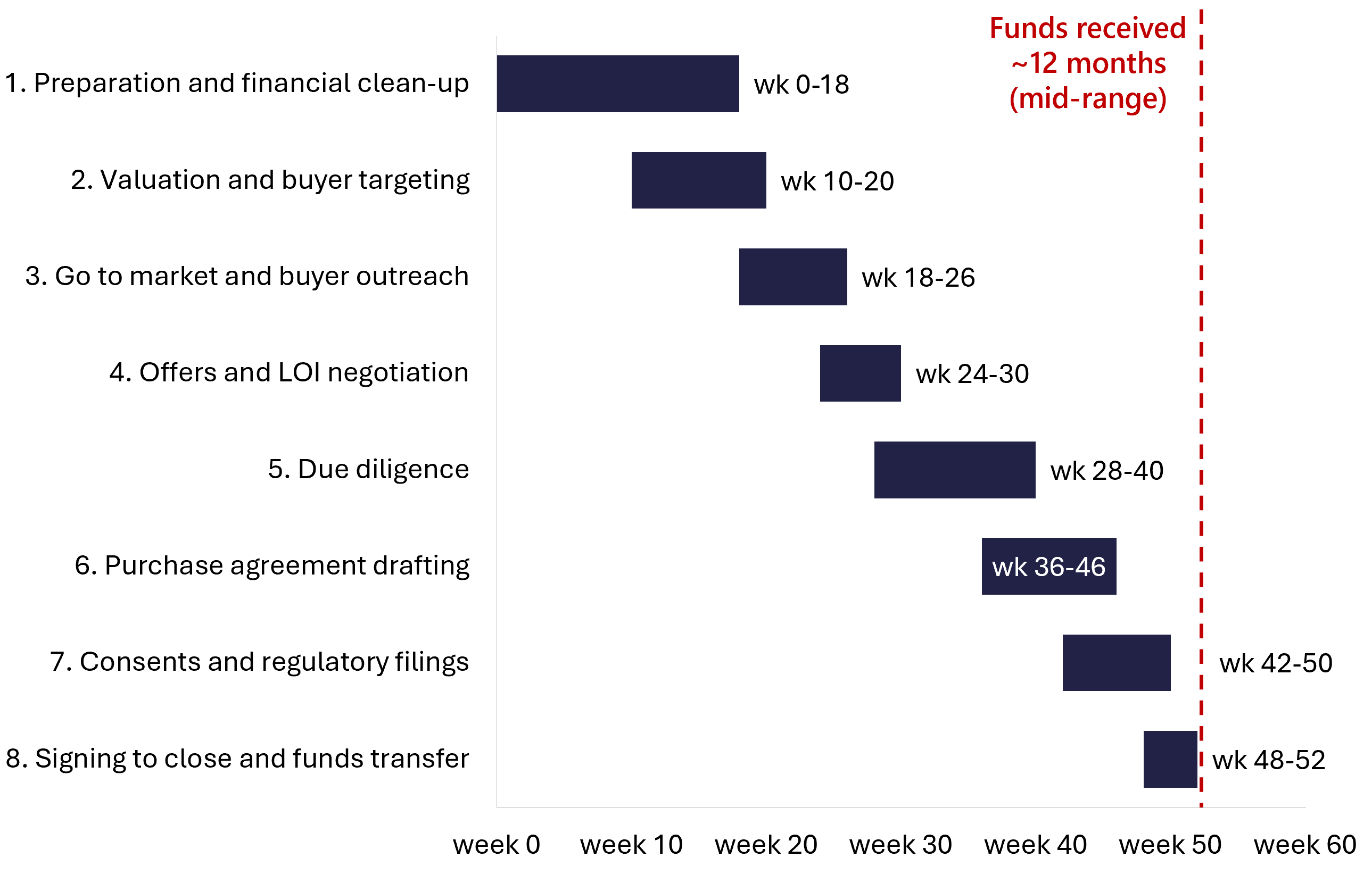
Once the business is ready, reaching a signed letter of intent usually takes four to ten weeks. Outreach, NDAs, buyer calls, management presentations and first-round indications all compress into that window when the process is run in parallel rather than one buyer at a time.
Buyer appetite is currently working in sellers' favour, which shortens this stage. Datasite recorded new global deal kickoffs up 31% in the first half of 2026, with the Americas up 52%. On the strategic side, Gartner forecasts worldwide software spending of $1.47 trillion in 2026, growing 15.5%, and software buyers with growing budgets tend to buy capability rather than build it. Our mid-year 2026 tech M&A report covers where that demand is concentrated.
The practical lesson is about structure rather than luck. A single interested buyer sets the pace on their own schedule. Six buyers in a managed process work to yours, because none of them wants to be the one who moved slowly. That is the mechanism behind FE International's 94.1% success rate on private sales and acquisitions across 1,500-plus completed transactions since 2010.
Stage three: due diligence, where the timeline is really decided
Diligence is the longest single block in almost every SaaS sale. On FE International deals it typically occupies weeks 28 to 40 of a twelve-month process, and the Datasite figure of 181 days median time in diligence across all sectors tells the same story from a different angle.
What buyers examine in a SaaS business is fairly predictable, which is exactly why it can be prepared for in advance: revenue recognition and deferred revenue treatment, churn and expansion by cohort rather than in aggregate, contract assignability and change-of-control provisions, customer concentration, security and compliance posture, and clear ownership of code written by contractors. Our SaaS due diligence checklist walks through what a buyer's list actually looks like.
Technology is starting to take real time out of this phase. McKinsey's February 2026 M&A report finds that deal cycles have become 10 to 30 percent faster where AI tooling is applied to diligence and document review, with M&A activities running about 20 percent cheaper. Sellers benefit from that only if their documentation is machine-readable and complete. A well-organised data room now compounds in a way it did not three years ago.
Diligence is the longest stage of a SaaS sale and the most compressible. Every question a buyer can answer from your data room is a question they do not have to ask you.
Stage four: signing to closing, and when regulators join the clock
Signing a purchase agreement and closing it are separate events. Deloitte puts the median gap at about three months on transactions of $100 million or more, with some running to ten months, and notes sign-to-close timelines have lengthened by roughly 6% since 2020.
For most SaaS sellers the regulatory question resolves quickly, and in your favour. The FTC set the 2026 Hart-Scott-Rodino size-of-transaction threshold at $133.9 million, effective 17 February 2026. Below that figure no premerger notification is required, which removes the waiting period from your timeline entirely. Above it, the FTC's guidance is that parties must wait 30 days after filing before closing, and if the agency issues a Second Request it gets a further 30 days once the parties have substantially complied. For scale, Bain reports that deals above $10 billion take roughly seven months from announcement to close.
The more common source of extra weeks in a SaaS deal is far less dramatic: third-party consents. Enterprise customer agreements frequently contain change-of-control clauses, and each one that needs a signature is a separate conversation on someone else's calendar. Identifying those contracts during preparation rather than during signing is worth several weeks on its own.
What your buyer type does to the clock
The same business sells on three different timetables depending on who buys it.
- Strategic acquirers often move fastest on the money because there is no financing contingency, though internal approvals and integration planning can add a round. Bain reports strategic buyers transacting at a median 11.6 times enterprise value to EBITDA in 2026, and buyers paying with cash tend to want certainty of close.
- Private equity buyers bring a fixed governance rhythm: an investment committee that meets on set dates, a commissioned quality of earnings report, and sometimes a debt package that has its own approval chain. McKinsey notes average PE hold periods reached 6.2 years in 2025, up from 4.0 years in 2009, which is a useful signal that these buyers are patient rather than rushed.
- Individual buyers and search funds add a lender to the process. Underwriting sits outside both parties' control, so this route carries the most timeline variance, and it is worth setting expectations early.
None of these is better than the others in the abstract. They simply price and pace differently, and our comparison of PE, strategic and individual buyers for SaaS sets out which suits which kind of business.
The five things that shorten the timeline most
Buyers are active. PitchBook counted 267 enterprise SaaS M&A deals in Q1 2026 worth $292.7 billion, the largest quarter on record for the sector. Demand is not the constraint. Readiness is, and five things move it more than anything else.
- Accrual-basis financials, finished before launch rather than during diligence. This is the single largest time saver available.
- Cohort-level retention you can defend, with a written definition of how gross and net retention were calculated.
- A contract review that flags every change-of-control and assignment clause, with consents sequenced before they become urgent.
- Clean IP ownership, including assignment agreements from every contractor who has touched the codebase.
- A competitive process, so that pace is set by the seller rather than by whichever buyer is slowest.
Sellers who arrive with those five in place consistently close several weeks faster than sellers assembling them while a buyer waits. The work is the same either way. Doing it early simply means doing it without a countdown.
The timeline that runs after closing
There is a second answer to how long selling takes, and it is the one founders tend to discover late: the day you close is not always the day you are finished being paid.
SRS Acquiom's 2026 M&A Deal Terms Study, drawn from more than 2,300 private-target acquisitions worth $569 billion that closed between 2020 and 2025, found earnouts in 24% of deals, with a median earnout potential of 34% of the closing payment. Of the deals that use one, 23% run a year or less, 38% run one to two years, and 20% run two to three years. Escrows add their own tail, with the median across all deals at about 10% of deal value.
A transition services period is common too, typically three to twelve months of founder involvement at a defined commitment. None of this is a problem to be avoided. Earnouts frequently exist because a buyer is willing to pay more than the current numbers alone support, and structuring one well is how sellers capture that upside. It just belongs on the calendar from the start rather than arriving as a surprise at signing.

Planning your timeline with confidence
So how long does it take to sell a SaaS business? Eight to sixteen months, and the answer depends far more on you than on the market. Diligence is the longest block inside that range, and preparation completed before launch is what decides which end of it you land on. Buyers are active and software budgets are growing, so the businesses that are ready are the ones capturing that attention.
FE International has completed more than 1,500 transactions since 2010 with a 94.1% success rate on private sales and acquisitions, and we handle SaaS sales end to end, from preparation through to closing. If you are working out where your own eight to sixteen months would begin, that is the conversation to start with.
