


Selling a SaaS business in 2026 takes eight to sixteen months from decision to funds received, depending on deal size. Private SaaS companies trade at roughly 2x to 7x ARR, with retention, growth, and the Rule of 40 setting your position in that range. Running a competitive process moves the final number more than any single metric.
Most founders sell a company once. The people sitting across the table do it forty times a year. That asymmetry is the single biggest reason good businesses sell for less than they are worth, and it is almost entirely fixable with preparation.
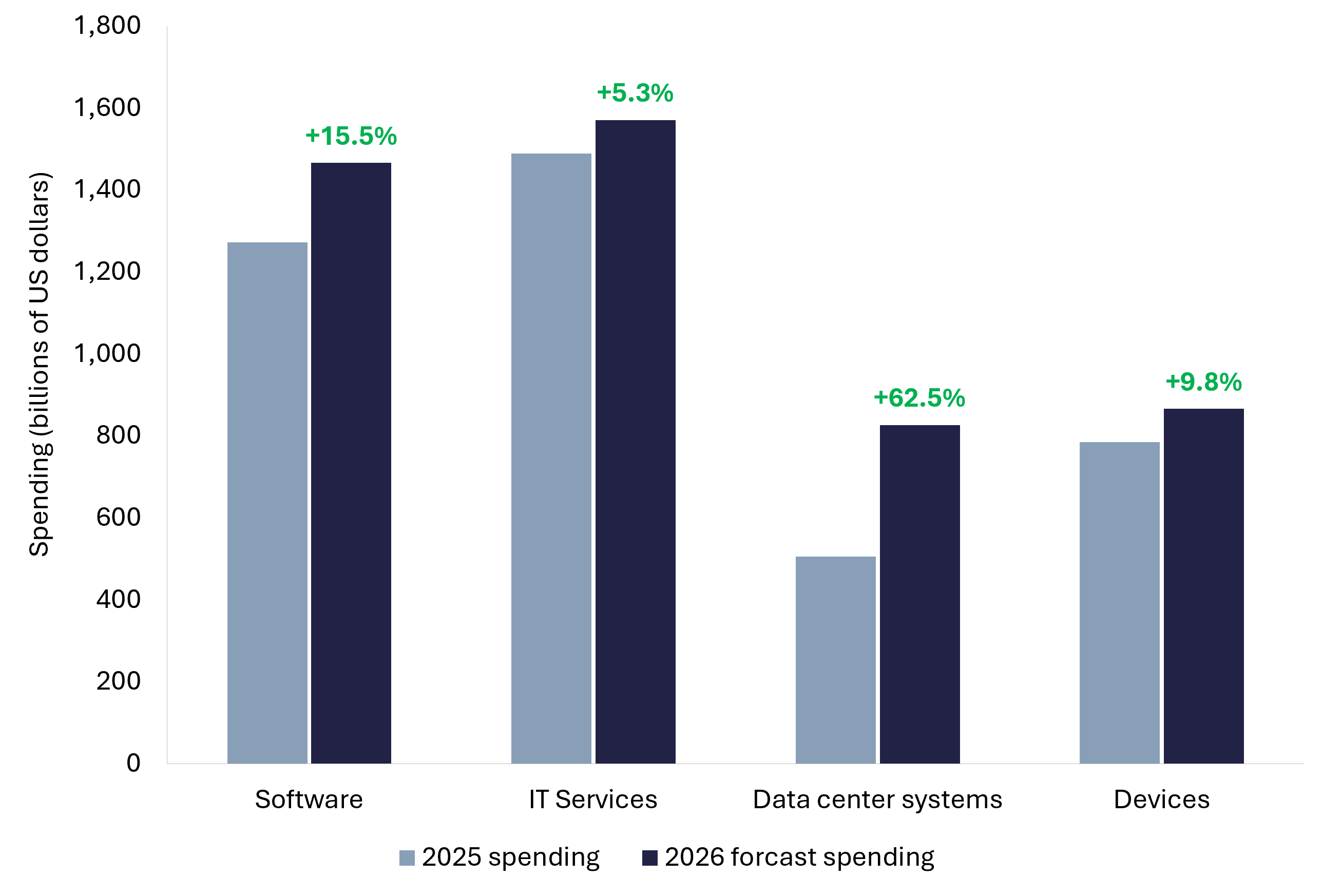
The market itself is in reasonable shape. Global deal value climbed 41% year over year to $2.4 trillion in the first five months of 2026, putting the market on track for its second-highest year on record. Worldwide software spending is forecast at $1.47 trillion for 2026, growing 15.5% and outpacing IT services, devices, and communications. Buyers have capital, the underlying demand for software keeps expanding, and enterprise SaaS dealmaking in the first quarter of 2026 alone topped the full-year total for 2025, which was itself the strongest year for the category since 2021.
What has changed is selectivity. Buyers are pricing evidence rather than narrative, which is good news if you can produce evidence and expensive if you cannot. The gap between a well-prepared SaaS business and an averagely prepared one has widened, and that gap is worth more than any move in the market index.
This guide is written for founders of bootstrapped and lightly funded SaaS companies somewhere between $1M and $100M in enterprise value. It covers when to sell, how buyers actually calculate your number in 2026, the eight steps of a sale process, how long each one really takes at your deal size, who the buyers are and how they differ, what to fix before you go to market, and why the number of people bidding tends to matter more than any line in your P&L.
When Is the Right Time to Sell a SaaS Business?
There is no perfect quarter. There is a window, and the window is defined by three things lining up: your business is performing, you are personally ready, and buyers are active in your category. Two out of three is usually workable. One out of three usually is not.
Business readiness comes first. The uncomfortable truth is that the best time to sell is when you least feel like it. Buyers pay for trajectory, and trajectory is a forward-looking judgement they form from your last eight quarters. A business that has grown steadily for two years and is still growing sells at the top of its range. The same business twelve months after growth flattened sells at the bottom of it, even though nothing about the product changed. Sellers who wait for one more record quarter often find the record quarter arrives after the trend has already turned.
Personal readiness matters more than founders expect. A sale process consumes five to ten hours a week for months, and most of those hours land during due diligence, which is exactly when the business needs you paying attention to customers. Founders who start a process while ambivalent tend to abandon it partway through, and a business that has been to market and withdrawn carries a mild stigma when it returns. Decide first. Then run.
Market readiness is the part you control least and worry about most. The good news for 2026 is that the conditions favour sellers who have done the work. Bain surveyed more than 300 M&A executives and found that 80% expect to sustain or increase deal activity through the year, with almost half of technology deals now carrying an artificial intelligence angle. Private equity firms remain constructive too, with 72% of general partners expecting deployment activity to increase over the next six months.
Common reasons founders decide to sell
- The next stage needs capital or distribution you do not have. Scaling from $10M to $50M ARR usually requires a sales organisation, and building one is a different job from the one you signed up for.
- Concentration risk has become personal. When most of your net worth sits in one private company, taking chips off the table is a portfolio decision rather than a lack of belief.
- The category is consolidating. Selling into consolidation as an attractive target beats selling after the consolidators have already bought your closest comparable.
- You want to build something else. This is a perfectly good reason and buyers hear it constantly. It does not weaken your position provided the business runs without you.
Founders sometimes ask whether they should wait until the business is bigger. The arithmetic usually favours acting sooner than instinct suggests, because multiples step up at scale thresholds rather than climbing smoothly. Getting from $4M to $6M ARR can move you into a different buyer pool and a different multiple band. Getting from $6M to $7M generally does not. Know which side of a threshold you sit on before you decide to wait.
Quotable takeaway: the best time to sell is while the trend line is still pointing up, because buyers price the next three years rather than the last one.
How Are SaaS Companies Valued in 2026?
Three valuation bases dominate software transactions, and which one applies to you is decided by your buyer based on your size and profitability. It is not a choice the seller makes.
- SDE multiple. Seller discretionary earnings is net profit with the owner salary, benefits, and one-off personal expenses added back. Standard below roughly $5M in enterprise value, where the buyer is stepping into an owner-operator role.
- EBITDA multiple. The default for mature, profitable software companies above that threshold, and the metric private equity underwrites against. EBITDA does not add back an owner salary, because a buyer at that size has to hire someone to do the job.
- ARR or revenue multiple. Applied when a business reinvests heavily enough that current earnings understate its earning power. Common above $5M ARR, and the default framing in most SaaS conversations.
The gap between SDE and EBITDA catches people out constantly. A business with $600,000 of SDE where the founder draws $150,000 has roughly $450,000 of EBITDA. Same business, same cash, two numbers a third apart. Applying an EBITDA multiple to an SDE figure always overstates the answer, and it is the most common valuation error we see. Our guide to valuing a SaaS business works through each method with examples.
What the 2026 benchmarks actually say
Private SaaS businesses generally transact between 2x and 7x ARR in 2026. The public market sets the reference point that private buyers anchor against, and it repriced quickly this year: the median enterprise value to trailing revenue multiple across public enterprise SaaS companies moved to 3.3x at the end of March, from 4.9x at year-end 2025. Public investors were working through what agentic AI means for per-seat pricing, and they repriced faster than private buyers did.
Underneath that reset, the operating story kept improving, which is the part sellers should pay attention to. Median EBITDA margins across public SaaS are projected at 22.6% for 2026, up from 20.0% in 2025 and 17.4% in 2024, and median gross margins sit at 77.1% in PitchBook’s second-quarter comp sheet. Software businesses are more profitable than they were two years ago, and buyers can see it.
Private multiples also move on a different clock. Software valuations held inside private equity portfolios declined roughly 8% through the first quarter of 2026, far less than the corresponding public move, drawing on MSCI analysis of first-quarter buyout marks. A public multiple reprices in hours. A private multiple is the output of a negotiation that runs for months, so deals signing today were priced against a market view formed a while ago. That lag cuts both ways, and what it provides is stability. Our full breakdown of SaaS valuation multiples by ARR band covers where each size of business currently prices.
One clarification that saves a lot of pain
ARR is not revenue. ARR is the annualised value of your recurring contracts at a point in time. Trailing revenue is what you actually billed over the last twelve months. In a business growing 30% a year those two numbers can differ by 15% or more, and quoting the larger one to a buyer who is modelling the smaller one starts the relationship on the wrong footing. Decide which number you are using, define it in writing, and use it consistently from the first conversation.
The second clarification concerns benchmarks you find online. Search for the average SaaS revenue multiple and you will get answers between 3x and 12x, all published this year, all technically defensible. They disagree because averages describe the largest companies in a dataset while medians describe the middle. As a seller you are priced against the middle, adjusted for your own facts.
Which Metrics Actually Move Your Multiple?
Scale sets your band. Four or five metrics decide where inside that band you land, and the spread they create is wider than the spread between bands. Two businesses at $6M ARR growing at the same rate routinely receive offers two turns apart.
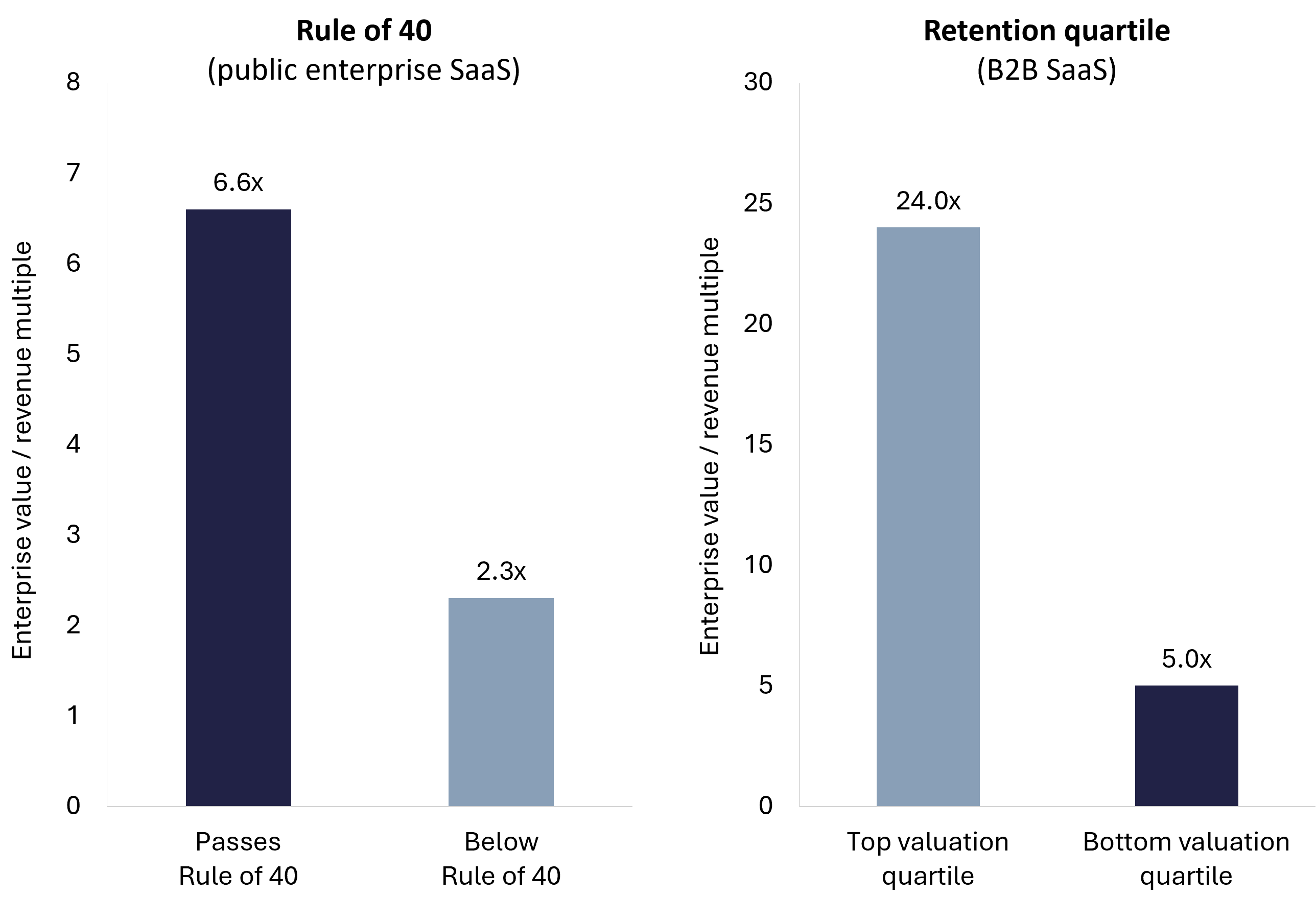
Net revenue retention is the heaviest single factor. McKinsey analysed more than 100 B2B software companies and found that the top quartile by valuation multiple traded at a median 24 times revenue against 5 times for the bottom quartile, with net revenue retention the metric most closely associated with the difference. A fivefold valuation gap traced primarily to one number. The mechanism is compounding rather than sentiment: a business at 120% net revenue retention grows its existing customer base 20% a year without signing a single new logo, while a business at 95% has to sell just to stand still. Our guide to net revenue retention and SaaS valuation works through the arithmetic.
The Rule of 40 runs a close second. Growth rate plus profit margin should exceed 40. Public SaaS companies meeting the benchmark trade at a median 6.6x trailing revenue against 2.3x for companies below it. Nearly a threefold difference, on a threshold most management teams can move deliberately over twelve to eighteen months.
There is a genuine complication in 2026 that most valuation guides have not caught up with. Bain argues that AI is making the 40 threshold harder to clear for reasons unrelated to company quality, and that some companies may need to accept a Rule of 30 for a period while they reinvest. Paying for inference, infrastructure, and model access introduces real variable cost into a business model that previously had almost none. If your score sits below the threshold because you are funding a deliberate AI programme with measurable returns, that is a defensible position and increasingly a recognised one. If it sits below because growth slowed and costs did not, buyers can tell the difference in about twenty minutes. The distinction is documentation.
Gross margin works as a gate rather than a slider. Above roughly 75% a business is treated as software. Below 70% buyers start asking which part of the revenue is really services, and they price that part differently. If your business blends software and services, separating the two cleanly in your accounts is one of the cheapest valuation improvements available to you.
Churn degrades quietly, which is what makes it dangerous. A business can post 40% growth while losing a third of its logos annually, because new sales mask the leak. Acquirers isolate retention first for exactly this reason. Retention pressure has also become more segmented: ChartMogul’s 2026 retention research found that price point predicts retention strongly in AI-native products, with plans above $250 a month retaining far better than sub-$50 plans, because cheap tools are substitutable and embedded ones are not. Present your churn cohort by cohort before anyone asks. Our SaaS churn rate benchmarks set out what buyers expect at each customer size.
Customer concentration is the fastest way to lose a turn. A single customer above 15% of ARR invites an earnout tied to that account renewing. Above 25%, some buyers decline to engage at all. This is worth fixing eighteen months out rather than explaining during diligence.
Owner dependency is the metric bootstrapped founders most consistently underrate. If you personally own the enterprise relationships, hold the only complete mental model of the codebase, or approve every pricing exception, the buyer is pricing the risk that you leave. For businesses under $5M ARR, transferability moves the multiple further than another five points of growth, because it attacks the exact risk the buyer is underwriting.
Quotable takeaway: retention, Rule of 40, margin quality, concentration, and owner dependency are all metrics you can move deliberately in twelve to eighteen months. The market index is not.
How Do You Prepare a SaaS Business for Sale?
Preparation is the highest-return work in the entire process, and it is the part founders skip. Every hour spent before you go to market saves several during diligence, and diligence delays are where deals lose momentum and price.
The preparation window depends on where you are starting. A business with clean accrual accounts, documented processes, and a real management layer can be ready in eight weeks. A business run out of a personal bank account with the founder as the only point of failure needs six months or more. Here is what the work actually consists of, by workstream.
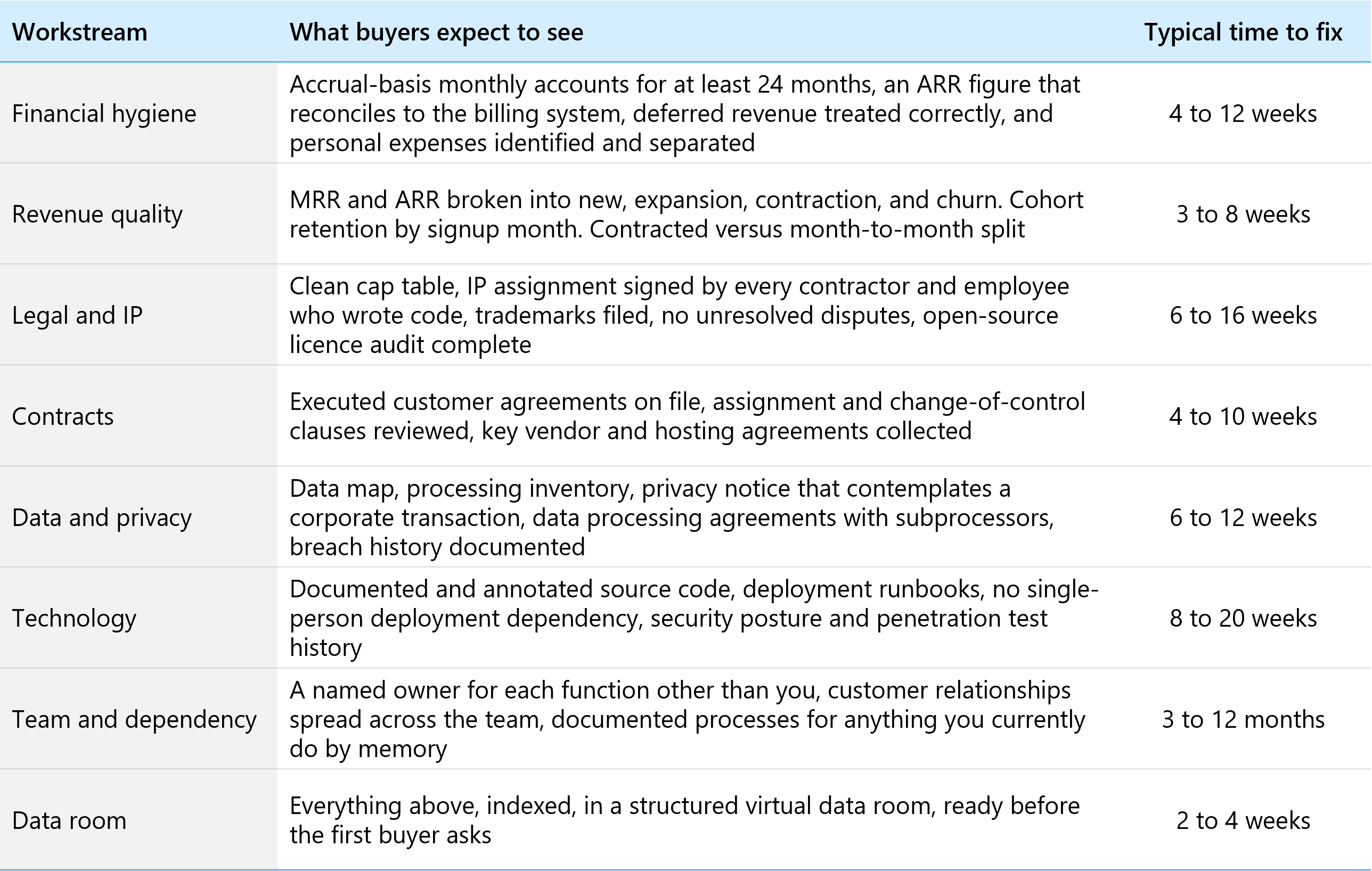
The three fixes with the best return
Rebuild your ARR from the billing system. If a third party cannot reconstruct your ARR figure from raw billing data in an afternoon, buyers apply a risk discount to the number, and that discount is almost always larger than the cost of fixing it. This is the single cheapest valuation improvement available to most sellers.
Separate services revenue from software revenue. Bundled implementation and support revenue drags your blended gross margin below the software threshold and invites a lower multiple on the whole business. Split the lines and the software margin speaks for itself.
Get the IP assignments signed. Contractors hired through freelance marketplaces years ago are a routine diligence finding, and chasing signatures retroactively while a buyer waits is a bad negotiating position. Do it now, quietly, while nobody is watching the clock.
It is worth understanding what buyers are going to examine, because preparing against their checklist is more efficient than preparing against a generic one. Our breakdown of SaaS due diligence and how buyers evaluate the model walks through the specific questions software acquirers ask about code quality, customer support load, and technical transferability.
What Are the Eight Steps to Sell a SaaS Company?
A sale process is not one long negotiation. It is a sequence of eight stages, each with a distinct purpose, and the ones founders underestimate are the first and the sixth. Here is the whole thing, with realistic durations for a lower middle market SaaS transaction.

The eight-step SaaS sale process. Durations reflect FE International transaction experience in the lower middle market and overlap in practice, so the stages do not simply add up to the total timeline.
Where founders lose time and money
Step 2 is where the money is made. Everything downstream is easier when the data room was built before buyers arrived. Sellers who assemble documents reactively spend the entire diligence period in a defensive posture, and every delay hands the buyer a reason to revisit price.
Step 4 determines your ceiling. A process that reaches eight qualified buyers produces a different result from one that reaches two, and the difference has nothing to do with your metrics. This is covered properly in the competitive process section below.
Step 7 is where deals die. Set aside five to ten hours a week specifically for responding to diligence requests, and delegate day-to-day operations so you can. Slow responses are the most common cause of a deal stretching past nine months, and time is the enemy of every transaction.
On listing platforms and where to market the business: for most SaaS companies above $1M in value, a public listing is the wrong mechanism because it trades confidentiality for reach you do not need. A targeted confidential process to a curated buyer list preserves your position with customers, employees, and competitors while still generating competition. Below that threshold, a structured self-directed process can work well.
How Long Does It Take to Sell a SaaS Business?
Eight to sixteen months from the decision to sell to the funds arriving, depending on deal size and how prepared you were on day one. Most published timelines quote six to nine months, which is accurate for the active process and ignores the preparation that precedes it. That omission is why first-time sellers consistently feel behind schedule.

The pattern in that chart is worth reading carefully. Preparation scales with deal size because larger businesses have more entities, more contracts, and more diligence surface. Marketing scales because the qualified buyer universe is larger and institutional buyers move on committee schedules. Diligence scales for the same reason, plus the arrival of quality of earnings work and, above a threshold, regulatory filings.
What compresses the timeline
- A data room built in advance. The single largest variable. Well-prepared sellers routinely complete diligence in five to seven weeks where unprepared sellers take ten to twelve.
- Accrual accounts already in place. Rebuilding two years of financials mid-process adds six to ten weeks and undermines buyer confidence at the same time.
- A clean cap table. One unlocatable early shareholder can hold a signing for a month.
- Fast responses. Answering diligence requests within 48 hours keeps momentum. It also signals competence, which affects how aggressively a buyer negotiates the remaining open points.
What extends it
- Customer concentration. Buyers will want reference calls with your largest accounts, which introduces scheduling risk and, occasionally, surprises.
- Third-party consents. Customer contracts with change-of-control clauses have to be identified and, sometimes, waived. Find them in preparation rather than in week nine.
- Regulatory filings. For 2026 the Hart-Scott-Rodino size-of-transaction threshold rose to $133.9 million, effective for deals closing on or after 17 February 2026. Below that, most SaaS deals in this range avoid a filing and the associated waiting period entirely.
- Cross-border structures. Multiple entities, foreign subsidiaries, or contractors across jurisdictions add legal and tax workstreams that run in parallel but still take calendar time.
One counterintuitive point. Trying to sell quickly usually makes the process slower, because it means skipping preparation, and skipped preparation surfaces during diligence when it costs more to fix. If speed genuinely matters, the way to get it is a narrow process to a small number of pre-qualified buyers with a complete data room ready on day one. That can close in four to six months. It typically costs you some price, because a narrow process is a smaller auction.
Who Buys SaaS Companies, and How Do They Differ?
The buyer you sell to is often a larger variable in your outcome than the multiple you negotiate, because different buyer types offer fundamentally different structures, different cash at close, and different lives for you afterwards. A $30M offer with 30% in earnouts is a different deal from a $25M offer that is mostly cash.
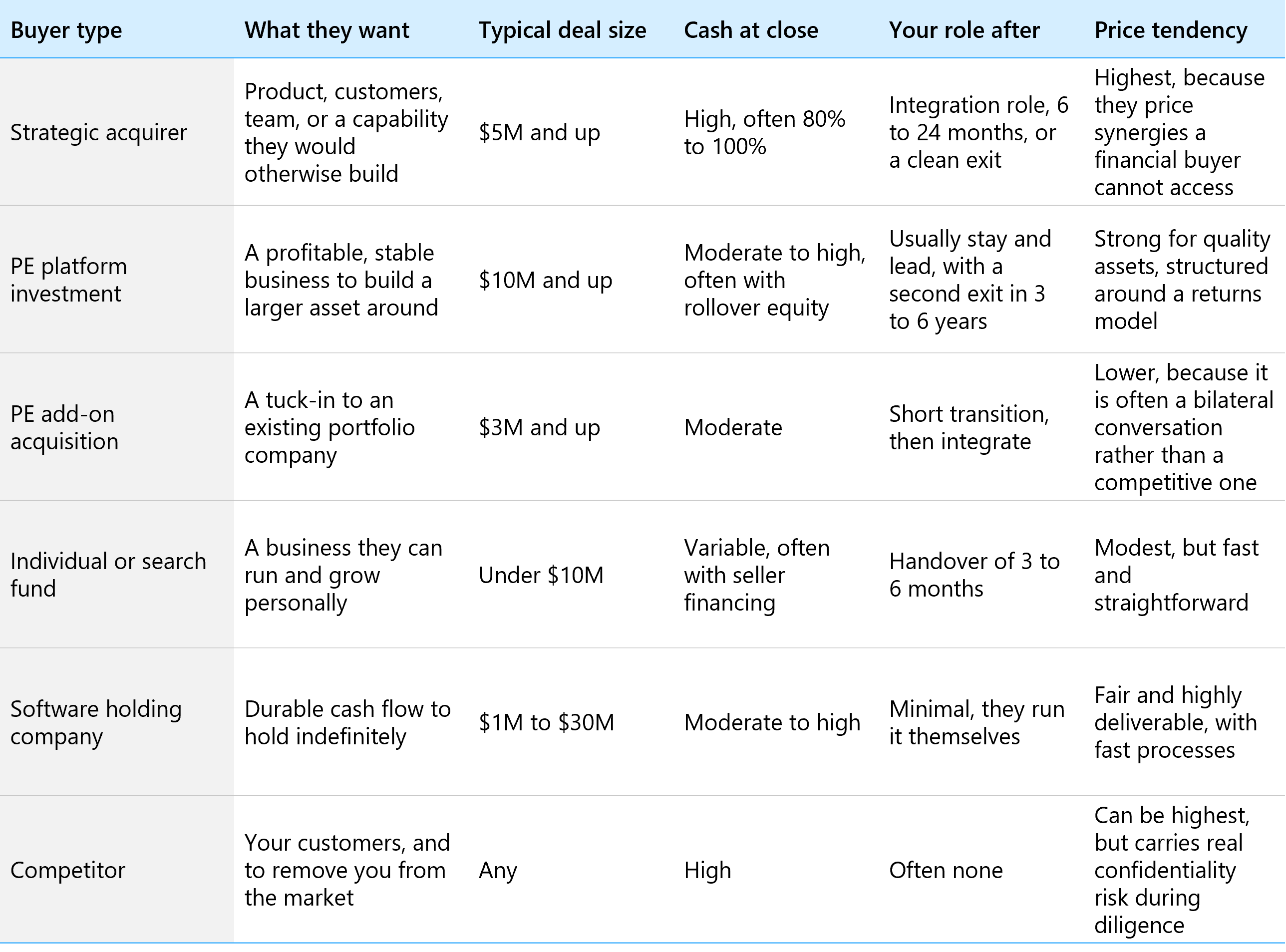
Buyer type comparison for SaaS transactions. Based on FE International transaction experience across 1,500+ completed deals. Our full comparison of private equity, strategic, and individual buyers covers each in more depth.
Who is buying SaaS businesses in 2026
Strategic acquirers are the strongest bid for many SaaS businesses right now, partly because they fund deals from balance sheet and cash flow rather than a debt package. PwC observes that buyers are reassessing which platforms are AI-native, AI-resilient, or AI-exposed, and that capital is concentrating around businesses with defensible data and embedded workflows. Recent transactions suggest buyers are prioritising platforms with embedded workflows, proprietary data, and high switching costs, precisely because those attributes become more valuable in an AI-enabled operating environment rather than less.
Financial buyers remain active but selective. PwC notes that compressed valuations are beginning to drive renewed interest in software M&A and take-private opportunities for selected assets, which is a helpful dynamic for sellers: buyers who found software expensive two years ago are engaging again, and more engaged buyers means more bidders.
There is also a structural reason sponsors are motivated. The private equity exit backlog remains substantial, with 34% of portfolio companies held for more than five years as of March 2026, up from 25% in 2025. Funds under pressure to return capital are both motivated sellers of mature assets and motivated buyers of the quality assets that make their platforms exitable.
Selling to a competitor
It can produce the highest number, because a competitor understands your product without explanation and can quantify the synergy precisely. It also carries the sharpest risk, because diligence hands your customer roster, pricing, and margin structure to a company that competes with you if the deal fails. Manage it by staging disclosure: nothing customer-identifying before a signed LOI, sensitive commercial detail released late and in aggregate, and a clean team arrangement where the competitor cannot let its commercial staff see your data. If a competitor is the only bidder, that is a weak position. If a competitor is one of five, that is a strong one.
Selling internationally
Cross-border interest is a real source of extra bidders, particularly for European and Asia-Pacific businesses where North American strategic acquirers are actively looking. The practical considerations are withholding tax, entity structure, transfer pricing history, and whether your customer contracts and data flows survive a change of controlling jurisdiction. None of these are blockers. All of them take longer to resolve if they surface during diligence rather than during preparation.
How Does a Competitive Process Lift the Final Price?
This is the part of a sale process that founders most often treat as optional and that most reliably changes the outcome. A seller negotiating with one interested party is discovering that party’s reservation price. A seller running a structured process is discovering the market’s.
The economics are settled and have been for thirty years. Bulow and Klemperer showed that an auction with one additional bidder generates more expected revenue than an optimally structured negotiation with one fewer bidder, and stated the implication for company sales directly: a single extra bidder more than makes up for any loss of negotiating power. Their conclusion is that there is no merit in restricting a sale to one or a few buyers in order to preserve seller control.
The mechanism is informational rather than adversarial. Buyers who know they are competing bid closer to their true valuation, because bidding low risks losing the asset. Buyers who know they are alone bid closer to your floor, because there is no cost to trying. Nothing about your business changes between those two situations. Only the information available to the person writing the offer.
What competition actually buys you
- A higher headline number. The most visible effect and the one everyone focuses on.
- Better structure. More cash at close, smaller escrows, shorter earnout periods, and narrower indemnities. This is frequently worth more than the headline difference and it is where competition pays quietly.
- Protection against retrading. A buyer who knows there are two underbidders waiting is far less likely to attempt a price reduction over a minor diligence finding.
- Speed. Competing buyers move faster, because delay costs them the asset.
- A real alternative. If the lead buyer walks in week eight, a process with underbidders continues. A bilateral negotiation starts over.
How competitive tension is built
Tension is manufactured through sequencing, not through pressure. A well-run process approaches a wide qualified list simultaneously under NDA, sets a common date for indications of interest, holds management meetings in a compressed window, and requests final offers on the same day. Every buyer knows others are looking, nobody knows who or how many, and each one prices against the possibility rather than the certainty of a rival.
The practical target for a lower middle market SaaS business is three to six credible parties at the indication stage, converting to two to four written offers. Below three, the process is a negotiation wearing a process costume. Above eight or so, quality control becomes the constraint and management meeting time gets diluted across parties who were never going to transact.
One caution worth stating plainly. Competition only works if the underlying preparation supports it. Running five buyers through a disorganised data room produces five buyers who all reach the same unfavourable conclusion at the same time, which is worse than one. Competition amplifies whatever quality signal your business already sends.
Quotable takeaway: the number of credible buyers at your table on the same day is a variable you control, and it moves the final number more reliably than any single operating metric.
How Are SaaS Deals Structured?
The headline number is the part founders remember and the part that matters least. Structure determines what you actually receive, when, and with what conditions attached. Two offers with the same enterprise value can differ by 40% in risk-adjusted terms.
Cash at close
The cleanest component and the most favourable to sellers. It provides immediate liquidity and a clean break. All-cash deals are more common at lower valuations where the risk profile is well understood, and blended structures become the norm as size and complexity increase. When comparing offers, always compare cash at close first and headline value second.
Earnouts
An earnout ties part of the price to future performance. Their use has settled into a stable range: earnouts appeared in 24% of private-target deals in 2025, up from 22% in 2024 and down from the unusual 33% peak in 2023, based on SRS Acquiom’s study of more than 2,300 private-target acquisitions worth $569 billion that closed between 2020 and 2025. The long-run historical average sits around 20%, so current usage is modestly above normal rather than exceptional.

Two details matter more than the headline prevalence. The median earnout potential as a share of the closing payment climbed to 34%, and earnout length skewed sharply toward one to two years, which accounted for 38% of deals against 23% for periods of a year or less and 20% for two to three years. If a buyer proposes a four-year earnout, that is outside market practice and worth negotiating on that basis. The detail on earnout and milestone trends is worth reviewing before you negotiate one.
The practical rules for earnouts are simple. Tie them to metrics you still control after closing, which usually means revenue rather than profit, because a buyer who takes over cost decisions can affect profit without affecting your performance. Define the measurement method in the agreement rather than by reference to a standard. Insist on information rights so you can verify the calculation. And treat the earnout as optional upside when you compare offers, not as part of the price.
Escrow, holdbacks, and working capital
A portion of consideration is typically held back to cover breaches of representations, usually released over twelve to eighteen months. Escrow sizes ticked up modestly in recent deal terms data as buyers stayed cautious about post-closing disputes. Separately, a working capital adjustment trues up the balance sheet at closing against an agreed target. Software businesses with deferred revenue need particular care here, because the treatment of unearned subscription revenue in the working capital calculation can move real money and it is often negotiated late by people who have not modelled it.
Representations, warranties, and insurance
You will make a set of statements about the business, and you will be liable if they turn out to be wrong. Representation and warranty insurance shifts much of that exposure to an insurer, which allows for a smaller escrow and a cleaner break for the seller. It has become common in mid-market technology deals and is worth raising early, because it changes the negotiation on indemnity caps and survival periods.
Transitioning ownership
Almost every deal includes a transition period, typically thirty to ninety days of active handover for smaller transactions and six to twenty-four months of ongoing involvement where the buyer wants continuity. Negotiate the shape of this before signing rather than after: hours per week, scope of responsibility, reporting line, and what happens if the buyer wants more of your time than agreed. Founders who leave this vague frequently find the transition period is the least pleasant part of the whole experience.
What Legal, Tax, and Data Issues Should Sellers Plan For?
These are the workstreams that most often surprise first-time sellers, because they operate on legal timelines rather than commercial ones and cannot be accelerated by wanting them to move faster.
Asset sale or stock sale
Buyers usually prefer an asset purchase, because it lets them select what they acquire and leaves unknown liabilities behind, and it often produces a better tax position for them. Sellers usually prefer a stock or share sale, because it is cleaner, transfers contracts without individual consents in most cases, and frequently produces a better tax outcome. This is a negotiable point with real money attached, and it should be raised early rather than discovered in the first draft of the purchase agreement.
Qualified small business stock, and why it is worth checking now
For US founders holding C corporation stock, Section 1202 can exclude a substantial share of your gain from federal tax, and the rules improved materially. The One Big Beautiful Bill Act introduced a tiered exclusion for stock acquired after 4 July 2025, allowing 50%, 75%, and 100% exclusions after three, four, and five year holding periods respectively, raised the per-issuer cap from $10 million to $15 million, and raised the aggregate gross asset ceiling for the issuing corporation from $50 million to $75 million.
Two implications for sellers. First, the shortened holding period means a sale at year three or four can now preserve part of the benefit rather than none, which changes exit timing arithmetic for founders who previously had to wait out the full five years. Second, stock issued on or before 4 July 2025 stays under the old regime, so which shares you hold and when they were issued determines which rules apply. This is a conversation to have with a tax adviser twelve months before a sale rather than during the closing week, because some of the planning options close once a process is underway.
Customer data and privacy
Data handling runs through the whole transaction and is frequently underestimated. In a share sale the controller does not change, so the position is relatively simple. In an asset sale the identity of the controller changes, which means affected individuals generally need to be informed and the transfer itself needs a lawful basis.
The diligence stage carries its own exposure. Personal data uploaded to a data room should be redacted or anonymised unless a lawful basis clearly applies, access should be restricted, and the data room provider needs an appropriate processing agreement in place. Legacy data is a specific risk area: analysis published through the International Bar Association highlights that data retained past the purpose for which it was collected creates real regulatory exposure, and that structurally unlawful data practices can impair the value of the asset itself where the business model depends on that data.
The practical preparation is a data map, a processing inventory, subprocessor agreements collected in one place, a privacy notice that contemplates a corporate transaction, and a documented deletion policy that you actually follow. Buyers who find this ready move faster and discount less.
Antitrust and regulatory filings
Most transactions in the $1M to $100M range fall well below the reporting threshold. For 2026 the size-of-transaction threshold rose to $133.9 million, with revised filing fees ranging from $35,000 upward. If your deal approaches that level, build the waiting period into the timeline from the beginning rather than treating it as a formality at the end.
Intellectual property and open source
Every person who wrote code needs a signed IP assignment, including contractors engaged years ago through freelance marketplaces. Run an open-source licence audit before a buyer runs one for you, because copyleft licences in a commercial codebase are a finding that can genuinely reduce price or, in rare cases, end a process. Trademarks should be filed. Domain registrations should sit with the company rather than with your personal account.
Do You Need an M&A Advisor to Sell a SaaS Business?
It depends on size, and the honest answer differs by band rather than being universally yes.
Below roughly $1M in value, a self-directed process is often reasonable. The buyer pool is individuals and small operators, diligence is proportionate, and the fee on a small transaction can be material relative to proceeds. What you still need is clean financials, a written summary of the business, and a lawyer for the purchase agreement. The FE International M&A Platform exists for exactly this case, giving sellers a structured route to qualified buyers without a full advisory engagement.
Between $1M and $5M, it becomes a judgement call that usually resolves in favour of getting help. The buyer universe widens to include small sponsors and holding companies who negotiate professionally, and the structure of the deal starts to matter as much as the price. A founder who has sold before and has time can run this. Most first-time founders find the process consumes more attention than expected at exactly the moment the business needs it.
Above $5M, advisory representation pays for itself through the competitive process alone. The buyer pool includes institutional acquirers with dedicated corporate development teams who transact continuously. Reaching that pool requires relationships and a credible process, and negotiating against it requires knowing where market practice sits on earnouts, escrows, indemnity caps, and working capital pegs. That is the work sell-side investment banking is built to do.
What advisors actually do, and what to ask
The visible work is finding buyers and negotiating. The less visible work matters more: preparing the business so diligence does not reduce the price, positioning the growth story so buyers underwrite the future rather than the past, running the timeline so competitive tension actually forms, and managing the hundred small negotiations between LOI and close that determine how much of the headline number reaches your account.
- How many transactions have you closed in my size band and my vertical in the last 24 months?
- What proportion of businesses you take to market actually complete?
- How many buyers will you approach, and how many will be strategic rather than financial?
- What does the fee structure look like, and what is payable if the deal does not close?
- Who specifically will run my process day to day?
That completion rate question is the one worth pressing on. A high proportion of listed businesses that fail to sell suggests a firm that lists broadly and prepares lightly. FE International has advised on more than 1,500 completed transactions since 2010 with a 94.1% success rate, across SaaS, ecommerce, fintech, cybersecurity, edtech, AI, agencies, and marketplace apps, and much of that rate comes from pre-listing due diligence that resolves issues before a buyer ever sees them.
What This Means for Your Exit
The 2026 SaaS market rewards preparation more than it rewards timing. Buyers have capital, software demand keeps growing, and the distance between an average outcome and a strong one has widened rather than closed. That gap is the opportunity.
Almost every variable that decides where you land is one you can influence. Retention. Margin separation. Financial hygiene. Customer concentration. Owner dependency. Deal structure. And the number of credible buyers at your table on the same day. None of them depend on where the public index sits when you sign.
The most valuable thing you can do right now, if a sale is somewhere in the next twelve to twenty-four months, is find out how your current metrics read to an acquirer while there is still time to move them. A gap identified eighteen months out is a project. The same gap identified during due diligence is a discount.
Request a confidential valuation to see where your business sits against the benchmarks in this guide, learn more about how we sell SaaS businesses, or explore the FE International M&A Platform if a self-directed process suits your situation better.
