
.jpg)
What Do Buyers Look For in a SaaS Acquisition in 2026?
Something changed in SaaS diligence this year, and it is worth understanding before you go to market. Bain & Company has been using AI to build working replicas of the software it is asked to evaluate, a practice its teams call vibecoding. According to a Financial Times report covered by Private Equity Wire, what began in 2023 as a specialist engineering capability is now used across Bain's private equity advisory teams, and its purpose is blunt: to see how easily a product could be replicated and to judge how durable its competitive position really is.
That reframes the central question a buyer asks. It is no longer whether your software is good. It is whether your software is the thing that is actually hard to reproduce. For most SaaS businesses the honest answer sits somewhere else entirely: in the data, the workflow design, the integrations, the switching costs and the customer relationships. Buyers in 2026 are looking for exactly that, and they are testing for it rather than taking it on trust.
The good news is that this rewards well-run businesses more clearly than the old criteria did. What follows is what buyers screen on now, what moved since 2024, and what that means for how you present the business. For the process around all of it, start with how to sell a SaaS business.
The short answer: five criteria, one of them new this year
Buyers screen on five things in 2026: defensibility, retention quality, revenue quality, security posture, and operational cleanliness. Defensibility is the one that changed, because it is now demonstrated rather than asserted.
None of the other four are new, but the weighting has shifted. Retention has split into two questions rather than one. Revenue quality now outranks headline growth for most acquirers. Security moved from a diligence item to a screening gate. And operational cleanliness, meaning documentation a stranger can verify, decides how long the process takes rather than whether it happens.
Appetite is not the constraint. Deloitte's April 2026 pulse survey of 500 corporate and private equity M&A leaders found 67% expecting deal counts to rise over the following six months and 69% expecting aggregate deal value to increase. PitchBook counted 267 enterprise SaaS M&A deals in Q1 2026, the sector's largest quarter on record by value. Buyers are active and they are selective, which is a favourable combination for a business that meets the criteria.
Defensibility is now tested, not asserted
The vibecoding development matters because it changes what evidence counts. A buyer who can stand up a rough working version of your core product in days will not accept the product itself as the moat. They will ask what remains valuable once the software is reproducible, and they will expect a specific answer.
The answers that hold up in 2026 are concrete. Proprietary data that took years to accumulate and cannot be bought. Workflows embedded deeply enough in a customer's operations that replacing them means retraining a team. Integrations that sit inside systems of record. Regulatory approvals or certifications that took time to earn. Distribution and brand in a niche where trust is the barrier. Each of those is demonstrable, and each survives the question of whether the code could be rewritten.
Data is the answer sellers reach for most often and defend least well. A buyer will distinguish between data you happen to hold and data that compounds: whether it accumulates with use, whether a competitor could buy or scrape an equivalent, whether customers would lose something switching away, and whether you have the rights to use it in the first place. Usage logs that nobody has modelled are not a moat. A labelled corpus that improves the product every month, which took four years and a customer base to assemble, is one. Be precise about which you have.
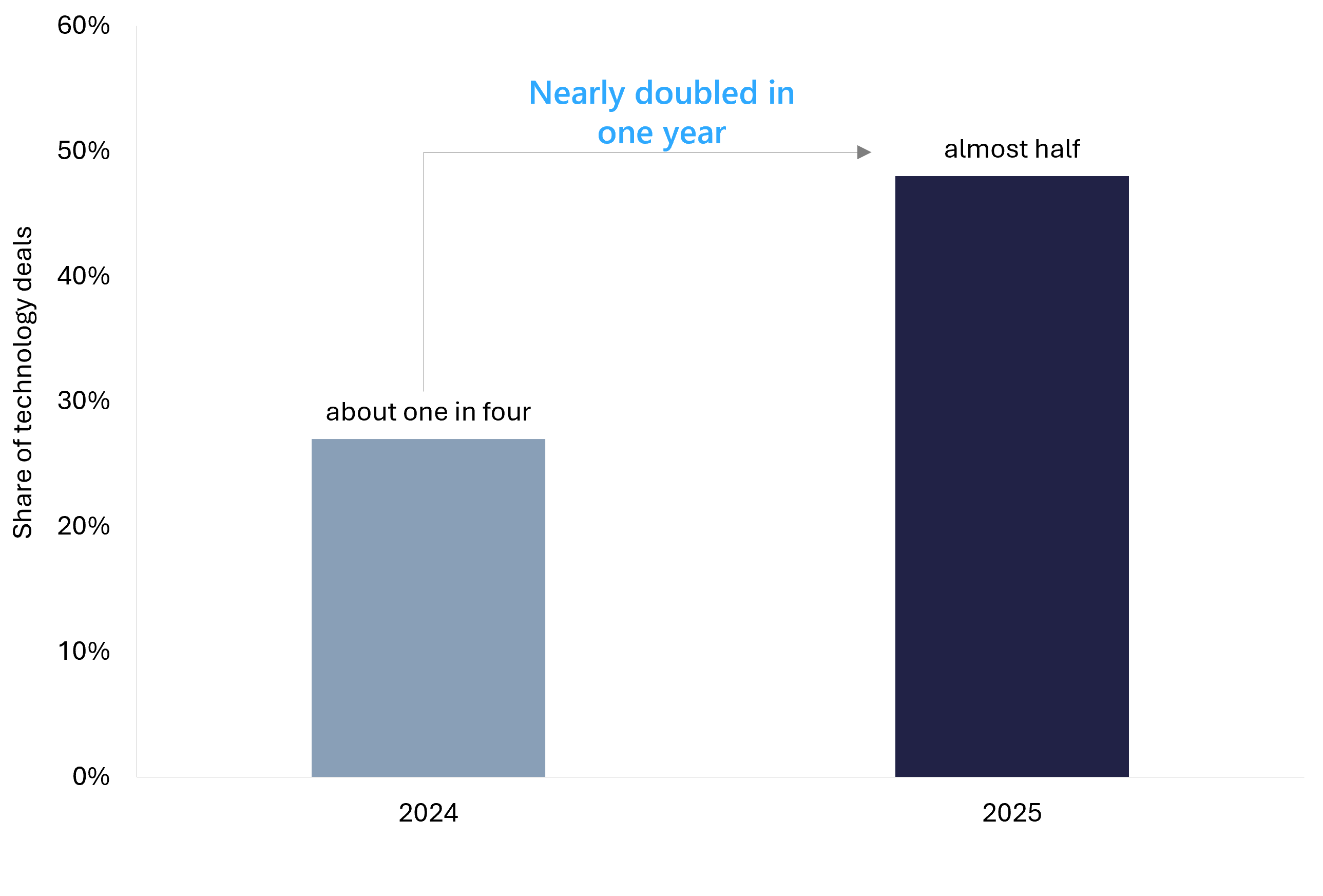
AI is now present in the deals themselves. Bain's January 2026 software M&A report found that almost half of technology deals in 2025 carried some AI component, up from roughly one in four the year before. Our analysis of why acquirers pay premium multiples for AI capability covers where that premium actually lands. For sellers the practical task is documentation: which models you depend on, on what commercial terms, what happens if pricing or availability shifts, and whether any customer data trains anything. A dependency with a stated mitigation reads as competence. An undocumented one reads as an unpriced risk.
Retention, and the new question about AI revenue
Retention has always been the metric that moves a SaaS valuation most. What changed in 2026 is that buyers now ask about it twice: once for the business as a whole, and once for any AI-native portion of the revenue.
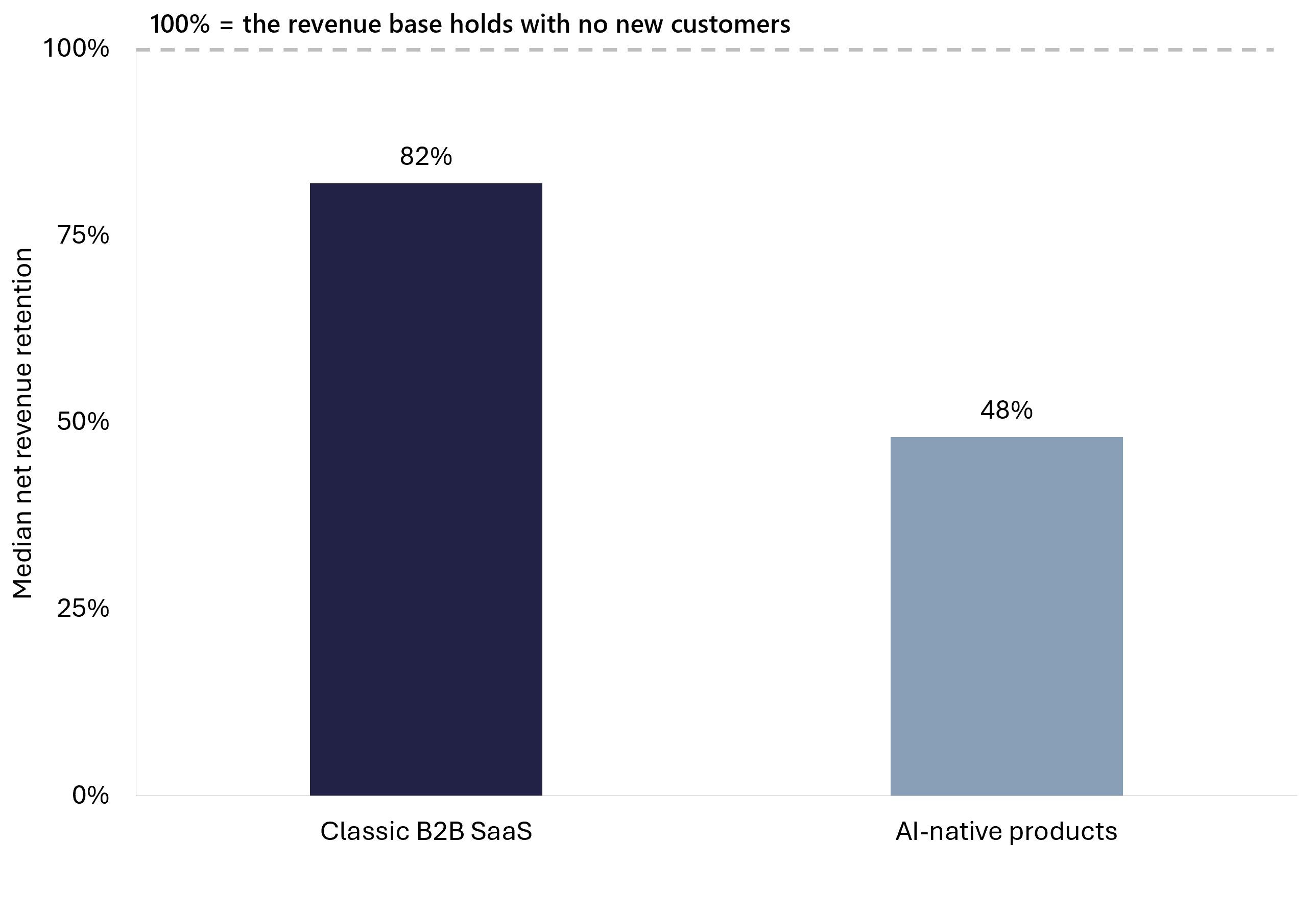
The reason is in the data. ChartMogul's analysis of roughly 3,500 software companies puts median net revenue retention for B2B SaaS at 82%, with the upper quartile at 97%. For AI-native products the median sits at 48%, with gross revenue retention at 40%, though that gross figure has risen from 27% earlier in the same period as those products mature. Two businesses reporting identical ARR growth can therefore have very different revenue durability underneath, and buyers have learned to check.
For a classic SaaS business this is an advantage worth making visible. Durable retention now stands out against a cohort where it cannot be assumed. Report gross and net retention separately with the calculation method written down, show revenue by signup cohort rather than aggregate churn, and split out any usage-based or AI-native revenue so a buyer does not have to guess. The same study found annual plans run 10 to 20 percentage points higher on net retention than monthly equivalents, so contract mix is part of the story too. Our guide to the metrics that drive SaaS valuations sets out how each is treated.
Revenue quality now outranks the growth rate
A business growing 30% with contracted annual revenue and 110% net retention prices better in 2026 than one growing 60% on monthly plans with concentrated customers. That ordering is firmer than it was two years ago.
What buyers examine: the split between recurring and non-recurring revenue, with setup fees and professional services separated out; contract length and the share on annual or multi-year terms; customer concentration, where a single account above roughly 15% of revenue draws questions and one above 25% affects structure; and the Rule of 40 as a combined read on growth and margin. Our breakdown of SaaS valuation multiples by ARR, growth and retention shows how far apart the quartiles price on precisely these inputs.
Gross margin gets closer attention now that inference costs sit in many cost bases. A product with genuine AI functionality carries a variable cost per use that traditional SaaS does not, and buyers want to see margin after those costs are loaded in rather than before. Showing that calculation yourself, clearly, removes a question that would otherwise be asked with suspicion.
Security became a gate rather than a diligence item
In SRS Acquiom's 2026 survey of 150 senior dealmakers, 84% expect greater scrutiny of cybersecurity diligence over the next one to two years, 51% already call technology diligence the most demanding element of a review, and 47% made it their top priority this year. That concentration has changed where the question sits in the process. It now arrives early enough to affect whether a conversation continues.
What satisfies it is evidence rather than intention: a SOC 2 report where the customer base warrants one, penetration test results, a data handling and encryption map, an incident log, and signed data processing agreements with every sub-processor touching customer data. Our guide to the documents you need to sell a SaaS company sets out the full folder structure and the format buyers expect, and the SaaS due diligence checklist for buyers shows how the other side works through it.
Who is buying in 2026, and what each type screens for
The market is large and the money is concentrated in technology. McKinsey's February 2026 report puts technology, media and telecom at 23% of global deal value, up 61% to $1.1 trillion. Gartner forecasts worldwide software spending of $1.47 trillion in 2026, growing 15.5%, which keeps strategic acquirers funded and motivated.
- Strategic acquirers screen for fit first: does this product extend a line, reach a segment, or remove a competitor. They tolerate lower margins where the strategic case is strong, and Bain reports strategic buyers transacting at a median 11.6 times enterprise value to EBITDA in 2026.
- Private equity buyers screen for durability and margin expansion: retention, pricing power, and whether the cost base can support leverage. They are the most rigorous on the Rule of 40 and on customer concentration.
- Individual buyers and search funds screen for transferability: can the business run without the founder, and will a lender underwrite it. Documentation matters disproportionately here.
Our comparison of PE, strategic and individual buyers for SaaS covers which suits which business, and our mid-year 2026 tech M&A report tracks where the activity is concentrated.
What gets a business set aside before the first call
Selectivity works in favour of prepared sellers, but it is worth knowing what causes a buyer to move on early. Five things account for most of it.
- Cash-basis financials with no accrual conversion, which makes revenue quality impossible to assess without weeks of work.
- Unclear IP ownership, particularly contractor-written code with no signed copyright assignment on file.
- Customer concentration above roughly a quarter of revenue with no contractual protection around it.
- No security evidence at all where the customer base plainly expects it.
- An AI dependency the seller cannot describe in commercial terms.
Each is fixable, and each is cheaper to fix before going to market than to explain during diligence. McKinsey notes deal cycles running 10 to 30 percent faster where AI tooling is applied to document review, and that gain only reaches sellers whose material is complete and machine-readable in the first place.
What changed between 2024 and 2026
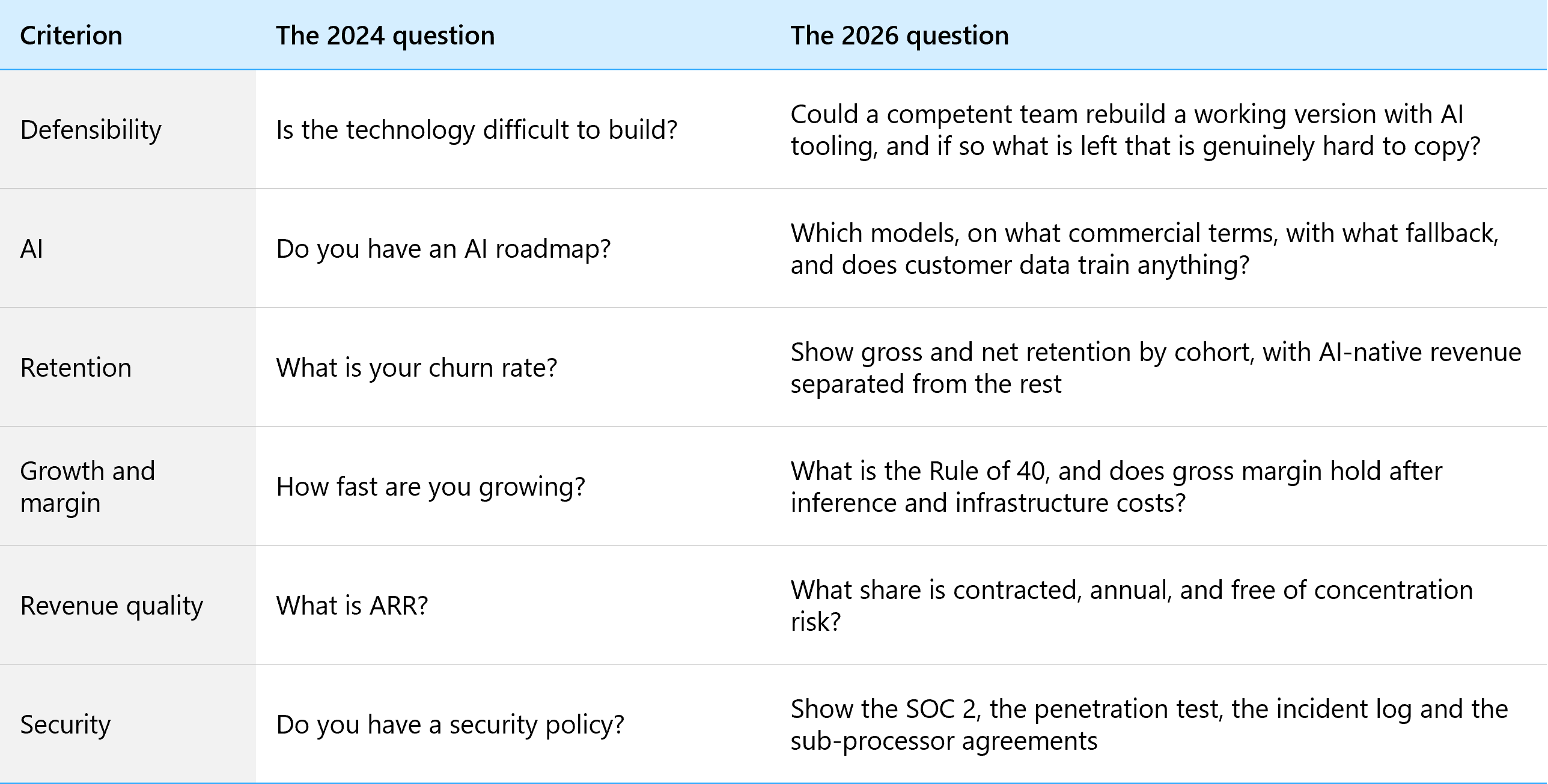
The criteria did not so much change as sharpen. The same five headings, asked with more precision and with more evidence expected behind each answer.
Meeting the 2026 criteria
So what do buyers look for in a SaaS acquisition in 2026? Evidence, where assertion used to be enough. Defensibility is tested rather than described, retention is examined by cohort and by revenue type, margin is checked after the costs that AI products actually incur, and security is confirmed before a conversation progresses. That shift favours businesses that are genuinely well run, because for the first time the diligence process can tell the difference quickly.
FE International has completed more than 1,500 transactions since 2010 with a 94.1% success rate on private sales and acquisitions, and we handle SaaS sales end to end. If you want to know how your business reads against these five criteria before a buyer forms a view, that is the conversation worth having first.
