
.jpg)
ARR vs Revenue vs SDE vs EBITDA: Which Number Values a SaaS Business?
Four numbers get quoted in SaaS valuation conversations, and founders are often told to pick one. That framing causes most of the confusion, because these are not four opinions about the same figure. They are four different measurements, taken over different periods, using different rules, answering different questions. A business can honestly report all four and watch them disagree by an order of magnitude.
This page is about how they relate to each other and where each one breaks. It is not about which basis a buyer will apply to your business by size, because that question is already answered at length in our analysis of SaaS valuation multiples and in our guide to the metrics that drive a SaaS valuation. Read either of those for the convention. Read this one for the arithmetic underneath it.
One framing note before the detail. What follows describes conventions and what commonly happens in diligence. None of it is a rule that binds a particular buyer, and none of it predicts what any specific number will produce in a negotiation.
The short answer
ARR and recognised revenue are top-line measures and are not interchangeable: one is an annualised run rate at a point in time, the other is what accounting rules say you earned over a period. SDE and EBITDA are earnings measures separated mainly by how they treat the owner's own compensation. A buyer will generally rebuild whichever number matters to them from source rather than accept the one presented.
The practical consequence is that the number you lead with matters less than whether you can walk someone from any one of them to any other without the story breaking. That reconciliation is what tends to get tested.
Four Measurements, One Business
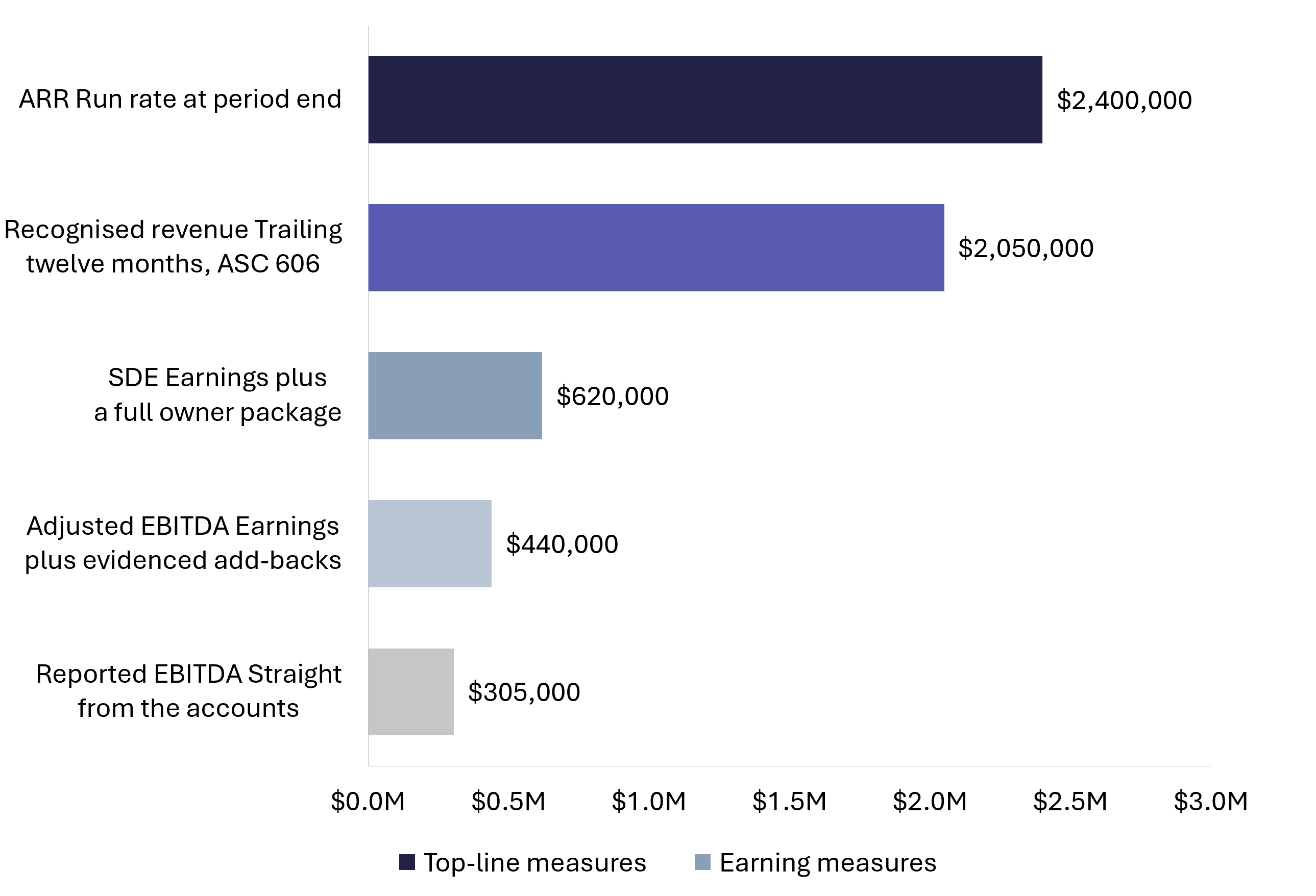
The chart above uses one invented business to make a single point. Five figures, all defensible, spanning from $2.4 million to $305,000. Nobody in that example is being dishonest. The gaps come from three things: the period being measured, the accounting rules being applied, and what is being added back.
It helps to stop thinking of these as a menu and start thinking of them as two pairs. ARR and recognised revenue both describe the top line and differ on timing and accounting treatment. SDE and EBITDA both describe earnings and differ mainly on how the owner is treated. Comparing an ARR figure to an SDE figure is not comparing two views of the same thing; it is comparing two entirely different things that happen to be denominated in dollars.
ARR and Recognised Revenue Are Not the Same Measurement
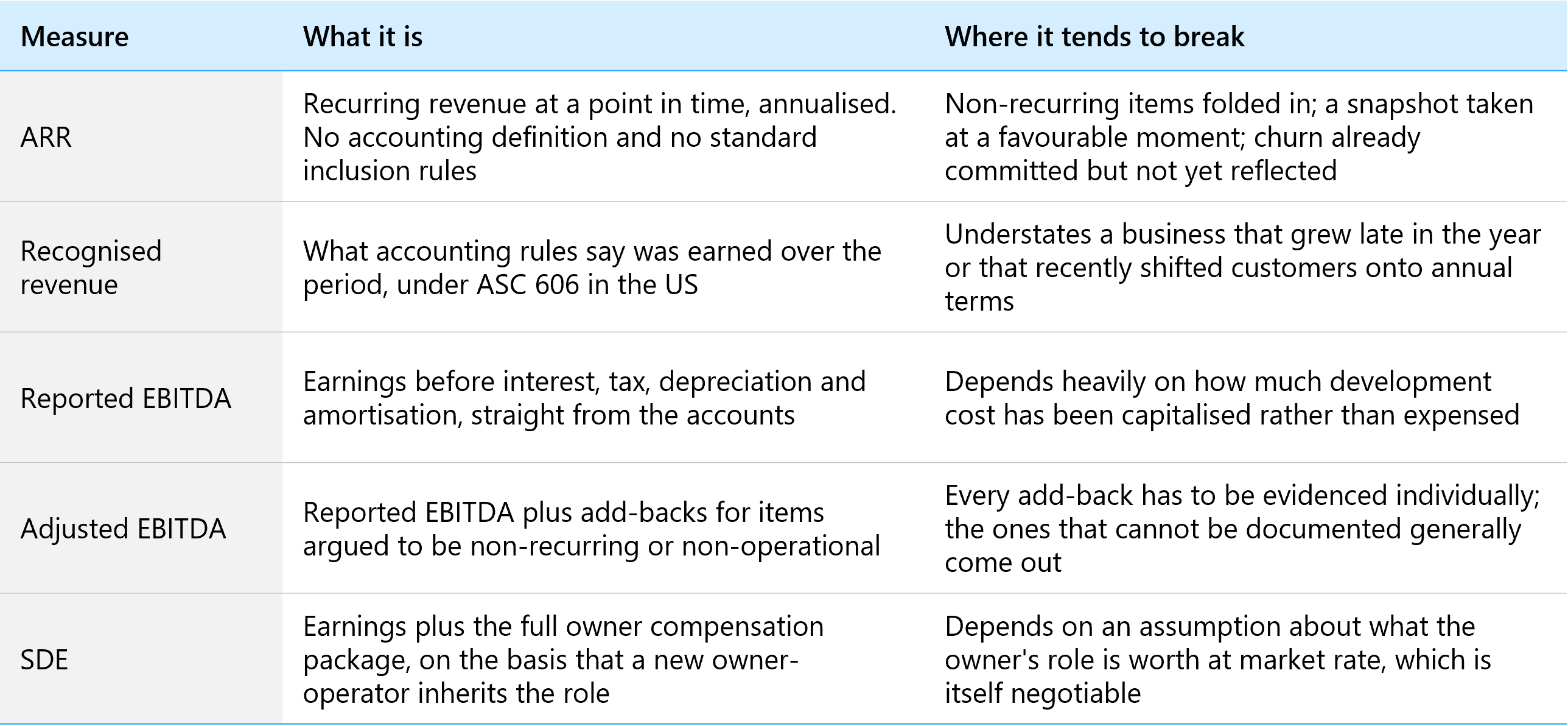
This is the gap founders are least prepared for, partly because ARR is the number the whole industry talks in and partly because it has no accounting definition at all.
The clearest available statement of that comes from a public company answering SEC staff questions about its own ARR disclosure. In its 2023 response the company confirmed that ARR is not calculated based on recognised or unearned revenue and has no direct relationship to revenue recognised under ASC 606, and that the measure does not have any standardised meaning, so it is unlikely to be comparable to similarly titled measures used by other companies. That is a company describing its own metric to its regulator, which makes it about as candid a description as the topic has.
Two mechanical things drive the gap. The first is timing: ARR is a snapshot annualised at a moment, while recognised revenue accumulates over twelve months, so any business that grew during the year will show ARR above trailing revenue. The second is billing structure. ChartMogul's analysis of more than 2,500 SaaS companies found that at the $3m to $8m ARR stage, annual plans account for roughly 47 percent of ARR. Annual prepayments sit on the balance sheet as deferred revenue and unwind over the term, which separates cash, ARR and recognised revenue from one another in ways that need explaining rather than assuming.
ARR also tends to overstate where usage-based pricing, professional services, one-off implementation fees or discounted first terms are folded in. Whether those belong in a recurring-revenue figure is a judgement, and the SEC's guidance on presenting key performance indicators asks companies to define the metric and explain how it is calculated for exactly that reason. Private sellers face no such requirement, which is precisely why buyers ask.
What Each Number Actually Measures
Where EBITDA and Cash Come Apart
EBITDA is often treated as a proxy for cash generation. In software it can drift some distance from it, and the main reason is an accounting choice rather than anything operational.
Development costs can be capitalised rather than expensed, which moves them below the EBITDA line and lifts the number without anything changing in the business. How much gets capitalised has historically depended on a project-stage test that sits awkwardly with iterative development. The FASB acknowledged this directly in ASU 2025-06, which removes the project-stage language and replaces it with a test based on whether management has committed funding and completion is probable, with capitalisation delayed where significant development uncertainty remains. It applies to annual periods beginning after 15 December 2027, with early adoption permitted.
The practical point for a seller is not the standard itself but what it implies: capitalisation policy is a judgement, two otherwise identical businesses can report materially different EBITDA because of it, and a buyer comparing your EBITDA to a benchmark will generally want to know which policy produced it. Expect the question, and be able to answer it with the policy written down rather than reconstructed.
SDE and EBITDA Differ on One Assumption
The distinction between these two is usually explained as a size convention, and our guide to the metrics that drive a SaaS valuation sets out where each is conventionally applied. Underneath the convention there is a single assumption doing the work, and it is worth seeing plainly.
SDE assumes the buyer will step into the owner's role. On that assumption the owner's entire compensation package is available to the new owner and belongs in earnings. EBITDA assumes the buyer will not, and that someone has to be paid market rate to do whatever the owner currently does. The two measures are therefore not converted by a formula; they are separated by a judgement about what the founder's job is worth to hire.
That judgement is where the discussion tends to land in practice. A founder writing code, running sales and handling support full time is doing several jobs, and replacing them may cost more than the salary currently drawn. A founder working a few hours a week on a business that runs itself is doing very little, and the picture is different again. Neither position is automatically right, which is why this part is negotiated rather than calculated, and why our note on what buyers look for in a SaaS acquisition treats owner dependence as a valuation input in its own right.
What a Buyer Does With Your Numbers
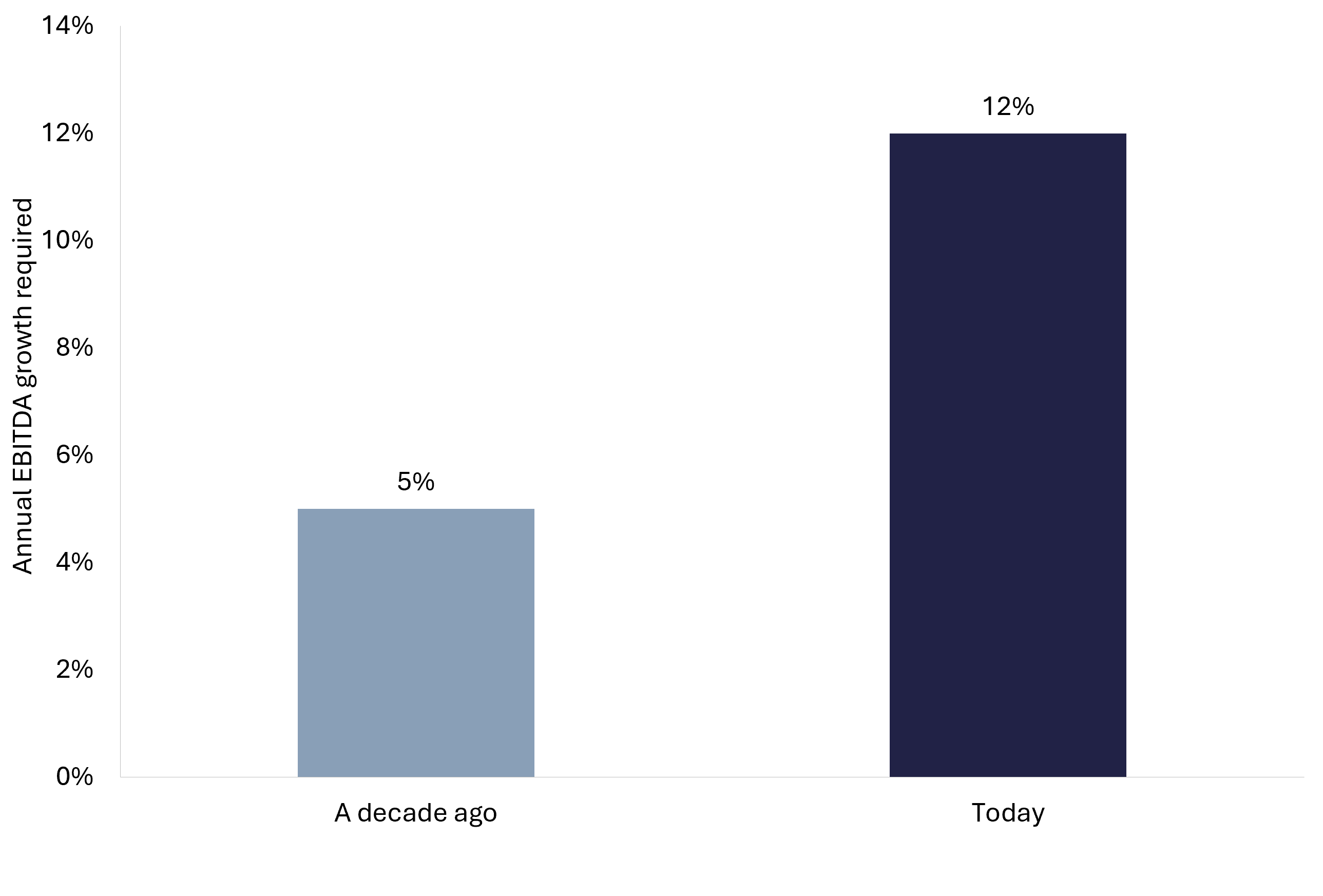
There is a reason the earnings figure gets taken apart so carefully. Bain's mid-2026 read of private equity notes that a deal which a decade ago needed roughly 5 percent annual EBITDA growth to reach a target 2.5x return over five years now needs something closer to 12 percent, with multiple expansion no longer doing the work it once did. When the return has to be earned out of the business, the starting earnings number stops being a formality.
On most processes that shows up as a quality of earnings analysis that rebuilds the figures from source rather than reviewing the summary. Deloitte's guidance to sellers on pro forma EBITDA is blunt about what survives: adjustments need a clear narrative, cash flow models and other substantiation, and a track record of having actually delivered the change being claimed. Our guide to EBITDA add-backs covers which categories tend to hold up, and FE International's own quality of earnings service exists because the exercise is usually easier to do before a buyer does it to you.
Different acquirers weight the numbers differently. A financial buyer is typically underwriting to an earnings figure and a debt structure; a strategic buyer may be underwriting to revenue and what it becomes inside their own business. Our comparison of private equity, strategic and individual buyers sets out how those motivations diverge, and the wider mid-year 2026 tech M&A picture gives the market backdrop.
Which Number Ends Up in the Agreement
A headline price is usually expressed against one basis, but the agreement itself tends to reference several, and the definitions in it do real work.
Working capital adjustments are now close to standard. SRS Acquiom's study of more than 1,500 private-target acquisitions reports that purchase price adjustments are present in more than 90 percent of transactions, against around half a decade ago. For a SaaS business that matters more than it sounds, because deferred revenue from annual prepayments interacts directly with the working capital calculation, and how that balance is treated can move the cash that changes hands.
Where an earnout is used, the metric it is measured against becomes one of the more consequential definitions in the document, since it determines what the seller is paid for and what the buyer can change afterwards. Our overview of what documents are involved in selling a SaaS company covers the paperwork this sits inside, and the wider arc is set out in our guide to how to sell a SaaS business.
It is also worth noting that adjusted figures attract scrutiny even in public markets, where the SEC maintains detailed interpretations on non-GAAP measures. Those rules do not bind a private seller. The habits behind them travel anyway, because the buyer's advisors were generally trained under them.
What to Have Ready
The work that tends to pay off is reconciliation rather than presentation. A few things are generally worth having before a buyer asks.
A bridge from ARR to trailing recognised revenue, with the timing and billing effects itemised rather than netted. A written ARR definition stating what is included and excluded. The capitalisation policy for development costs, written down. An add-back schedule where every line has evidence attached, prepared on the assumption that unevidenced items will be removed. And both an SDE and an EBITDA view, with the market-rate assumption for the owner's role stated openly rather than buried.
Most of this overlaps with what a preparation checklist would cover anyway, and with the ground a buyer walks in a SaaS due diligence process. Doing it early tends to be the difference between explaining a gap and defending one. Retention figures belong in the same pack, since net revenue retention and churn are what tell a buyer whether an ARR figure is likely to still be there next year, and the buyer-side diligence checklist shows how those questions arrive.
One caveat for businesses with a meaningful AI component. Where inference and infrastructure costs scale with usage, the relationship between revenue and earnings behaves less like classical software, and both how AI businesses are being valued and how valuation models are adapting are moving quickly enough to be worth checking rather than assuming.
Where This Leaves You
The ARR vs revenue vs SDE vs EBITDA question is usually posed as a choice and is better treated as a translation exercise. Each measure answers a different question honestly, and the interesting information sits in the gaps between them: how much of the top line is genuinely recurring, how much of the earnings figure depends on an accounting policy, and how much of it depends on an assumption about the owner.
If you want to see the four figures worked out on your own accounts before a buyer does it, you can request a confidential valuation, or read how FE International handles SaaS sales end to end. For the longer view, our SaaS exit planning overview covers the work that tends to happen well before any of these numbers gets quoted, and our note on how much a business is worth covers the question they all feed.
