

How to Sell an AI SaaS Business
An AI SaaS business gets looked at twice. Once as a software business, where a buyer is pricing recurring revenue, predictable gross margin and a customer base that compounds. Once as an AI business, where the same buyer is weighing model dependency, usage-linked costs and whether the advantage survives the next generation of available models. Both readings are legitimate. They do not always produce the same conclusion about the same company, and the gap between them is where these processes get difficult.
This page is about that gap. For the sequence of a sale, the stages and the evidence file, our guide to AI M&A trends in 2026 covers the market and positioning side, and the general arc is set out in how to sell a SaaS business, most of which applies unchanged. What follows is narrower: the four places where the software reading and the AI reading disagree, and what tends to resolve them.
Two framing notes. No multiple appears anywhere on this page, deliberately, because the published figures for AI businesses vary so widely that quoting one would be asserting something the evidence does not settle. Where you want the valuation methods, our AI business valuation model and how to value an AI business cover them. And nothing here predicts what any particular business will achieve; it describes what buyers commonly examine.
The Short Answer
Selling an AI SaaS business is mostly a conventional software sale with four specific points of friction: which pricing model the revenue sits on and whether it is migrating, what gross margin looks like with inference fully loaded, whether retention resembles the SaaS population or the AI-native one, and which comparable set a buyer should apply. None of those has a single right answer. All of them are answerable with evidence, and the businesses that transact well are the ones that answered them before anyone asked.
The order matters. Pricing model determines how revenue is counted, revenue counting determines what margin means, margin and retention together determine which comparable set applies, and the comparable set determines who buys it. Resolving them out of order tends to produce a process that keeps reopening the same question.
Friction One: Which Pricing Model the Revenue Sits On
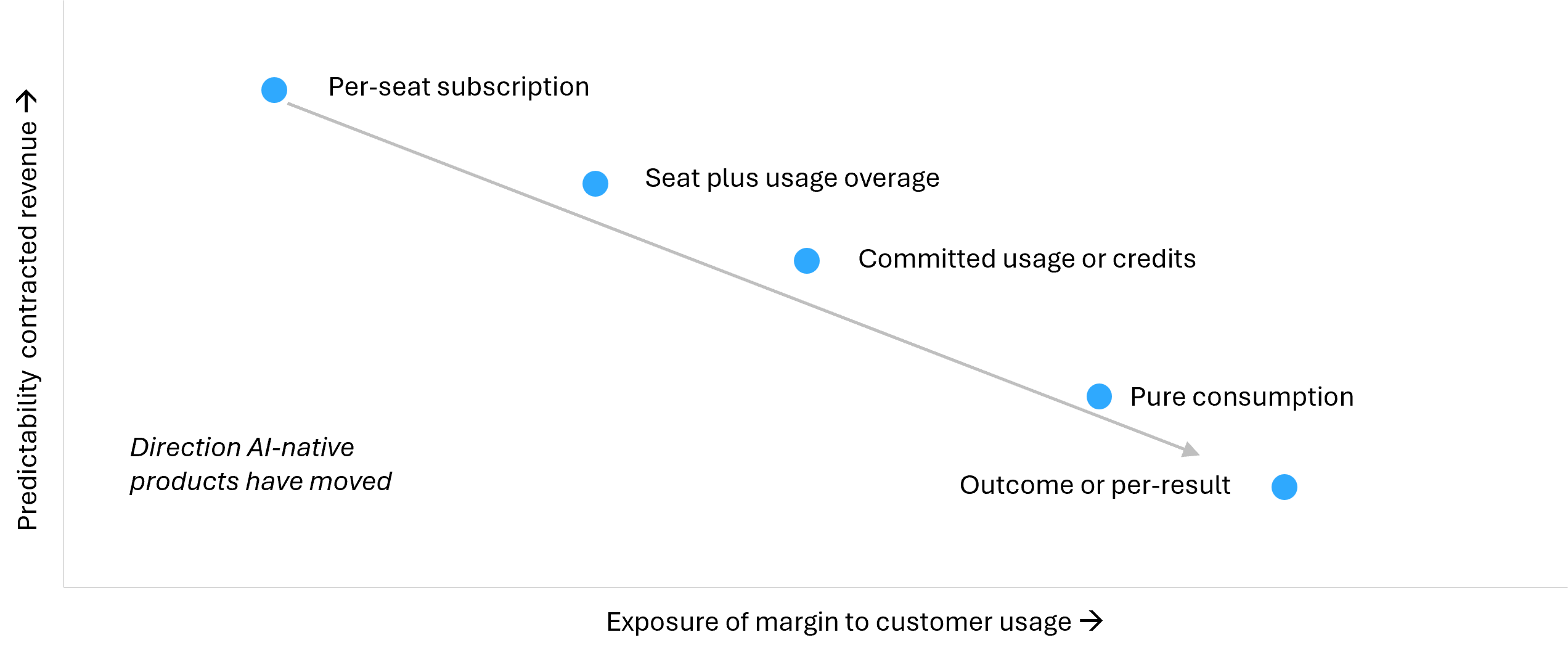
The subscription software model rests on an assumption that is quietly load-bearing: revenue is contracted in advance and costs very little to serve. AI products put pressure on both halves of that, and the market has responded by changing how software is priced.
Bessemer's work on AI monetisation describes the direction plainly, observing that AI-native companies are by and large abandoning seat-based SaaS pricing in favour of usage, workflow or outcome models. Andreessen Horowitz's read is consistent: AI-native companies have leaned towards usage, outcome or hybrid pricing while established vendors have mostly stayed with per-seat or bundled options. McKinsey's analysis of software business models in the AI era documents the same movement among incumbents, towards credit-based and action-based structures, and notes that only 16 percent of SaaS incumbents have commercialised AI as standalone products even as those that have report materially higher traction.
For a seller, none of this is a problem in itself. A business can be attractive on any of these models. What complicates a sale is being part-way between two of them without being able to show each stream separately, because a buyer then cannot tell how much of the revenue is contracted, how much is discretionary usage, and how either behaves if a customer's volumes move. Where a migration is under way, the useful thing to present is the split by model, by cohort, over time, so the trend is visible rather than asserted.
There is a second reason to show the split rather than the total. A pricing migration usually changes who the customer is as well as how they pay: seat-based contracts tend to sit with a procurement process and an annual renewal, while consumption revenue often grows or shrinks inside a month without anyone renegotiating anything. Those two revenue streams carry different risks and, to a buyer modelling five years forward, they are genuinely not the same asset. Presenting them as one line asks the buyer to assume the more conservative reading of both.
The related question is what belongs in your recurring revenue figure at all. Usage revenue that recurs in practice is not the same as revenue that is contracted, and an ARR definition that blends them will be unpicked. Our guide to ARR vs revenue vs SDE vs EBITDA covers why that distinction matters and how buyers tend to reconstruct it, and where annual prepayments are involved, deferred revenue in SaaS acquisitions interacts with it directly.
Friction Two: Gross Margin, and the Absence of a Benchmark
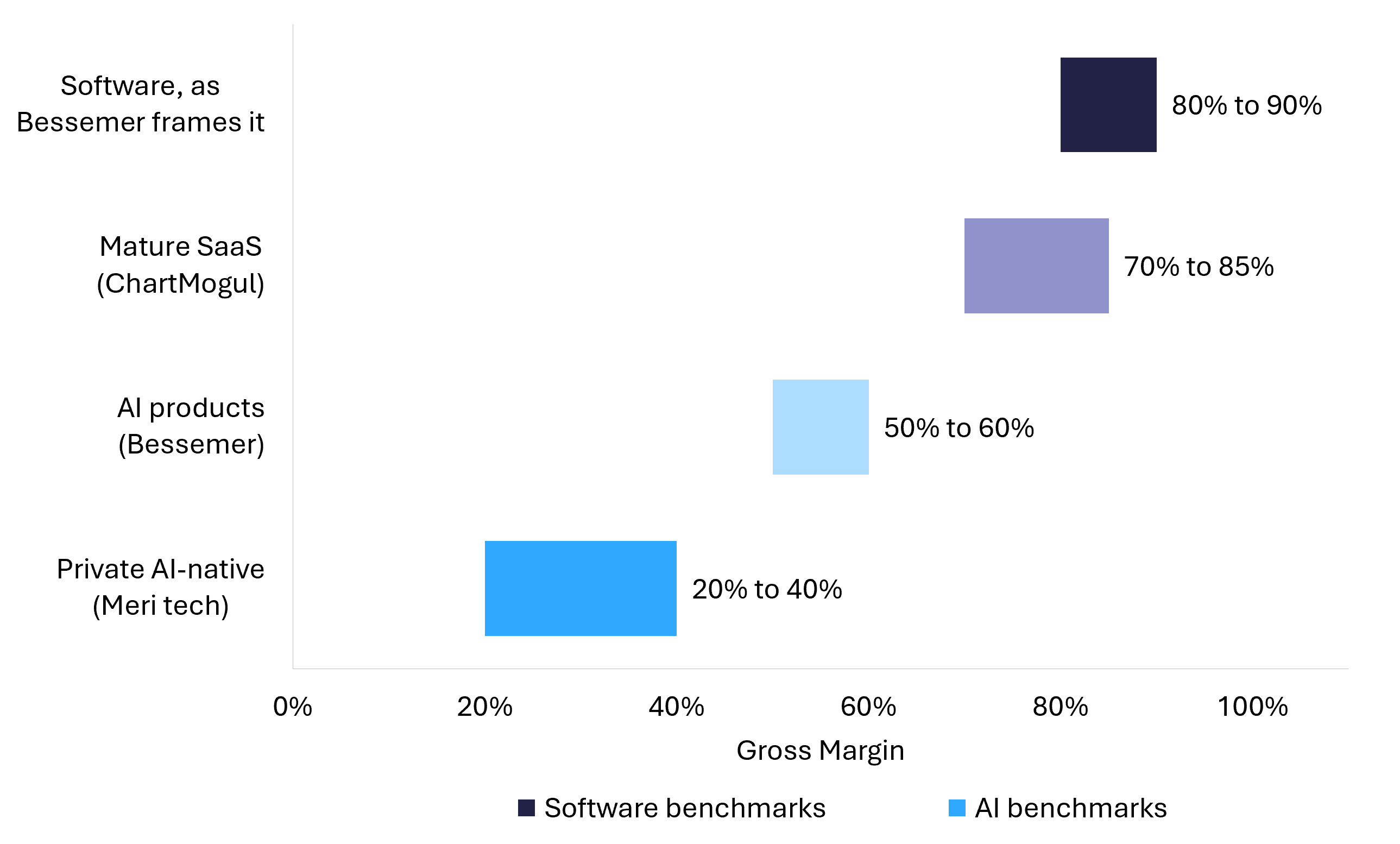
Gross margin is where the software reading and the AI reading collide most directly, and the honest starting point is that the published benchmarks do not agree with each other.
ChartMogul puts mature SaaS at 70 to 85 percent, and makes the point that matters underneath it: a company only recovers the margin it keeps, not the revenue it bills. Bessemer's monetisation work contrasts software at 80 to 90 percent with AI products at 50 to 60 percent. Meritech, writing in February 2026, puts private AI-native companies at 20 to 40 percent gross margins alongside very fast revenue growth. Those three AI-relevant figures do not overlap. They are measuring different populations with different definitions, and that is precisely the problem.
The practical consequence for a seller is liberating rather than discouraging. Because no settled benchmark exists, you are not being measured against one. You are being asked to produce your own number, fully loaded, with the components visible: model access and inference, hosting and compute, data costs, and any human-in-the-loop review that is doing work the product claims to automate. A business that can show that build-up, and show how it moves as volume grows, is in a stronger position than one quoting a favourable industry figure.
The cost side is also moving. Bain's analysis of AI effects on software economics describes variable costs entering a model that previously had very few, citing a high-growth company whose revenue rose 38 percent while costs rose 349 percent over the same period, largely on AI infrastructure. That is one company rather than a benchmark, and it illustrates the direction of the risk a buyer is pricing. Our guides to EBITDA add-backs and quality of earnings in tech M&A cover how the earnings questions around all of this are usually handled.
Friction Three: Which Retention Population You Belong To
Retention is the metric a software buyer reaches for first, and an AI SaaS business sits awkwardly between two very different reference points.
ChartMogul's analysis of roughly 3,500 software companies puts median B2B SaaS net revenue retention at 82 percent against 48 percent for AI-native companies on 2025 data, with gross retention for the AI-native group improving across the year from 27 percent in January to 40 percent in September. Those are two different populations, and the question a buyer is implicitly asking is which one your business resembles.
The answer is rarely rhetorical. It is cohort retention by signup period, over enough periods to show a trend, with logo and revenue retention separated. A fast-growing business can post strong headline numbers while older cohorts decay underneath, and blended averages hide exactly that. Our guides to net revenue retention and SaaS valuation and SaaS churn rate benchmarks set out what the evidence looks like when it is assembled properly.
There is a second-order point worth anticipating. On usage or consumption pricing, revenue retention and customer retention can diverge sharply: a customer who stays but reduces volume looks like retention in one measure and churn in the other. Presenting both, and explaining which customers moved in which direction and why, is more persuasive than a single figure. The related unit-economics questions are covered in our note on the LTV to CAC ratio benchmark buyers expect, and the lifetime assumption is harder to defend where usage is discretionary.
Friction Four: Which Comparable Set Applies
The three frictions above converge on one question that a buyer has to settle before they can price anything: is this a software company with AI features, or an AI company that happens to bill monthly?
The answer changes the comparable set, and the comparable sets are far apart. Meritech's February 2026 read of public software records the median public company's growth slowing to 16 percent year on year, the lowest in a decade, with the public software index trading at a fraction of its earlier levels, while AI-native companies in the same analysis carry very fast growth on much thinner margins. Those are not two points on one spectrum so much as two different business models being valued on different logic.
Most AI SaaS businesses genuinely sit between them, and the useful posture is to say so and then evidence where. A business with durable contracted revenue, software-like margins and compounding cohorts is making a software argument and should be compared accordingly. A business with thinner margins, consumption revenue and very fast growth is making a different argument, and should expect different buyers. Trying to claim both tends to invite scepticism about each.
It is worth saying what this does not mean. Sitting between the two populations is not a weakness, and a great many successful software businesses have sat between categories at the point of sale. What causes difficulty is ambiguity that the seller has not resolved for themselves, because a buyer confronted with a business that could be read two ways will generally price the less favourable reading and wait to be persuaded otherwise. Choosing a position and evidencing it is a stronger stance than leaving the question open in the hope that a buyer resolves it generously.
Buyer type follows from this more tightly than founders expect. A strategic acquirer may be buying a capability and can justify a number a financial model would not support. A private equity platform is usually underwriting recurring revenue and a path to a larger exit, which makes the contracted portion of your revenue the part they care most about. Our comparison of private equity, strategic and individual buyers sets out how those motivations diverge, and our note on why some SaaS companies sell for 10x ARR covers why headline outcomes are a poor planning anchor in either case.
What to Have Ready
Almost everything in a conventional software sale still applies, and our preparation checklist and note on what documents you need to sell a SaaS company cover that ground. Five additional items tend to earn their keep in an AI SaaS process.
Revenue split by pricing model, by cohort, over time, so a migration is visible as a trend rather than a complication. A fully loaded gross margin build-up with inference, hosting, data and any human review itemised, together with how unit costs behave as volume rises. Cohort retention separating logo from revenue, and separating seat-based from usage-based customers where both exist. A model and licence inventory covering every dependency and the terms attaching to it. And a short, honest statement of where the defensibility sits, with whatever evaluation evidence supports it.
That last item is worth a sentence more. The useful version is not a claim about moats but a description of what a competitor would have to assemble to reach parity, and how long it took you. Where the honest answer is that the advantage is partly timing, saying so with evidence of what has been built on top of it lands better than a stronger claim that diligence will test. Our note on what buyers look for in a SaaS acquisition in 2026 covers the general risk factors, and SaaS due diligence covers how the examination usually runs.
Where This Sits in the Wider Picture
Two contextual points are worth holding, neither of which changes what a particular business should do.
The first is that the buyer pool has broadened considerably, which our review of AI M&A trends in 2026 covers, and that buyers have become correspondingly better at distinguishing genuine AI-driven value from an AI feature attached to a conventional product. More interest and more scrutiny have arrived together.
The second is that depth in a specific industry has been attracting particular attention, which our case study on selling a vertical SaaS business illustrates. Where an AI SaaS business owns a workflow in a defined sector, the vertical depth is often as much of the story as the AI, and presenting it that way can be more persuasive than leading with the technology. The broader market backdrop is covered in our mid-year 2026 tech M&A report, and how growth and profitability are weighed together is covered in what the Rule of 40 is and how it affects valuation.
The structural work, margin clarity, retention evidence, pricing model coherence, belongs in exit planning a year or more ahead rather than in the weeks before a process, and how long it takes to sell a SaaS business covers why the preparation stages set the pace of everything after them.
Where This Leaves You
Knowing how to sell an AI SaaS business comes down to accepting that two readings of the same company are running in parallel, and that your job is not to argue for the more flattering one but to make either one answerable. Pricing model, loaded margin, cohort retention and comparable set are the four places they diverge. Each is a question of evidence rather than positioning, and each takes months rather than weeks to answer properly.
If you want a view of how your business currently reads before deciding anything, you can request a confidential valuation. FE International's AI industry team works across AI, data and software transactions, larger mandates are handled by the investment banking team, and you can read how the firm sells SaaS and technology businesses end to end.
