

What Happens to My Team When an AI Company Is Acquired?

Price comes up first, always. Then, usually in the same breath, somebody asks about the people, and that one tends to get a vaguer answer than it deserves.
So, plainly: what happens to my team when an AI company is acquired has less to do with the buyer's intentions than with a handful of things decided months earlier. Which names end up in the diligence papers. How much of the money arrives at close and how much arrives later. Whether there's an earnout sitting on somebody's shoulders. By the time your people hear about any of it, those calls have been made.
That's not an argument against selling. It's an argument for treating the team as part of what you design, instead of leaving it on the buyer's integration checklist.
The short answer
Most people keep their jobs through closing. Separation tends to show up later, across the first twelve to eighteen months, and it is uneven. Research by Daniel Kim, reported by MIT Sloan, tracked roughly 350,000 people who changed employer through about 4,000 high-tech startup acquisitions in US Census records. Within twelve months a third of them were gone. Among comparable people who had simply been hired, the figure was 12%.

Worth two caveats before anyone over-reads that gap: the sample is high-tech acquisitions generally rather than AI deals, and it stops in 2011, so treat it as a durable pattern and not a reading of this year. Kim's explanation, though, has held up better than the dates would suggest. People who pick small companies are usually picking autonomy and pace. An acquisition hands them a bigger organisation they had no say in choosing.
Who tends to stay, and who tends to move on
The pattern is not spread evenly. A Revelio Labs analysis of acquired companies found the highest departure rates in recruiting, with marketing, sales and administrative functions also high. Senior management at the acquired company came in near 20%. Middle managers showed relatively low rates.
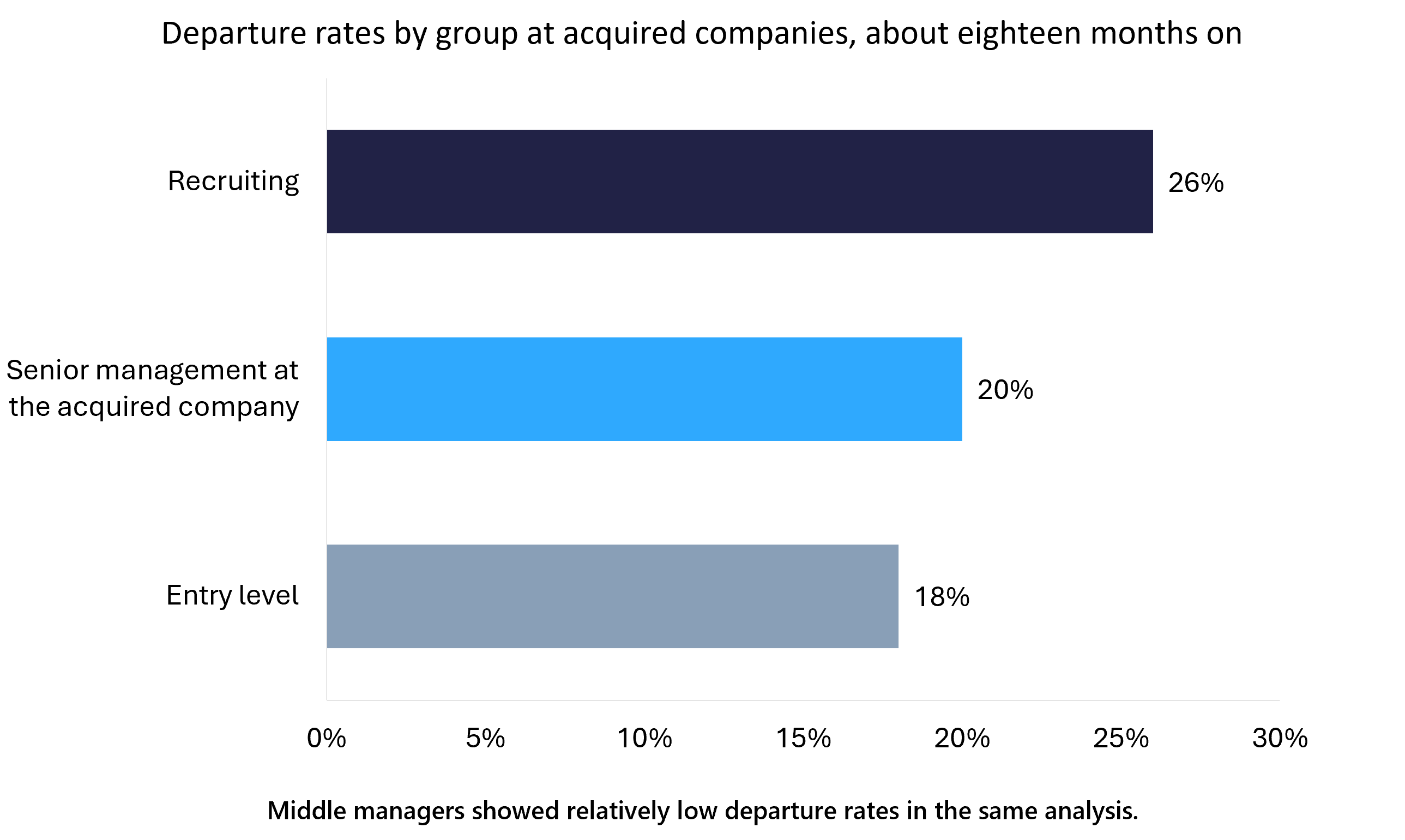
The logic behind that list is not mysterious. Wherever the buyer already has a function, there are now two of them: recruiting, finance, marketing operations, chunks of sales. Engineering and research rarely fall into that bucket, which is one reason they tend to be the quietest rows on the org chart in the months after a close.
Senior leaders sit in their own category. Some go because the job they signed up for no longer exists above them. Others see out a retention period and then take the next thing that comes along. A founder-CEO who becomes a divisional lead is doing a genuinely different job, and nobody on either side is really surprised when that gets tested.
Why AI deals handle teams differently
In most software transactions the product is the asset and the team maintains it. A good share of AI transactions invert that. The model, the data pipeline and the evaluation harness live in a small number of heads, and the buyer is underwriting those heads as much as the code. Our note on what drives AI M&A activity covers the buyer-side logic, and how to value an AI business goes through what that concentration does to a valuation.
The clearest illustration sits in the reverse acquihire structures of the last two years. A paper by Justine Haekens submitted to the Digital Competition Conference walks through five of them. In each case an incumbent hired the founders and key technical staff and licensed the technology, leaving the company itself in place. At Google and Character AI, 30 of about 130 employees moved; the remainder received cash and equity and the company carried on under employee ownership. Amazon and Adept saw the co-founders and roughly two-thirds of staff transfer. Microsoft and Inflection left two people behind.
Those are headline cases, not the median outcome for a profitable AI business with customers and revenue. They still matter, because they show what the market pays for when the people are the product. And the same force cuts both ways: whatever makes a handful of people extraordinarily valuable makes everyone else easier to leave out of the structure. Which is just key person risk in a business sale wearing a newer suit, and better dealt with before a buyer brings it up.
The deal terms that actually decide it
Four mechanisms carry most of the weight. Retention agreements, earnouts, management carveouts and equity rollover. Each of them is negotiable, and each one tends to be negotiated by people thinking about something other than your team.
Start with retention agreements. The WTW M&A Retention Survey found 72% of companies either track or set aside fixed retention payments. C-suite executives and their direct reports are far more likely to be offered one than everyone else. Only 19% of respondents selected more than a fifth of their other salaried staff.

They appear to work. Deloitte reports that voluntary attrition rises by over 30% during a transaction, and that fewer than 5% of employees given a financial retention award leave before it vests. Deloitte's own advice is to tie awards to milestones such as knowledge transfer rather than to the calendar, and to stagger payments where the period runs long.
For the other three, the transaction data is more useful than anyone's opinion. The 2026 SRS Acquiom Deal Terms Study runs across more than 2,300 private-target acquisitions, and Fasken's summary of it puts earnouts in 24% of 2025 deals, median potential 34% of the closing payment, 38% of them running one to two years. Management carveouts turned up in 4.3%. Deal size moves that number a lot: 7.6% at $50m or below, 1.3% above $100m. Cash plus management rollover made up 21% of consideration structures, three points up on the year before.

FE International's framing. Term availability and typical treatment vary by buyer, deal size and jurisdiction.
What you can settle before signing
Different buyers approach people differently, and our comparison of private equity, strategic and individual buyers goes through how each tends to treat an acquired team. Whichever you end up with, these are the points worth raising while you still have leverage, which is before the terms are agreed rather than after.
- Who ended up named? Diligence produces a shortlist of people the buyer treats as load bearing, and that list quietly drives retention, earnout and employment terms all at once. Ask to see it.
- What is the plan for everyone else? A short list is perfectly normal. A short list with nothing behind it is usually where those first-year departures come from.
- Who pays for the retention pool? Money that comes out of the purchase price and money the buyer puts in on top are two very different outcomes for selling shareholders, and the difference hides easily inside a headline number.
- How is unvested equity treated? Awards can be assumed, converted, partly accelerated or cashed out, and the answer sits in the plan documents rather than in anybody's intentions. Somebody on your team will ask on day one. Have counsel's answer ready before then.
- If there is an earnout, what control comes attached to it? Targets handed over without the budget, the headcount or the roadmap authority to reach them are a well-known source of friction, and the person carrying that risk usually sits on your side of the table.
- Who tells the team, in what order, on which day? Write it down. Our guide to keeping a business sale confidential covers the stretch before that, when there are good reasons for the circle to stay small.
The order things happen in
Founders tend to picture the team question arriving with the announcement. The announcement is actually one of the last things to happen, long after the decisions it communicates were taken.

Which means preparation shifts the outcome further than negotiation ever will. Documented processes. Engineers cross-trained on each other's work. A founder who is no longer the only person able to explain the training pipeline. Each of those makes the buyer's dependency look less concentrated than it otherwise would. Our checklist for preparing a business for sale and the due diligence checklist buyers work from both cover the ground, and the timeline of a typical sale shows where in the calendar each stage sits.
The first hundred days
Reporting lines change. So does the tooling, usually more disruptively than anyone budgeted for, and then somebody reopens compensation design. Writing in Harvard Business Review, Mina Milosevic, Katherine Rau and Lisa Steelman make the point that enormous effort goes into pre-deal diligence and comparatively little into what the following Tuesday feels like for the people who arrived with the deal. Their fixes are unglamorous. Assess the culture properly. Map the employee journey through integration. Let mid-level leaders actually steer their own teams. Stay flexible once the plan meets reality.
One lever here costs considerably less than a retention bonus. Mercer's Global Talent Trends 2026 found 63% of employees would trade a 10% pay rise for AI and digital upskilling, and 62% think leaders underestimate how AI lands on people emotionally. WTW's respondents put enhanced career opportunities top of their non-monetary tactics, cited by 62% for salaried staff. For engineers who have spent three years at the front edge of the technology, where their career goes next is often the live question, and a buyer can answer it cheaply. Someone just has to think to ask.
Treat the team as part of the structure
The founders who get the best outcomes here are not the ones who negotiated hardest at the end. They are the ones who knew, before the process started, which three people a buyer would fixate on and what they wanted for them. What happens to my team when an AI company is acquired turns out to be a question you answer largely in advance.
A reasonable place to start is a sober read of where the dependencies sit. Our pillar on how to sell my SaaS business covers the wider process, the step-by-step guide for founders runs through the stages in order, what multiple does a SaaS business sell for sets expectations on value, and net revenue retention and valuation covers the customer side of the same question. For context on the AI market specifically, the AI valuation model and our mid-year tech M&A report are the current references.
FE International has completed more than 1,500 transactions since 2010 with a 94.1% success rate on private sales and acquisitions, and team outcomes come up in nearly every one of them. If you want a view on how your own dependencies would read to a buyer, a business valuation is the usual first step. Our notes on choosing an M&A advisor and what happens after you sign with an advisor cover what the process looks like from there, and you can open a conversation about selling your business without committing to anything.
What happens to my team when an AI company is acquired is worth working through early, while the answer is still yours to shape.
