


Key-person risk is the share of a business’s revenue, decisions and knowledge that runs through one individual, usually the founder. Buyers price it directly. High dependence lowers the multiple, shifts money out of cash at close into escrow and earnouts, and lengthens the transition you are asked to commit to after closing.
Every technology business has some of this. The founder who wrote the first version of the product usually still knows it better than anyone. The founder who closed the first fifty customers is usually still the person the biggest account calls. None of that is a flaw. It is what building a company looks like. The problem starts at the moment you decide to sell, because the buyer is not paying for what the business produced while you ran it. They are paying for what it will produce after you stop.
That gap is measurable, and it is the single largest avoidable discount in lower and middle-market technology M&A. It is also fixable on a shorter timeline than most sellers assume. This guide covers how buyers find owner dependence in diligence, what it costs in price and structure, how to score your own exposure across five areas, and a twelve-month plan that turns each fix into an artifact a buyer can verify. If you are 6 to 24 months from a process, you have enough runway to change the answer.
What is key-person risk in a business sale?
Key-person risk is the risk that the business’s performance depends on a specific individual continuing to show up. In an M&A context it has a narrower, more useful definition: it is the portion of future cash flow a buyer cannot underwrite because the person generating it is leaving.
It is worth separating it from operational risk, because buyers treat the two differently. Operational risk is about the system: churn, margin volatility, platform dependency, security posture. It is diffuse, and buyers price it into the multiple. Key-person risk is concentrated in one node, which makes it both more dangerous and more solvable. A buyer cannot fix your churn in ninety days. They can, in principle, replace a person. What they cannot do is replace someone whose knowledge was never written down, whose relationships were never introduced, and whose judgement was never encoded in a process.
The evidence that this matters is not anecdotal. Harvard Business Review reported in early 2026 that founder-CEO transitions carry a risk of failure or performance downturn two to three times greater than transitions involving non-founder CEOs. Buyers know this. When they look at a founder-led business, they are underwriting the hardest kind of leadership handover there is, and they price accordingly.
The encouraging part is that dependence is a condition, not a verdict. It is one of the few diligence findings a seller can materially improve before going to market, and the improvement shows up in both the headline number and the terms.
Buyers do not pay for the business you built. They pay for the business that runs without you.
How do buyers detect owner dependence in due diligence?
Buyers do not ask whether you are essential. They ask questions whose answers reveal it, and then they cross-check those answers against documents. Diligence has also become faster and more forensic: Deloitte’s 2026 study of generative AI in M&A found 90% of organisations now use the technology somewhere in the deal cycle, with 49% applying it at deal closing and 52% in post-close integration. Compressed timelines mean fewer months of diligence but more pointed questions per week, and documentation answers those questions faster than assurances do.
Five areas carry almost all of the signal.
Sales and customer relationships
The buyer will ask for a list of your top accounts and then ask who at your company each of them has spoken to in the last twelve months. If your name is the only one on the list, the revenue is attached to you rather than to the business. They will also read the CRM: whether opportunities are logged by other people, whether anyone else runs renewals, whether pricing exceptions all route to one approver. On a reference call they will ask the customer directly why they renewed. The answer tells them everything.
Product and roadmap decisions
They will ask who decides what gets built. If every prioritisation call, every pricing change and every architectural decision traces back to one person, the buyer is acquiring a product with no decision-making layer. They will look for written roadmap documentation, evidence of a product function that operates on a cadence, and prior decisions made and executed while the founder was uninvolved.
Supplier, platform and partner relationships
Handshake arrangements are common in founder-led businesses and they do not survive diligence well. Buyers check whether key vendor terms, reseller agreements, data providers and platform relationships are written, assignable and free of change-of-control triggers. A preferential rate that exists because of a personal relationship is a rate the buyer assumes they will lose.
Technical knowledge
For technology businesses this is the deepest area and the one covered in the next section. In short, the buyer wants to know whether anyone other than the founder or one senior engineer can deploy, debug, restore and extend the system.
Decision rights and daily operations
The simplest test buyers run is the absence test. What happens if you are unreachable for thirty days, then ninety? They will ask your team, not you. If the answer involves waiting for your approval on hiring, pricing, refunds or escalations, the business has a single point of failure regardless of what the org chart says.
A quality of earnings review surfaces much of this alongside the financial work, which is why commissioning one before you go to market is worth doing. It is better to find these answers yourself than to have a buyer find them in week three of exclusivity.
Why is key-person risk different in technology company sales?
Software has a measurable version of this problem, and technical diligence teams now compute it. The metric is the bus factor: the minimum number of engineers who would have to leave before a project stalls. A bus factor of one means a single person’s knowledge is load-bearing.
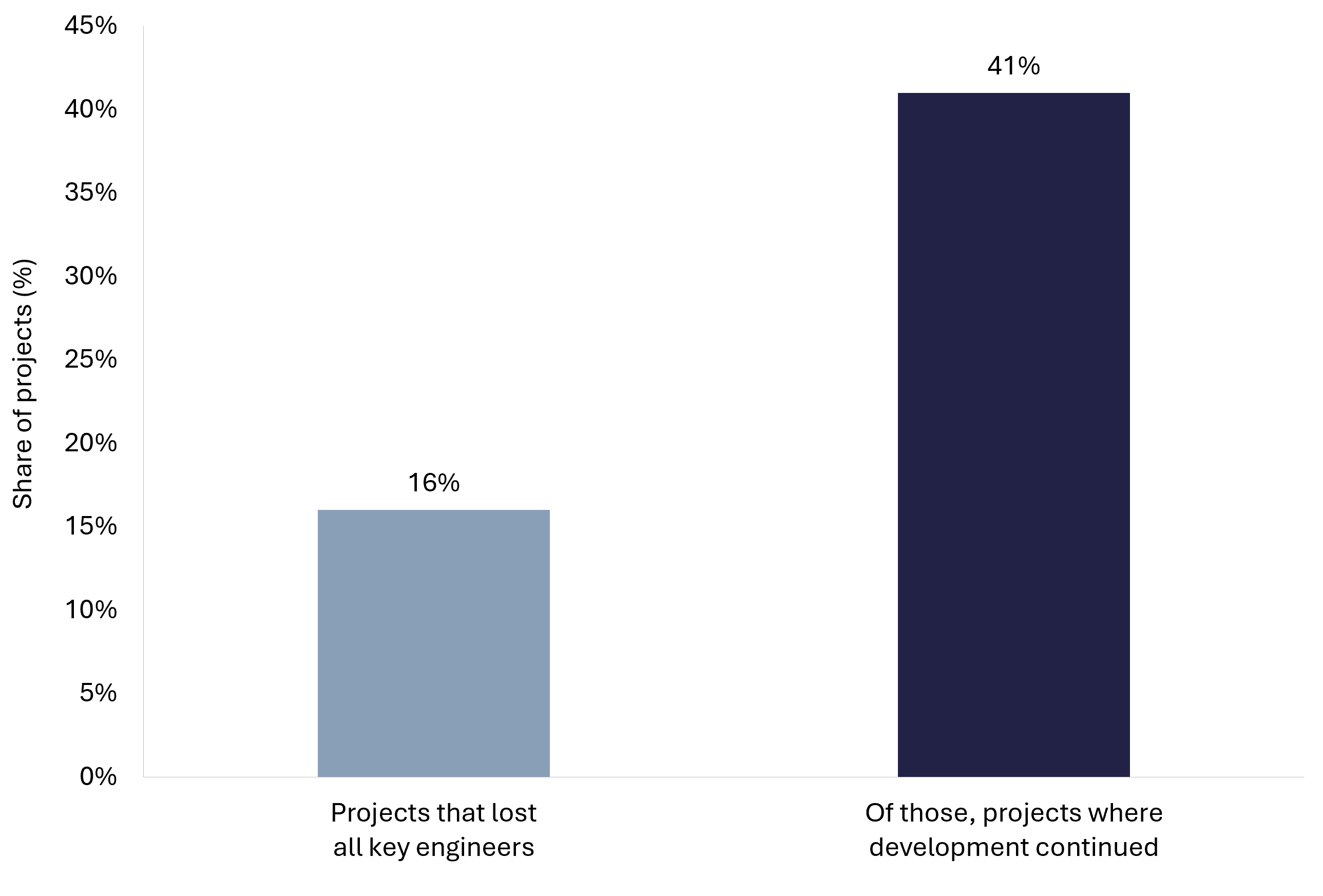
The research is sobering and specific. A study published at the International Conference on Software Engineering examined 1,932 software projects and found that 16% had faced the departure of all their key engineers. Development continued afterwards in only 41% of those cases. The same paper surveyed 269 professional engineers, who ranked concentrated knowledge as the most impactful collective development problem of the seven they were asked about, ahead of missing documentation and unclear responsibility. Recovery, where it happened at all, sometimes took up to six person-months, and some subsystems had to be rewritten from scratch.
One finding from that survey matters more than the rest for anyone planning an exit: engineers reported that knowledge about a given piece of code halves in roughly four months. Technical understanding is not a permanent asset sitting in someone’s head. It decays, including in the head of the person who wrote it. That is the argument for documenting early rather than during diligence, when you are least able to spare the time.
Technology sellers carry three dependencies that non-technical businesses do not:
- Codebase ownership. If commit history shows one author across the critical services, the buyer assumes rebuild cost and prices it.
- Infrastructure and access. Cloud accounts, deployment pipelines, domain registrations, secrets management and third-party API keys held under one person’s credentials are a continuity problem before they are a security problem.
- Undocumented architecture. Systems that work but that nobody can explain, and changes the team avoids making because the outcome is unpredictable.
This scrutiny sits inside a broader shift. PwC’s 2026 mid-year outlook notes that AI is accelerating diligence and valuation work while human judgement still decides the outcome, and that buyers are reassessing software with more care than they applied two years ago. More careful buyers reward businesses that can be explained. A codebase with distributed ownership and current documentation is exactly that, and it is one of the clearer ways a prepared seller stands out.
What does owner dependence actually cost in price and terms?
It shows up in four places, and the last three matter more than sellers expect because they determine how much of the headline number you actually receive.
The multiple
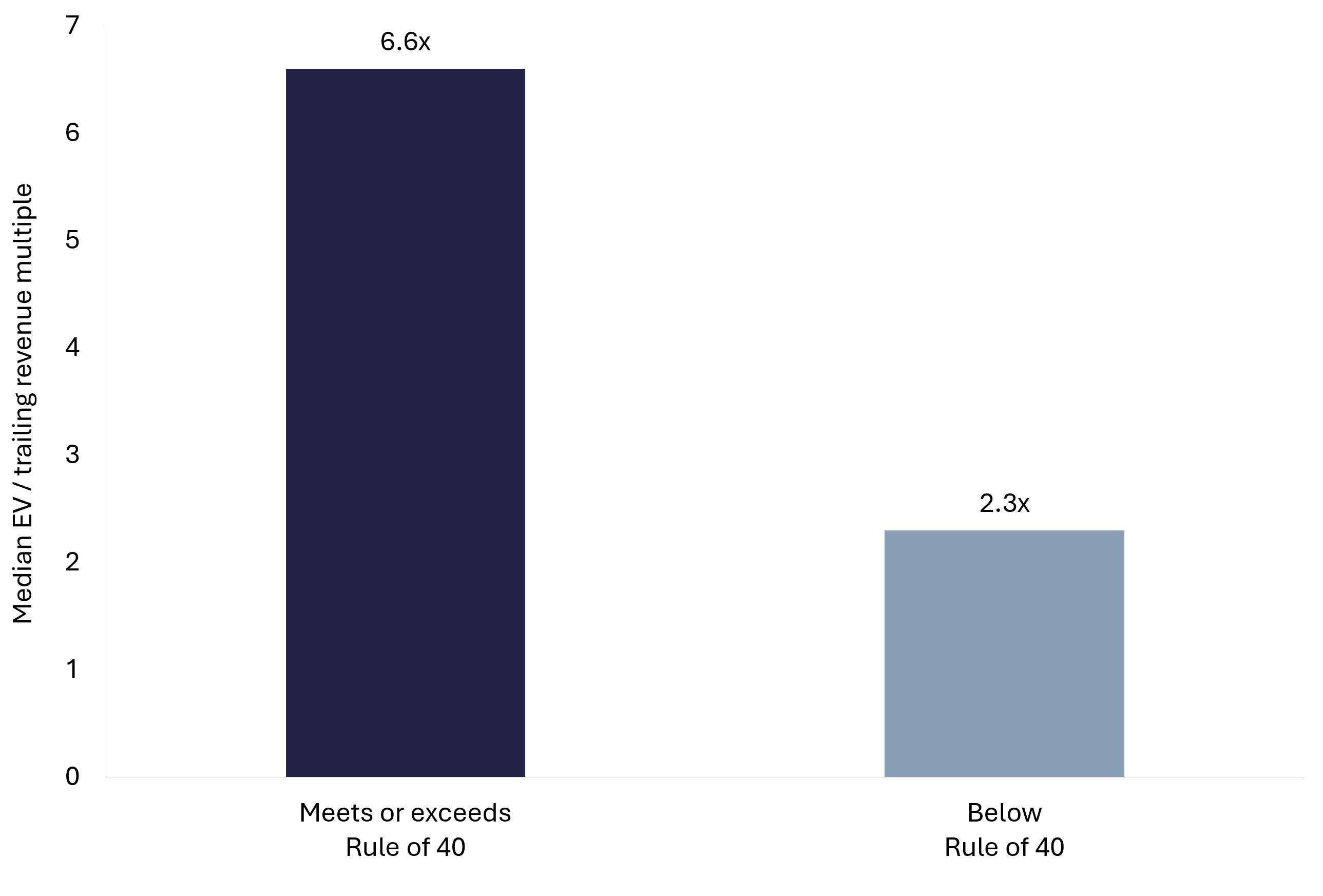
Buyers apply a company-specific adjustment for transferability. The size varies by business and buyer, and any advisor quoting you a fixed percentage is guessing. What is measurable is how sharply the market now separates businesses it can underwrite from those it cannot. PitchBook’s Q2 2026 enterprise SaaS analysis found companies meeting or exceeding the Rule of 40 trading at a median 6.6x trailing revenue, against 2.3x for those below it. That spread is about durability of performance, and a buyer who believes performance depends on a departing founder does not credit the business with durability.
Cash at close versus deferred consideration
This is where dependence bites hardest. A buyer who is confident the business runs itself can pay more of the price at closing. A buyer who is not will hold money back through earnouts, escrows and holdbacks until the business proves it survives your departure. Two identical headline valuations can deliver very different outcomes depending on how much of the money is contingent and how long you wait for it.
The length of your commitment
The more dependent the business, the longer the transition period a buyer requires and the more of it they want full-time. Founders routinely underestimate this term when comparing offers. A higher headline price that binds you to the business for two years post-close is not obviously better than a lower one that releases you in six months, and it is worth modelling both before you decide.
The size of the buyer pool
Some buyers simply pass. Financial buyers without an operating partner to install, and individual acquirers who intend to run the business themselves, both need to see a business that functions without its founder. Fewer bidders means less competitive tension, and competitive tension is what produces premium outcomes. This is one of the practical reasons running a process without an advisor is harder than it looks: a narrow buyer pool is difficult to widen once a process is underway.
There is a financing dimension too, and it is more concrete than most sellers realise. Under the SBA’s current lending rulebook, SOP 50 10 8, lenders must obtain life insurance covering the collateral shortfall for principals of sole proprietorships, single-member LLCs, and for businesses otherwise dependent on one owner’s active participation, where the loan is not fully secured. The federal government’s own small business lending standard contains a formal test for owner dependence. Failing it adds a condition to your buyer’s financing, which adds time, and time is where deals lose momentum.
How dependent is your business? A five-area self-assessment
Score each area from 0 to 4, where 0 means the function runs without you and 4 means only you can do it. Answer as your team would answer, not as you would like the answer to be. Then total the five scores.
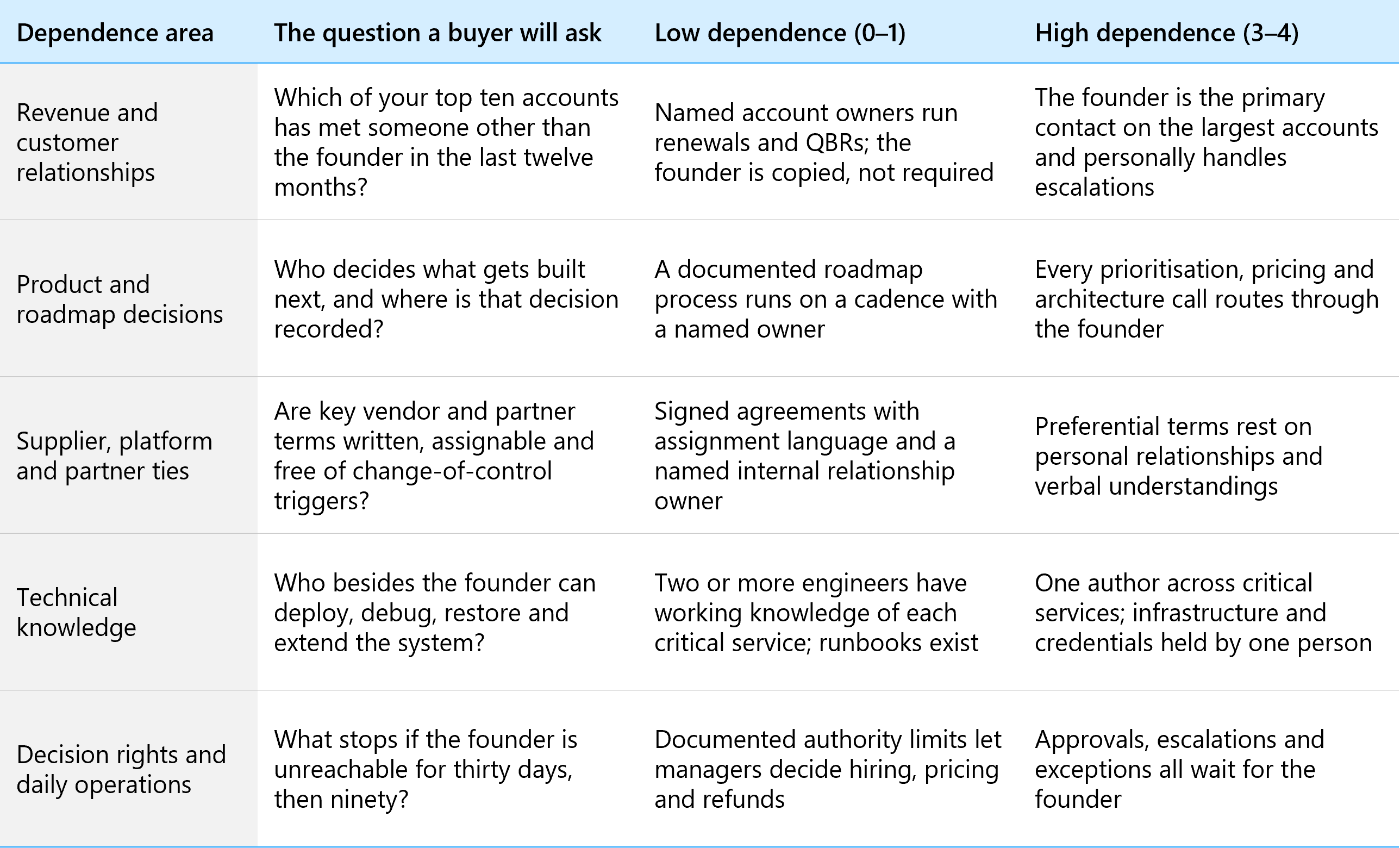
Reading your score. 0 to 5 is low dependence and a genuine asset in a process, worth evidencing in your materials. 6 to 10 is moderate, normal for a founder-led business, and largely fixable inside a year. 11 to 15 is significant: expect deferred consideration and a longer transition unless you address it before going to market. 16 to 20 is high, and the honest advice is to spend twelve months on the work below before starting a process, because the value created will exceed anything a negotiation can recover.
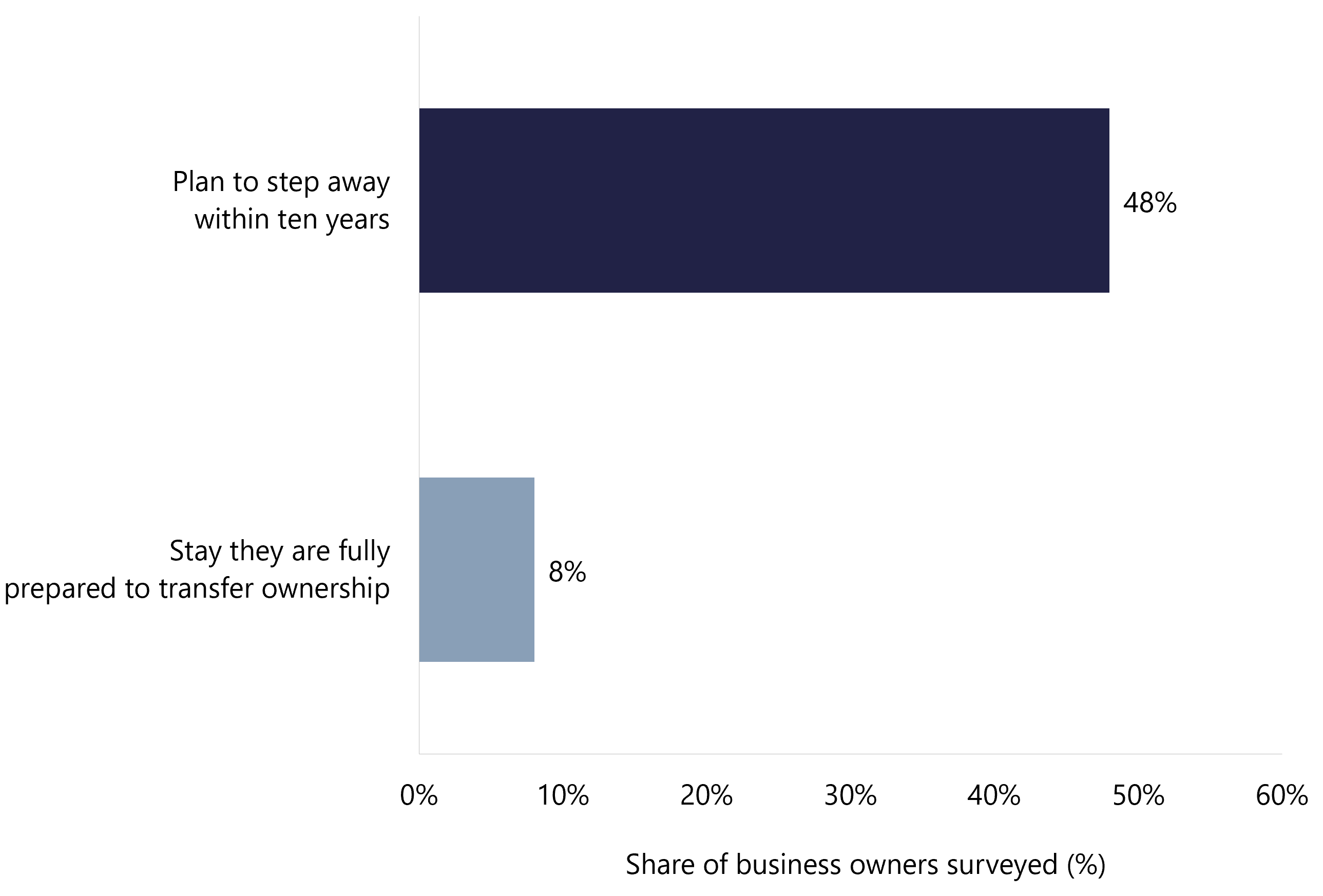
Most owners score higher than they expect, which is normal rather than alarming. Gallup research published in 2026 found roughly a third of US business owners have no plan or are unsure about what happens to their business after they step away. A Chase survey of about 1,000 owners conducted in March 2026 found that while nearly half expect to step away within the next decade, only 8% describe themselves as fully prepared to transfer ownership. The same survey found owners who engage an outside expert are far more likely to move beyond the earliest planning stages.
What is the 12-month plan to reduce founder dependency?
The work divides into four streams that run in parallel: documentation, leadership depth, relationship transfer and automation. What makes the plan credible to a buyer is that each stream produces an artifact they can inspect. A claim that the business runs without you is worth nothing in diligence. A dated runbook, a signed account-ownership map and six months of board minutes you did not chair are worth a great deal.
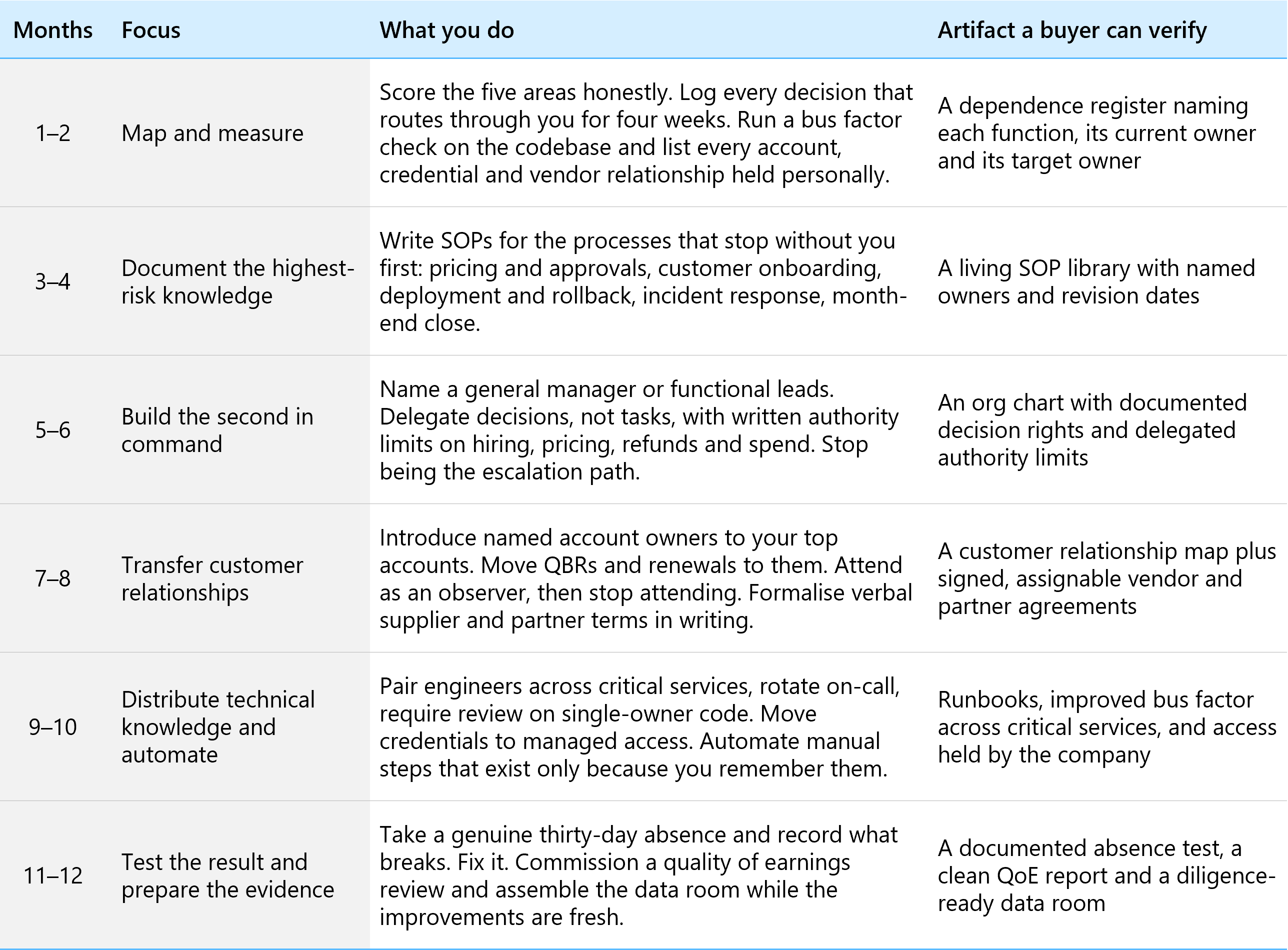
Two notes on execution. First, the absence test in months 11 to 12 is the part founders skip and the part buyers find most persuasive, because it converts an assertion into evidence. Second, sequencing matters more than speed. Documentation before delegation gives your team something to work from; delegation before documentation just moves the bottleneck.
This is also the work that makes integration go well, which is why sophisticated buyers pay for it. McKinsey’s research on merger integration emphasises that value is captured or lost in how the combined company actually runs, with early clarity on leadership and decision-making governance among the priorities that separate value capture from value dilution. A target that arrives with documented processes and a functioning leadership layer removes most of that risk on day one. Structured exit planning support can compress this timeline considerably, particularly on sequencing and on knowing which artifacts buyers actually ask to see.
What changes in the deal when dependence drops? A worked example
The following is an illustrative composite rather than a specific transaction, built to show how the same business can receive two different structures twelve months apart. Consider a B2B vertical SaaS company with $4.2M ARR, growing 14%, with a 26% EBITDA margin. Its Rule of 40 score is exactly 40. The founder runs product, owns the top eight accounts personally and is the only person who has deployed to production in two years.
Month 0, before any work. An unsolicited indication arrives at 4.0x ARR, or $16.8M. The structure reflects what the buyer cannot underwrite: $10.1M cash at close, $2.0M in escrow, and $4.7M in an earnout running thirty months. The founder is asked for twenty-four months full-time post-close. Sixty percent of the headline number is available at closing; the rest depends on performance the founder is contractually required to deliver.
Month 12, after the plan. ARR has grown to $4.8M. More importantly, a general manager runs the business, six of the eight major accounts have a named owner who is not the founder, three engineers deploy regularly, and a thirty-day absence test passed with two minor issues that were fixed. The business goes to market properly and attracts competing bidders. The winning structure is 4.5x ARR, or $21.6M: $17.7M cash at close, $1.3M escrow, and a $2.6M earnout over twelve months, with a six-month part-time transition.
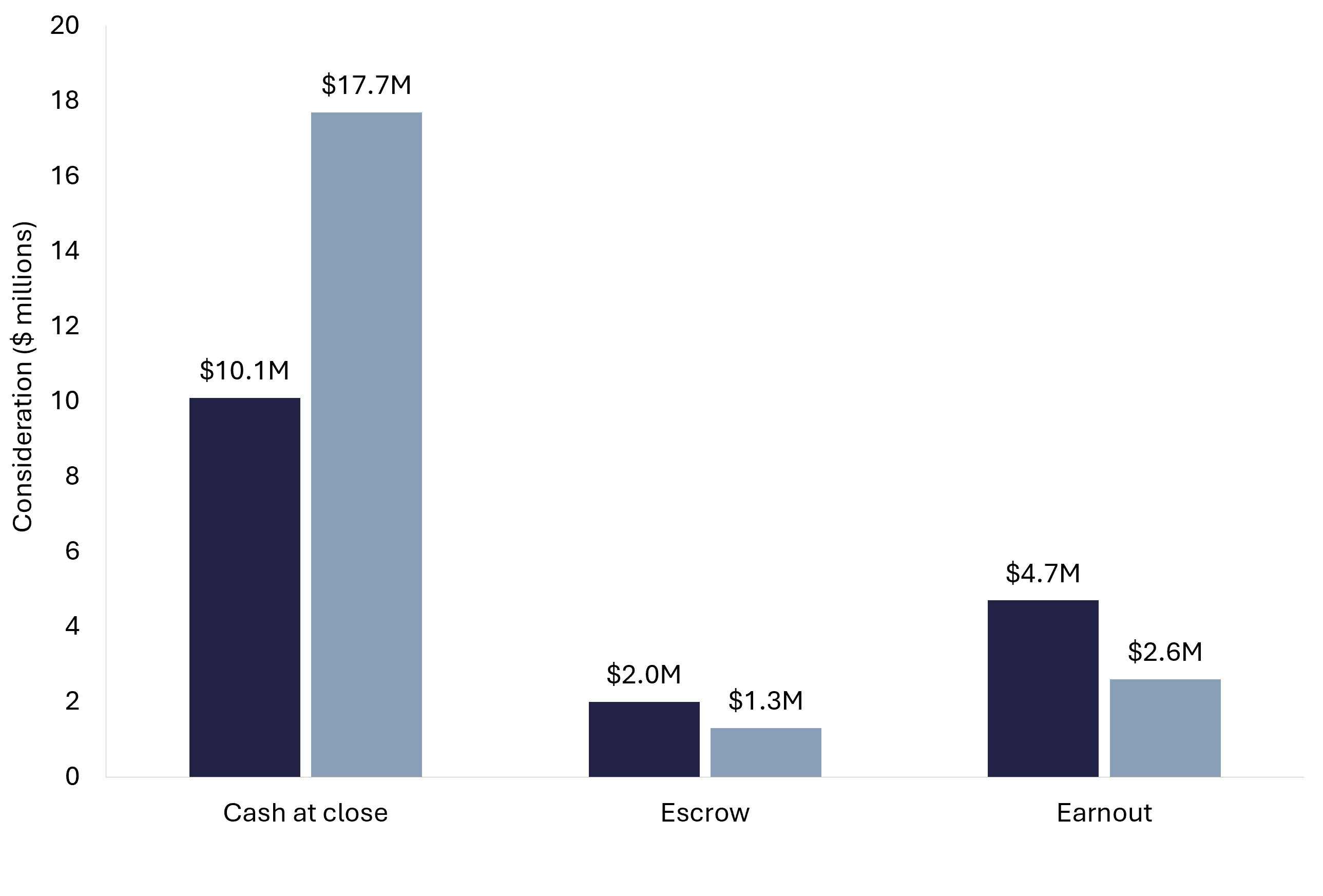
The headline price rose by $4.8M. Cash at closing rose by $7.6M, which is the number that matters, because it is money received rather than money hoped for. The earnout period shortened by eighteen months and the founder’s commitment fell from two years full-time to six months part-time. Some of the gain came from ARR growth over the year. The half-turn of multiple expansion, the shift from 60% to 82% cash at close, and the shorter commitment came from transferability.
That distinction is worth sitting with. Growth improved the headline. Reduced dependence improved everything about how and when the money arrived, and what the founder had to give up to receive it.
The effect continues after closing. An earnout tied to a business that already runs without its founder is one the founder is far more likely to collect, because performance no longer depends on their personal capacity to keep delivering through an integration. Sellers who reduce dependence before a process tend to be paid more, paid sooner, and paid more completely.
Where do key-person insurance and non-competes fit in?
These are containment tools rather than solutions. They allocate the risk of dependence between the parties. They do not remove it, and no buyer treats them as a substitute for a business that functions.
Key-person insurance
A policy on a critical individual, payable to the company, gives a buyer and their lender a financial backstop against death or disability. It does not protect against the much more common scenario, which is the founder losing interest twelve months into an earnout. Where it becomes decisive is in financing. As noted above, the SBA’s current rulebook requires lenders to take life insurance covering the collateral shortfall where a business depends on one owner’s active participation and the loan is not fully secured, so for deals in that size range the policy is often a closing condition rather than a nice-to-have. Putting one in place early removes a source of delay.
Non-competes and the 2026 legal position
The federal picture settled during 2026. The FTC’s Non-Compete Clause Rule was struck down in court and, effective 12 February 2026, formally removed from the Code of Federal Regulations. There is no nationwide ban, and enforceability is governed by state law, which varies widely. What has remained consistent throughout is the sale-of-business exception: non-competes given by a seller in connection with a bona fide sale of a business have always been treated more favourably than employment non-competes, including under the vacated rule and in states that otherwise restrict them heavily.
For sellers this means the restrictive covenant you sign at closing is likely to be enforceable, and it is one of the least carefully negotiated documents in the transaction. Scope, duration and geography are worth the same attention as the price. So are non-solicits covering both customers and employees, which buyers increasingly rely on where non-competes are constrained.
Retention packages for the people who are not you
If a non-owner engineer or account lead is load-bearing, the buyer will want them locked in. Retention bonuses, equity rollover and stay-bonus pools are all standard. The point sellers miss is that these are usually funded out of the purchase price. Every person the buyer feels they must retain with cash is a claim on your proceeds, which is a further argument for spreading knowledge rather than concentrating it in a second person.
None of this changes a favourable backdrop. Bain’s Global M&A Report 2026 recorded global deal value rising 40% to $4.9 trillion in 2025, the second-highest on record, with 80% of surveyed M&A executives expecting to sustain or increase activity in 2026. Deloitte’s 2026 M&A Trends Survey of 1,500 corporate and private equity leaders points to particular opportunity in small and mid-sized deals. Capital is available and buyers are active. They are also more selective, which means preparation is what converts that demand into a premium outcome. Our mid-year 2026 technology M&A report covers the current buyer pool and where demand is concentrated in more depth.
Turning transferability into price
The question underneath every diligence request is the same one, asked in different ways: what happens to this business when you leave? You will answer it whether you prepare or not. The only variable is whether the answer comes from documentation you built deliberately or from a buyer’s assumptions filled in during exclusivity, when your leverage is at its lowest.
Score yourself across the five areas this week. Pick the highest score and start there. Twelve months of unglamorous work on documentation, leadership depth, relationship transfer and automation changes what a buyer is willing to pay, how much of it arrives at closing, and how quickly you get your life back afterwards. It also produces a better business to run in the meantime, which is a reasonable consolation if you decide not to sell at all.
Find out what your business is worth today. FE International has advised on more than 1,500 technology transactions with a 94.1% success rate. Get a free valuation and a confidential read on where owner dependence sits in your business before a buyer forms their own view.