

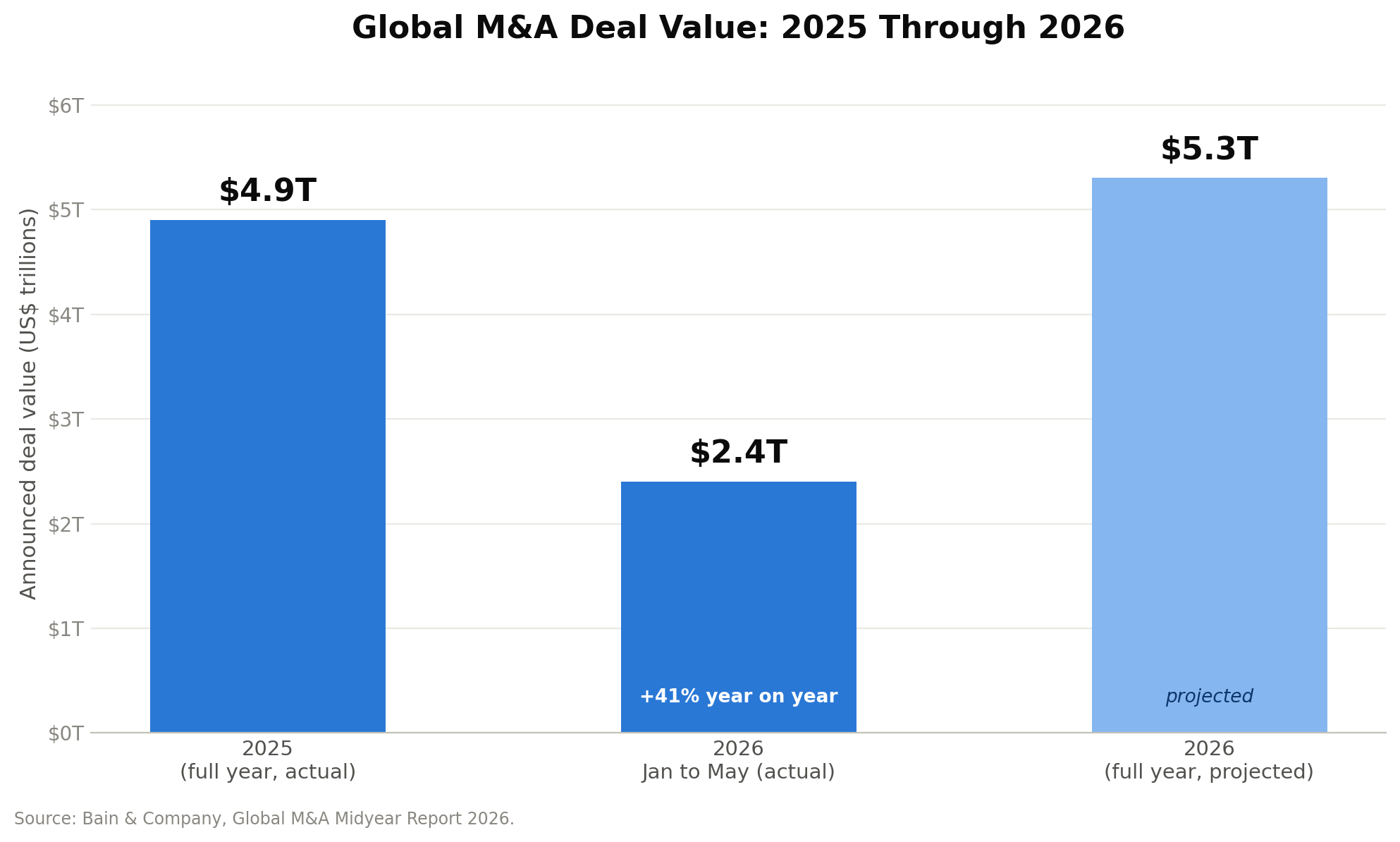
If you are working out how to sell a SaaS business, start with the demand side, because it is in your favour. Software is where the money is going. Gartner puts worldwide software spending at $1.468trillion in 2026, growing 15.5% year on year, and that spending is what acquirers are buying exposure to when they buy your company. On the deal side, Bain reported $2.4 trillion of global M&A in the first five months of 2026, a 41% increase year on year, with full-year value projected to reach $5.3 trillion.
So the demand is real. What most founders underestimate is how much of the final number they control. Two SaaS companies with identical revenue and identical Rule of 40scores can trade at very different multiples, and the gap comes down to growth composition, retention quality, and how well the business is packaged before buyers see it. That is the part you can influence, and it is what this guide is about.
Below is the full process: how buyers arrive at a number, which metrics get stress-tested, the eight stages of a sale and roughly how long each takes, how to prepare in the twelve months before you go to market, who the buyers actually are, and how deal structure and tax treatment change what you keep. If you want the shorter commercial route instead, FE International's team handles SaaS sales end to end.
What Your SaaS Business Is Actually Worth
A SaaS valuation is a multiple applied to an earnings or revenue base. Which base depends on size and profile. Smaller, owner-operated SaaS companies are usually valued on a multiple of seller's discretionary earnings or EBITDA. Larger, growth-stage companies are valued on a multiple of annual recurring revenue, because a buyer expects to fund growth rather than take out profit.
The multiple is where the real variance sits. Meritech's public software index put the medianimplied ARR multiple at 3.7x as of 1 May 2026, with 73% of public software companies trading below 5x EV to next-twelve-months revenue and only eight above 10x. Private company multiples are set by reference to those public comparables, adjusted for size, concentration and growth.
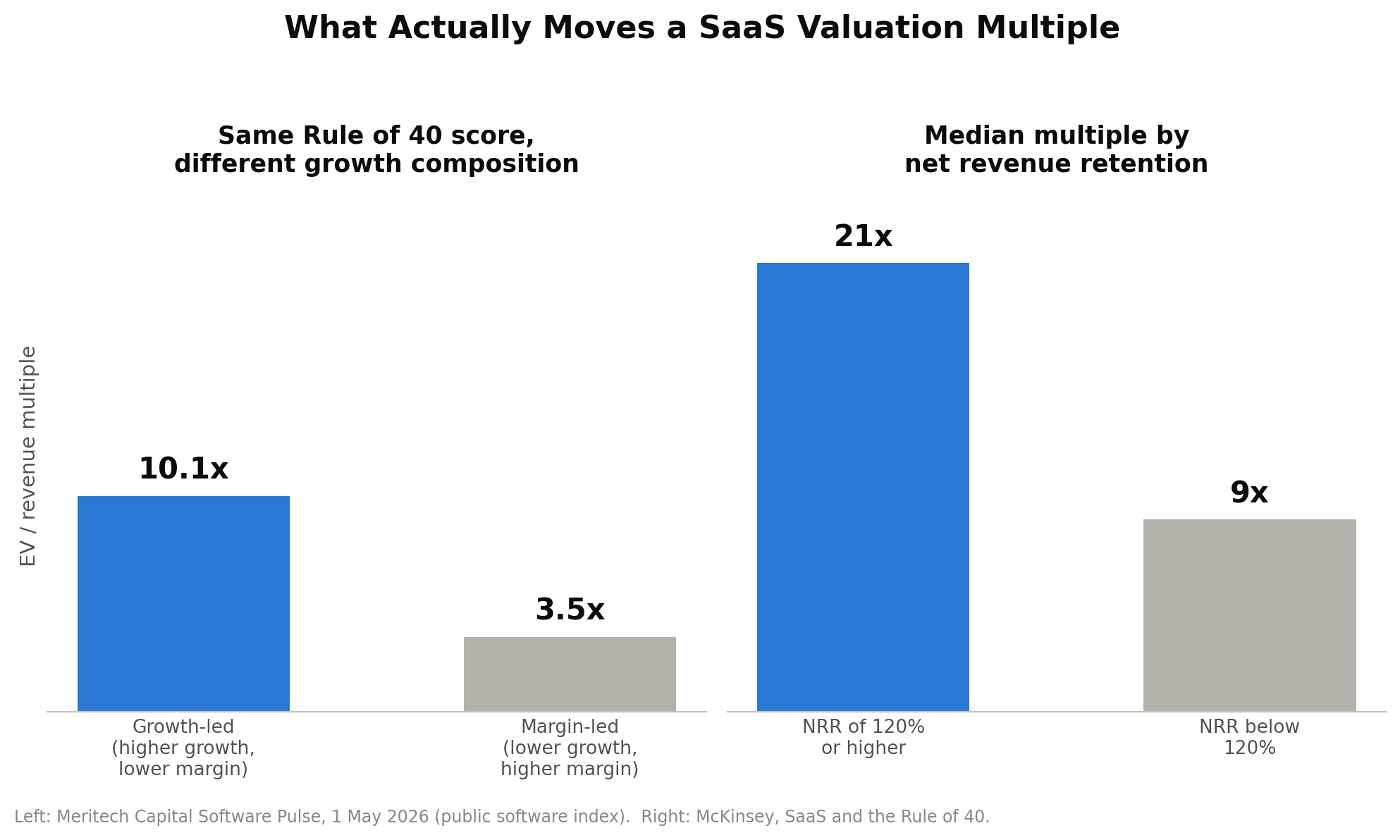
Here is the part worth internalising. Meritech looked at companies with similar Rule of 40scores and found the market pays very differently depending on how that score is composed: higher-growth companies traded at 10.1x while lower-growth, higher-profitability companies traded at 3.5x. Growth correlated to valuation3.1 times more strongly than free cash flow margin. Retention compounds it further. McKinsey found SaaS businesses with net revenue retention of 120% or higher commanded median EV/revenue multiples of 21x,against 9x for those below that threshold.
Growth and retention set the multiple. Profitability sets the floor. A founder optimising for margin in the year before an exit is usually optimising against their own valuation.
For a full breakdown of the metrics that feed the calculation and how each one is weighted, see FE International's guide to how to value a SaaS business. If you want a sanity check on your own numbers before you do anything else, that is the natural first step.
Is Now a Good Time to Sell a SaaS Business?
The honest answer is that market timing matters less than most founders assume, and readiness matters more. That said, the current backdrop is constructive.
Bain's mid year data shows strategic M&A up 36% year to date in 2026, with medianvaluations holding flat at 11.6x enterprise value to EBITDA across sectors.Deal counts rose modestly while value rose sharply, which tells you buyers arebeing deliberate rather than indiscriminate. That is good news for awell-prepared seller: when acquirers are selective, the businesses with cleanfinancials and defensible retention stand out rather than getting lost in acrowded field.
Inside software specifically, PitchBook counted 267 enterprise SaaS M&A deals in Q1 2026 and noted that 2025 was the strongest year for enterprise SaaS dealmaking since 2021. Quarterly deal value in software is heavily skewed by a small number of very large transactions, so for founders in the lower and middle market, deal count is the more useful signal, and deal count has been steady.
Buyer intentsupports the same read. Deloitte's 2026 M&A Trends survey of 1,500 corporate and private equity leaders found90% of private equity respondents and 80% of corporate respondents expectingincreased deal activity over the following twelve months.
AI is theother force reshaping who buys and why. Bain found that almost halfof strategic technology deals in 2025 involved an AI component, upfrom roughly one in four in 2024, and that acquirers are paying fordifferentiated intellectual property, proprietary data advantages and technicaltalent. If your product sits on proprietary data or workflow depth that wouldtake years to rebuild, there is a strategic buyer who wants that specifically.
The moreuseful timing question is personal rather than macro. FE International's guideto planning thetiming of your business exit works through the trade-offs betweenselling into growth and waiting for another year of numbers.
The Metrics Buyers Stress-Test Before They Make an Offer
Buyers do not take your dashboard at face value. They rebuild your metrics from raw data,usually from billing system exports rather than from your reporting layer.These are the numbers that carry the most weight.
Net revenue retention and gross retention
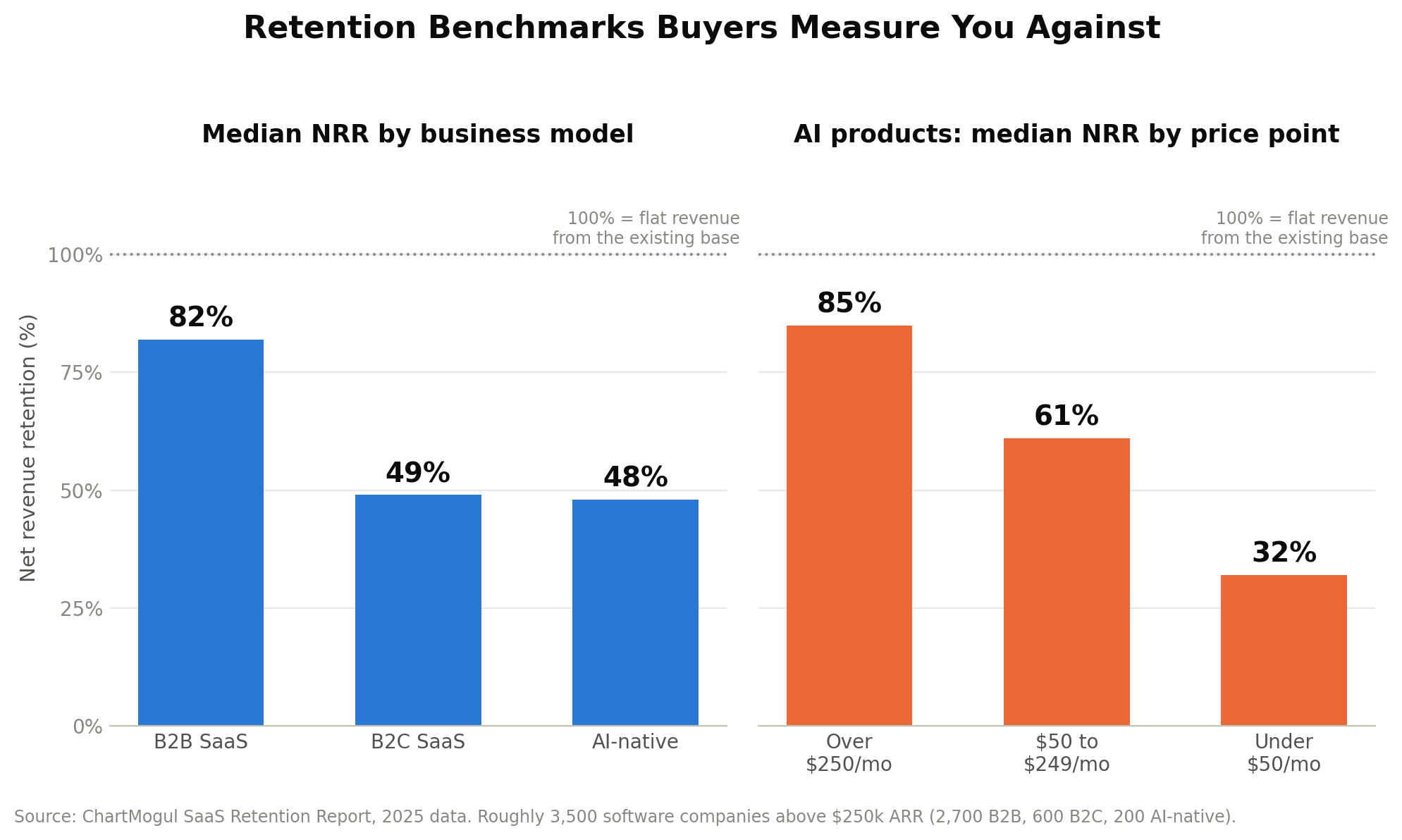
This is the single most scrutinised figure in a SaaS diligence process, and for good reason: it tells a buyer what the business is worth if they stop acquiring newcustomers. ChartMogul's analysis of roughly 3,500software companies above $250k ARR put median net revenue retentionat 82% for B2B SaaS and 49% for B2C in 2025. Among AI-native products,retention correlates strongly with price point: products above $250 per monthshowed 85% median NRR, while those under $50 per month showed 32%.
If your NRR sits above 100%, say so early and prove it, because it moves your multiple more than any other single disclosure. If it sits below the benchmark, knowing that before a buyer tells you gives you time to fix the underlying cause.
Growth rate, and its durability
Absolute growth matters, but consistency matters more. McKinsey found that only 1.6% of200 software companies sustained revenue growth of 30% or higher between 2011 and 2021, and that median growth among 100 public US SaaS companies above $100million in revenue was 22%. A business growing steadily at 30% is often valuedabove one that spiked to 60% and fell back, because the steady one isforecastable.
Revenue quality and concentration
Contracted,annual, auto-renewing revenue from a diversified base is the gold standard.Buyers discount month-to-month revenue, one-off services revenue, and any customer representing more than about 10% of ARR. Concentration is one of themost common reasons an offer comes in below expectation, and it is fixable withenough runway.
Rule of 40 and unit economics
Growth rate plus profit margin should reach 40. McKinsey's work suggests only about a third of SaaS companies achieve it, and that businesses exceeded Rule of 40 performance just 16% of the time across a decade of data. Bain's study of 86software companies found only 16% sustained it across five consecutive years, and that the companies which did achieved valuations roughly double those of the companies that fell short. Sustaining the score matters more than hitting it once. Alongside it, buyers look at CAC payback: McKinsey found top-quartile companies recover acquisition cost in under 16 months, against nearly four years for the bottom quartile.
Gross margin and cost of revenue
Software gross margins are expected to sit high, and anything materially below the norminvites questions about what is really being sold. Hosting and infrastructure costs, third-party API fees, payment processing and any human-delivered elementof the service all sit in cost of revenue, and buyers will look at whetherthose costs scale with revenue or ahead of it. This has become a sharperquestion for AI-native products, where inference costs are a genuine variablecost per user rather than a fixed platform cost. If your margin profile isunusual for the category, have the explanation ready and the numbers behind it,because a buyer who discovers it themselves will assume the worst case.
Owner dependency
If you are the top salesperson, the lead engineer and the only person who understands thedeployment pipeline, a buyer is not acquiring a business, they are acquiring ajob. Every function that runs without you raises the multiple and shortens theearnout you will be asked to accept.
Buyers pay for revenue they can predict withoutyou in the room. Everything in exit preparation is a version of that one idea.
How to Sell a SaaS Business: The Eight Stages, Step by Step
A sell-side process has a defined shape. KPMG's mapping of a typicalacquisition process reports an average of nine months from launch toclose with a strategic buyer and seven months with a financial buyer, with afull range of three to fourteen months. The stages below overlap in practice,which is why the timeline compresses rather than simply adding up.
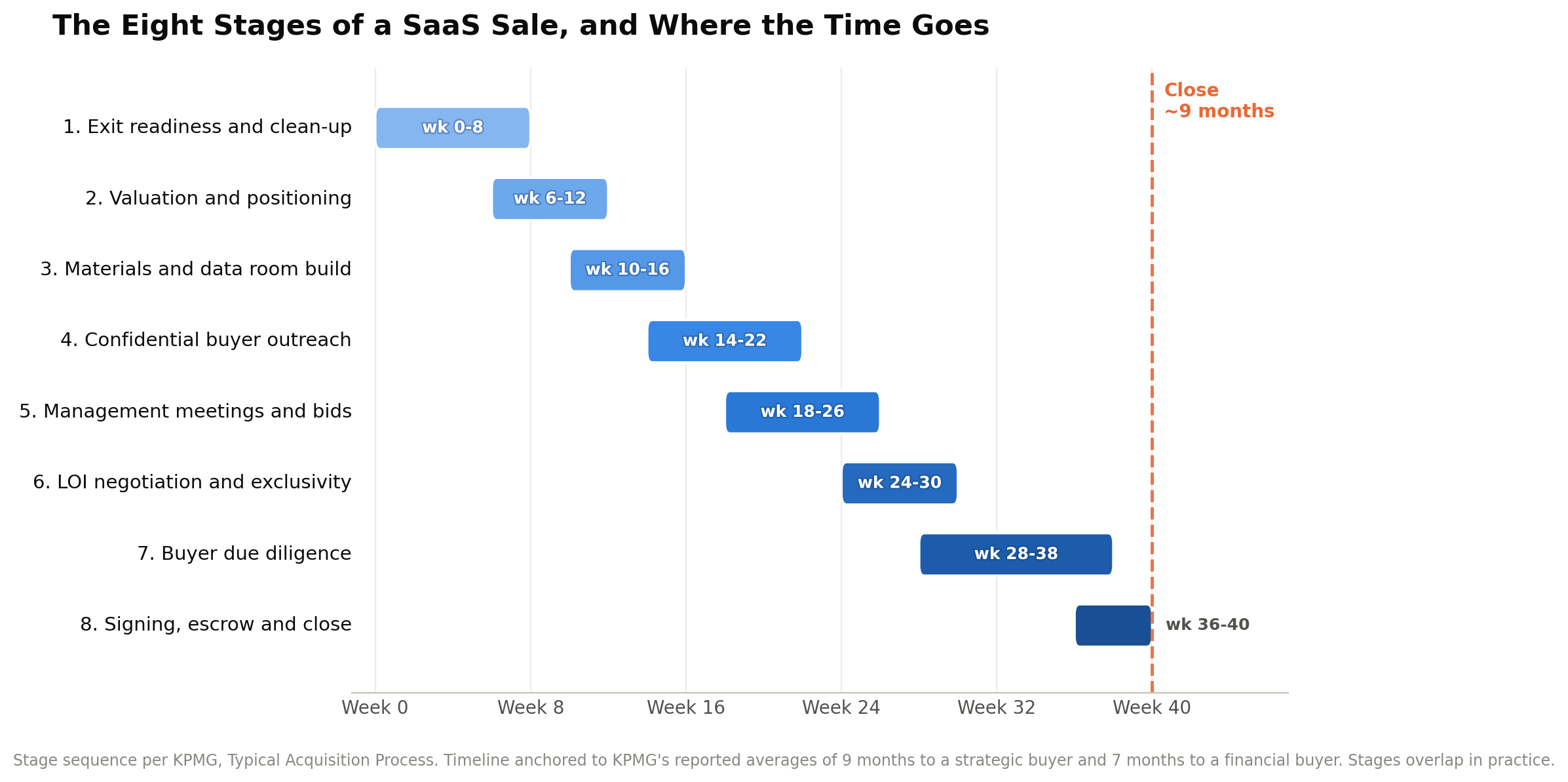
Stage 1: Exit readiness and clean-up (weeks 0 to 8)
Before anyone sees the business, the housekeeping gets done: financials moved onto accrualaccounting, personal expenses separated out, contracts and IP assignmentslocated and filed, cap table confirmed, code ownership verified. This stage isunglamorous and it is where the most value is created per hour spent.
Stage 2: Valuation and positioning (weeks 6 to 12)
You establish a defensible range and decide what story the business tells. A vertical SaaScompany with 130% NRR in a niche is positioned very differently from ahorizontal tool with broad appeal and higher churn. The positioning determineswhich buyers you approach, which in turn determines the multiple.
Stage 3: Materials and data room build (weeks 10 to 16)
The information memorandum, a financial model, cohort retention analysis, and apopulated data room. Buyers read the data room as a proxy for how well thecompany is run. A disorganised one invites deeper diligence and lowerconfidence.
Stage 4: Confidential buyer outreach (weeks 14 to 22)
Approaches go out under NDA to a curated list rather than a broad blast, because confidentiality protects your team, your customers and your negotiatingposition. The goal is several credible parties in the room at once, which is what creates competitive tension.
Stage 5: Management meetings and indicative bids (weeks 18 to 26)
Interested buyers meet the team, dig into the product, and submit indicative offers.Comparing them takes care: headline price, cash at close, earnout terms andescrow all move independently, and the highest headline number is frequentlynot the best deal.
Stage 6: LOI negotiation and exclusivity (weeks 24 to 30)
You select a party and sign a letter of intent, usually granting 30 to 90 days ofexclusivity. This is the moment your leverage is highest, so the terms thatmatter should be settled here rather than left to be argued during diligence.
Stage 7: Buyer duediligence (weeks 28 to 38)
Financial,technical, legal and commercial review runs in parallel. Expect a quality of earnings analysis, a code and security audit, customer reference calls and acontract-by-contract read. This is the longest stage and the one most likely toextend.
Stage 8: Signing,escrow and close (weeks 36 to 40)
Definitive agreements, working capital true-up, escrow funding and the transfer itself,followed by a transition period that is typically three to twelve monthsdepending on how dependent the business is on you.
Preparing Your SaaS Business for Sale: A Twelve-Month Runway
The founders who achieve the best outcomes start roughly a year before going to market. Not because a sale takes that long, but because the changes that move a multipleneed time to show up in the data. A buyer wants to see twelve months of clean,consistent numbers, not a quarter of them.
Months 12 to 9: get the financial house in order
• Move to accrual accounting and, if you can justify thecost, get a review or audit. Re stated financials mid-diligence costcredibility.
• Separate personal and business expenses completely, anddocument any add-backs you intend to claim.
• Build monthly cohort retention reporting from billing data, not from your analytics tool. Buyers will rebuild it from billing dataanyway.
Months 9 to 6: reduce concentration and dependency
• Work down any customer above 10% of ARR, ideally by growing the rest of the base rather than by losing the account.
• Move month-to-month customers onto annual contracts.This lifts revenue quality and shortens the time a buyer needs to feelconfident.
• Hire or promote so that sales, support and engineeringeach have an owner who is not you, then step back visibly enough that it showsin the org chart.
Months 6 to 3: fix the legal and technical file
• Confirm IP assignment from every contractor andemployee who has touched the codebase. Missing assignments are one of the most common deal-delaying findings.
• Review the contract stack for change-of-controlclauses, which can give customers a termination right on a sale.
• Address known security gaps and technical debt, and document the architecture. FE International's SaaS duediligence checklist covers what a buyer's technical team will lookfor.
Months 3 to 0: build the story
• Assemble the data room before you need it, so outreach is not gated on document collection.
• Write down the growth thesis a buyer would executeafter closing: the pricing move you have not made, the segment you have notsold into, the integration you have not built. Buyers pay for headroom they cansee.
FE International's SaaS exitplanning overview goes deeper on sequencing this work, and the Upright Labscase study shows how the preparation translated into an enterpriseSaaS outcome in practice.
Who Buys SaaS Companies, and What Each Buyer Optimises For
There are three broad buyer groups, and the right one depends less on price than on whatyou want after close. Deloitte's survey found 90% of private equity respondents and 80% of corporate respondents expecting more deals in 2026, so both ends ofthe market are active.
Strategic acquirer
Private equity
Individual buyer
What they want
Product, customers, team or data that accelerates their own roadmap
A platform to grow and resell, usually with leverage
A profitable business to own and operate
Typical target profile
Differentiated IP, proprietary data, workflow depth
Predictable ARR, expansion headroom, Rule of 40 potential
Owner-independent, cash generative, simple to run
Average time to close
About 9 months (range 3 to 14)
About 7 months (range 5 to 11)
Often faster, smaller deals
Consideration mix
More likely to include stock, especially at larger scale
Cash-heavy with rollover equity common
Cash plus seller financing
Your role after close
Integration role, often 12 months or more
Continue leading, or hand over to a new CEO
Short handover, then out
Timeline data from KPMG, Typical Acquisition Process. Consideration mix reflects Bain'sfinding that stock-plus-cash reached 35% of megadeals in 2026, a historicalhigh. Other rows reflect general market practice.
One point about strategic buyers is worth knowing before you negotiate: the most disciplined ones are serial acquirers. McKinsey's study of 11,746transactions across 2,000 companies from 2013 to 2022 found programmatic acquirers outperform, and that they are willing to pay more, both in absolute price and relative to their own valuation. A buyer who has done thirty deals is a faster, cleaner counterparty than one doing their first, and often a better-paying one.
FE International's comparison of PE, strategicand individual buyers for SaaS works through how each type behavesonce a process is live.
Deal Structure: Why the Headline Price Is Not the Number
Two offers at the same headline valuation can differ by a wide margin in what you actuallyreceive, and when. These are the components that move it.
Cash at close
The portion wired on completion, and the only part with no conditions attached. Bainreported stock-plus-cash structures reaching 35% of megadeals in 2026, ahistorical high, with all-cash deals at a cyclical low of 55%. In the lower andmiddle market, cash at close typically remains the majority of consideration.
Earnout
A deferred payment contingent on hitting agreed targets after close. Earnouts bridge a gap in views on growth, and they are common where the seller's forecast is ahead ofthe buyer's. The terms deserve close attention: which metric, measured how,over what period, and who controls the levers that drive it. An earnout tied torevenue you no longer control the spend behind is a different instrument fromone tied to a metric you still own.
Escrow and holdback
A portion ofthe price held back to cover breaches of representations and warranties,usually released over twelve to twenty-four months. SRS Acquiom's 2026 DealTerms Study, covering more than 2,300 private-target acquisitions worth $569billion tracks how these terms move across the market.
Rollover equity
Where you keep a minority stake in the acquired business, common in private equity deals. Itgives you a second bite if the buyer's growth plan works, and it ties part ofyour outcome to their execution rather than yours.
Working capital adjustment
A true-up at close against an agreed target. For SaaS companies this deserves attentionbecause deferred revenue from annual prepayments sits on the balance sheet as aliability, and how it is treated in the working capital definition can movereal money.
The terms that are not about money
Two non-financial items regularly decide whether a founder is happy a year afterclosing. The first is the transition and employment arrangement: how long you are expected to stay, in what role, reporting to whom, and what happens if therelationship does not work. The second is the restrictive covenant package,meaning the non-compete and non-solicit terms and how broadly they are drawn. Anon-compete written across the whole software category rather than yourspecific niche can close off your next venture entirely. Both are negotiable,both are usually easier to move than price, and both are frequently signedwithout much attention because they arrive late in a long document.
Negotiate the structure with the same energy you negotiate the price. The structure decides how much of the price you keep.
Asset Sale or Share Sale: The Structure That Decides Your Tax Bill
This is alegal and tax question, and it is worth settling with your own advisers early,because it changes the net proceeds materially. What follows is general information rather than tax advice, and it reflects US federal treatment.
In an asset sale, the buyer purchases specific assets and assumes specific liabilities. The IRS treats this as a sale ofeach individual asset rather than a single transaction, so the price is allocated across asset classes and each class carries its own treatment:some proceeds are capital gain, some are ordinary income. Both parties fileForm 8594 to report the allocation, and the allocation must match. IRS Publication 544 setsout how gains and losses on the different asset classes are characterised.
In a share sale, the buyer purchases your equity and the entity continues with its history intact. Sellers generally prefer this: it is simpler, and the gain is typicallycapital rather than a mix. Buyers often prefer an asset sale, because they geta stepped-up basis in the assets and a cleaner break from historicalliabilities.
Two practical implications. First, the structure preference is a negotiating item with realvalue on both sides, so it should be priced rather than conceded. Second, theallocation inside an asset sale is where a lot of the tax outcome is decided,and it is negotiated, not automatic. Bring your tax adviser in before you signa letter of intent, not after.
Due Diligence: What Gets Checked, and Where Deals Get Renegotiated
Diligence is where a well-prepared business is rewarded and an unprepared one gets repriced.Expect four work streams running at once over roughly six to ten weeks.
Financial diligence
A quality of earnings analysis rebuilds your revenue and earnings from source data. Revenue recognition, the treatment of deferred revenue, add-back justification andcohort-level retention all get tested. Discrepancies between your reportedmetrics and what the billing data shows are the most common cause of a priceadjustment.
Technical diligence
Code review,architecture assessment, security posture, infrastructure cost and dependency analysis. The buyer is establishing what it would cost to maintain and extendthe product, and whether there is anything in the stack that becomes theirproblem. FE International's due diligenceservices team runs this work from both sides of transactions, whichis a useful perspective when preparing for it.
Legal diligence
Corporate records, the cap table, IP chain of title, customer and supplier contracts,employment agreements, data protection compliance and any litigation.Change-of-control provisions get read carefully, because a clause giving yourlargest customer a termination right on a sale directly affects value.
Commercial diligence
Reference calls with customers, competitive positioning, market sizing and pipelinevalidation. This is the workstream you can influence most through preparation,by knowing which customers will speak well of you and making sure they arereachable.
How to keep diligence from repricing your deal
The pattern in repriced deals is rarely a single catastrophic finding. It is an accumulation of small surprises that erodes a buyer's confidence in everything else you have told them. Three habits prevent most of it. Disclose known problems yourself, early, with your assessment of the cost to fix, because a problem you raise isa credibility gain and the same problem discovered in week six is a price adjustment. Answer information requests within a day or two, since a slow dataroom reads as either disorganisation or concealment. And keep running the business: growth that flattens during a nine-month process invites a buyer tore-cut their model on the new trajectory, which is one of the most common ways a good deal quietly gets worse.
It is worth keeping the wider picture in view here. HBR reported on Bain research covering more than660,000 acquisitions over two decades which found roughly 70%succeeded, a reversal of the failure rate that dominated earlier thinking.Buyers know this, and they know preparation is the variable. Presenting abusiness that has clearly been readied for a transaction changes the tone ofthe entire process.
What Changes When You Sell With an M&A Advisor
It is possible to sell a SaaS business without an adviser, and some founders do, usually to a buyer who approached them directly. The trade-off is worth understanding beforeyou decide.
A single inbound buyer negotiating against a founder with no comparable process runninghas a structural advantage. They set the pace, the price reference and the diligence scope. An advised process changes three things: it puts multiplecredible buyers in the room at the same time, it means the person negotiatingthe terms has seen how those terms behave across many deals, and it keeps thefounder running the company while someone else runs the transaction. That lastpoint matters more than founders expect, because a business whose growth stallsduring a nine-month process gets repriced for it.
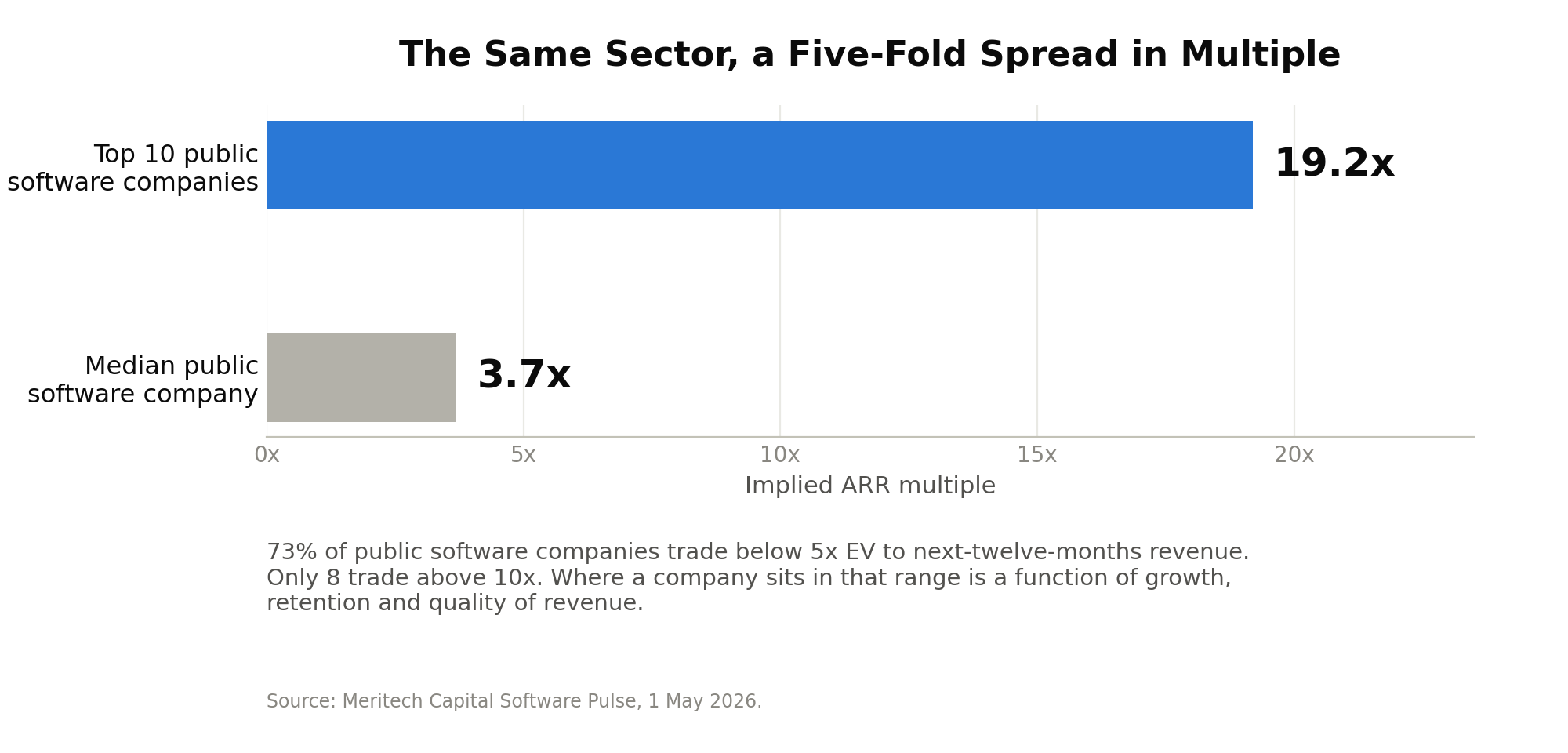
That spread is the argument for taking positioning seriously. The gap between a median multiple and a premium one is not mostly luck, and it is not mostly the sector.It is growth, retention, revenue quality and how clearly those are evidenced tothe right buyer. FE International has completed over 1,500 transactions with a94.1% success rate on private sales and acquisitions, across SaaS, ecommerce, agencies, AI,cybersecurity, edtech, fintech and marketplace apps.
Getting Started
Selling a SaaS business rewards preparation more than timing. The market backdrop is supportive, with Bain projecting $5.3 trillion of global M&A in 2026 and Deloitte finding the large majority of both corporate and private equity buyersexpecting to do more deals. But the difference between a median multiple and apremium one comes down to work you do before a buyer ever sees the business:clean financials, retention you can prove, concentration reduced, and a companythat runs without you.
If you aretwelve months out, start with the financial clean-up and the retentionreporting. If you are closer than that, start with a valuation so you know whatyou are working with. FE International has advised on over 1,500 technologytransactions with a 94.1% success rate, and you can get aconfidential valuation of your SaaS business to find out where yourssits and what would move it.
