
.jpg)
What Happens After I Sign With an M&A Advisor?
Most of the advice available to founders stops at the signature. There is a great deal written about how to choose an advisor and comparatively little about the months that follow, which is where the actual work sits. This page picks up where our guide to choosing an M&A advisor leaves off.
The short version is that the first few weeks are heavier on your time than most founders expect, and the later months are lighter. Signing does not hand the process over. It starts a collaboration in which the advisor does the building and the running, and you supply the raw material early and make the decisions late.
One caveat worth stating at the outset. What follows describes how a sell-side process commonly runs; it is not a description of any particular engagement. Sequence, timings and terms vary by advisor, by deal size and by how ready the business was on the day it started, and your own engagement letter governs the specifics. Read it with a transaction attorney before you sign rather than after. For the process in full, our guide on how to sell a SaaS business sets out the wider arc.
The short answer
In a typical process the first four to six weeks are information gathering and positioning, the middle months are marketing and buyer conversations, and the later months are diligence and closing. Your heaviest involvement usually sits at the start and at the decision points, not in the middle.
Where you land inside that pattern depends mostly on how prepared the business was. A seller arriving with accrual financials, cohort retention and contracts already reviewed can move through the early phase quickly. A seller assembling those from scratch spends longer before anything reaches a buyer. Our note on how long it takes to sell a SaaS business covers the overall range, and our SaaS exit planning overview covers what would ideally have been done beforehand.
It is also worth setting expectations about effort rather than just elapsed time. Founders who have been through it often describe the process as demanding in bursts rather than continuously, which is part of the argument our piece on how an M&A advisor protects your time makes, and part of the trade-off explored in selling yourself versus using an advisor.

Week one: the kickoff and the information request
Processes usually open with a kickoff call covering objectives, the buyer types to target, the confidentiality position, and who at your end is cleared to know. Shortly after, an information request arrives. It is longer than most founders anticipate.
Expect it to cover financial statements on an accrual basis, a deferred revenue schedule, revenue by customer, cohort retention exports, the contract set, corporate records, the cap table, and product and infrastructure notes. Our guide to the documents you need to sell a SaaS company sets out the full inventory and the formats buyers generally expect, and our guide to quality of earnings in tech M&A covers whether a sell-side review is worth commissioning alongside it.
Two things tend to slow this phase. Financials kept on a cash basis need converting, which is accounting work rather than administration. And metric definitions often need settling: gross and net revenue retention calculated a particular way, with the method written down. For context on where SaaS retention sits generally, ChartMogul's study of roughly 3,500 software companies reports median B2B net revenue retention of 82% with an upper quartile of 97%. Our guide to the metrics that drive SaaS valuations covers how each tends to be treated.
What the engagement letter generally commits you to
The terms below appear in most sell-side engagement letters in some form. The wording, the figures and the balance between them differ considerably between advisors and between mandates, so treat this as a guide to what to look for rather than a description of any particular agreement.
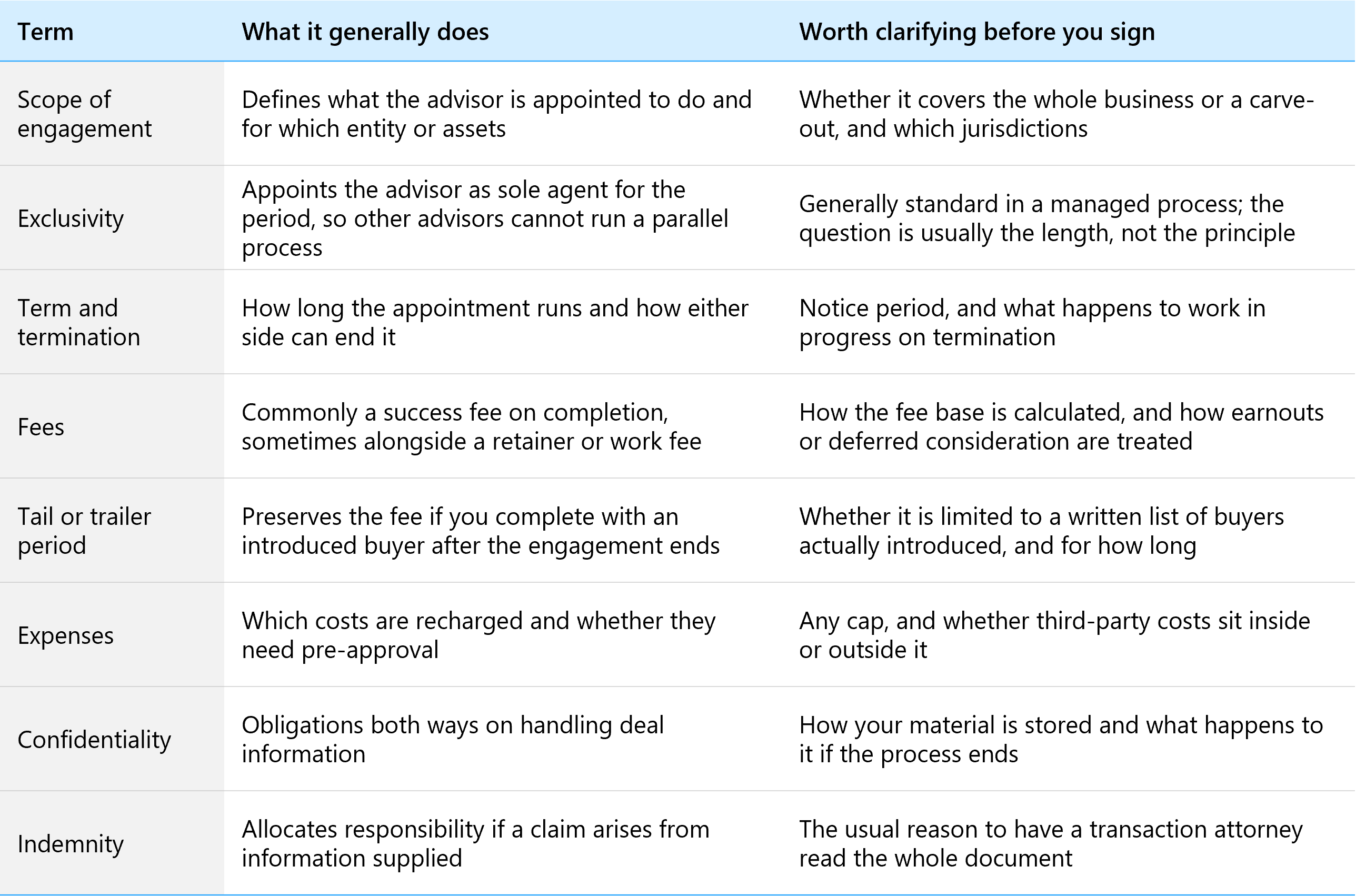
One regulatory point is worth knowing rather than worrying about. Since March 2023 a federal exemption has allowed certain M&A brokers to operate without registering as a broker-dealer, subject to conditions and eligibility limits set out in the Securities Exchange Act, which among other things restrict handling client funds or securities. Advisors operate on different bases, so if it matters to you, it is a reasonable question to ask.
Valuation and positioning
Once the information is in, the advisor generally works up a valuation view and a positioning argument. These are two different things and both matter.
The valuation view is the defensible range, built from comparable transactions, the metric profile and current market conditions. Our analysis of SaaS valuation multiples by ARR, growth and retention sets out the inputs that tend to move it, and our mid-year 2026 tech M&A report covers the market backdrop. The positioning argument is the case for why this particular business should sit at the upper end of that range rather than the middle.
This is the first real decision point. A founder who expects a number the analysis does not support has a choice to make early, which is better than discovering the gap after three months of outreach. A good advisor should be willing to explain how they arrived at the range rather than simply asserting it, and this is a conversation worth having properly rather than quickly.
The marketing documents
Two documents generally come out of this phase. An anonymised teaser of a page or two that describes the business without naming it, and a confidential information memorandum that names it and carries the full argument. Financial Edge Training notes that a CIM commonly runs from 30 to over 150 pages depending on the complexity of the business.
The advisor normally drafts both from the material you supplied. Your role is review and sign-off, and it is worth taking seriously: this is the version of your business that buyers will read first, and every figure in it should be one you can stand behind and trace back to a source document. Corrections are far cheaper at this stage than during diligence.
Expect some back and forth on emphasis. Founders tend to lead with the product; buyers tend to read for revenue durability and defensibility first. Where those pull in different directions, the document usually has to serve the reader rather than the author.
The buyer list and going to market
The advisor builds a target list, typically spanning strategic acquirers, private equity and, depending on size, individual buyers. Our comparison of PE, strategic and individual buyers for SaaS covers how each tends to evaluate and what each usually prioritises.
You should expect to approve that list, and to be able to veto names on it. Competitors, current partners and parties you would rather not approach at all are all legitimate exclusions, and a process where the seller does not see the list before outreach begins is worth questioning.
Outreach itself is usually anonymised until an NDA is in place. From there the advisor fields initial questions, qualifies interest and manages the flow, which is the part of the process that most reduces the demand on your time. Market conditions affect how quickly responses come back, and Datasite's 1H26 data showed new global deal kickoffs up 31% year on year, which gives some sense of how active the environment has been.
Calls, offers and the move into diligence
Interested buyers generally want to meet management. These calls are yours to lead, with the advisor in support, and preparation makes a visible difference. Expect questions on retention and why customers leave, on concentration, on the roadmap, and increasingly on technology and security.
On that last point, SRS Acquiom's 2026 survey of 150 senior dealmakers found 84% expecting greater scrutiny of cybersecurity diligence and 51% already describing technology diligence as the most demanding element of a review. Being ready for that line of questioning tends to help.
Offers then arrive, usually as indications of interest and later as letters of intent. The advisor normally runs the comparison and the negotiation; you choose. Price is only one axis: structure, earnout terms, escrow, transition commitments and closing certainty all vary between offers that look similar on headline value. Once an LOI is signed, the process moves into confirmatory diligence, where our buyer-side due diligence checklist shows what tends to be requested and FE International's due diligence services team supports the seller side. Deloitte reports a median gap of about three months between signing and closing on transactions of $100 million or more.
What stays with you throughout
Three things do not transfer to the advisor at any point, and it is worth being clear about them from the start.
The first is running the business. Performance during a sale process is visible to buyers, and a dip in the months before closing tends to invite renegotiation. The second is every decision that matters: the valuation range you accept, who may be approached, which offer to pursue, what you are prepared to concede. An advisor advises. The third is the accuracy of what you supply, which is why the indemnity clause exists and why the material in the CIM and the data room should be information you can defend.
What the advisor generally takes on is the building, the outreach, the qualification, the negotiation choreography and the process management. FE International's investment banking team works this way, though as with everything above, the specifics of any engagement are set by its own letter rather than by a description on a web page.
Going in with the right expectations
What happens after I sign with an M&A advisor is, in most processes, a front-loaded collaboration: an intensive information phase, a set of decisions that stay yours throughout, and a long middle stretch where the advisor carries the work. Knowing which parts need you and which do not is most of what makes the experience manageable, and preparation done before signing tends to shorten the demanding part.
FE International has completed more than 1,500 transactions since 2010 with a 94.1% success rate on private sales and acquisitions, and we work with SaaS founders through the full process. If you would like to understand how an engagement would work for your business specifically, that is the conversation to start with.
