
.jpg)
Should I Sell My AI Startup or Raise Another Round?
Most founders arrive at this question with a comparison already half-formed. A number they have seen attached to a funding round in their category, set against a number they imagine an acquirer might pay. The gap between the two looks enormous, and the conclusion seems to follow on its own.
The difficulty is that those two numbers are not measuring the same thing. A round price and a sale price answer different questions about different quantities of your company, settled in different currencies, with different risks attached. Comparing them directly tends to confirm whichever answer the founder was already drawn to, which is the opposite of useful.
This page is about making the comparison properly. It sets out what each transaction actually prices, the questions that separate the two options in practice, and what the current market does and does not tell you. For the mechanics of a sale once that route is chosen, our guide to AI M&A trends in 2026 covers the market and how to sell a SaaS business covers the process.
One thing this page will not do is tell you which to choose. The honest position is that the answer depends on facts specific to your company, your cap table and your own circumstances, several of which only you can weigh. What follows is a way of structuring the decision rather than a recommendation, and nothing here is financial or legal advice.
The Short Answer
A funding round prices a minority stake in new shares, puts capital into the company rather than into your hands, and leaves execution risk with you. A sale prices the whole company, settles in cash or buyer stock, and transfers that risk to the buyer. The headline numbers are therefore not comparable, and the decision turns on questions that have nothing to do with either: whether more capital would change what the business becomes, what your own cap table does to proceeds at realistic prices, and how much longer you want to carry the risk.
Founders who frame it as a valuation comparison usually end up relitigating the same point for months. Founders who frame it as a question about risk, time and capital tend to reach an answer faster, and are better prepared for whichever route they take.
Why the Two Numbers Are Not Comparable
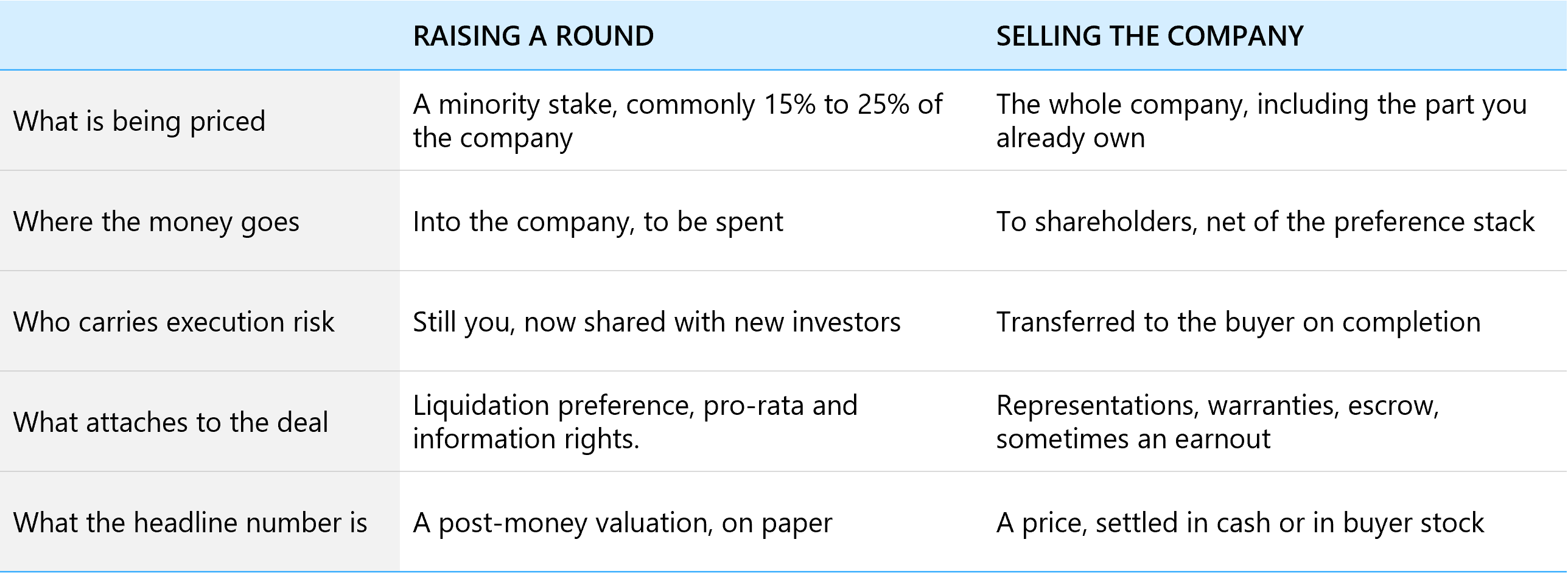
Our analysis of what multiple a SaaS business sells for puts the structural point plainly: a funding round prices a minority stake with liquidation preferences, pro-rata rights and information rights attached, in exchange for growth optionality, while an acquisition prices the whole business in cash with the buyer assuming execution risk from day one. The same company can carry a high round multiple and a considerably lower exit multiple at the same moment, and both can be accurate.
Three consequences follow, and each one surprises founders at a different point in the process.
A round valuation is a price for optionality. An investor buying 20 percent of a company is buying a claim on a wide range of outcomes, most of which they expect to be worthless and one of which they hope will be very large. They can pay a price that looks indefensible against current revenue because the distribution of outcomes, not the median one, is what they are underwriting. An acquirer buying the whole company has no such distribution to rely on.
A round price is paid in new shares, not to you. Capital raised goes into the company to be spent on growth. The founder's position changes on paper and, usually, not at all in cash. A sale converts a position into proceeds, net of whatever the cap table takes first.
Preferences change what a headline means. Cooley's review of 166 venture financings in the second quarter of 2026 found 96.4 percent carrying non-participating preferred and 95.8 percent at a 1x preference, which is the founder-friendly end of the range and still means investors are paid before common equity at any exit. Each round adds to that stack. Modelling what a given sale price produces for you, at several prices rather than one, is the single most clarifying exercise available before this decision.
What the Venture Premium Does and Does Not Prove

The AI premium in venture pricing is not imaginary. PitchBook's analysis of first-quarter 2026 data puts the median pre-money valuation for Series D and later AI and machine learning startups at $4.7 billion against roughly $1.2 billion for non-AI peers, with median deal size at that stage nearly doubling from the prior full year. Capital availability has run ahead of demand: the same analysis records $1.10 of capital available for every $0.90 being sought at venture-growth stage.
What that establishes is that investors will fund AI businesses at prices they would not pay elsewhere. What it does not establish is what an acquirer will pay, and PitchBook says so directly, noting that because the most heavily capitalised AI companies have not yet tested public markets, exit valuations remain unvalidated. That is an unusually candid caveat from a data provider and it is worth taking at face value.
The acquisition market is priced on different logic and sits at different levels. PitchBook's Q2 2026 global M&A report puts the median enterprise value to EBITDA multiple at 10.2 times on a trailing basis across the market. Meritech's February 2026 read of public software records the index at 3.5 times next-twelve-months revenue with median public company growth slowing to 16 percent. Bessemer's Cloud 100, by contrast, covers the most highly regarded private cloud companies and averaged around 20 times ARR in its 2025 report. Those are three different populations measured three different ways, and lining them up against each other is exactly the comparison this page is cautioning against.
McKinsey makes a related argument about multiples generally, observing that a deal can create real economic value while diluting a multiple, or destroy value while expanding one, and concluding that net present value remains the better lens. For a founder weighing two routes, the equivalent question is not which option carries the bigger headline but which produces the better outcome for you, after preferences, tax and the time you spend getting there.
The Two Routes, Side by Side
The table below sets out how the two options differ on the dimensions founders most often weigh. It describes general patterns rather than any particular transaction, and the right answer varies by business.
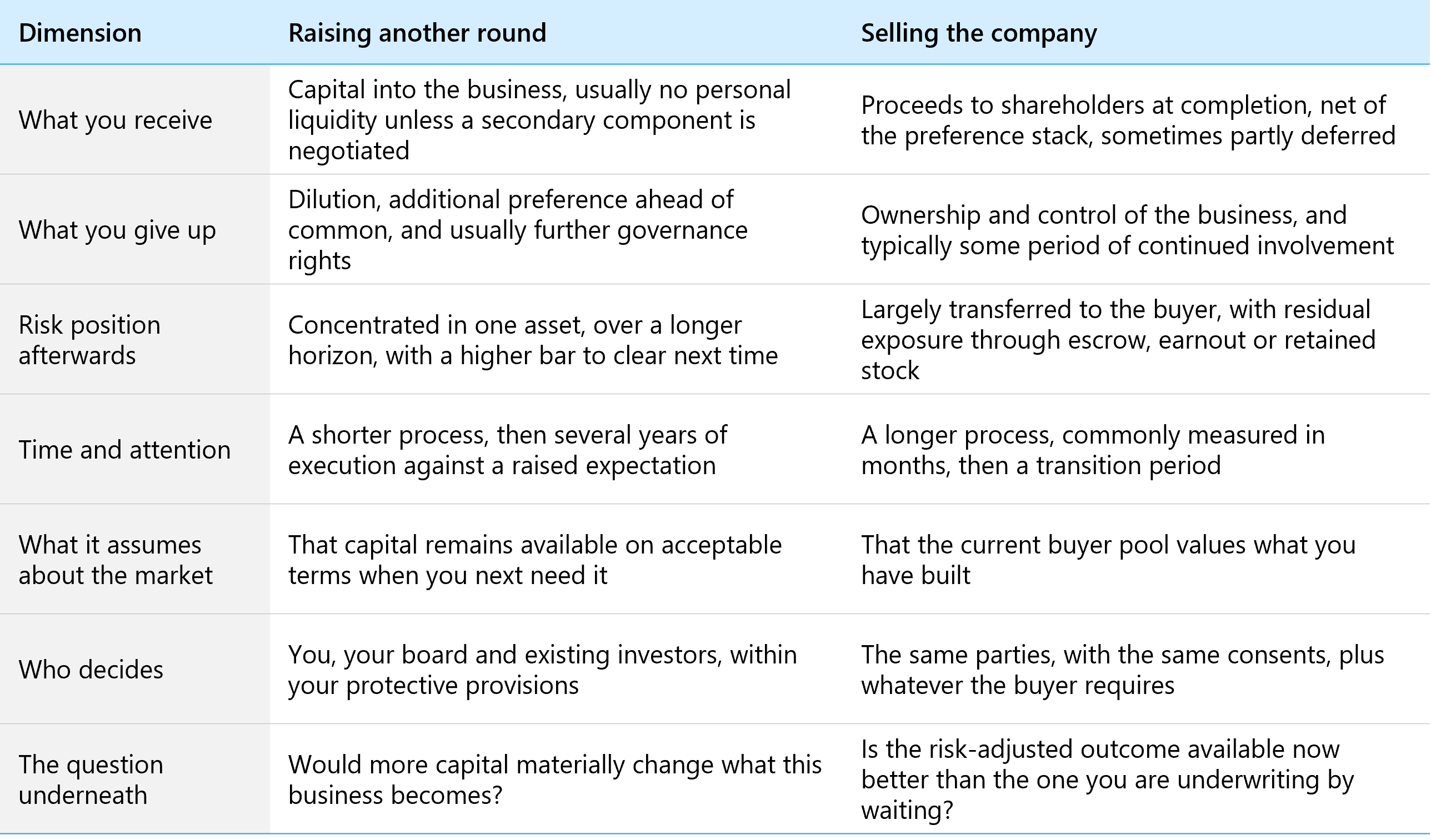
What Raising Commits You To
A round is often framed as keeping options open. It does, and it also closes some, which is worth seeing clearly before signing.
The most consequential is the expectation it sets. Capital raised at a given valuation creates a bar that the next event has to clear, and a sale below it becomes harder to agree even when it is the sensible outcome, because investors holding preferences at the higher price may prefer to wait. The PitchBook and NVCA Venture Monitor for the second quarter of 2026 notes that everyday exit paths remain thin for the broader market and that many venture-backed companies without a route to a marquee listing may need to accept exit prices below peak-era expectations. A round raised into a strong funding market does not guarantee an exit market that agrees with it later.
The second is governance. Each round typically adds consent rights, and the question of who has to agree to a future sale becomes more complicated with every investor on the register. Our note on managing investor access, requests and offers covers how those conversations tend to run, and it is considerably easier to understand your own position before adding to it.
None of which argues against raising. Capital that buys growth which compounds can leave a founder materially better off despite the dilution and the preference stack; our note on when and how to raise capital for a SaaS business covers the case for it, and on the other side of the same decision, building a profitable business from day one covers the alternative. The test is whether the capital changes what the business becomes, not whether it is available.
What Selling Commits You To
A sale is similarly often framed as a clean ending, and similarly is not quite.
The process itself takes months rather than weeks, and the preparation that precedes it takes longer still. Our note on how long it takes to sell a SaaS business covers the general pattern, and the stages are broadly the same for an AI business with an additional technical track running alongside. During that period the business still has to perform, because deteriorating numbers mid-process are both visible and expensive.
The outcome is also rarely all cash at completion. Deferred consideration, escrow against post-closing claims and earnouts tied to future performance are all common, which means some portion of the price remains contingent on things that happen after you have given up control of them. Where the team is part of what is being acquired, retention arrangements typically extend your involvement well past signing.
And the figure a buyer arrives at will be built from evidence rather than narrative. Expect retention examined by cohort, margins examined with costs fully loaded, and earnings rebuilt from source in a quality of earnings analysis. Our notes on what buyers look for in a SaaS acquisition in 2026 and the preparation checklist cover what that examination looks for, and our comparison of private equity, strategic and individual buyers covers how different acquirers weigh it.
The Questions That Actually Decide It
Strip out the valuation comparison and a handful of questions do most of the work. None has a general answer.
Would more capital change the outcome, or only extend it? If there is a specific thing the business could do with money that it cannot do without it, and that thing plausibly changes what the company is worth, raising has a clear case. If the capital would mostly fund more of what is already happening, the case is weaker.
What does your waterfall produce at realistic prices? Model it at several sale prices, not one, and include the round you are considering. Founders are regularly surprised by how little the headline difference between two scenarios changes what reaches common equity. This is arithmetic rather than judgement, and it is worth doing first.
How much longer do you want to carry this risk? A founder's wealth is usually concentrated in one illiquid asset, and continuing is an active decision to keep it there. That is a personal question rather than a financial one, and it is legitimate to answer it on personal grounds.
Is the business demonstrably better in twelve months, or only bigger? Buyers price durable characteristics, as our note on the SaaS metrics that drive a valuation sets out. Growth that improves net revenue retention and reduces churn strengthens a future position. Growth bought at a price that worsens the unit economics covered in our note on the LTV to CAC ratio benchmark buyers expect may not.
Do your investors agree with you? Where preferences and consent rights exist, the decision is shared whether or not it feels like it. Establishing where each party stands before an offer arrives is far easier than discovering a divergence during one.
What the Current Market Does and Does Not Tell You
Two contextual points are worth holding lightly, because neither settles an individual case.
Capital for AI businesses has been unusually available, and buyers for them have been unusually active, which our review of AI M&A trends in 2026 covers. Both routes are therefore open in a way they have not always been. That is genuinely useful information about the environment and tells you nothing about your own business.
The second is that conditions change faster than preparation does. Whichever route you are leaning towards, the work that makes it possible, clean financials, evidenced retention, a documented view of what your technology rests on, takes months. Doing that work makes both options better and commits you to neither, which is a rare position in this decision and the reason our SaaS exit planning overview recommends starting it well before a decision is due. The wider backdrop is covered in our mid-year 2026 tech M&A report.
If you want a defensible view of what your business would be worth in a sale, obtaining one is a reversible step rather than a commitment. A 409A valuation answers a different question for a different purpose, and the methods applied to AI businesses specifically are set out in our AI business valuation model and in how to value an AI business.
Where This Leaves You
Whether to sell my AI startup or raise another round is a question that resists a general answer, and the comparison most founders start with makes it harder rather than easier. A round price and a sale price describe different transactions, and treating them as rival offers for the same thing obscures the decision rather than resolving it.
What does resolve it is more prosaic: a modelled waterfall at realistic prices, an honest view of what additional capital would change, a clear read on where your investors stand, and a decision about how much longer you want to carry a concentrated risk. Those four take weeks rather than months, and they are worth completing before either route is chosen.
If a defensible view of sale value would help you decide, you can request a confidential valuation; it is a reversible step and commits you to nothing. FE International's AI industry team works across AI, data and software transactions, larger mandates are handled by the investment banking team, and you can read how the firm sells SaaS and technology businesses end to end.
