

AI-Native vs AI-Enabled SaaS Multiples

Every software company has an AI story these days. Buyers know it, so the opening hour of a diligence call on an AI business usually goes on working out which kind of story this one is.
Founders ask about AI-native vs AI-enabled SaaS multiples constantly, and the honest trouble with answering is that neither term means anything fixed. File the same company twice and you can land it on either side, depending who is doing the filing. Buyers settle it in diligence with a fairly blunt question: what breaks if we switch the model off?
What follows is where the evidence points, what sits behind the difference, and how to work out which side of that line your own business lands on.
Where the line actually falls
Everything gets easier once you treat this as a spectrum. One end has AI bolted onto a screen that worked perfectly well without it. The other end has a model doing the whole job, where pulling it out leaves nothing anybody would pay for. Almost every company we see lands somewhere between those two poles.
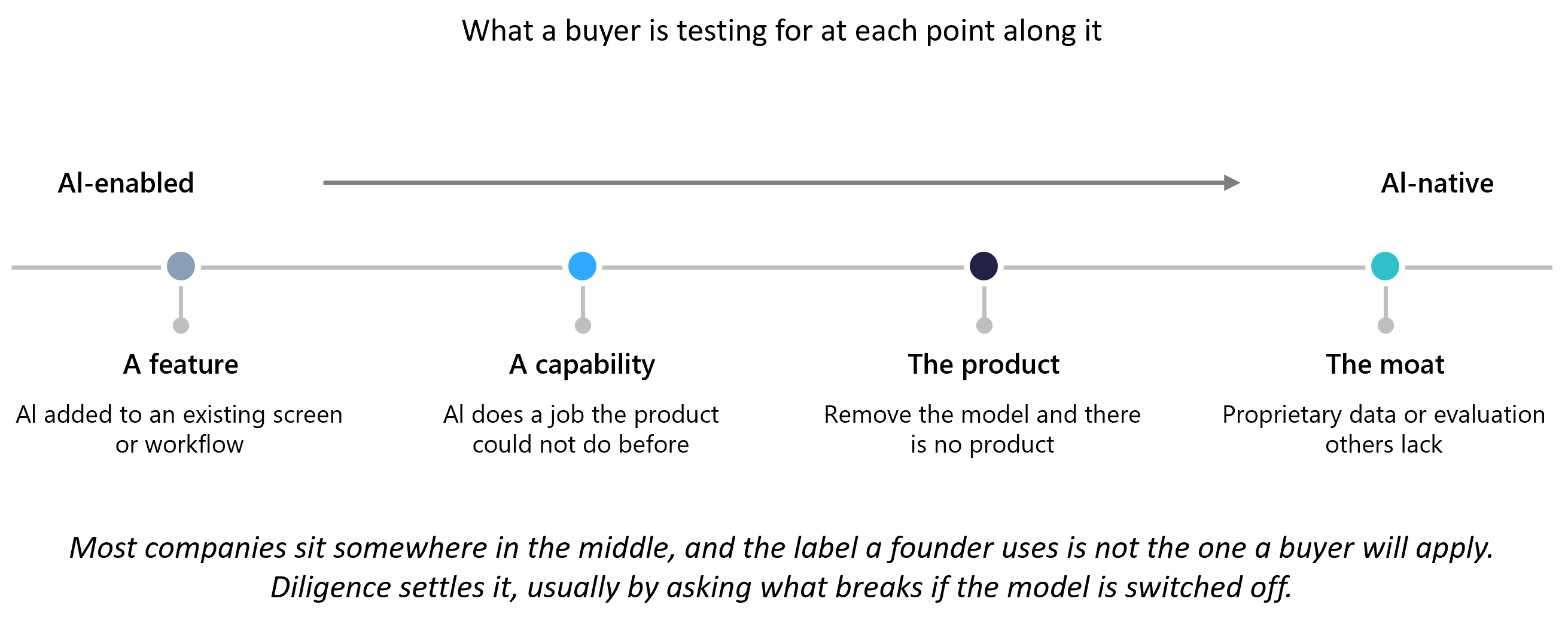
Buyers reach for substitution. Drop a cheaper model behind the product, or a general-purpose API, then watch output quality and watch the customer. If barely anything shifts, the AI was packaging all along. If the thing stops working, you sit nearer the native end and the valuation conversation usually travels with you.
The growth gap underneath the multiple gap
Here is the part that moves numbers. Working from preliminary second-quarter data supplied by Standard Metrics, the State of AI Report 2026 split companies built around AI from companies adding AI to software they already sold. Between $1m and $20m of annualised revenue, at the 75th percentile, the AI-native group grew 256% year on year. The AI-enabled group managed 90%. Above $20m it was 172% against 53%.
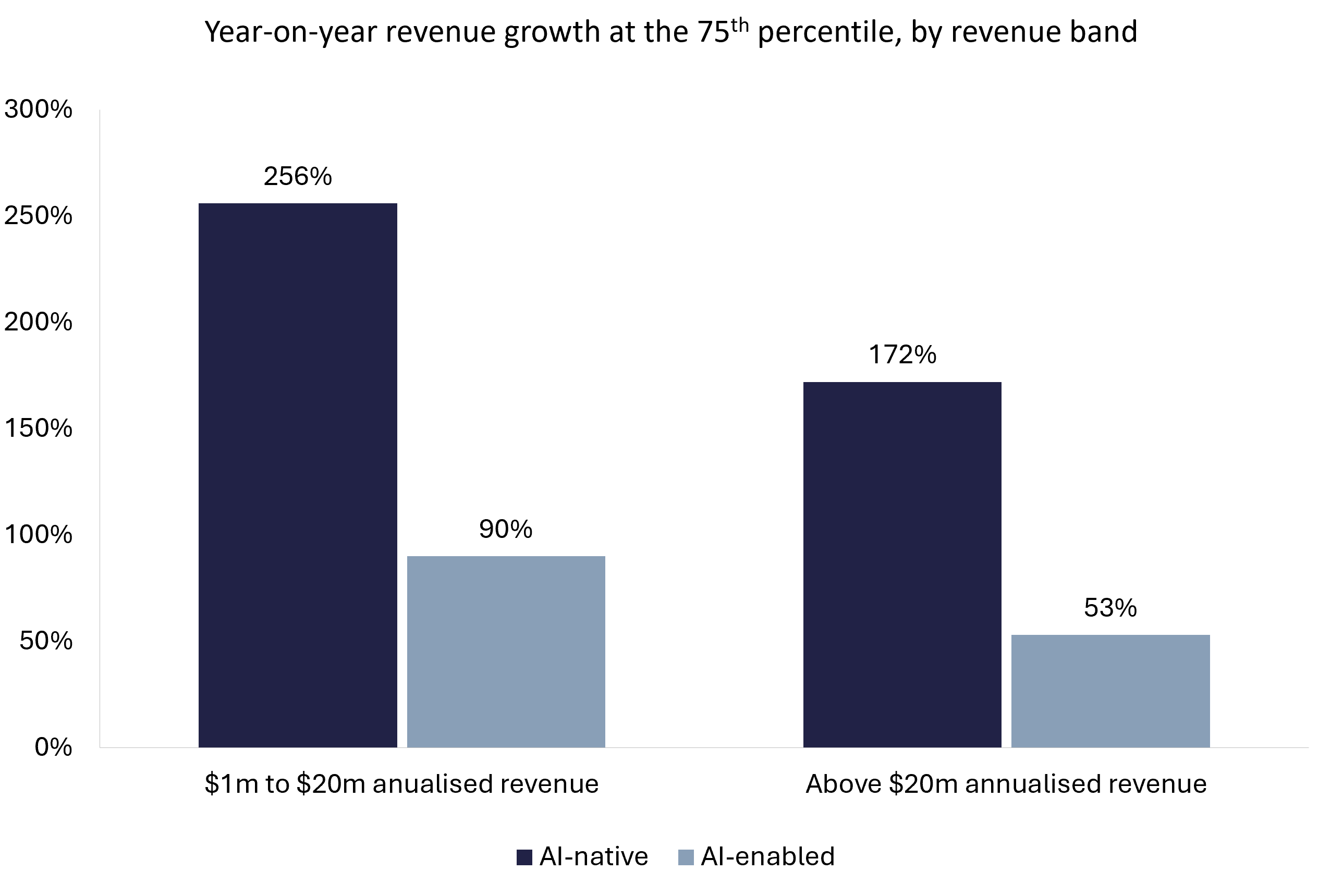
The report attaches a caveat to its own figures and it deserves repeating: none of this establishes causality. Companies growing at those rates may simply have had their own reasons for picking an AI architecture early.
Private investors price the same split. Carta's cap-table data put the median Series A pre-money valuation near $300m for AI foundational model companies in the first quarter of 2026, against roughly $55m for everything else. That is a venture figure rather than an acquisition figure, and the two behave differently, but it shows the distinction being made with real money well before anyone reaches a sale process.
Either way, growth is what carries a multiple. Meritech's analysis of public software companies puts growth at roughly five times the correlation with the multiple that free cash flow margin manages, and shows companies with similar Rule of 40 scores trading at 11.8x against 4.4x depending on the mix. So the growth differential above is probably doing more work on valuation than the classification itself.
A side-by-side comparison
What a buyer actually asks you to evidence differs between the two, and knowing that is worth more to a founder than any quoted range.
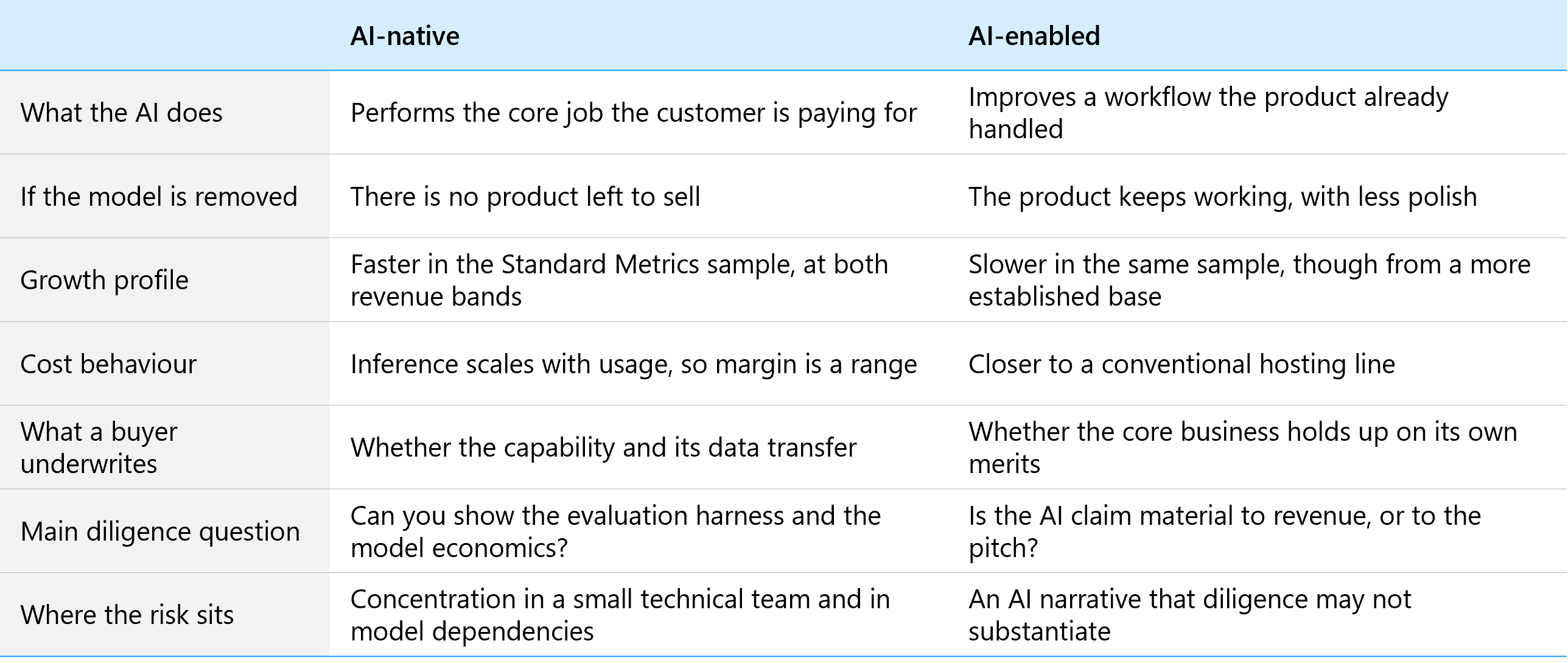
FE International's framing, drawn from the sources cited in this post. Neither term has an agreed industry definition, and individual businesses vary, so treat this as a general comparison rather than a classification test.
Why the cost line reads differently
Conventional SaaS gross margin is fairly predictable. An AI-native one arrives as a distribution, and on a per-unit basis the trend is encouraging: Epoch AI puts the cost of reaching a fixed benchmark score down roughly 47% per quarter since 2023, something like thirteenfold a year.
Cheaper calls invite more calls, though. An agentic product fires many model calls at one task, so the total bill climbs while unit cost collapses underneath it. The same report has the concentration too: $7,205 per employee per month for the median top-1% AI spender in a Ramp sample from August 2026, against $12.50 at the median firm.
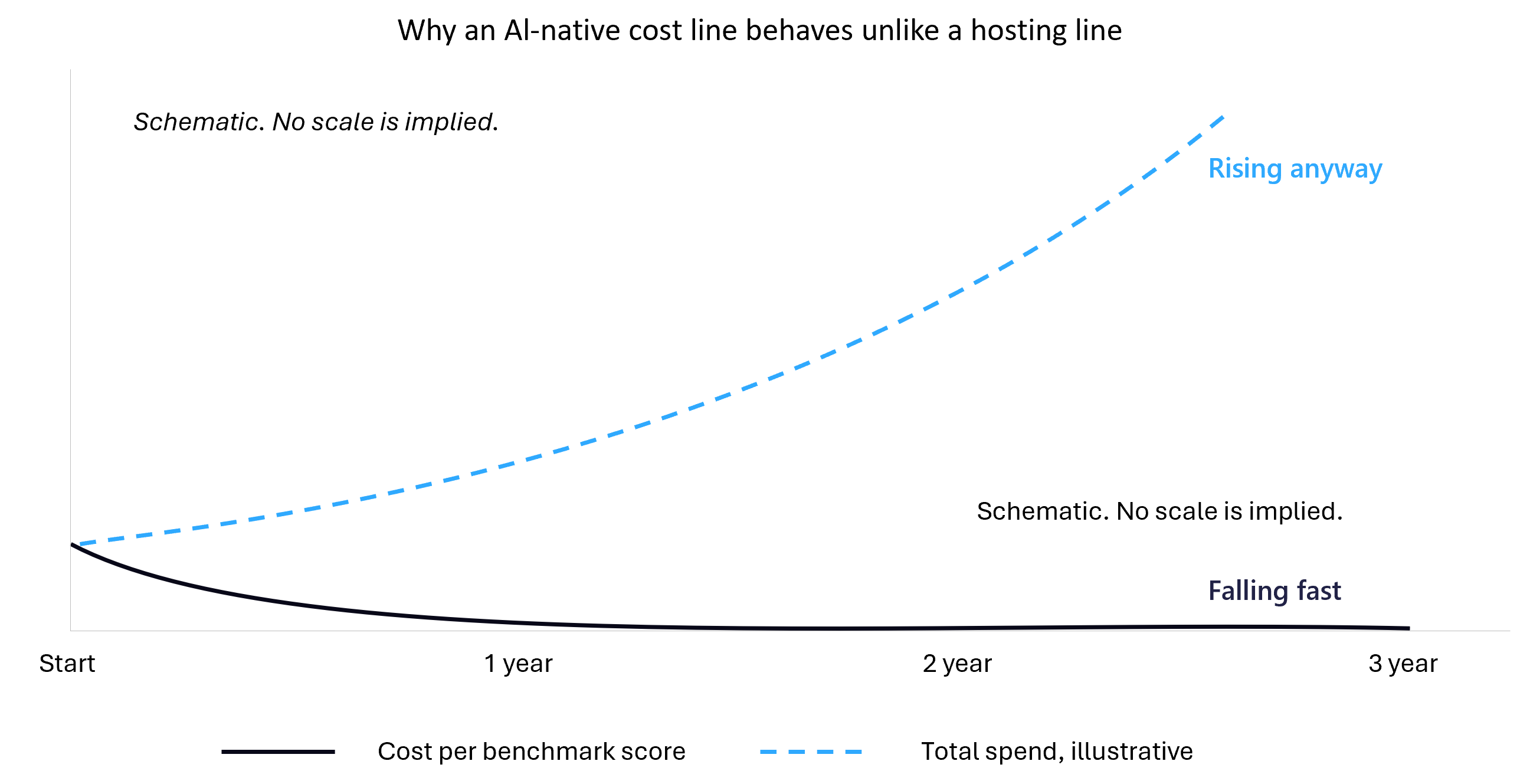
For a seller the implication is practical. A buyer will want the cost per completed task as a series, not a snapshot, and they will want to see what happens to it at two or three times current volume. Our note on the LTV to CAC ratio buyers expect and the retention work in net revenue retention and valuation both read differently once a cost line moves with usage.
Why buyers have become sceptical
Founders tend to underrate the regulatory backdrop here. Evelyn Woo, Grace Schuette and Atinuke Lardner set it out in The Regulatory Review in March 2026: the SEC has brought enforcement actions over what it calls AI washing, meaning AI claims the regulator judged exaggerated or unsubstantiated. No new statute was needed. The 1933 and 1934 Acts and Rule 10b-5 already reach it.
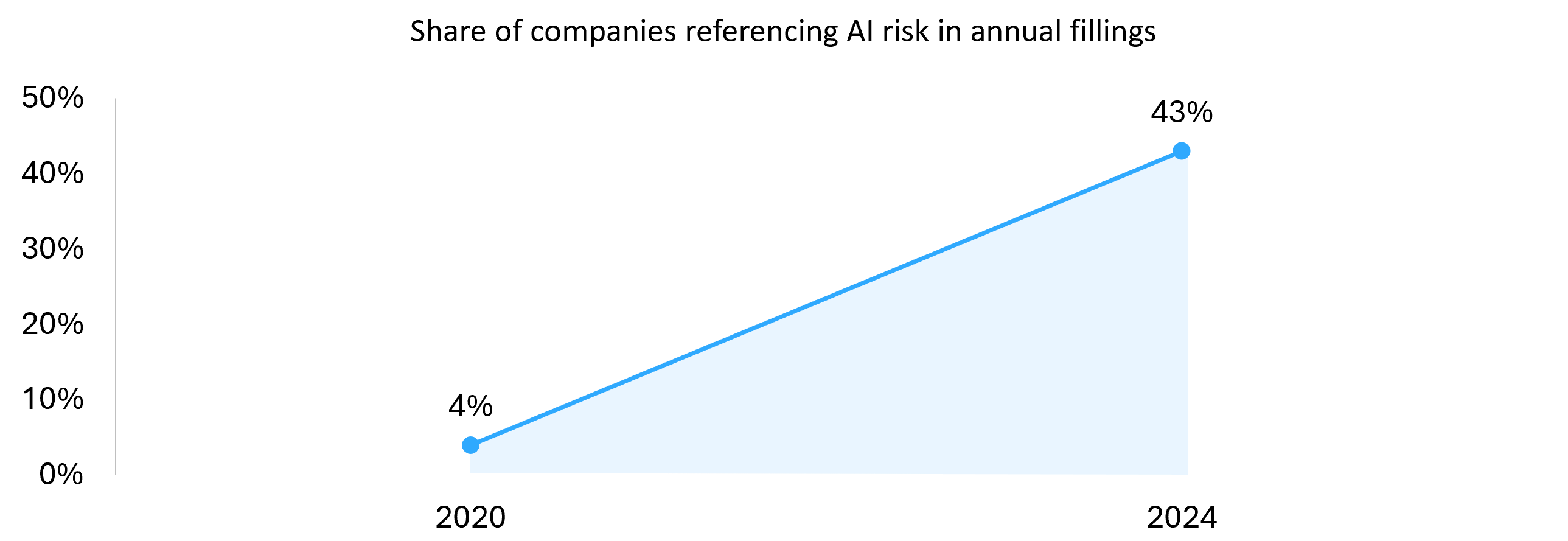
The sheer scale of the claiming is what stands out. Going through more than 30,000 annual filings, Uberti-Bona Marin and colleagues at Maastricht University found companies referencing AI risk climbing from 4% in 2020 to 43% in 2024. Over 7,800 filings in a separate Social Science Research Council working paper, and roughly two thirds of the AI disclosures led with benefits while leaving the significant risks out.
None of that says anything about any particular company, though it does explain the posture you will meet across the table. Once almost every filer mentions AI, no buyer can take the claim at face value, and the burden lands on evidence instead. Hence the AI section that has appeared in the diligence requests behind our due diligence checklist for buyers, and the shift in what buyers look for in a SaaS acquisition toward demonstrability over positioning.
What the buyer is really purchasing
Sorting by deal rationale instead of by label, BCG's 2026 M&A Report chapter on AI deals went through 11,372 AI-linked acquisitions. Capability buying took 4,394 of them, product expansion another 2,653, so 95% of the sample between the two. Which means most buyers are purchasing something a team can already do.
For AI-enabled sellers worried they sit on the wrong side of the line, that is genuinely useful news. No capability buyer requires the whole company to be AI-native. They want one specific capability that works and that transfers, a considerably lower bar than owning a frontier model. BCG also counted non-AI buyers outnumbering ecosystem buyers roughly two to one for AI targets, and acquirers like those price against comparables of their own.
The volume backs it up, with CB Insights counting 266 AI M&A deals in the first quarter of 2026, up 90% on the year. Our AI M&A trends analysis covers where that activity concentrates, and how to sell an AI SaaS business walks the process from the seller's side.
Which side you are on, and what to do about it
Five questions settle this faster than any amount of positioning work.
- What happens to the product without the model? Answer it honestly before a buyer asks, because they will run the substitution test either way and the answer is usually obvious within a demo.
- Is the data genuinely yours? Proprietary data and a real evaluation harness are what separate the native end of the spectrum from a thin wrapper, and they survive diligence in a way that architecture diagrams do not.
- Can you produce unit economics as a series? Cost per completed task over several quarters, with the inputs visible, answers the question a buyer actually has about margin.
- How concentrated is the capability? If two engineers hold the whole thing, that reads as key person risk in a business sale whichever label you use, and it tends to shape structure as much as price.
- Which comparison set will a buyer reach for? Classification moves a number before anyone argues about AI. Aswath Damodaran's NYU Stern sector data from January 2026 has US listed Software (System & Application) at 11.41x EV to sales and Computer Services at 1.48x, and a services-heavy implementation business can plausibly be filed under either. Working out which heading fits you is worth an afternoon.
Put an AI-enabled business with clean evidence and a transferable capability next to an AI-native one that cannot show its workings, and buyers frequently prefer the first. Our checklist for preparing a business for sale covers the evidence set, and the SaaS metrics that drive valuation covers what to measure.
The label is not the asset
Comparing AI-native vs AI-enabled SaaS multiples is really a question about what a buyer can verify. Growth, transferable capability and measured economics travel through diligence. A classification does not, and the published figures attached to each category vary enough that we would rather hand you the drivers than a range you could not defend in a room.
For the valuation inputs themselves, how to value an AI business and the AI business valuation model work through what moves a number. What multiple does a SaaS business sell for covers our private benchmarks, why some SaaS companies sell for 10x ARR examines the top of the range, and vertical versus horizontal SaaS multiples shows how much the comparison set matters. Current conditions sit in the mid-year tech M&A report.
FE International has completed more than 1,500 transactions since 2010 with a 94.1% success rate on private sales and acquisitions, and this classification question comes up in most AI processes we run. A business valuation works from your actual numbers rather than a category. Our notes on choosing an M&A advisor and the documents a buyer will ask for cover what follows, and you can open a conversation about selling your business without starting a process.
