

Is Now a Good Time to Sell an AI Company, and How Long Does It Take?

Is now a good time to sell an AI company only means something if you also know how long the sale would take, because a decision taken this month lands somewhere in late 2027. You are never really asking about today's market. You are asking about next year's.
The short answer is conditions are steadier than the headlines of earlier this year suggested, buyers are being choosier about what they pay up for, and an AI sale runs longer than the equivalent software sale for reasons you can name in advance and plan around.
Anything written about a market ages, and the figures below carry the day they were measured so you can judge how much weight to put on them. For the sibling view covering conventional software, our SaaS sale timeline breaks that process down stage by stage, and our note on AI M&A trends covers the wider backdrop.
Where software valuations actually sit in October 2026
Start with the number everyone quotes. Across public software companies, the median implied ARR multiple was 4.4x on 9 October 2026, against a pre-ZIRP median of 8.7x. On its own that looks like a straightforward halving, and plenty of commentary has treated it that way.
Now adjust for growth, which is what buyers do. Meritech Capital's figures put the median growth-adjusted revenue multiple at 0.29x against a pre-ZIRP median of 0.30x. Two per cent apart. Software is growing more slowly than it was in 2021, and the market is paying close to its long-run rate for the growth that remains.

That reframing matters for sellers because it changes what the headline multiple is telling you. Valuations have normalised rather than repriced, and a normalised market is one where benchmarks are clearer for both sides than they were at the peak. The direction over recent weeks has been upward too: Meritech's index was up 9% year to date at the time of writing, around 90% of its constituents had risen since the previous update, and public software crossed $3 trillion in combined market value that week.
One caveat we repeat to every client. These are public comparables. They inform private conversations, but they are not private transaction values, and the gap between the two moves independently. Our breakdown of what multiple does a SaaS business sell for sets out the private ranges separately, and the AI business valuation model covers how the same mechanics apply to AI businesses.
Buyers are being selective, which works in a prepared seller's favour
Sixty-two per cent of public software companies trade below 5x next-twelve-month revenue. Fourteen trade above 10x, up from eleven a fortnight earlier, and the top ten sit at 21.7x against the 4.4x median.
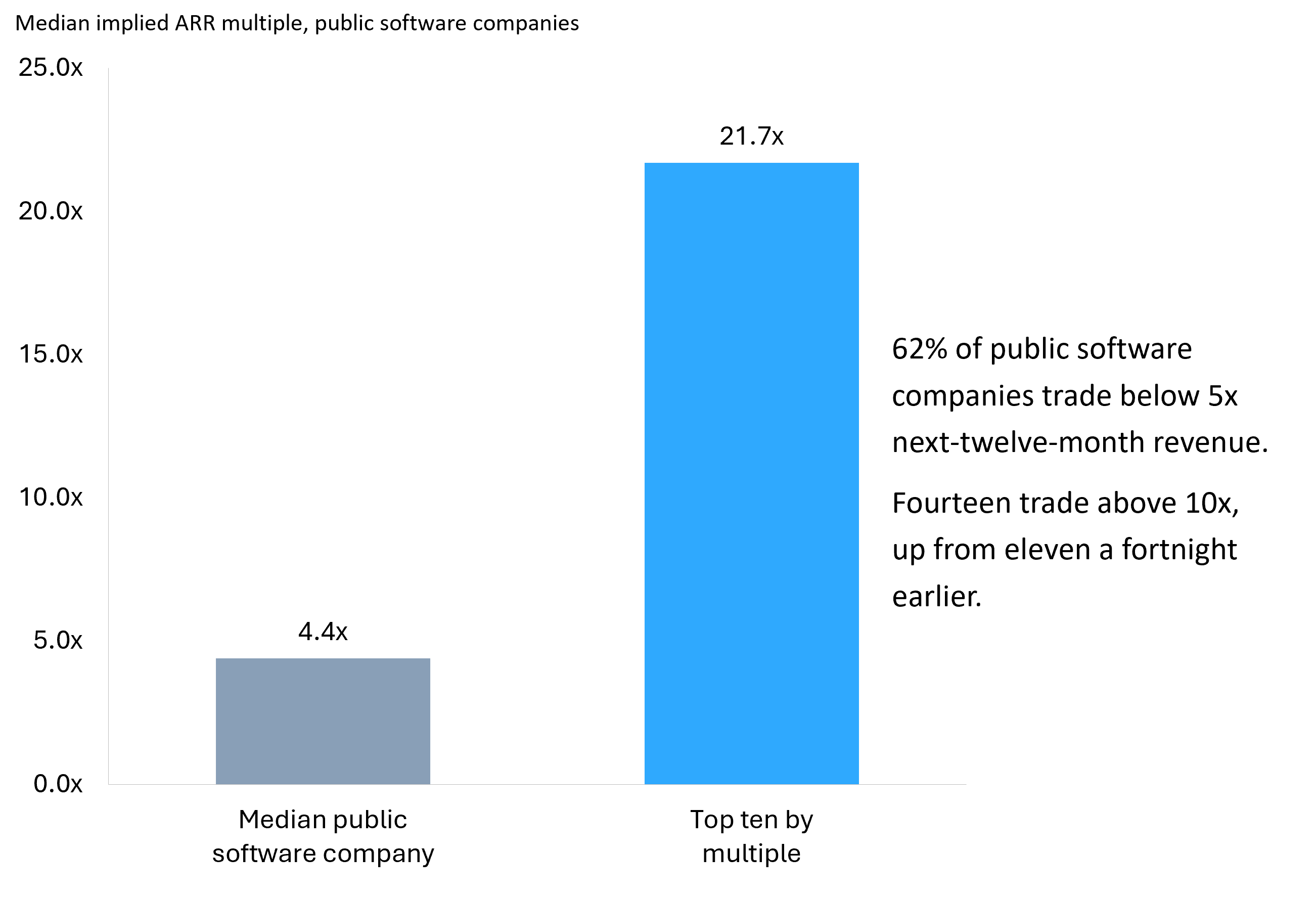
A five-fold spread inside one sector is a statement about selectivity. Bain's software research describes the same thing from the private side, noting a market separating between companies that can show measurable AI traction and those that cannot, and sponsors concentrating on bringing their strongest assets to market. Meritech's data points the same way: the companies with clear AI tailwinds have outperformed, and that gap widened through 2026.
For a seller that reads better than it sounds. When buyers are discriminating, a business that can evidence what it claims is competing against a thinner field for the same attention. Better that than a market where everything clears and the differentiator is whoever shouted loudest.
So is now a good time to sell an AI company?
For a business that can already evidence what it claims, the conditions look workable. Multiples have settled, buyers are active, and the spread rewards the companies that stand up to inspection. Deal completion rates support that: Datasite's third-quarter figures put global completion at 49%, three points higher year on year, with the Americas at 54%.
For a business where the evidence is not yet assembled, the question is slightly different, and the honest answer is that the market will still be there. PitchBook describes the venture-backed AI exit market as barbell-shaped, with exits achievable but the path "narrower and more acquirer-specific" than headline activity suggests. Narrow paths reward preparation.
Which brings us back to the calendar, because the gap between deciding and completing is where most of the answer lives.
How long does it take to sell an AI company?
On FE transactions, a conventional software sale runs eight to sixteen months from the decision to exit to funds received, with enterprise value the best single predictor of where a given business lands. An AI business sits at the longer end of that band more often than not, and sometimes past it.

Three things account for the difference, and none of them is mysterious. Clearing data rights usually waits on a renewal cycle. Technical diligence has no settled template, so it runs longer. And in a growing number of AI transactions the parties have to agree what is actually being bought before they can agree a price.
Preparation, and the renewal cycle hiding inside it
Most of the preparation work is the same as it would be for any software business: accrual financials, retention you can defend at cohort level, documented operations, clean IP ownership. Our checklist for preparing a business for sale covers that set, and none of it changes because the product uses a model.
What does change is the contract question. If your customer agreements do not clearly grant the right to use customer data for training, and do not clearly assign that right to an acquirer on a change of control, the fix is rarely a mid-process amendment. It is a conversation at renewal. Depending on your contract mix, that can mean a quarter or two before the position is clean, and it is the single most common reason we see an AI timeline run longer than the equivalent SaaS one.
The useful move is to run the contract review first rather than last. Identify which agreements are affected, sequence the renewals, and start the process once the answer is known rather than discovering it in week thirty.
Going to market, four to ten weeks
This stage behaves much as it does in any technology sale. Outreach, non-disclosure agreements, management calls and first-round indications compress into four to ten weeks when the process runs in parallel rather than one buyer at a time.
Confidentiality deserves a little more attention in an AI deal than elsewhere, because the buyer universe is smaller and often overlaps with your own commercial partners. Our guide to keeping a business sale confidential sets out the staging, and the question of which private equity, strategic and individual buyers to approach shapes how wide the first round goes.
Diligence, and why it runs longer here
Diligence is the longest block in almost any sale, and in an AI business it is longer still. The commercial and financial work is familiar. The technical work is not, and buyers are still building the template as they go.
Deloitte frames the requirement as a living, auditable baseline across IP, data, infrastructure and talent, and sets the operational test as whether a buyer can run the acquired capability on day one and improve it by day thirty. Meeting that means producing model and data provenance records, inference economics as a tracked series rather than a figure, evaluation results across versions, and a clear account of third-party dependencies. McKinsey puts deal rationale in the same place, describing acquirers pursuing access to talent, proprietary data and model IP rather than conventional scale economics.
Regulatory position adds its own thread. Parts of the EU AI Act apply on dated timetables, with high-risk obligations for Annex III systems following on 2 December 2027 under the current implementation timeline. A buyer looking at a 2027 completion will want to know you have mapped your obligations against those dates, since they inherit whatever has not been done. Which of the dates apply to a given business is a question for counsel.
All of it can be prepared in advance, which is the argument for starting early. The work is identical either way. Only one version of it happens without a buyer waiting. Our SaaS due diligence checklist and the list of documents you need to sell a company cover the conventional half, and FE's due diligence services exist to find the gaps before a buyer does.
Agreeing what is actually being bought
Here is the stage with no equivalent in a conventional sale. Deloitte observes that in AI transactions "the transaction perimeter is often undefined at close," and that acquirers are frequently after capability rather than ownership. Some of these deals end up as whole company sales. Others become licences, minority stakes, or arrangements built around specific people.
On FE deals the sellers who handle this well are the ones who formed a view early about what they were and were not willing to sell, and who priced each version before the buyer proposed one. Sellers who leave it open find the perimeter being defined for them, usually late, and usually in the buyer's favour. Allow a few weeks for it.
Retention of named technical people sits inside the same conversation. Deloitte calls speed-to-retention "existential" in these transactions, and our note on key person risk in a business sale covers the general version of the problem.
The AI sale timeline, stage by stage
A planning view of where the months go, with the items worth starting early marked. Figures are typical ranges on FE transactions rather than guarantees, and deal size moves all of them.

Putting both answers together
Is now a good time to sell an AI company? On the evidence available in October 2026, conditions are steadier than the first quarter suggested, buyers are selective in a way that favours businesses with something to show, and the market is paying close to its long-run rate once growth is accounted for. None of that is a forecast for next year, which is when a process started now would actually conclude.
That is why the two questions belong together. The timeline is the part you can influence, and the three AI-specific workstreams above are all things that can be started this quarter without committing to anything. Our guide to how to sell my SaaS business sets out the full sequence, what buyers look for in a SaaS acquisition covers what diligence tests, and the tech M&A mid-year 2026 report tracks where buyer appetite is concentrated.
FE International has completed more than 1,500 transactions since 2010 with a 94.1% success rate on private sales and acquisitions. If you want to know where your own timeline would start, or what a process might produce at today's benchmarks, a business valuation is the usual first step, and our note on how to choose an M&A advisor covers who should be in the room. You can also start a conversation about selling your business without committing to a process.
