

AI Funding Multiples vs AI Acquisition Multiples

A founder we spoke with last year had raised at a number she could recite from memory. Everyone on her cap table could. When a buyer later put an indication in front of her, the implied multiple was a long way from it, and her first instinct was that something had gone wrong with the process.
Nothing had. The comparison of AI funding multiples vs AI acquisition multiples trips up more founders than almost anything else in a sale, because the two figures look like the same kind of number and are not. One prices a slice of shares against what might happen. The other prices every share at once against what already does.
Neither one is wrong, by the way, and neither is the real one. If you know which question each was built to answer, you walk into a process with expectations that survive contact with a term sheet. If you don't, the first indication tends to land badly.
The short answer
A funding round prices the newest shares. A buyer prices the business. Most of what follows is just that sentence, unpacked.
Here is the mechanics of it. An investor leading a round buys preferred stock, and preferred stock carries terms that common shareholders never see. The headline post-money figure then gets worked out as though every share in the company were worth whatever that preferred share just went for. Useful convention. Also, by construction, a ceiling rather than a midpoint.
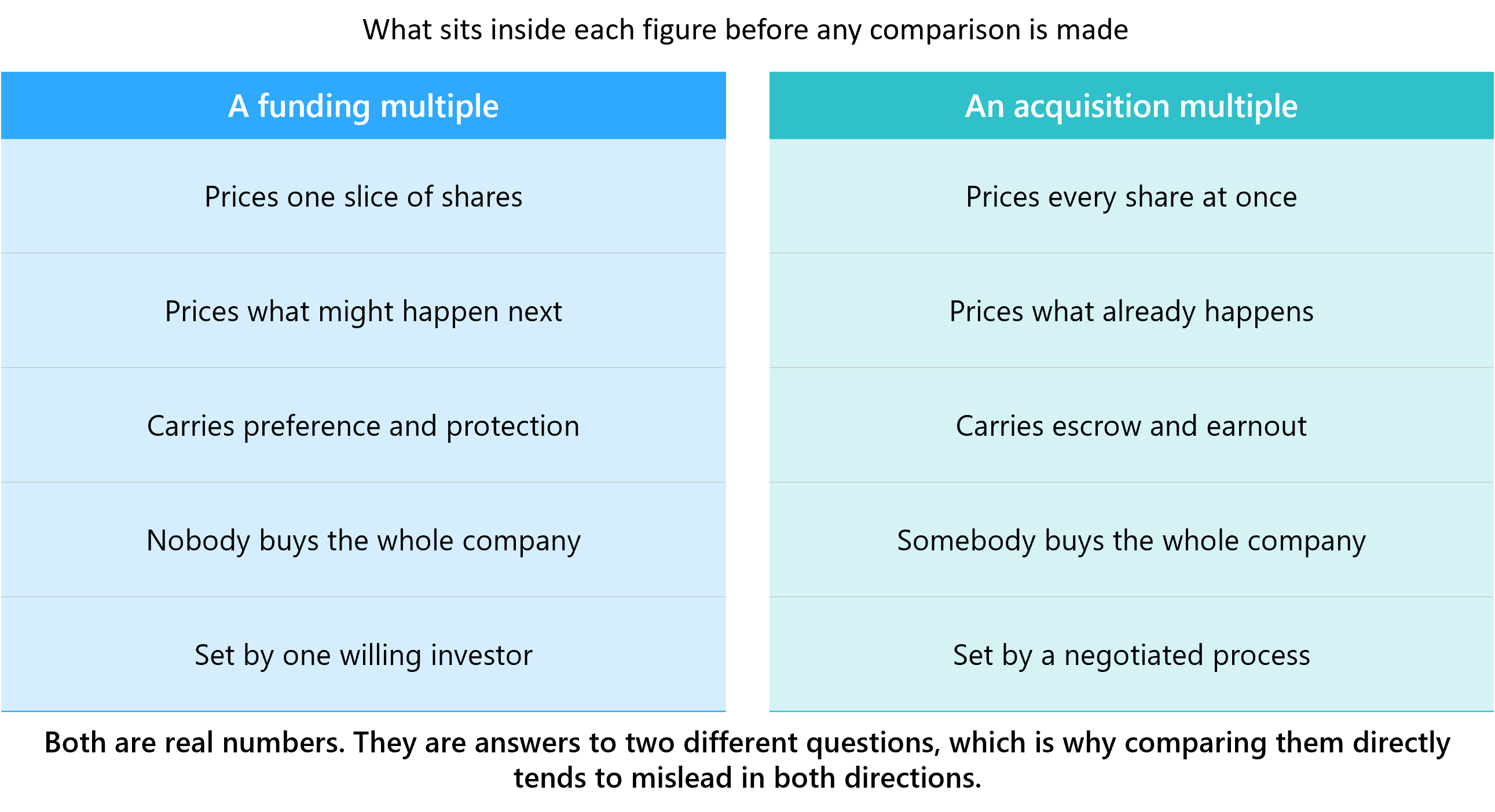
What a funding multiple is actually pricing
Carta's cap-table data puts the point better than any argument could. In the first quarter of 2026, the median primary pre-money valuation at Series A sat near $300m for AI foundational model companies and near $55m for everything else. Same round label, same quarter, roughly five times the number.

Nobody is being careless with a gap that size. What they are buying is an option on a market that might turn out to be enormous. Hyperscaler capital expenditure of roughly $780bn this year, annual AI infrastructure spending nearing $1.5tn by 2031, an AI market somewhere around $6tn a year by then: those are the numbers in Bain's Technology Report 2026, on Bain's own assumptions. Bain is equally clear that about $4.2tn of that still needs new sources of value to show up. Price a round today and you are betting on who captures it.
The round data shows you the size of that bet. Roughly $226bn went into private AI companies in Q1 2026 on CB Insights' count, 94% of it through deals of $100m or more, average deal size for the year running at over four times the 2025 full-year figure. Then the PitchBook-NVCA Venture Monitor for Q2 2026, as SiliconANGLE reported it: $412.7bn of US venture deal value in the first half, around $355.9bn of it, call it 86%, into AI. Structural rather than cyclical, was PitchBook's phrase for the shift. Strip the headlines away and what those numbers describe is investors competing hard for access to a fairly small group of companies.
How quickly those prices move is the other half of the story. The same reporting notes Anthropic's pre-money valuation rising 157% in roughly three months, from about $350bn to about $900bn. An acquisition multiple does not behave like that, because the thing it is measuring does not change at that speed.
The underlying market is also in better shape than it was. Carta puts down rounds at 11.4% of priced rounds in Q1 2026, back in line with 2019 and 2020 levels after a 2023 peak near 22%, with Series B valuations up 17.2% and Series C up 12.5% year on year. Founders raising now are doing so into a more settled pricing environment than founders raising three years ago.
What an acquisition multiple is actually pricing
A buyer has a harder job. They are not buying a slice with downside protection attached. They are buying the whole thing, usually with cash they have to find, and then they own whatever is inside it. Contracts that may or may not assign. Compute costs that may or may not scale the way the model says. A small group of people whose continued presence the thesis quietly depends on, which is the shape of key person risk in a business sale.
So the question shifts from what could this become to what does this reliably produce, and the evidence bar moves with it. Our note on what buyers look for in a SaaS acquisition covers the diligence side of that, and the due diligence checklist buyers work from shows the level of detail involved.
There is one measure that gets nearer to the comparison founders actually care about than any multiple does. The 2026 SRS Acquiom M&A Deal Terms Study tracks what a transaction returned against the equity investors had put in. Take the 2025 numbers out of Fasken's summary and you get 6.5x on average and 3.3x at the median, both ahead of the 5.6x and 2.5x recorded a year earlier.

The distance between those two series is what to read, not either one alone. A handful of very large outcomes drag the average up to where it sits, and that same pull is what makes headline comparisons unreliable in both directions.
The structural reason the funding number sits higher
There is a well-documented mechanism here, and it is worth knowing because it explains the gap without anyone having to be wrong. William Gornall and Ilya Strebulaev set it out in Squaring Venture Capital Valuations with Reality, an NBER working paper from October 2017. They took 135 US unicorns, modelled the actual terms attached to each share class, and compared the result with the reported post-money figure.
Post-money valuations sat on average 50% above their modelled fair value, with a median of 37%. For common shares, which is what founders and employees usually hold, the average was 58% and the median 41%. Sixty-five of the 135 fell below a $1bn fair value once the terms were accounted for.

Now, that paper is from 2017 and none of its companies are AI companies, so take it as the mechanism rather than a reading of this market. The mechanism itself has not moved. Doing the work are terms you will recognise: seniority that puts the newest preferred ahead of everyone else in a sale, liquidation multiples above 1x, participation rights, conversion vetoes, IPO return guarantees. For how those behave specifically when a company gets sold rather than floated, there is a Stanford Law analysis of liquidation preferences in M&A worth reading.
The practical consequence is simple enough. If your last round carried a 1x non-participating preference and nothing else, the distance between your post-money number and what common shares would see in a sale is relatively small. If it carried seniority, a multiple above 1x and participation, that distance can be considerable, and it is arithmetic rather than anybody's opinion about your company.
A side-by-side view
Set them side by side and the two figures turn out to share almost nothing beyond the word multiple.
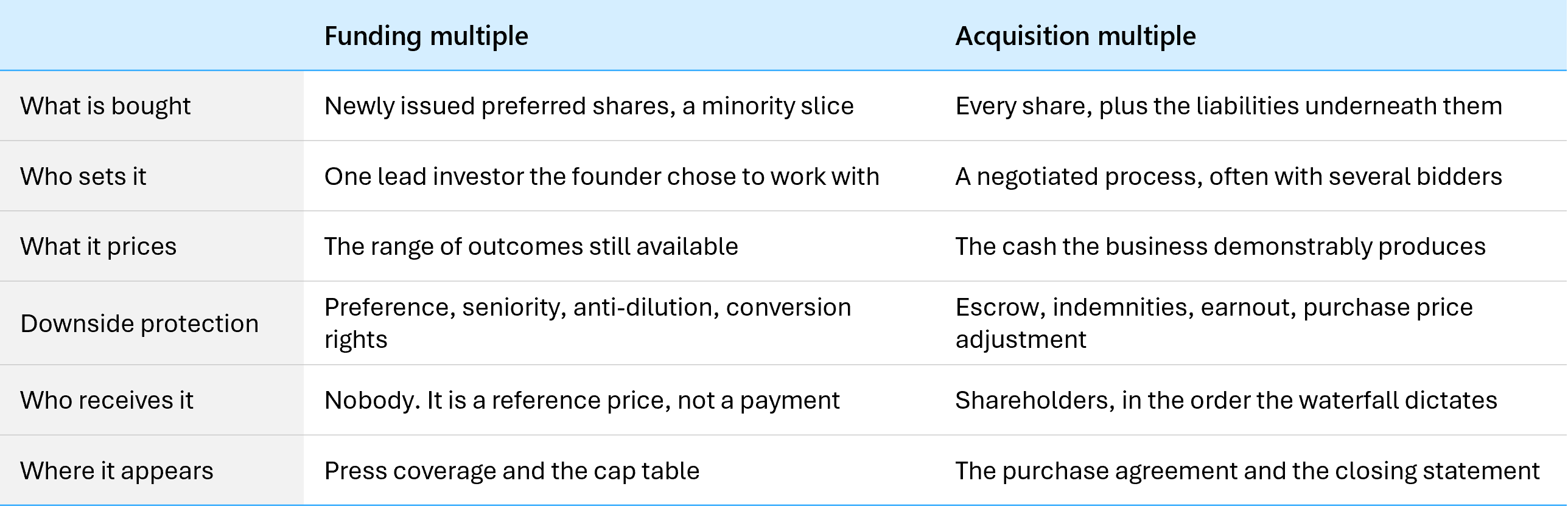
FE International's framing. Terms and process vary by deal, buyer and jurisdiction, so treat this as a general comparison rather than a description of any particular transaction.
How to read both numbers before a process starts
None of this argues against raising, and none of it argues against selling. What it argues for is knowing which number is in front of you. Five questions tend to get you there.
- What does the waterfall say, as opposed to the headline? Running what common shares would actually receive at four or five different total consideration figures takes an afternoon, and afterwards every conversation about price reads differently.
- Which parts are story and which parts are evidence? Investors funded the story. A buyer underwrites the evidence, which pushes weight onto the measurable things covered in the SaaS metrics that drive valuation and net revenue retention and valuation.
- How old is the comparison you are working from? Carta's figures move quarter to quarter, and the SRS Acquiom series shifted noticeably between 2024 and 2025. Anything quoted from two years back is describing a different market than the one you would sell into.
- What is the structure, not just the price? Cash at close, rollover, escrow, earnout: each of those changes what a headline multiple is worth to you in practice, so one number can mean several quite different things depending on how it gets paid out.
- Who would actually buy this? Strategics, sponsors and individual operators all underwrite differently, as our comparison of private equity, strategic and individual buyers sets out, and that tends to shape the multiple more than the sector label does.
Where you sit on that list matters a good deal more than where your last round priced. In our experience the companies that finish a process with the smallest gap between what they expected and what they got are the ones that did the measurement work early, which is most of what our checklist for preparing a business for sale is about.
Two numbers, two questions
Working out which figure is honest gets you nowhere, since both of them are. Ask instead what each was built to answer, then go and do the work that moves whichever one you care about. Reading AI funding multiples vs AI acquisition multiples as a single scale is what produces the surprise in the first place.
With a sale anywhere on the horizon, the groundwork will look familiar enough. Our pillar on how to sell my SaaS business covers the process end to end, the step-by-step guide for founders runs the stages in order, how to value an AI business goes through the inputs, and documents you need to sell a company lists what a buyer will ask for. Market context sits in our AI M&A trends note and the mid-year tech M&A report.
FE International has completed more than 1,500 transactions since 2010 with a 94.1% success rate on private sales and acquisitions, and this particular gap comes up in most venture-backed processes we run. If you want a view on what your own numbers would support, a business valuation is the usual first step, our note on choosing an M&A advisor covers who should be in the room, and you can start a conversation about selling your business without committing to a process.
AI funding multiples vs AI acquisition multiples is a comparison worth settling early, while there is still time to act on the answer.
