
.jpg)
When Is the Right Time to Sell an AI Company?
Asking when is the right time to sell an AI company usually means asking one of two different questions without separating them. The first is whether the business is ready. The second is whether the market is. They have different answers, they move at different speeds, and only one of them responds to anything you decide this week.
The question also arrives with more urgency attached than it did two years ago. Founders of AI and AI-adjacent businesses are revisiting exit plans earlier than they expected to, and the reasoning is not irrational. The baseline that buyers price software against has moved: Bain & Company reports median year-on-year revenue growth at US public software companies at about 10% in 2025, against a 2021 peak of 27%, with median quarterly net revenue retention moving from 117% in the first quarter of 2021 to 108% by the third quarter of 2025. When the reference points shift, the instinct to move earlier follows.
What follows does not tell you when to sell, because nobody can. It sets out the three clocks that together decide what a particular date is worth, which of them you control, and the signals that tend to point one way or the other. The companion piece on AI M&A trends covers the market backdrop, and our note on what buyers look for in a SaaS acquisition covers the criteria side of the same decision.
Three clocks run at once, and only one is yours
Most timing advice collapses into a single question about market conditions. That is the one variable a seller has no influence over at all. Separating it from the two that are at least partly yours makes the decision tractable.
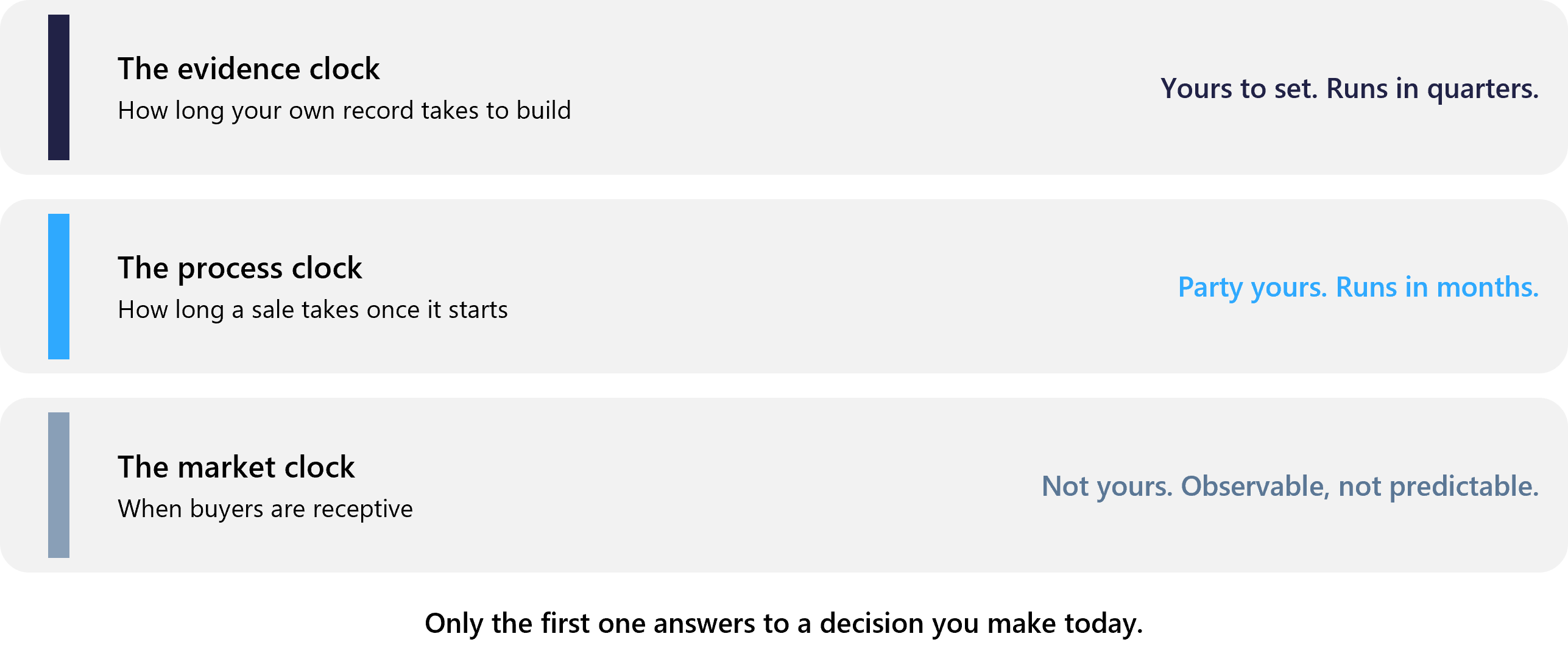
The evidence clock is the record a buyer will verify: contracts, data rights, retention behaviour, documented process, a finance function that produces the same number twice. It is slow, it is entirely yours, and it is the one most often compressed when a seller feels hurried.
The process clock starts the day a sale begins and ends the day funds arrive. It is partly yours, in the sense that preparation shortens it, and partly a function of buyer behaviour and regulatory timetables.
The market clock is the one everyone watches. It can be observed in deal counts, completion rates and published buyer intent. It cannot be forecast, and a timing plan that depends on forecasting it is not a plan.
The market clock gets the attention. The evidence clock decides the outcome.
Why the question feels urgent right now
Three things appear to be happening at the same time, and together they explain the change in temperature.

The first is the reset in the chart above. Buyers anchor private expectations to public comparables, so a different public baseline shows up in private conversations within a quarter or two. Our analysis of what multiple does a SaaS business sell for sets out the private ranges that sit underneath that, and the AI business valuation model covers how the same mechanics apply to AI businesses specifically.
The second is that the field is sorting itself. Bain describes a market separating between companies that can show measurable AI traction and those that cannot, and notes a gap between what buyers and sellers expect on value. A seller who believes they sit on the favourable side of that sorting has an incentive to be measured against it while it is still being drawn.
The third is consolidation. McKinsey describes technology M&A as entering a phase in which AI capability is bought rather than built, with deal rationale moving toward access to talent, proprietary data and model IP rather than conventional scale economics. Periods of consolidation tend to reward companies that are ready when the buyer arrives rather than companies that start preparing afterwards.
None of that establishes that sooner is better. It establishes that the question is being asked for sound reasons, which is a different claim and a more useful starting point.
The evidence clock: the part you actually control
Buyers of AI businesses are increasingly asking to see things rather than be told them. Deloitte's work on how AI companies are rewriting M&A describes the requirement as a "living, auditable baseline, across IP, data, infrastructure, and talent," which is a specific way of saying that a file assembled during a process reads differently from a record kept as a matter of routine.
That distinction is what makes the evidence clock a timing variable rather than a preparation task. Several of the things buyers verify can only be demonstrated over elapsed time:
- Retention behaviour, which needs enough renewal cycles to show a pattern rather than a snapshot.Inference cost per transaction, which is more persuasive as a tracked series than as an estimate.Evaluation results, which carry weight when they show a trajectory across versions.Revenue under contracts that clearly grant the data rights you have been exercising, which can take a renewal cycle to put right.Management depth, where the question is whether the business runs without you, and the proof is that it already has.
That last point is worth separating out, because key person risk in a business sale is both one of the most common findings in diligence and one of the slowest to remedy. Our checklist for preparing a SaaS business for sale and the companion list of documents you need to sell a company set out what the finished record looks like. The timing point is simply that most of it is measured in quarters, not weeks.
The process clock: what "now" means on a calendar
Sellers often underestimate the gap between deciding to sell and receiving funds. It is worth looking at the actual shape of it before fixing a date.

On FE International's own transactions, the span from decision to funds received has typically run from around eight months at lower enterprise values to around sixteen at higher ones, with the active sale process accounting for six to nine months of that and preparation making up the balance. Our detailed view of how long it takes to sell a SaaS business breaks that down stage by stage.
Datasite's platform data for the third quarter of 2026, published on 8 October, puts median active diligence at 170 days globally, against 174 a year earlier, and median preparation of the data room itself at 12 days, down three days year on year. The second figure is the instructive one. Building a data room is quick. Building the record that goes into it is not, which is the whole of the timing argument in one comparison.
The practical consequence is that a founder deciding today is choosing a completion date somewhere in late 2027, not a date this year. Any view about market conditions is therefore a view about conditions roughly a year out, which is a reason to weight the clocks you control more heavily than the one you do not.
The market clock: what the current quarter shows
The market clock can still be read, provided the reading is treated as description rather than forecast. Two observations from the most recent data are worth holding together.

Datasite's third-quarter figures show global completion rates at 49%, three points higher year on year, with the Americas at 54% and Asia-Pacific at 56%. Over the same quarter, technology, media and telecommunications kickoffs ran 15% below the prior year. Read together, those two numbers describe a quarter in which fewer technology processes started and a higher share of the processes that did start reached completion. For a prepared seller that combination is not an unfavourable one, since it implies less competition for buyer attention among the processes that are running.
Buyer intent points the same way. Deloitte's survey of 1,500 US corporate and private equity leaders, published in January 2026, found 90% of private equity and 80% of corporate respondents expecting to do more deals over the following twelve months. PitchBook adds a useful qualification, describing the venture-backed AI exit market as barbell-shaped, with exits remaining achievable but the path "narrower and more acquirer-specific" than headline activity suggests. Our tech M&A mid-year 2026 report sets out the same picture from FE's transaction data.
Signals that tend to argue for starting sooner
None of these is decisive on its own, and all of them are patterns rather than rules. They appear often enough in practice to be worth checking against your own position.
- The record is already there. If retention, contracts, data rights and financials would survive scrutiny today, the main argument for waiting has already been satisfied.Your differentiation is a position rather than a capability. Ownership of a workflow, a customer base or a data pipeline ages more slowly than a model advantage does.A credible buyer has approached you. Inbound interest is not a reason to sell, but it is a reason to find out what the business is worth before the conversation goes further.The next phase needs capital or people you would rather not raise or hire. A sale is one of several answers, and it is easier to weigh when the alternatives are priced.Concentration is rising. Revenue gathering into fewer customers, or capability gathering into fewer people, tends to read worse later than it does now.
If several of these apply, the sensible next step is usually a business valuation rather than a process, because it converts an open question into a number you can test the other options against.
Signals that tend to argue for waiting
- A material part of the thesis cannot yet be evidenced. Where a buyer has to take something on trust, structure tends to move value out of the closing payment and into a condition.Data rights are unresolved. Training rights and change-of-control assignment are contractual questions, and they are usually fixed at renewal rather than at signing.The business still runs through you. This is the slowest item to remedy and among the most visible in diligence.A single quarter is doing too much work. One exceptional period rarely changes a valuation and can invite questions about what preceded it.You have no view of what you would do afterwards. Sellers without a next step tend to negotiate differently, and it shows.
Working through these is what making your business more attractive for acquisition actually consists of, and the SaaS due diligence checklist is a reasonable way to find out which of them apply to you. FE's due diligence services exist to surface these before a buyer does.
The timing error that is hardest to undo
There is a version of urgency that works against itself. A seller concludes the window is moving, compresses preparation to reach the market sooner, and arrives with a record that cannot answer the questions buyers now ask. The response is predictable: more of the price sits behind a condition. The SRS Acquiom 2026 deal terms study, as summarised by Fasken, covering more than 2,300 private-target transactions closing between 2020 and 2025, found earnouts in 24% of 2025 deals with a median earnout worth about 34% of the closing payment.
Put plainly, haste on the evidence clock is paid for on the process clock and in the deal terms. The observation is not new. FE's long-standing position on the timing of your business exit has been that selling under pressure tends to cost, and nothing in the 2026 data contradicts it. What has changed is the list of things a buyer wants evidenced, not the principle that evidence takes time.
Moving the date forward is easy. Moving the evidence forward is the part that takes planning.
Putting a date on it
The honest answer to when is the right time to sell an AI company is that the date follows from the evidence rather than the other way around. A founder who can already show what a buyer will test has the widest set of options, including the option to wait, and that optionality is worth more than any attempt to read the market a year ahead.
The useful exercise is therefore not to pick a quarter. It is to list the things a buyer would want evidenced, mark which of them are already true, and see how many quarters the remainder would take. That list is the timetable. Everything written above about market conditions is context for it, not a substitute. The broader sequence is set out in our guide on how to sell my SaaS business, and the valuation side in our guide to how to value an AI business.
FE International has advised on more than 1,500 transactions since 2010, with a 94.1% success rate on private sales and acquisitions. If you want a view on where your business sits against the three clocks above, you can request a business valuation or start a conversation about selling your business without committing to a process.
