

What Is a Reverse Acquihire, and Should You Accept One?

If you have been asked what is a reverse acquihire, the short answer is that it is a way for a large company to obtain the parts of a startup it wants without buying the startup. It hires named people directly, pays the company a fee, and usually takes a non-exclusive licence to the technology. No merger happens. The company continues to exist, with its shareholders, its remaining staff and its contracts still in place.
The structure became prominent through a run of transactions between 2024 and the end of 2025, and it has since attracted attention from legislators, regulators and legal academics. What has had less attention is the question a founder on the receiving end actually faces, which is where the money goes and who is left holding what.
This page sets out the structure, summarizes what has been reported about the deals that defined it, and ends with a checklist of questions worth answering before accepting one. Everything here describes publicly reported transactions and published commentary. None of it is legal, tax or financial advice, and the terms of any particular offer will differ, so take your own professional advice on the specifics. For the wider market picture, see our note on AI M&A trends.
What a reverse acquihire is
A conventional acquihire is a purchase: a company is bought largely for its people rather than its product. A reverse acquihire inverts that. The people move, the money moves, and the company does not change hands at all.
Writing in the Yale Law Journal in June 2026, David T. Wong sets out the components. The acquiring firm agrees to hire some, but not all, of the target's leadership, researchers or engineers. It pays the target a significant fee, described as ranging from hundreds of millions to billions of dollars. It obtains something of value, typically a non-exclusive licence to the technology, and in one recent case a minority stake. And, as the Comment puts it, "the two firms do not merge, nor does one firm formally acquire the other."

That last column is the whole of the founder's problem. In a conventional sale, the thing being sold is the company, so the proceeds run through the cap table in an order everyone agreed in advance. In this structure the company is not sold, so the money arrives as something else: a licence fee here, compensation there. How it is characterised determines who receives it.
The cap table governs a sale. It does not necessarily govern a licence fee and a hiring package.
Why the structure exists
Three explanations appear across the published commentary, and they are not mutually exclusive.
The first is that buyers want capability rather than ownership. Deloitte describes acquirers racing to access capability, naming talent, intellectual property and inference infrastructure, and notes that in AI transactions "the transaction perimeter is often undefined at close." McKinsey makes a related point, observing that open-weight models and cross-border regulation are together pushing some activity toward minority stakes, partnerships and acquihires rather than full acquisitions.
The second is speed. Hiring a team and signing a licence can be done in days. An acquisition of the same business is a process measured in months, as our guide to how to sell my SaaS business sets out.
The third is regulatory. Goodwin's antitrust and competition technology update for the first half of 2026, published in July 2026, notes that these arrangements fall outside Hart-Scott-Rodino notification thresholds as currently structured, because those thresholds cover acquisitions of voting securities, assets or non-corporate interests. Whether a non-exclusive licence plus hiring amounts to an acquisition of assets is described as an open question with no settled answer.
The deals that defined the pattern
In February 2026, Senators Elizabeth Warren, Ron Wyden and Richard Blumenthal wrote to the Department of Justice Antitrust Division and the Federal Trade Commission about these arrangements. Their letter sets out the transactions in one place, which makes it a useful summary of the reported record.
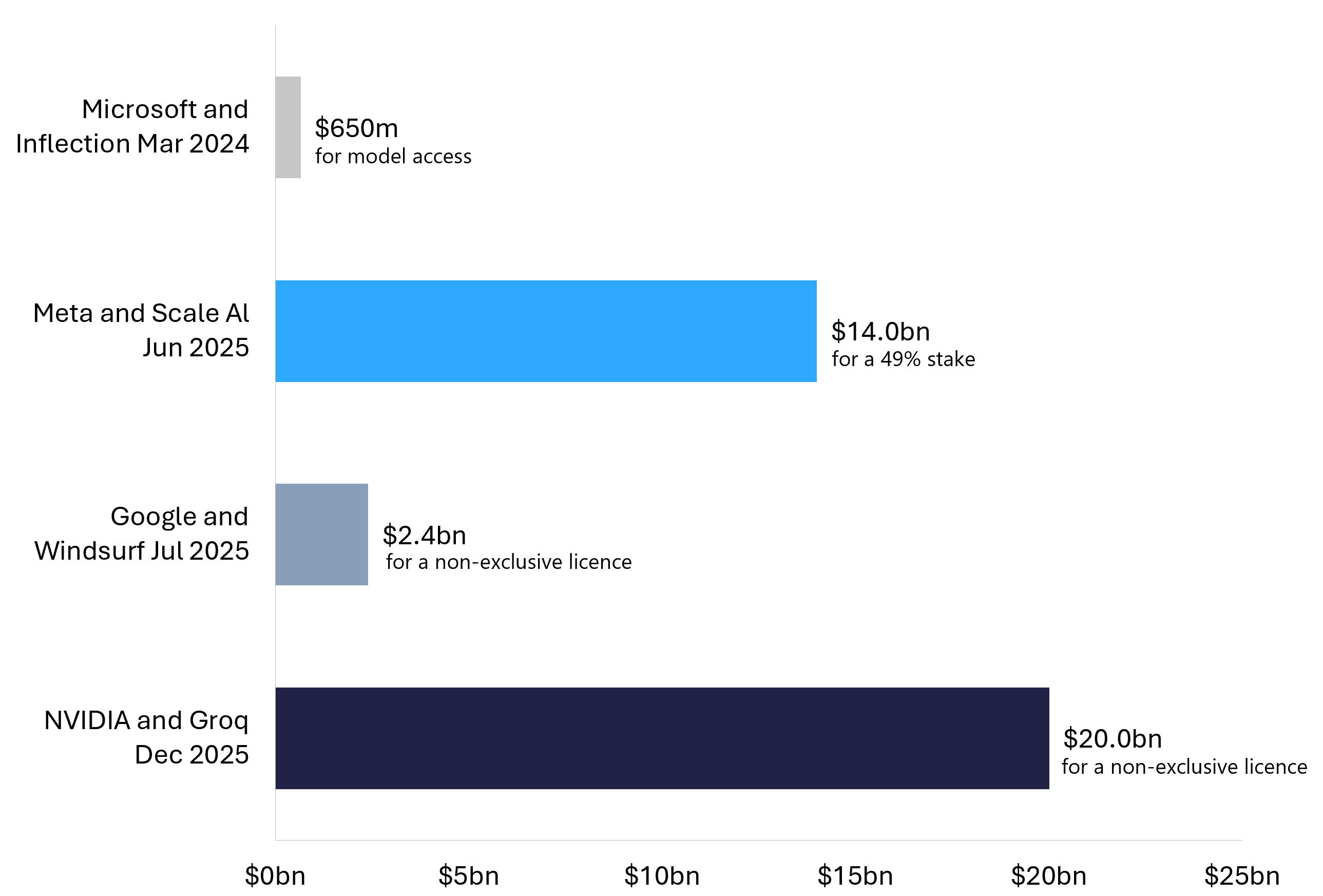
Two things in that record are worth drawing out. The reported amounts are not small, so this is not a structure used only where a conventional sale would fail. And the senators record consequences for the companies left behind: after the Meta arrangement, they write, Scale AI's largest customer and other clients ended ties, with one investor comparing the company to a "gutted fish," and the company reduced headcount by 200 full-time staff and ended work with 500 contractors within weeks. Those are the senators' characterizations of reported events rather than findings of fact, and the companies have not accepted them.
Where the money actually lands
The most detailed public account of how one of these payments was divided concerns the Google and Windsurf arrangement of July 2025. Reporting by TechCrunch in August 2025, based on people familiar with the deal, describes a split that is worth reading closely, because it shows the mechanism rather than just the headline.

The structural lesson sits in the right-hand half. Money characterized as compensation for the people being hired does not run through the cap table. It goes to those people. On the reported account, a substantial portion of that half went to the two co-founders, and the same reporting states that employees hired in the prior year received no payout from the arrangement, while some of those Google did hire had existing stock grants revoked.
What happened next matters too, and it was not part of the original arrangement. Within days, a separate company acquired what remained. Reporting at the time quotes the acquirer's statement that "100% of Windsurf employees will participate financially in this deal" and that employees would have "vesting cliffs waived for their work to date." That outcome appears to have been a response to the position the first arrangement created rather than something guaranteed when it was signed, which is precisely why it belongs in a founder's thinking rather than in the footnotes.
None of this establishes what any future offer would look like. It is one reported transaction. What it illustrates is that the question "how much is the deal worth" and the question "how much reaches each group of people" are separate questions with separate answers, and that the second one is decided by how the payment is characterized.
What happens to the company that remains
The entity survives, and so does everything attached to it: the shareholders, the customer contracts, the obligations, the people who were not named. What it may not retain is the leadership and the technical core that made it work, which is the concern the Clayton Act analysis published in September 2026 is built around. Dan Mogin of Mogin Law summarizes the academic argument as turning on whether "economically significant assets changed hands," with human capital potentially being that asset.
For the directors of the remaining company the practical questions are immediate: whether the licence fee is sufficient to fund operations, whether the remaining team can support existing customers, whether customer contracts contain provisions engaged by a change in key personnel, and what the board's duties require given the interests of different share classes. Those questions tend to arrive at once. Our note on key person risk in a business sale covers the general version of the underlying issue.
Where the regulatory position stands
This is an area in motion, and anything written now should be read with that in mind.
On the published record, Goodwin reports that FTC Chairman Andrew Ferguson indicated in January 2026 that the agency would review acqui-hires, and that the FTC had begun examining whether particular arrangements are reportable or were structured to avoid notification. The senators' February 2026 letter asks the agencies to scrutinise these deals and to block or reverse any found to violate antitrust law. As of Goodwin's July 2026 update, no United States enforcement action had been brought against them.
The senators' letter also records that the FTC opened an investigation into the Microsoft and Inflection arrangement, launched an informal inquiry into Amazon and Adept, and that the DOJ was reported to be looking at Google and Character.AI. Whether any of that produces enforcement is unresolved, and the National Law Review analysis is explicit that the trend does not establish that these transactions are unlawful.
The practical consequence for a founder is narrower than the policy debate. An offer structured this way may carry a longer tail of regulatory attention than a conventional sale, and that is a question for counsel at the term-sheet stage rather than afterwards.
Questions to answer before accepting a reverse acquihire
There is no general answer to whether you should accept one, because the terms vary and so do the circumstances. What can be done is to make the offer legible before deciding. These are the questions that tend to decide whether the structure serves the people involved.
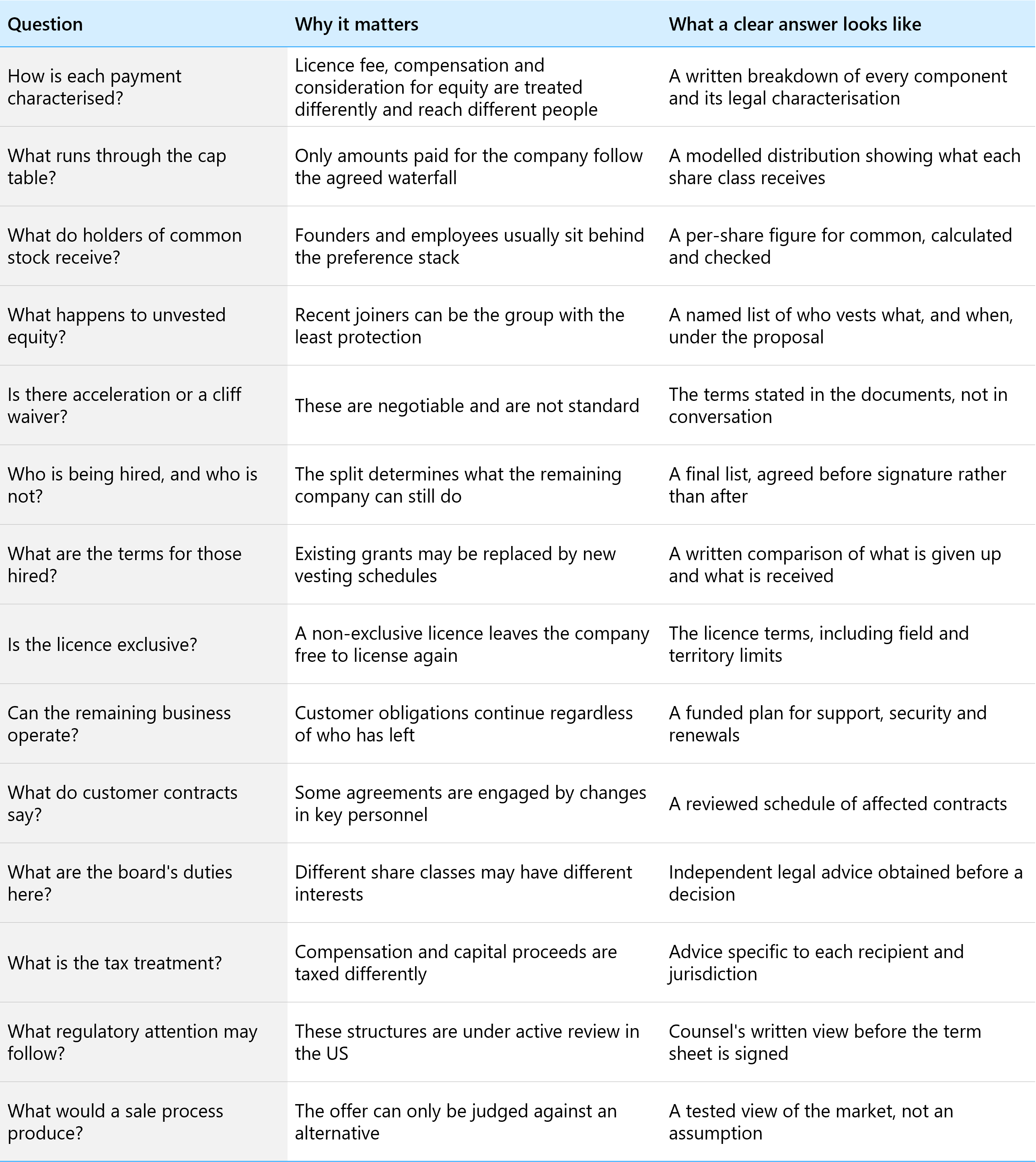
Fourteen questions. The answers will be specific to the offer, the jurisdiction and the cap table, and every item here is a matter for your own legal, tax and financial advisers.
Weighing it against the alternatives
An offer is only assessable next to something. Three comparisons are usually worth making.
- A conventional sale of the whole company, where proceeds follow the agreed waterfall and the buyer assumes the customer obligations along with the team. Our guide to what buyers look for sets out what that process tests. A further funding round, where no one exits but the capital question is answered and the team stays together. Continuing independently, which is a real option whenever the business is funded and the leadership intends to stay.
The point of making the comparison explicit is that it converts a yes-or-no decision into a ranking, and rankings are easier to defend to a board. Our pieces on what buyers look for in a SaaS acquisition and on when and how to raise capital cover the first two, and the question of private equity, strategic and individual buyers is worth reading before assuming a single acquirer represents the market.
Knowing what a conventional process would be likely to test for is also the cheapest form of preparation. Our checklist for preparing a business for sale and FE's due diligence services both start from that question, and the timing of your business exit shapes how much latitude you have to run the comparison properly.
The question underneath the question
What is a reverse acquihire, as a matter of structure, is settled enough: people, a fee and a licence, with no change of ownership. What is not settled is how any particular version of it treats the people who built the company, and that is decided in the drafting rather than in the headline number.
The reported record suggests two things worth carrying into any conversation. Payments characterized as compensation reach the individuals named in them, not the cap table. And the company left behind inherits the obligations without necessarily inheriting the capacity to meet them. Both are negotiable at the term-sheet stage and considerably harder to revisit afterwards. Our analysis of what multiple does a SaaS business sell for, the guide to how to value an AI business and the AI business valuation model set out how a conventional process prices the same assets, and the tech M&A mid-year 2026 report covers current buyer appetite.
FE International has advised on more than 1,500 transactions since 2010, with a 94.1% success rate on private sales and acquisitions. If an offer of this kind is in front of you and you want a view on what a conventional process might produce instead, you can request a business valuation or start a conversation about selling your business. Whether to run a process with an adviser at all is itself a decision, and our comparison of selling a business yourself versus using an M&A advisor covers it.
