

Selling an AI Company to a Strategic vs Private Equity

Ask most advisers about selling an AI company to a strategic vs private equity and you get the generic answer: strategics pay for synergy, sponsors pay for cash flow, strategics want a clean break, sponsors want you to stay. All true, all covered already in our guide to private equity, strategic and individual buyers, which goes through the three buyer types, their structures and their valuation logic in detail. Start there if you want the general picture.
What changes when the asset is an AI business is the size of the gap between the two. It widens, because so much of what an AI company is worth sits outside its own accounts.
Two buyers, two different questions
Everything downstream follows from one difference. A strategic is asking what your business is worth inside its system. A sponsor is asking what your business will produce on its own.
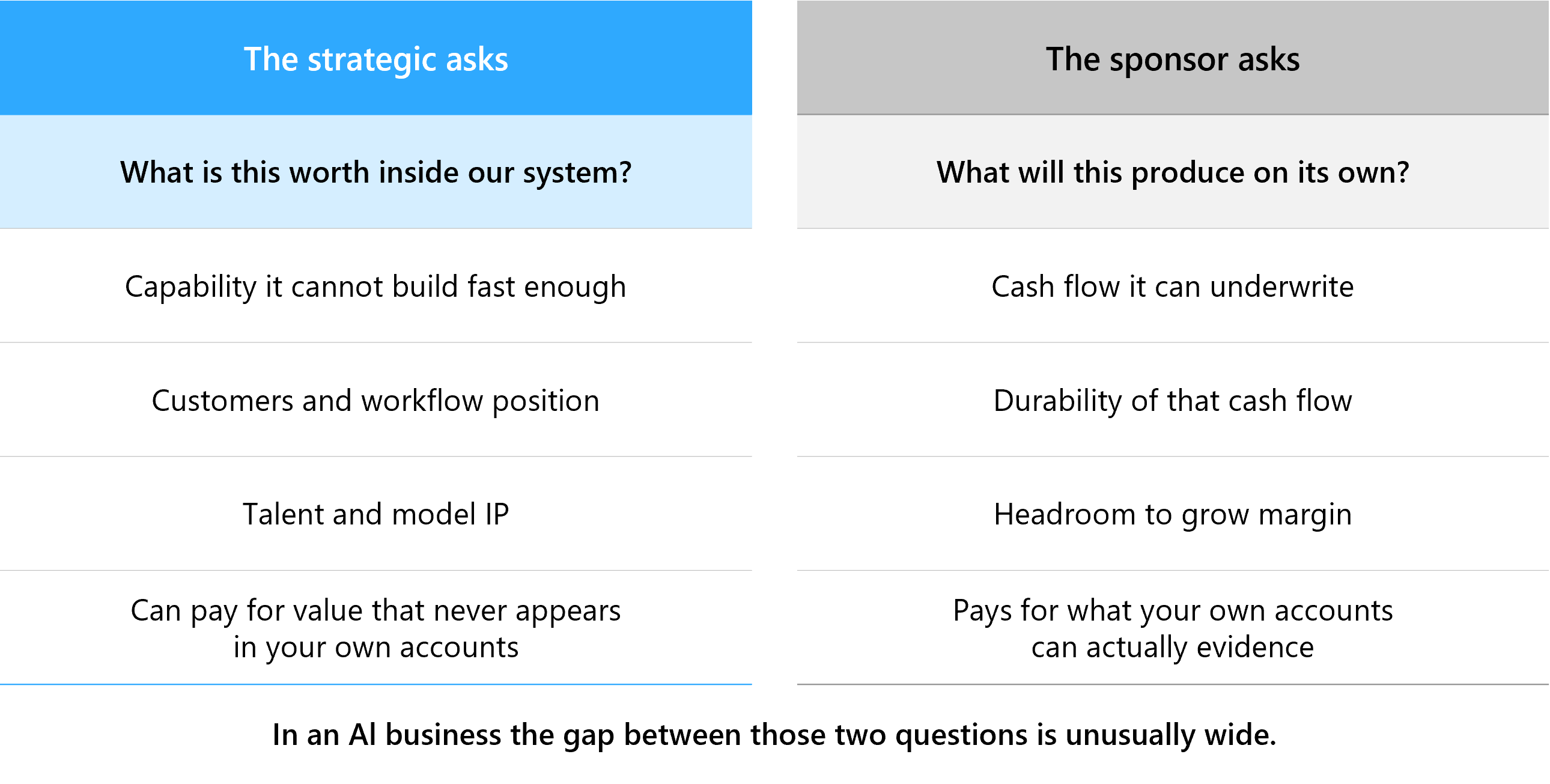
For a conventional software business those two questions often land in a similar place. Recurring revenue, retention and margin travel reasonably well between a standalone model and an acquirer's model. An AI company is different. A large part of what makes it valuable to a strategic is capability, position and people, and none of those show up cleanly in a cash-flow forecast.
What a strategic is actually buying
Deloitte's work on how AI companies are rewriting M&A describes acquirers "racing to access capability," naming talent, intellectual property and inference infrastructure, and notes that in these deals "the transaction perimeter is often undefined at close." McKinsey reads the motive the same way, describing access to talent, proprietary data and model IP displacing conventional scale economics as the rationale.
Two consequences for a seller. The first is that a strategic can pay above anything your own numbers support, because it is pricing an outcome in its business rather than yours. The second is less comfortable: the same logic lets a strategic want only part of you. Licences, minority stakes and arrangements built around named people all come from the same place.
Bain adds a wrinkle that cuts the other way. In its 2026 software M&A work it notes that AI assets often arrive without many customers, so cross-selling runs one way. A business with real customers and a position in their workflow is therefore unusually interesting to a strategic, because it supplies the thing most AI targets cannot. Our note on what buyers look for in a SaaS acquisition covers how that gets tested.
Why a sponsor has to care about your own numbers
Sponsors are not being difficult when they press on profitability. The arithmetic of a buyout has moved, and it has moved a long way.

Bain's 2026 global private equity report sets it out in an illustrative US example. To reach a 2.5x return over five years, a 2015 deal used around half leverage at a 6% borrowing cost and needed roughly 5% annual EBITDA growth. A 2025 deal runs about 36% leverage at 8%, and needs 10 to 12%. Bain also notes that multiple expansion once "powered over 50% of all buyout returns" and no longer does.
Read that as a seller and the behaviour makes sense. Capability a sponsor has no way to monetize inside five to seven years cannot be paid for. The growth has to come from your business as it stands. So the conversation turns quickly to margin, retention and cost to serve, and what multiple does a SaaS business sell for reads as a narrower question in that room than in a strategic's.
A strategic can pay for what your business does for them. A sponsor can only pay for what it does by itself.
Where the diligence actually diverges
Both will read your contracts and rebuild your retention. After that they separate.
Capability transfer is what a strategic tests. Deloitte frames the operational question as whether a buyer can run the acquired capability on day one and improve it by day thirty, and calls speed-to-retention "existential" in these transactions. Expect close attention to handover readiness, documentation, and the specific people who make the thing work. Our note on key person risk in a business sale covers what that looks like in practice.
Sponsors run the opposite test: whether the business survives AI rather than whether it embodies it. Bain's April 2026 guidance to sponsors on technology diligence is unusually direct about this. Diligence should start by assessing how much AI can affect the workflows a product supports, and how much risk AI poses of displacing the software inside those workflows. "Stress testing requires specificity," since product, workflow and data moats face different levels of pressure. The question Bain says sponsors are now asking is not whether you have an AI strategy. It is "Can they show me the proof points?"
That same piece tells sponsors to track AI revenue in three separate buckets, traditional machine learning, AI features added to an existing product, and agentic products, and to track AI costs separately too: infrastructure, third-party model costs, and the loaded cost of AI-related engineering. Bain attributes part of the gap between buyer and seller value expectations to sellers not tracking their AI progress with concrete data. If you are preparing for a sponsor process, that sentence is the brief. Our checklist for preparing a business for sale and the SaaS due diligence checklist cover the rest of the file.
The third pool, and what we see of it
A caveat first. There is a third kind of buyer in this market that the published research has not caught up with: the AI-enabled consolidator, usually sponsor-backed, buying services or vertical software businesses with the explicit plan of rebuilding delivery around AI. We see these approaches on live mandates. We cannot point you at a credible dataset sizing the category, because none of the major houses has published one, so treat what follows as our own observation rather than a cited finding.
What is distinctive about them is the direction of the thesis. A conventional sponsor asks whether AI threatens your margins. A consolidator assumes AI will transform them, and is buying the customer base and delivery capacity to apply it to. That changes which of your attributes matter: contract length, delivery headcount and process documentation can carry more weight than your own AI capability does.
For founders it widens the field in a useful way. PitchBook describes the venture-backed AI exit market as barbell-shaped, with exits achievable but the path "narrower and more acquirer-specific" than headline activity suggests. A third category of acquirer is one more specific path worth testing, and our tech M&A mid-year 2026 report tracks where that appetite is concentrated.
Structure, and what each buyer pays with
Headline price is the part sellers compare. Form of consideration is the part that decides what they actually receive.

The SRS Acquiom 2026 deal terms study, as summarised by Fasken, covers more than 2,300 private-target transactions closing between 2020 and 2025. All-cash consideration accounted for 51% of 2025 deals, down from 58%. Cash plus management rollover reached 21% and cash plus buyer stock 20%, each up three points. Rollover is the sponsor's instrument; buyer stock is the strategic's. Both gained ground.
Those are all-industry figures rather than AI ones, and any particular offer sits where it sits. Model each component separately: cash at close, anything contingent, anything in paper, and what the paper would be worth under a few different outcomes. A rollover into a sponsor platform and stock in a listed acquirer are both non-cash, and they behave nothing alike.
Paper deserves its own look when the buyer is listed. On Meritech Capital's figures for 9 October 2026, the top ten public software companies traded at 21.7x implied ARR against a 4.4x median. An acquirer whose own shares carry a high multiple is paying in a currency priced the same way, which is worth understanding before you accept it.
Strategic, sponsor and consolidator, side by side
Where the three tend to differ when the target is an AI business. Generalisations, and individual buyers vary widely inside each column.

Running both at once
The choice framed as either-or is usually a false one. On FE deals the strongest outcomes come from putting both logics in the room at the same time, because each one disciplines the other. A strategic that knows a sponsor is bidding has to justify why its synergy case is worth less than it claimed. A sponsor that knows a strategic is interested stops anchoring on its own entry multiple.
Doing that takes preparation of two different kinds. The strategic pack has to show capability, position and handover readiness. The sponsor pack has to show the unit economics underneath, including the AI revenue and AI cost lines Bain describes. Most of the underlying work overlaps, which is why we build both from the same file. The documents you need to sell a company list covers the shared half, and FE's due diligence services exist to test it before a buyer does.
One practical note on sequencing. Strategics and sponsors work to different calendars, and a sponsor's investment committee meets when it meets. Our view of how long it takes to sell a SaaS business sets out how those rhythms interact, and the timing of your business exit covers when to start.
Choosing by evidence rather than by type
Selling an AI company to a strategic vs private equity is less a choice between two kinds of buyer than a choice about which part of your business you can prove. Capability, position and people argue for one audience. Margin, retention and durability argue for the other. Most businesses have something to say to both, and very few know which case is stronger until they have tested it.
That is the argument for building the evidence before picking the audience. The valuation mechanics sit in our guides to how to value an AI business and the AI business valuation model, the wider market picture in AI M&A trends, and the full sequence in how to sell my SaaS business.
FE International has completed more than 1,500 transactions since 2010 with a 94.1% success rate on private sales and acquisitions, and we run processes across both buyer groups rather than one. If you want a view on which logic is likely to value your business more highly, a business valuation is the place to start, or you can open a conversation about selling your business without committing to a process.
