

How to Sell an AI Agent Business

Start with the boring part. Clean financials. Retention you can defend. Contracts that assign. A business that runs without you in it. All of that still applies, and our guide to how to sell my SaaS business walks through it.
The interesting part sits underneath. An agent business bills for work done. It pays for the compute that does the work. Then it pays again for the people who check the work. That is three moving parts where seat-based software has one. Most of learning how to sell an AI agent business is learning to evidence all three before somebody asks you to.
What counts as an AI agent business
Gartner draws the line at task specialisation. Assistants wait to be asked. Agents get an objective and run the whole task themselves. Gartner's own example is a security agent: it watches traffic, logs and user behaviour, decides there is a threat, and fires the response without waiting for anyone.
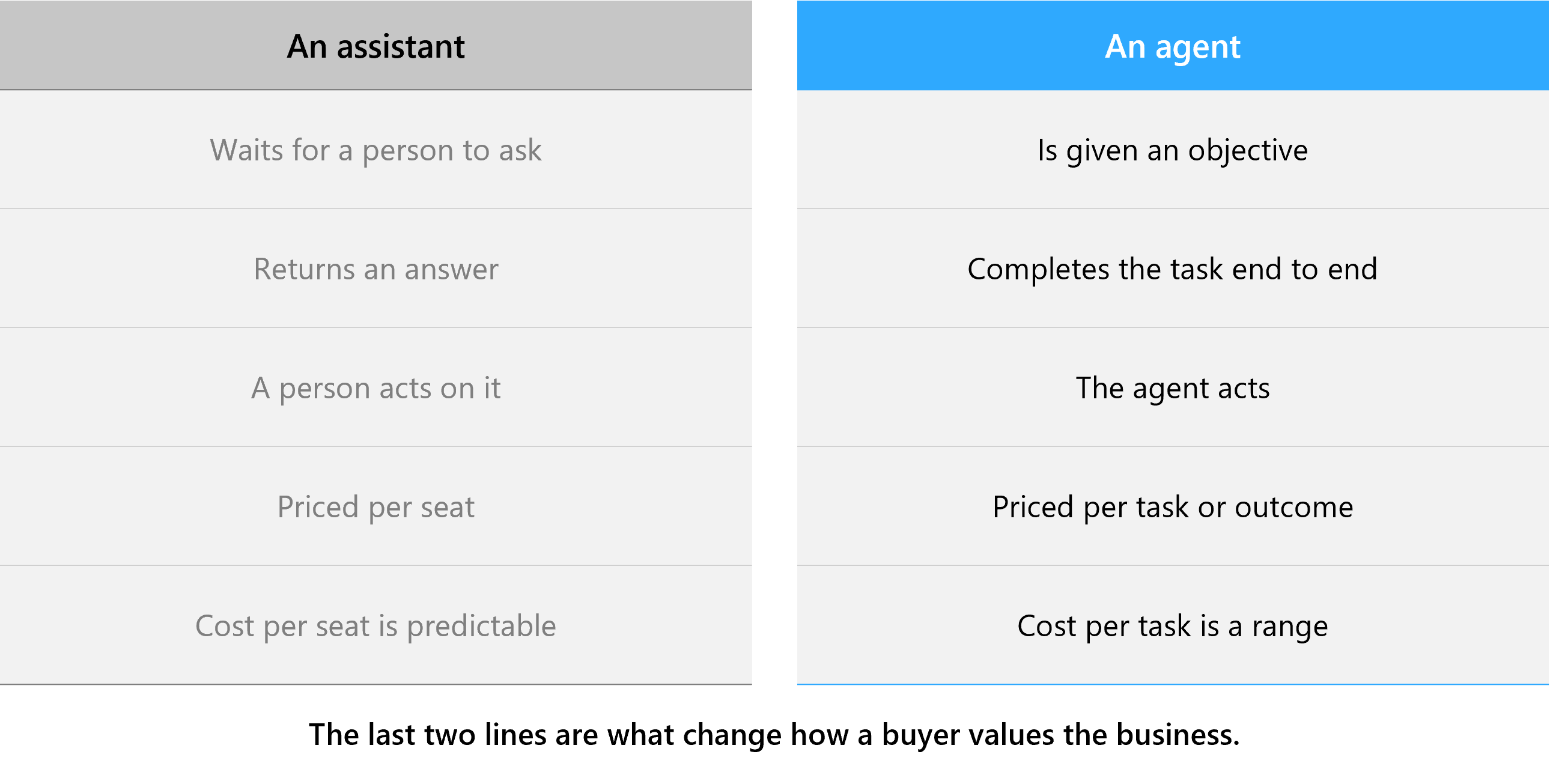
The bottom two rows are the ones that reach a valuation. Sell seats and a buyer already knows how to read your revenue. Sell completed tasks and they have to take it apart, because what it costs you to deliver that revenue will not sit still.
Agents are becoming a category rather than a feature
A buyer pool is forming around this. Gartner puts task-specific agents inside up to 40% of enterprise applications by the end of 2026. In 2025 the figure was under 5%. Look further out and its best case has agentic AI at roughly 30% of enterprise application software revenue by 2035, against 2% in 2025.

Forecasts are forecasts. Direction of travel is the part worth taking seriously, and the direction is that software companies without an agent are out looking for one. That widens your strategic buyer pool. Our note on AI M&A trends covers where the appetite sits. For how each type of buyer prices, see private equity, strategic and individual buyers.
The number buyers want is cost per completed task
Most agent businesses come up short right here. McKinsey QuantumBlack calls completed-work ROI the metric that matters most. Fully loaded cost to finish a job, counting humans and agents and the deterministic systems in between, against the value it produced. One agent's cost in isolation tells you almost nothing.
Why so little? Look at the composition. In their banking customer service example tokens are roughly 20 to 25% of variable run cost. Human oversight is 70 to 75%.

Sit with that. If three quarters of your run cost is people checking output, you have a services margin wearing a software label. No shame in it. Plenty of excellent businesses look exactly like that and sell well. The damage comes from presenting one thing and having the buyer rebuild the other in week six of diligence.
Tokens are the bill, not the business. The oversight line is where an agent company's margin actually lives.
Now the good half of the same research. Volume is on your side. Onboarding 2,500 customers a year cost McKinsey's example $10,000 to $15,000. Double the volume and it went to $15,000 to $20,000, not $30,000. Fixed build cost spread over more runs is real operating leverage, and it is one of the more persuasive things an agent business can put in front of a buyer. If you have it, chart it.
Your margin is a range, not a line
Something else catches sellers out. Agent costs are not fixed per unit. Pay-i's David Tepper, interviewed in McKinsey Quarterly in July 2026, says it straight: "Cost behaves as a distribution, not a fixed unit price." A true agent has no ceiling on a single task. Run the same prompt twice and outcomes can vary by thirty times.

Roughly 60% of what an agentic task costs goes on refining the answer, not producing it. The bill is driven more by what you asked the model to read than by what it wrote back. Tepper's line: "tokens are not value, tokens are the bill."
So buyers do not want your average. They want the shape. Cost per completed task over time, the spread around it, and what is sitting out in the tail. Produce that and you are answering a question the market only recently learned to ask. Offer one blended number instead and the buyer will price the worst end of a range they cannot see.
What this does to the revenue line
Seats make for tidy ARR. Tasks and outcomes do not, and the usual retention vocabulary fits them badly. Net revenue retention still tells you something. But expansion now means a customer running more tasks, not hiring more people, so your growth starts tracking their business rather than your product.
Split the revenue up before anyone asks you to. Committed minimums. Usage above the minimum. Outcome or success fees. Implementation. Those four hold up very differently when a market turns. Any buyer worth having will pull them apart whether or not you did. Bain tells investors to do the same thing from their side: traditional machine learning, AI add-ons and agentic products, each on its own line, each with its own margin. For the conventional accounting underneath all this, use our checklist for preparing a business for sale.
Be careful with borrowed benchmarks. Published multiple ranges for AI companies move around a lot depending on who measured what, and over what period. Two businesses on identical revenue will not read alike if one carries a heavy oversight line and the other sells seats. Our guides to how to value an AI business and the AI business valuation model cover the mechanics. For the software comparison point, see what multiple does a SaaS business sell for.
Reliability stops being a technical metric
Software gives an answer, a person acts on it, and a wrong answer is a support ticket. An agent acts for itself, and a wrong answer is an incident. That single difference promotes your evaluation record from engineering paperwork to a commercial asset.
Tepper has a useful rule for deciding what to keep. An agent earns its place when its odds of success beat the time a human would spend checking it. Factor in rework and that bar sits higher than most teams assume. He adds a warning worth remembering: "when an agent fails, it almost never fails on the last step." Grade the final output alone and you miss where it went wrong. In diligence, a corpus of traces from runs that worked and runs that did not will do more for you than any benchmark score.
Need somewhere to put all that? The NIST AI Risk Management Framework is a reasonable home for it, and an institutional buyer's risk function will already know how to read it. Its measurement guidance says plainly that test sets, metrics and the tools used in testing get documented.
Pin this one above the desk if you are planning a sale: "Retrofitting KPIs after launch is where attribution dies." Cannot attribute an outcome to your agent? Neither can your buyer. And value nobody can attribute has a habit of landing in the earnout instead of the cheque.
Because the agent acts, somebody owns what it does
Writing in Harvard Business Review in July 2026, M. Alejandra Parra-Orlandoni and Paulo Carvao make the point that "accountability tends to fall on the organization closest to the end user," not the model provider. For an agent business that sits between a frontier model and a customer's live process, that is a position worth understanding before a buyer raises it.
Have two files ready. One contractual. What do your customer agreements actually say about the agent acting for them, how much authority it holds, and who carries it when the agent gets something wrong? One regulatory. The EU AI Act lands in stages, and high-risk duties for Annex III systems arrive on 2 December 2027 under the current implementation timeline. An agent that takes consequential actions is likelier to be caught by that than a tool which drafts text. Whether your system is caught is a question for counsel. Not for an article.
What to assemble before you start
Everything in our SaaS due diligence checklist still applies. On top of it, an agent business is asked for a specific set:
- Cost per completed task, dated, with the spread left in rather than averaged away.The oversight line pulled out on its own, headcount and hours attached.Revenue split four ways: committed, usage, outcome, implementation.An evaluation record built from traces, the failed runs included.KPIs you set before launch, not after.Customer agreements that say what authority the agent holds and who carries the risk.A dated regulatory assessment against whatever applies to you.
Deloitte wants what it calls a living, auditable baseline across IP, data, infrastructure and talent. Its test: can the buyer run this on day one and improve it by day thirty? In an agent business that test tends to land on two or three people, the ones who tune the prompts and keep the evaluation harness honest. Which concentrates key person risk rather sharply. FE's due diligence services exist to find that before a buyer does.
Selling the economics, not the demo
Every agent business can show a buyer something impressive. Rather fewer can show what it costs to do it ten thousand times, how wide that cost spreads, and who is checking the output. Knowing how to sell an AI agent business comes down to closing that gap before a buyer opens it.
None of this is exotic work. It is measurement, kept as a series, started early enough to have a series to show. The companies that do it tend to find diligence shorter and the conversation about structure easier, because less of the thesis rests on trust. Market context sits in our tech M&A mid-year 2026 report, the buyer-side view in what buyers look for in a SaaS acquisition, and the wider document set in documents you need to sell a company.
FE International has completed more than 1,500 transactions since 2010 with a 94.1% success rate on private sales and acquisitions, and we advise founders on how to sell an AI agent business from preparation through to closing. If you want a view on how your own numbers would read to a buyer, a business valuation is the usual starting point, our note on how to choose an M&A advisor covers who should be in the room, and you can open a conversation about selling your business without committing to a process.
