
.jpg)
Do Bootstrapped SaaS Businesses Get Lower Multiples Than VC-Backed?
The short version of the multiple question is already settled on our pillar, and it is less dramatic than founders expect. Venture-backed businesses tend to carry a modest premium on headline multiple, bootstrapped businesses carry offsetting advantages that often close it, and the difference is measured in fractions of a turn rather than in multiples of each other. Our analysis of SaaS valuation multiples sets that out with the reasoning behind it, and this page does not repeat it.
What this page does instead is take up the instruction that analysis ends on: model your own waterfall before anchoring on any published benchmark. That is where the real difference between the two sits. Funding status moves the multiple a little. It moves what reaches you, who is entitled to decide, and how the transaction closes a great deal more, and almost nothing written about SaaS valuation covers that part.
Two framing notes. Nothing here is legal or financial advice, and preference and control provisions are legal instruments whose effect depends entirely on your own charter, shareholders agreement and financing documents. The worked examples below are illustrative arithmetic, not a description of your position. Model the actual waterfall with your counsel and your accountant.
The short answer
At the multiple level the gap is narrow and can run in either direction, which our pillar covers. At the proceeds level it can be enormous, because a headline price is divided according to the cap table rather than split pro rata. Two founders can announce the same multiple on the same revenue and take home amounts that are not comparable. Funding status also changes who has to agree to a sale, and how much machinery is needed to complete one.
So the useful question is rarely whether being funded costs you a turn of ARR. It is what your own documents say happens at the price you are likely to be offered.
Funding Status Is a Proxy, Not a Cause
Before the cap table, it is worth being precise about what funding status actually signals to a buyer, because it is easy to treat it as a characteristic in itself.
ChartMogul's comparison of more than 2,500 SaaS businesses, classified by funding status with Dealroom and covering the period to early 2024, found that VC-backed companies grow faster than bootstrapped ones and that at $1m to $30m ARR the VC-backed median sat around five percentage points higher on retention. The finding underneath that is more interesting: at the top quartile, the two groups were close to identical.
That pattern suggests funding status is standing in for characteristics rather than causing them. A buyer is not paying for the presence of investors. They are paying for growth rate, retention, management depth beyond the founder and reporting they can rely on, and venture-backed businesses are simply more likely to have several of those at once. A bootstrapped business that has them is not obviously disadvantaged, which is why the two ranges overlap so heavily. Our guide to the metrics that drive a SaaS valuation covers what is actually being priced, and net revenue retention and churn do more of that work than the funding history does.
How a Waterfall Turns One Price Into Different Outcomes
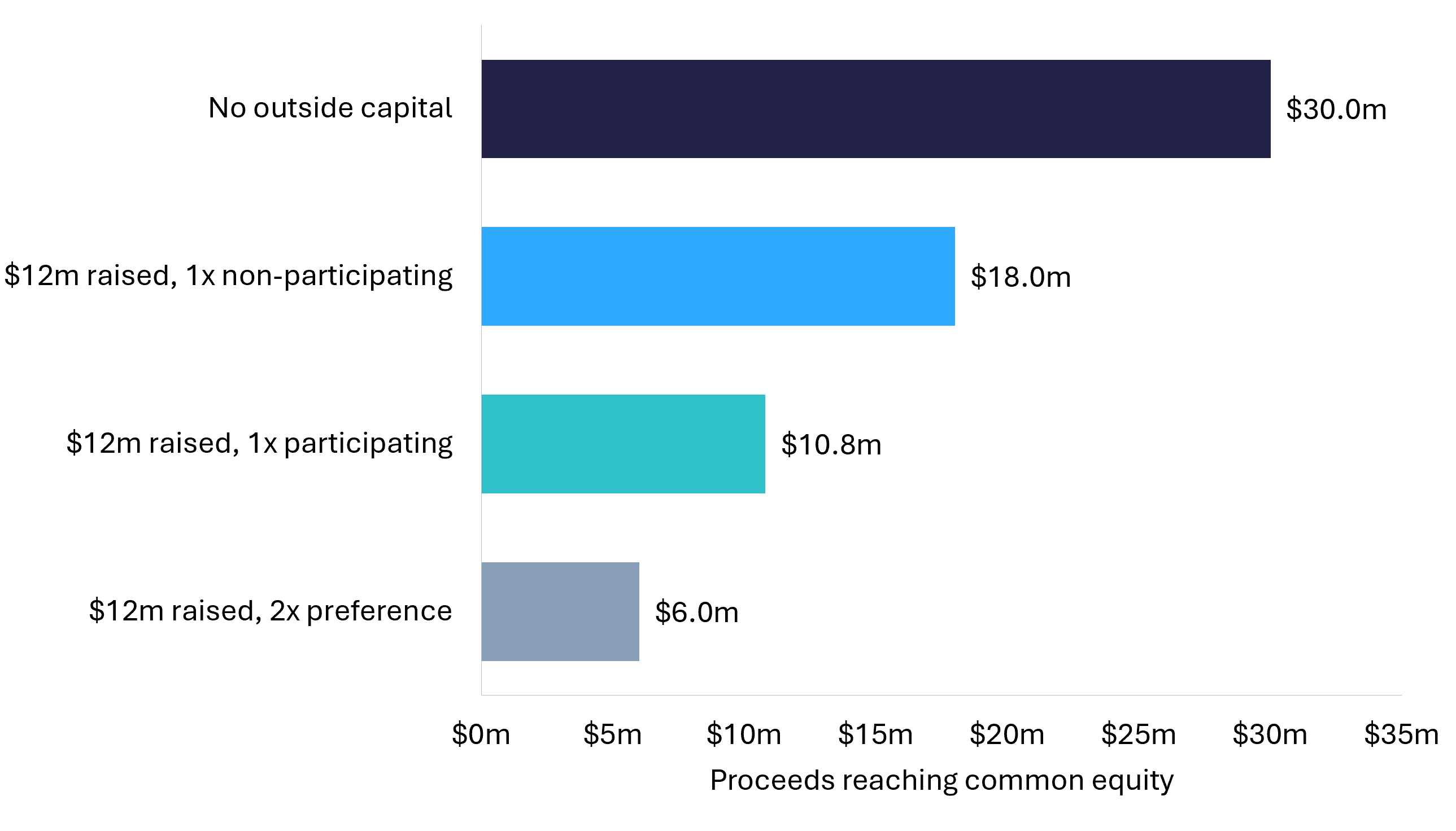
The chart holds the price constant at $30 million and changes only the capital structure. Every row reports the same multiple on the same revenue. What reaches common equity ranges from the whole amount to a fifth of it.
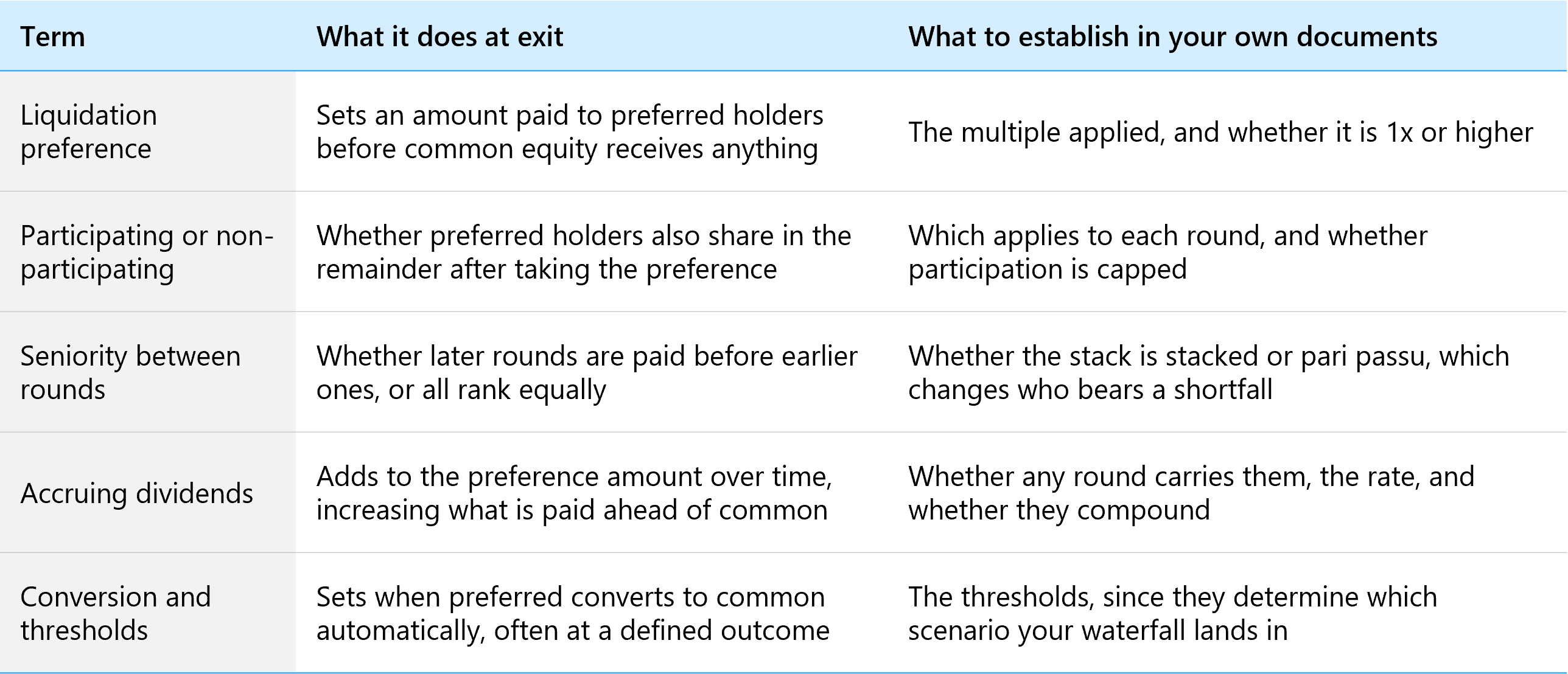
The mechanics are worth understanding rather than memorising, because the terms interact. A liquidation preference is an amount investors receive before common equity receives anything. Non-participating means investors choose between taking the preference or converting to common and taking their percentage, whichever is greater, but not both. Participating means they take the preference and then share in what remains, which is where the arithmetic starts to bite. A multiple preference, such as 2x, sets the preference at a multiple of the amount invested rather than at the amount itself.
Most Cap Tables Are Simpler Than the Worst Case
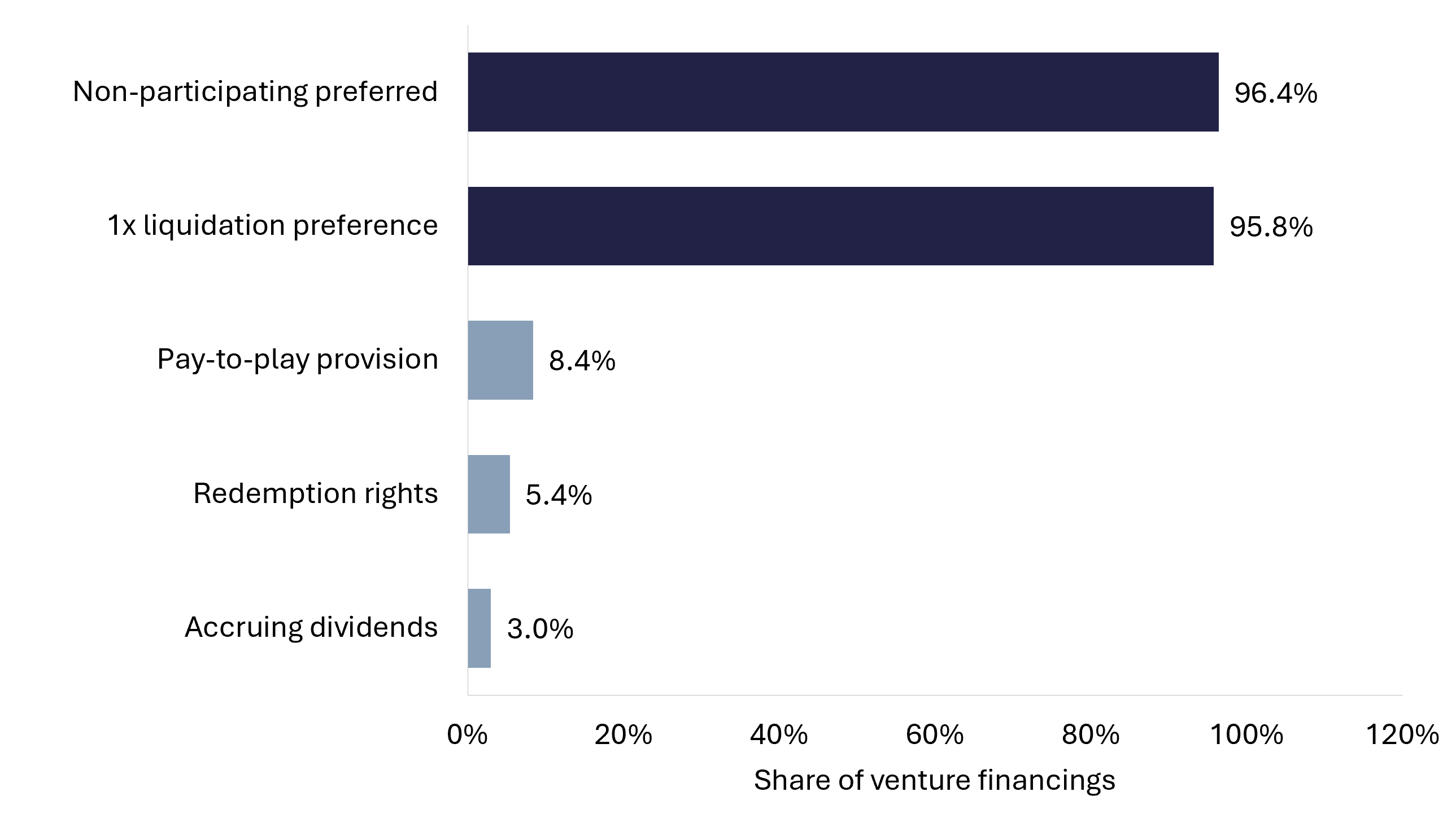
Having shown what the arithmetic can do, it is only fair to show how often it does it. Cooley's review of 166 venture financings in the second quarter of 2026 found 96.4 percent carrying non-participating preferred and 95.8 percent at a 1x preference, with pay-to-play provisions in 8.4 percent, redemption rights in 5.4 percent and accruing dividends in 3 percent. Fenwick's read of the same market reported that participating preferred structures, cumulative dividends and greater-than-1x preferences remained rare.
The practical reading is reassuring rather than alarming. For most funded founders the waterfall is closer to the second row of the chart than the fourth, and the exercise of modelling it is about precision rather than damage control. Two caveats sit alongside that. These figures describe new financings rather than the installed base of cap tables built over several years and several markets, and a business that raised through a harder period may carry terms that are uncommon today. And a stack of ordinary 1x preferences across several rounds still adds up to a meaningful number before common equity sees anything.
Who Actually Gets to Decide
The second real difference is control, and it tends to surface later than founders expect, usually once a price is already on the table.
A bootstrapped founder with no outside shareholders decides to sell, and the decision is made. A funded founder is generally working within protective provisions requiring preferred consent for a sale, a board that has to approve it, drag-along mechanics that determine whether a minority can be compelled to follow, and sometimes rights of first refusal or co-sale that shape who can be approached. None of this is unusual or adversarial; it is the ordinary architecture of taking investment. It does mean the decision is shared.
Where it matters most is on price rather than principle. An investor holding a preference that is satisfied at a given price may be indifferent to an offer a founder finds transformative, and an investor whose fund needs a particular outcome may prefer to wait. The PitchBook and NVCA Venture Monitor for the second quarter of 2026 noted that everyday exit paths remain thin for the broader market and that many venture-backed companies without a route to a marquee listing may need to accept exit prices below peak-era expectations. Aligning those views early is part of the work, and our note on managing investor access, requests and offers covers how that tends to run in practice.
Which buyer is across the table changes how much any of this matters. A financial buyer running a structured process is generally comfortable with preferred shareholders and consent mechanics, because it is the environment they work in. An individual buyer or a smaller strategic acquirer may find a multi-party cap table genuinely off-putting, not because of the terms but because of the coordination. Our comparison of private equity, strategic and individual buyers sets out how those appetites differ, and it is worth reading alongside your own shareholder list rather than in the abstract.
The bootstrapped advantage here is deliverability, and buyers price it. Where two similar businesses are in front of the same acquirer, the one that can sign without a consent process is easier to underwrite. It also tends to move faster, which our note on how long a sale takes bears out, and it makes running a confidential process simpler, since fewer parties need to know.
The Mechanics of Closing With Many Shareholders
This is the least discussed difference and the one most likely to surprise a first-time funded seller. A company with two shareholders and a company with two hundred do not close the same transaction, even at the same price.
Where a target has a broad shareholder base, the deal generally needs a shareholder representative to act for holders after closing, a paying agent to distribute consideration, and a mechanism to handle escrow and post-closing claims across every holder rather than one counterparty. SRS Acquiom, which provides those services, reports having acted across more than 12,000 deals and over 680,000 shareholders, and notes that more than 60 percent of deals see escrow claims. None of that changes the price, but it adds process, cost and time, and it means consideration reaches individual holders later than a founder might assume.
Preparation reduces most of it. A clean, reconciled cap table with every instrument accounted for, including options, warrants, convertible notes and any SAFEs still outstanding, is one of the more valuable things a funded seller can have ready before a process starts. It sits alongside the rest of the document pack a buyer will request and features on any sensible preparation checklist. Where the cap table is uncertain, it tends to be discovered during due diligence, which is the expensive moment to find out.
What Each Side Should Work On
The advice genuinely differs, which is unusual for a comparison of this kind.
If you are bootstrapped, the risks buyers price most heavily are the ones your structure creates: dependence on you, a thin management layer, informal reporting and concentration in a small number of customers or channels. Financial hygiene tends to remove discounts rather than add premiums, which makes it the most efficient work available, and a quality of earnings review done in advance usually costs less than the negotiation it prevents. The characteristics buyers look for are set out in our note on what buyers look for in a SaaS acquisition and in the buyer-side diligence checklist.
One specific item is worth calling out for bootstrapped sellers, because it comes up repeatedly. Owner-operated businesses frequently run personal costs through the company, and those become add-backs that a buyer will want evidenced individually. Assembling that evidence takes longer than founders expect and is considerably easier before a process than during one.
If you are funded, the highest-value work is knowing your own waterfall at several prices rather than one, so you understand where the outcome changes shape. Establish early where your investors sit on timing and on price, because discovering a divergence after an offer arrives is considerably harder than discussing it beforehand. And keep the cap table reconciled continuously rather than reconstructing it under deal pressure.
Both sides benefit from the same underlying discipline, which is that structural work belongs in exit planning rather than in the weeks before a process. Our guide to how to sell a SaaS business covers the sequence, and for businesses where a broad shareholder base and institutional buyers are both in play, FE International's investment banking team handles that kind of mandate. Founders still weighing whether to raise at all may find our notes on when and how to raise capital and on building a profitable business from day one useful on the other side of the same decision.
Where the Comparison Breaks Down
Two things make the bootstrapped-versus-funded framing less useful than it looks.
The first is that funding is not binary. A business that took a single small angel round, one that raised a seed and stopped, and one that has been through four institutional rounds with different investors and different terms have almost nothing in common at exit beyond not being bootstrapped. The relevant variable is the structure that resulted, not the label.
The second is that liquidity routes differ rather than simply being better or worse. Funded companies have access to secondary markets that bootstrapped ones do not: secondary transaction volume reached roughly $160 billion in 2024 and was projected to finish 2025 substantially higher, according to a venture outlook published on the Harvard Law School Forum on Corporate Governance, though the same piece notes only around 2 percent of unicorn market value trades that way. A bootstrapped founder has one realistic route to liquidity and complete control over when to take it. A funded founder has more routes and less unilateral control. Which of those is preferable depends on the founder rather than on the arithmetic, and it is the sort of judgement our mid-year 2026 tech M&A report can inform but not settle.
Where This Leaves You
Whether a bootstrapped SaaS business gets a lower multiple than a funded one is the question founders ask and the smaller half of what matters. The multiple gap is narrow enough that the characteristics underneath it, growth, retention and transferability, explain more than the funding label does. The gap between a headline price and what actually reaches you can be far wider, and it is written down in documents you already have.
If you want a view of where your business sits and what a realistic outcome looks like once the structure is taken into account, you can request a confidential valuation, or read how FE International handles SaaS sales end to end. The broader question of how much a business is worth is where most founders start, and it is the right place to come back to once the waterfall is modelled.
