

How to Prepare an AI Business for Sale: A Stage-by-Stage Checklist
Working out how to prepare an AI business for sale starts from an awkward fact: most of the preparation advice available was written for software businesses, and most of it still applies. Accrual financials, cohort retention, assignable contracts and a business that runs without the founder matter here exactly as much as they do anywhere else. Our checklist for preparing a SaaS business for sale covers that ground in full, and it is the right place to start.
What this page covers is the part that list does not reach. An AI business carries a second set of questions about where its capability came from, what rights travel with it, what it costs to run, and whether its performance can be shown rather than demonstrated. Those questions are answerable in advance, and most of them take longer to answer than a data room takes to build.
The sequence below is ordered the way the work is best done, with a consolidated checklist at the end. Nothing in it is a rule, and the applicable detail will vary with the product, the jurisdiction and the buyer. It is a description of where diligence attention appears to be going, drawn from what consultancies, regulators and standards bodies have published through 2026. For the wider process around it, see AI M&A trends and our guide to how to value an AI business.
Where the AI list diverges from the software list
It is worth seeing the two sets side by side before working through either, because the second set is where most preparation time now goes and it is the set most often left until a buyer asks.

The reason the second column exists is that buyers have changed what they ask to see. Deloitte's work on how AI companies are rewriting M&A describes the requirement as a "living, auditable baseline, across IP, data, infrastructure, and talent," and frames the operational test as whether a buyer "can run the acquired capability on Day 1 and improve it by Day 30." McKinsey describes technology M&A entering an industrial phase in which deal rationale rests on "access to talent, proprietary data, and model IP rather than traditional scale economics." Both point at the same preparation work.
A record kept as a matter of routine reads differently from a file assembled during a process.
Stage one: a financial record that separates the AI revenue
Start where every sale starts, then add two things. The first is a revenue split that a buyer can interrogate. Bain's September 2026 software report suggests tracking three categories separately: traditional machine learning, AI features added to an existing product, and agentic products sold in their own right. They behave differently on pricing, retention and cost, and reporting them as one line invites the buyer to assume the least favourable mix.
The second addition is the one most often missing. Bain also notes that AI products carry variable per-use costs that conventional subscription software does not, and that revenue models are moving toward usage and outcomes. That changes the shape of the margin question.
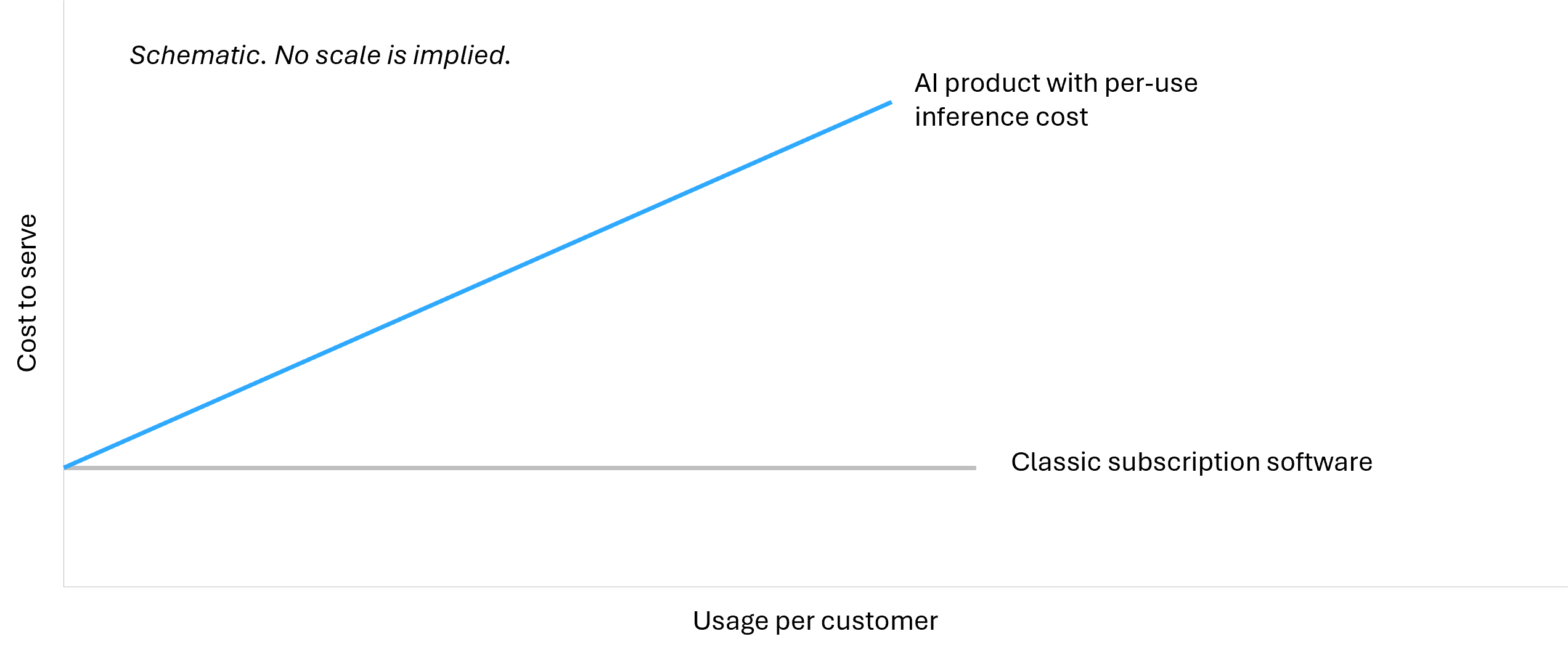
What a buyer tends to want is not a single gross margin figure but a series: inference cost per transaction or per customer, month by month, reconciled to the provider invoices, with the effect of any model or prompt changes visible in the line. A series shows whether unit economics are improving. A single number invites the question of which month it came from.
Gartner's September 2026 predictions point the same way from the buyer's side, suggesting that by 2028 a majority of Global 500 companies will embed cost controls at the point of inference, and that organisations deploying AI will set up dedicated functions to map AI cost to value. Predictions are predictions. The preparation implication is simply that a seller who already measures this is answering a question the buyer has learned to ask. Our note on what buyers look for in a SaaS acquisition covers the revenue-quality side that sits alongside it.
Stage two: model and data provenance
This is the workstream with no equivalent in a conventional software sale, and it is usually the longest. The question underneath it is simple: where did the capability come from, and can the buyer keep it?
Three registers tend to answer most of it. A model inventory listing every model in use, its version, its provider and the commercial and licensing terms attached. A training-data lineage record showing where each dataset came from and on what permission it is held. And a dependency list covering the third-party services the product calls at runtime, with a written view of what happens if pricing, terms or availability change.
That last point is not hypothetical risk management. Writing in Harvard Business Review in July 2026, M. Alejandra Parra-Orlandoni and Paulo Carvao argue that responsibility for a bought-in model tends to sit with the company closest to the end user rather than the model provider, noting that "accountability tends to fall on the organization closest to the end user" and that leaders "may have little visibility into how a model was trained or how it changes." Their suggested responses are worth borrowing wholesale for preparation: "hard-wiring transparency into contracts," "formally governing customization," and "designing for portability."
Portability is the one that reads best in a data room. A documented account of how the product would move to an alternative model, with evidence that it has been tested rather than merely considered, converts a dependency from an open question into a managed one.
Stage three: the rights that have to travel with the deal
An AI business can be built on data it does not have the right to use the way it has been using it, and the gap usually sits in the customer agreements rather than anywhere exotic. Three questions are worth running against every material contract during preparation.
- Does the agreement permit you to use customer data for training or model improvement, and on what terms? General service-provision language does not always reach this.Do those rights assign to an acquirer on a change of control, or does the contract require consent? Each consent is a signature on somebody else's calendar.What deletion and retention obligations attach, and can you evidence that they are met? A policy that exists only as an intention is a finding waiting to happen.
Where the answer is unclear, the fix is usually a renewal rather than a signing-day amendment, which is precisely why this belongs in preparation and not in diligence. Our SaaS due diligence checklist is a reasonable proxy for the list a buyer will work from, and the companion piece on documents you need to sell a company covers the wider document set. This is also a point to settle with your own counsel rather than treat as resolved by an article.
Stage four: an evaluation record, not a demonstration
Most AI companies can show that the product works. Rather fewer can show how well it has worked, consistently, across versions, measured the same way each time. The difference between those two is what separates a persuasive data room from an impressive demo.
The useful artefacts are an evaluation suite with its method written down, results held as a dated series across model and prompt versions, a regression record showing what changed and what it did to performance, and an incident log with resolutions. None of these can be created retrospectively with any credibility, which makes them a timing item as much as a documentation item.
The NIST AI Risk Management Framework is a reasonable structure to organise this against, and has the advantage of being recognisable to an institutional buyer's own risk function. Its four functions are govern, map, measure and manage, and its measurement guidance is explicit that "test sets, metrics, and details about the tools used during TEVV are documented." Adopting a named framework also answers the implicit question of whether the discipline predates the sale.
Stage five: governance, and the dates attached to it
Regulatory position is the one preparation item with external deadlines, which makes it unusually easy to plan around and unusually visible when it has been left alone.

The EU regulatory framework for AI applies in stages, and the stages were amended by Regulation (EU) 2026/1744, which entered into force in July 2026. On the current implementation timeline, the remainder of the Act applied from 2 August 2026, providers of generative systems already on the market have until 2 December 2026 on content marking, general-purpose models placed before August 2025 must comply by 2 August 2027, and high-risk duties for Annex III systems follow on 2 December 2027. The amendments also allow smaller companies to provide simplified technical documentation, which is worth checking against your own position.
Which of those dates applies to a given business depends on what the system does and what role the company plays, and that assessment belongs with counsel. The preparation point is narrower: a buyer looking at a 2027 completion will want to know you have mapped your obligations against those dates, because they inherit whatever has not been done. A short written assessment, dated, is usually enough to turn an open question into a closed one.
Stage six: the people, and the record of how you decided
Deloitte puts the retention question bluntly, describing speed-to-retention as "existential" in AI transactions. The preparation version of that is identifying every point where capability sits with one person and arranging cover, which is slow work and visible when it has not been done. Our piece on key person risk in a business sale covers the general case; in an AI business it usually concentrates around whoever owns the training pipeline and the evaluation harness.
There is a newer item that sits alongside it, and it is worth raising because it is easy to overlook. In Fortis Advisors v. Krafton, decided in the Delaware Court of Chancery in March 2026 and analysed for the Harvard Law School Forum on Corporate Governance by Mayer Brown, the court quoted at length from an executive's conversations with an AI chatbot about how to approach an earnout dispute, and relied on them in finding the conduct pretextual. The analysis notes that the executive had deleted some logs and that "deleting them may compound the problem."
The case concerned a buyer rather than a seller, and the facts were particular to it. The general lesson appears to travel: records generated when people use AI tools to think through a transaction are a records category like any other, they are not automatically privileged, and the time to agree a retention policy with counsel is before a process starts rather than during one. For sellers this sits naturally alongside the wider question of keeping a business sale confidential.
The AI pre-sale preparation checklist
Everything above in one place. The third column is the part worth reading closely, because an item is only finished when it would answer the question without you in the room.

Working through it is also the substance of making your business more attractive for acquisition, and FE's due diligence services exist to find the gaps in it before a buyer does.
Turning the list into a plan
How to prepare an AI business for sale comes down to deciding, item by item, whether the answer exists as a record or as an explanation. Records survive diligence. Explanations get tested, and testing takes time that a live process does not have.
The practical first step is to walk the sixteen items above and mark each one in one of three ways: already true, fixable this quarter, or needs a renewal cycle. That third category is the real timetable, and it is usually the one that decides when a process can sensibly begin. Our piece on the timing of your business exit covers how that interacts with the decision to sell, and the full sequence is set out in how to sell my SaaS business. Market context sits in our tech M&A mid-year 2026 report.
FE International has advised on more than 1,500 transactions since 2010, with a 94.1% success rate on private sales and acquisitions. If you would like a view on which items on this list matter most for your business, you can request a business valuation or start a conversation about selling your business.
