

Do AI Wrappers Get Lower Multiples Than AI-Native Companies?

Founders usually ask this expecting to hear about a penalty. Some discount a buyer applies once they decide your product is a layer over somebody else's model.
That is not really how it works. Do AI wrappers get lower multiples than AI-native companies? Often yes, and the reason is duller than a penalty and considerably more useful to know. Buyers re-underwrite the business at the gross margin it actually achieved, instead of the margin a software business is assumed to produce. Dependency shows up in that margin. The multiple then follows from it.
Which is good news, in a way. Nobody is going to argue you out of a category. A margin, on the other hand, is a number you can work on.
The discount is mostly arithmetic
Work it through and the mechanism is almost disappointingly simple. A buyer pricing on gross profit rather than revenue is effectively saying enterprise value equals some multiple of gross profit. Gross profit is margin times revenue. So the revenue multiple you end up quoting scales directly with the margin.
Put numbers on it. Hold the gross profit multiple constant at 10x, purely for the arithmetic, and an 85% margin business implies 8.5x revenue while a 55% margin business implies 5.5x. That is 35% lower, and not one percentage point of it came from a judgement about wrappers.

Nobody runs a transaction on a single clean formula, obviously. Growth, retention, concentration and buyer type all move the gross profit multiple itself. The point is narrower than that. Before any of those arguments start, margin alone can account for most of what founders experience as a wrapper discount.
Why the margin comes out lower in the first place
Martin Casado and Matt Bornstein made the structural case back in February 2020, in a16z's note on the new business of AI. Their figure for AI company gross margins was 50% to 60%, against 60% to 80% plus for comparable software. Anecdotal, as they said themselves. Cloud took 25% or more of revenue in their examples. Human-in-the-loop work took another 10% to 15% on top.
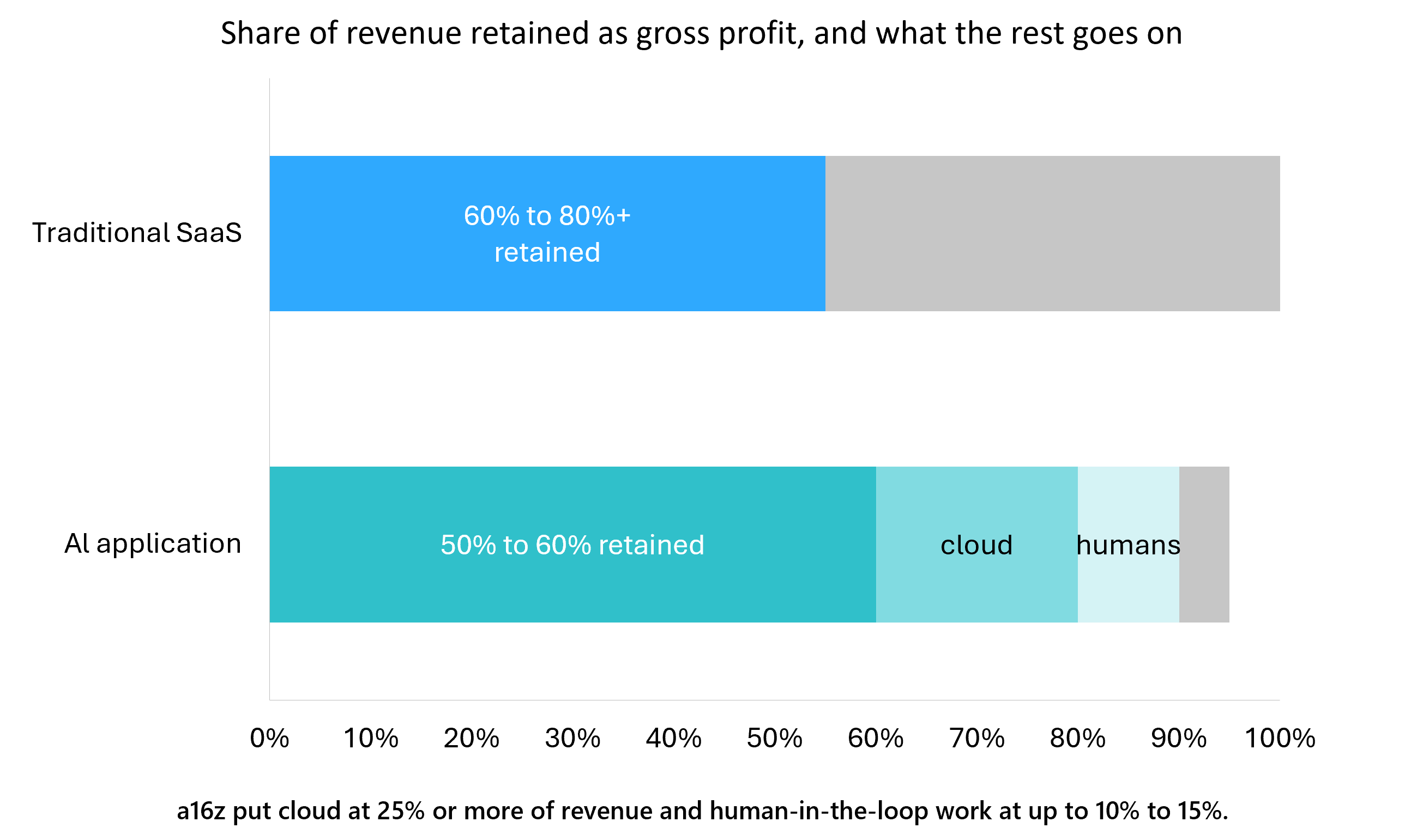
Six years on, those numbers are the origin of the argument rather than a current reading. The shape held, though. Revenue leaves the business as cost of goods every time somebody uses the product, so the margin lands below what a classic software assumption would suggest, and your P&L says so on its face.
The input cost has been moving in sellers' favour
Here is the part that gets missed in most conversations about wrapper economics. The cost side has improved sharply and quickly.
Max Woolf tracked frontier model list prices between June and September 2026 and documented the scale of the cuts. GPT-5.6 Luna's input price came down 80% on 30 July. Claude Fable 5.1 launched on 1 September with cache reads cut 75%. GPT-6 Sol arrived on 22 September at roughly half the prior version's input and output pricing, and Woolf estimates Claude Opus 5.5 at a 40% to 60% total cost reduction against Opus 5.

The State of AI Report 2026 gets at it from another angle, citing an Epoch AI estimate: around 47% per quarter since 2023 off the cost of reaching a fixed benchmark score. What is driving that, Woolf leaves open. Competitive pressure, efficiency gains, probably some of each.
For a seller the consequence is concrete. If a cost line that used to sit at 30% of revenue now sits at 18%, your achieved margin has moved, and with it the arithmetic above. Margin improvement that is already in the numbers is worth considerably more in a process than margin improvement you intend to make.
One caution worth keeping. Cheap calls get used more freely, and an agentic product fires a lot of them at a single task, so the total bill can climb even as unit cost falls away underneath. Only the achieved margin settles that, which is exactly why buyers look there.
What a buyer actually re-underwrites
Four things, in our experience, and a multiple only gets discussed afterwards.
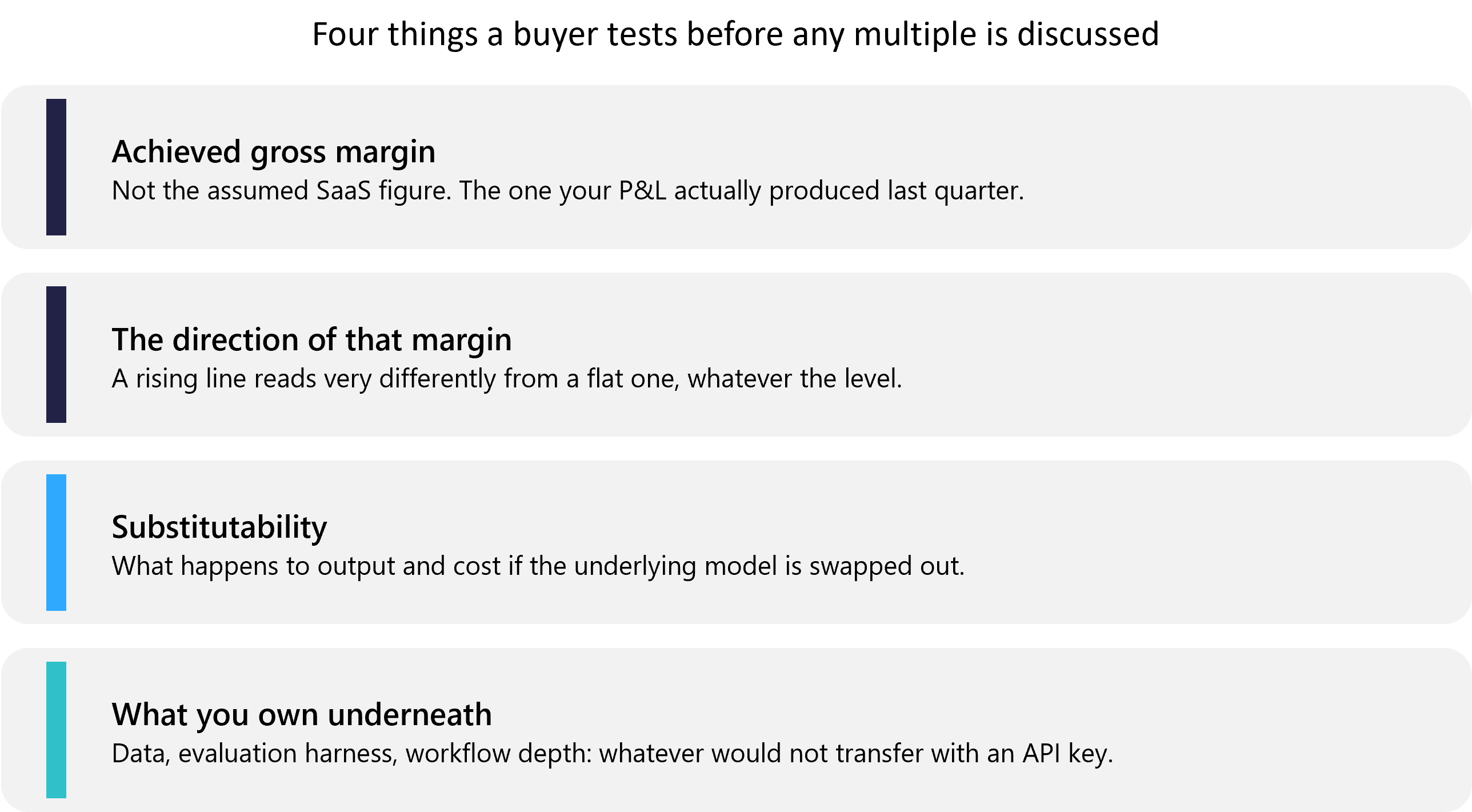
Substitutability is the one founders prepare for least, and it carries real weight. Swap the model behind the product: what happens to output quality, and what happens to unit cost? That one question governs margin durability and your negotiating position with a supplier at the same time. Our note on AI-native versus AI-enabled businesses covers how the same substitution test gets used to settle which category you are in.
Ownership underneath matters for a related reason. BCG's 2026 M&A Report chapter on AI deals found capability buying and product expansion accounting for 95% of AI-ecosystem acquisitions, so most buyers are purchasing a capability they intend to keep running. Anything that would not transfer along with an API key is the part they are genuinely paying for.
The evidence bar has risen generally, which affects how all of this gets received. Writing in The Regulatory Review in March 2026, Evelyn Woo, Grace Schuette and Atinuke Lardner describe SEC enforcement actions over AI washing, and cite Maastricht University research across more than 30,000 annual filings showing companies referencing AI risk climbing from 4% in 2020 to 43% in 2024. Once nearly everyone mentions AI, no buyer takes a description at face value. Demonstrated numbers do the talking, which the diligence requests in our due diligence checklist for buyers reflect.
Where margin stops being the whole story
Margin explains the mechanism, though it is not the biggest lever on a multiple, and wrapper founders should know which way that cuts.
Meritech's analysis of public software companies puts growth at roughly five times the correlation with the multiple that free cash flow margin carries. Companies holding similar Rule of 40 scores traded at a median 11.8x EV to implied ARR when the growth was faster, against 4.4x when the mix leaned toward margin instead. Listed companies, not private deals, so the direction is what travels across rather than the level.
Follow that through and it gets interesting. A wrapper growing quickly, on an improving margin it can evidence, is not obviously worse positioned than a slower business that happens to own its model. We see plenty of processes where the growth differential outweighs the margin differential comfortably. The AI-native growth figures published this year suggest the two often travel together, which is a separate question from whether either one causes the other.
This pattern is not unique to AI
Some perspective helps here, because none of this mechanism is new. Depending on a platform you do not control has always been priced through the numbers it touches rather than through a label. An app business living on one store. An ecommerce brand living on one channel. An agency living on one client. The exposure lands in margin, retention or concentration every time, and the multiple adjusts from there.
Classification moves numbers on its own, too, before anyone reaches the AI question. Aswath Damodaran's NYU Stern sector data from January 2026 has US listed Software (System & Application) at 11.41x EV to sales while Computer Services sits at 1.48x. A heavily services-led implementation business can plausibly be filed under either heading.
Our piece on whether bootstrapped businesses get lower multiples than VC-backed ones works through a structurally identical question, and lands in a similar place: the category correlates with the outcome without being the thing causing it.
What a founder can actually move
Given the mechanism, the work follows fairly directly.
- Can you show achieved gross margin as a series? Several quarters, with cost of goods broken out properly so inference, hosting and human review are each visible. Anyone forced to reconstruct this from a blended figure will reconstruct it conservatively.
- Has the margin been moving, and can you attribute why? Model price cuts, caching, routing cheaper queries to smaller models, prompt efficiency: each is a legitimate explanation, and a documented trend reads very differently from a single good quarter.
- What happens under substitution? Run that test on yourself before diligence runs it on you. Having the answer, with evidence behind it, beats hoping nobody asks.
- What would not transfer with an API key? Your data, your evaluation harness, how deeply the workflow is embedded, the integrations, the customer relationships. None of that comes with a model subscription, so document it the way you would document any other asset.
- Does the capability sit with one or two people? If so it reads as key person risk in a business sale regardless of how the product is classified, and it tends to shape deal structure as much as price.
Most of that is preparation rather than negotiation, which is the argument running through our checklist for preparing a business for sale. The measurable things in the SaaS metrics that drive valuation and net revenue retention and valuation carry more weight than any positioning exercise.
A margin is easier to argue with than a category
So the answer to do AI wrappers get lower multiples than AI-native companies is yes in many cases, no as an automatic rule, and the distinction is the practically useful part. A category penalty would be something to resent. A margin adjustment is something to work on, and the input costs behind it have been moving in the right direction all year.
On the surrounding questions, whether there is an AI premium on exit multiples examines what the evidence will and will not support, AI-native versus AI-enabled multiples covers the classification itself, and how to value an AI business goes through the inputs. For benchmarks, what multiple does a SaaS business sell for and why some SaaS companies sell for 10x ARR give the wider range, with current conditions in the mid-year tech M&A report.
FE International has completed more than 1,500 transactions since 2010 with a 94.1% success rate on private sales and acquisitions, and margin composition comes up in nearly every AI process we run. A business valuation works from your actual cost stack rather than a category assumption. Our notes on choosing an M&A advisor and the documents a buyer will ask for cover what comes next, and you can open a conversation about selling your business without starting a process.
Do AI wrappers get lower multiples than AI-native companies? Work on the margin and the evidence behind it, and the question matters a good deal less than it first appears.
