


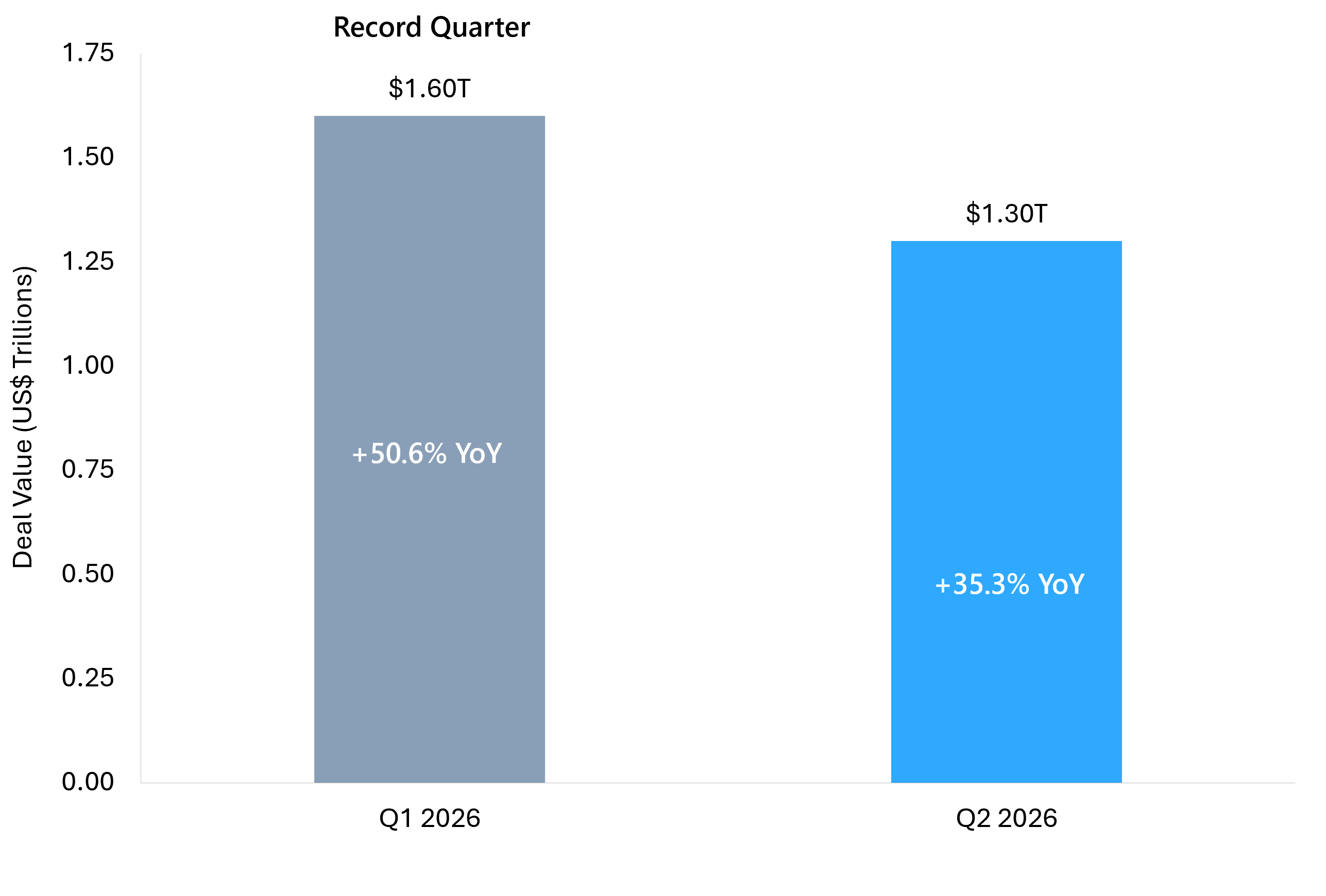
Global dealmaking set a record in the first quarter of 2026. Total deal value reached an estimated $1.6 trillion across 13,877 transactions, up 50.6% on the same quarter a year earlier, with North America alone contributing an all-time high of $1,022.2 billion. Momentum held through the second quarter at $1.3 trillion, up 35.3% year over year, and valuation discipline held with it. For anyone who owns a profitable technology business, that combination matters more than the headline: there is a lot of capital in the market, and buyers are paying for quality rather than bidding indiscriminately.
Which means the decision in front of most founders is not whether there is demand. It is who takes their business to that demand. Two names come up often when owners of SaaS, ecommerce, agency, AI, cybersecurity, edtech, fintech and marketplace app businesses start researching a sale: FE International and Website Closers. Both help owners sell online and technology companies. They are built differently, they reach different buyers, and they suit different sellers.
This guide compares them across the things that actually move a final number: service model, published track record, vertical depth, buyer network, valuation method, negotiation and execution, confidentiality, and who is accountable for your deal day to day. It also covers where FE International's M&A Platform fits for owners who want a faster, more self-directed route, and what the 2026 market means for a sale this year.
FE International vs Website Closers: The Short Answer
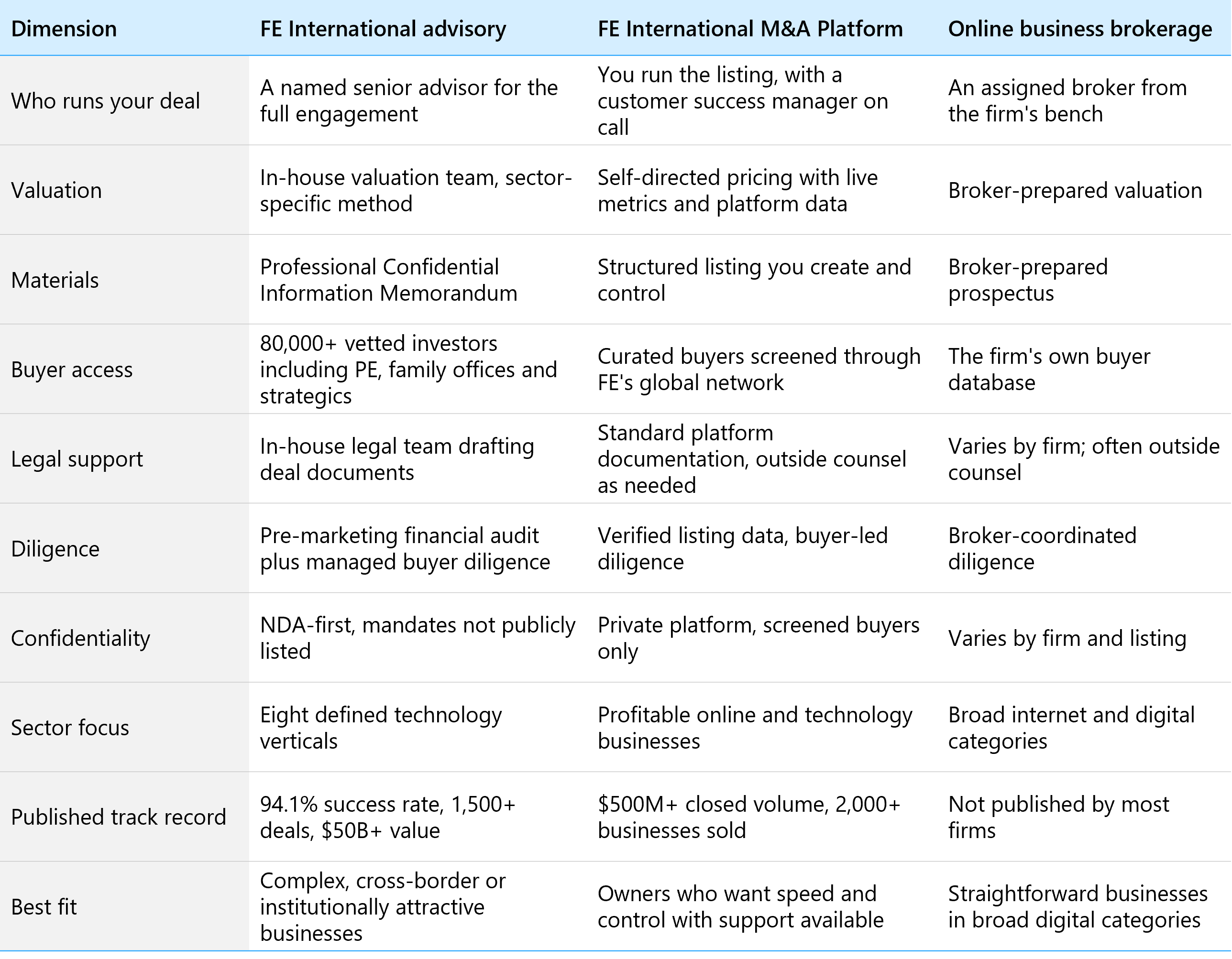
FE International is a technology M&A advisory firm founded in 2010. It has completed more than 1,500 transactions with combined value exceeding $50 billion, publishes a 94.1% success rate, and runs offices across three continents. Every advisory engagement is led by a dedicated senior advisor, with in-house valuation, financial audit, legal and diligence teams behind that person. Securities services are offered through FE Capital Markets LLC, a registered broker-dealer and member of FINRA and SIPC. Alongside advisory, FE runs an M&A Platform for owners and buyers who want to transact more directly, with support available rather than a full mandate.
Website Closers is a United States based online business brokerage. It represents sellers across a broad set of internet and digital categories, including ecommerce, Amazon businesses, SaaS, digital services and content, and it operates with a large team of brokers across multiple US offices. It does not publish a completion rate or a fee schedule, so a seller comparing the two should ask for both directly.
The practical difference is not size, it is structure. One route gives you a named senior advisor with an institutional team and a global buyer network behind them. The other gives you a broker from a large national brokerage bench. Ask which specific person runs your deal, and what happens when it gets complicated.
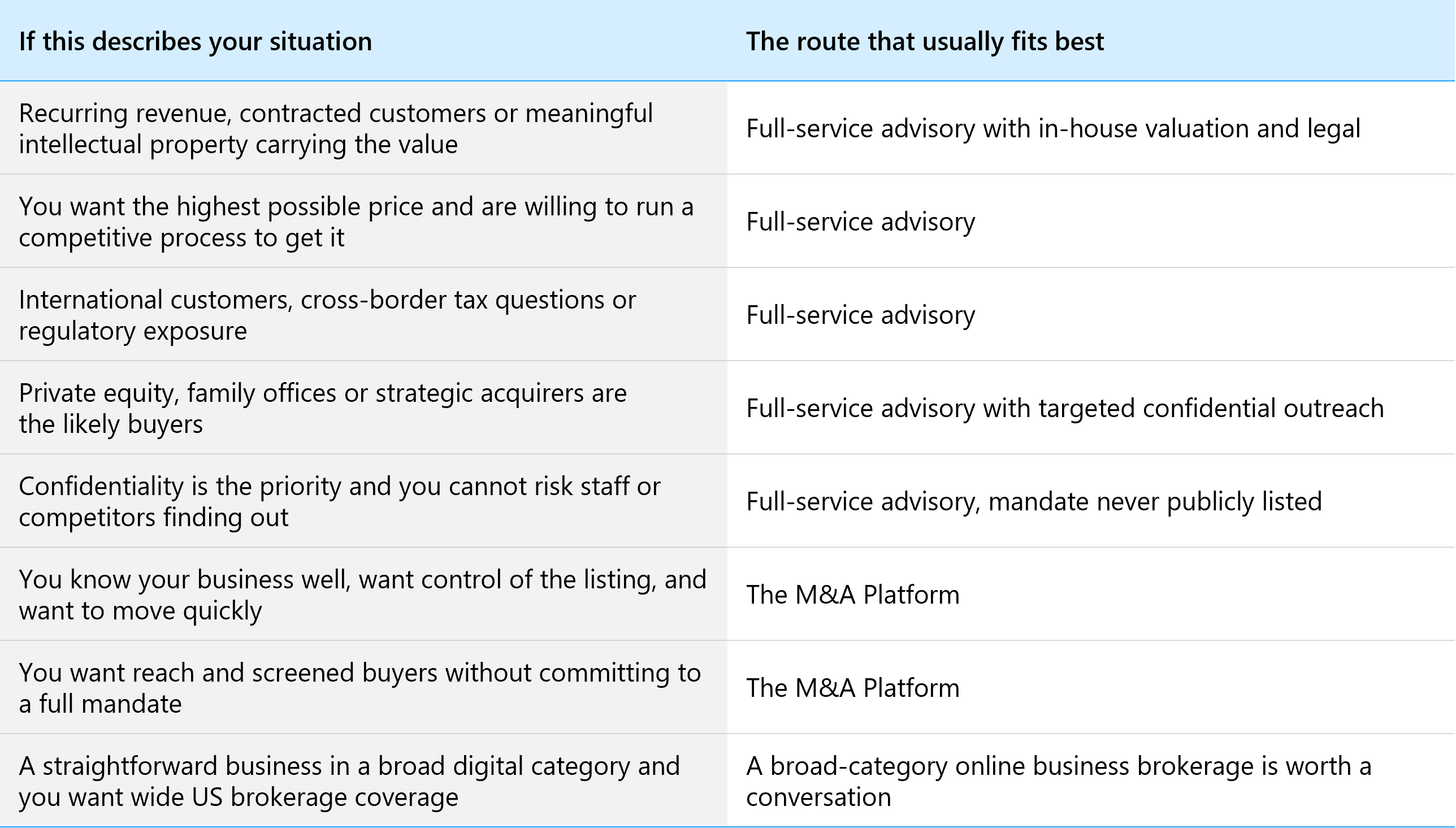
If your business is straightforward, sits comfortably in ecommerce or Amazon, and you want a broad US brokerage with wide category coverage, Website Closers is a credible option worth a conversation. If your business has recurring revenue, meaningful intellectual property, international customers, regulatory exposure, or a buyer pool that includes private equity and strategic acquirers, an advisory process with in-house legal and diligence is usually the better structure. And if you want to move quickly without a full mandate at all, the M&A Platform is the third route, open to both buyers and sellers.
Two Service Models, Compared Side by Side
The word "broker" covers very different businesses. Before comparing firms, it helps to be precise about what each model actually does and where the work sits.
What FE International does
FE International runs a sell-side process end to end. That begins with a free valuation and an assessment of exit readiness, then moves into preparation of a Confidential Information Memorandum, an internal financial audit designed to surface and resolve profit and loss issues before a buyer finds them, targeted and confidential buyer outreach, management of competing offers, negotiation of price and terms, and coordination of diligence through to close. The firm also offers investment banking, private sales and acquisitions and due diligence services as distinct service lines, which matters when a deal needs capital markets capability rather than only brokerage.
What Website Closers does
Website Closers operates as a full-service online business brokerage. A broker prepares marketing materials, presents the business to the firm's buyer database, handles buyer conversations, negotiates on the seller's behalf and coordinates the closing. Its category coverage is deliberately broad across internet and digital businesses rather than concentrated in a small number of technology verticals, and it works with sellers across a wide range of deal sizes.
What the M&A Platform does
FE International's M&A Platform is a private platform for buying and selling profitable businesses, built for owners who want a faster and more flexible path than a full advisory mandate. Sellers create and manage their own listing, buyers are screened through FE's network before they see anything, offers are structured to surface real intent, and a customer success manager is available directly rather than as a gatekeeper. It serves buyers and sellers equally: sellers get reach without handing over the whole process, buyers get listings with live metrics. You can read how the platform works or open an account to browse.
Track Record: The One Number Most Firms Do Not Publish
The most useful question a seller can ask any advisor is simple. Of the businesses you take on, what percentage actually close?
FE International publishes 94.1%, across more than 1,500 completed transactions with combined value above $50 billion. That figure is a function of how the firm operates rather than a marketing line. Mandates are accepted selectively, financials are audited before a business goes to market rather than after a buyer raises questions, and buyers are pre-qualified before they reach a seller. Fewer surprises in diligence means fewer deals that fall over late, which is when a collapse costs a seller the most in time, momentum and negotiating position. The client side of that record is visible in FE's client stories and published case studies, including the eight-figure edtech exit of PositivePsychology.com and the RegTech acquisition of Heywood Business Analysts by Regnology.
Website Closers does not publish a completion rate. That is not unusual in online business brokerage, where most firms publish transaction counts or aggregate value rather than the percentage of engagements that reach a close. It does mean the comparison is not symmetrical, and it is worth asking for the number directly, along with how it is calculated, before signing anything.
Transaction count tells you how busy a firm is. Completion rate tells you what happens to businesses like yours after they sign. Ask for both, and ask how each is calculated.
This is a well-studied question rather than a marketing one. The Quarterly Journal of Finance has published research examining whether hiring an M&A adviser changes outcomes for private sellers, and separate work looks specifically at adviser impact on pricing, premia, returns and deal completion. Privately held companies are the category almost every online business sits in, so the question is directly relevant. The mechanism is not mysterious either. A managed process creates competition, and competition is what moves price and terms.
How to Verify Any Firm's Track Record Before You Sign
Searching a firm's name plus the word "reviews" mostly returns pages written by people with a commercial interest in the answer. There are better checks available, and all of them are free.
- Regulatory registration. If a firm handles securities transactions it should be able to name its registered broker-dealer entity, and you can look that entity up on the public register maintained by FINRA. FE International offers securities services through FE Capital Markets LLC, a member of FINRA and SIPC, and FE International, Inc. operates under the M&A broker exemption in Section 15(b)(13) of the Securities Exchange Act.
- Named client outcomes. Anonymous praise is worth very little. Deals with named companies, named acquirers and a described process are worth a lot. FE publishes both client stories and full case studies.
- Independent recognition. Third-party rankings are audited on submitted financials rather than self-reported. FE International has been named to the Financial Times list of the Americas' Fastest Growing Companies and has recurring Inc. 5000 recognition, both listed on its company page.
- Published research. A firm that publishes sector data every year is exposing its own analysis to scrutiny. FE's market reports cover each vertical it advises in.
- References you choose. Ask to speak with a seller in your sector at roughly your size whose deal closed in the last twelve months. Ask specifically for one where something went wrong, and how it was handled.
Run the same five checks on every firm you are considering. The gaps that appear are usually more informative than anything either firm puts in a pitch deck.
Vertical Depth Across Eight Technology Sectors
Category breadth and vertical depth are different things, and they suit different sellers. A brokerage covering every digital category can place a wide range of businesses. A firm organised around a defined set of technology verticals knows which specific buyers pay a premium for each one, and why.
FE International is structured around eight verticals, each with dedicated coverage and published research in the firm's market reports.
SaaS and artificial intelligence
Software buyers in 2026 are underwriting recurring revenue quality rather than growth alone. Net revenue retention, churn by cohort, gross margin and the Rule of 40 carry most of the weight, and FE's SaaS due diligence checklist sets out how buyers test each of those. On the AI side, capital commitment is the story: the four largest hyperscalers have guided a combined $670 billion in 2026 capital expenditure, and dealmaking now centres on securing position across the AI value chain rather than acquiring single features. PwC's mid-year view describes a widening gap between AI-native, AI-resilient and AI-exposed businesses, which is exactly the distinction that sets a multiple. FE covers this through its artificial intelligence practice and its AI business valuation guidance.
Ecommerce and consumer products
Ecommerce valuation rests on transferable, sustainable earnings rather than revenue, and FE's guides on valuing a Shopify or DTC brand and valuing an ecommerce business set out the metrics buyers actually test: retention, contribution margin, channel mix and owner independence. Two shifts are worth watching. In consumer markets, buyers are prioritising assets that improve resilience, and discovery is moving. Deloitte's 2026 retail outlook reports that AI chat referrals already account for 15% to 20% of total referrals for some retailers, with agents potentially handling up to a quarter of global ecommerce sales by 2030. A brand that is discoverable inside AI answers is a more defensible asset than one that is not, and buyers have started pricing that. FE covers the sector through its ecommerce and consumer products practice, with process detail in how to sell an ecommerce business and ecommerce due diligence.
Cybersecurity and fintech
These two verticals reward specialist coverage more than most, because the buyer list is short and specific. Compliance regimes drive security acquisitions, and platform consolidation drives the rest, as FE's analysis of cybersecurity M&A in 2026 sets out. In payments and embedded finance the drivers are different again, covered in the fintech M&A outlook. FE runs dedicated cybersecurity and fintech coverage rather than treating both as software.
Agencies, edtech and marketplace apps
Agencies are valued on EBITDA with client concentration and retainer mix doing most of the work, which FE breaks down in how to value an agency business and its analysis of agency and marketing consolidation. Edtech turns on enrolment economics and institutional versus consumer models, and marketplace apps on gross merchandise value, take rate and liquidity. Each has its own agency, edtech and marketplace apps practice.
A generalist can sell your business. A specialist knows which five buyers will pay the most for it, and what each of them needs to see in the first ten pages.
How the Buyer Network Actually Works
Every firm claims a buyer network. What separates them is composition, screening and geography.
FE International maintains a network of more than 80,000 vetted investors spanning private equity firms, family offices, strategic acquirers, search funds and individual operators, reached from offices across three continents. That mix matters because the highest bidder for a technology business is frequently not the buyer who found the listing. It is a strategic acquirer in an adjacent market or a sponsor executing a buy-and-build, and neither of those browses public listings. They come through relationships and targeted outreach, which is why FE keeps advisory mandates off public listing pages entirely and runs confidential buyer outreach under NDA instead.
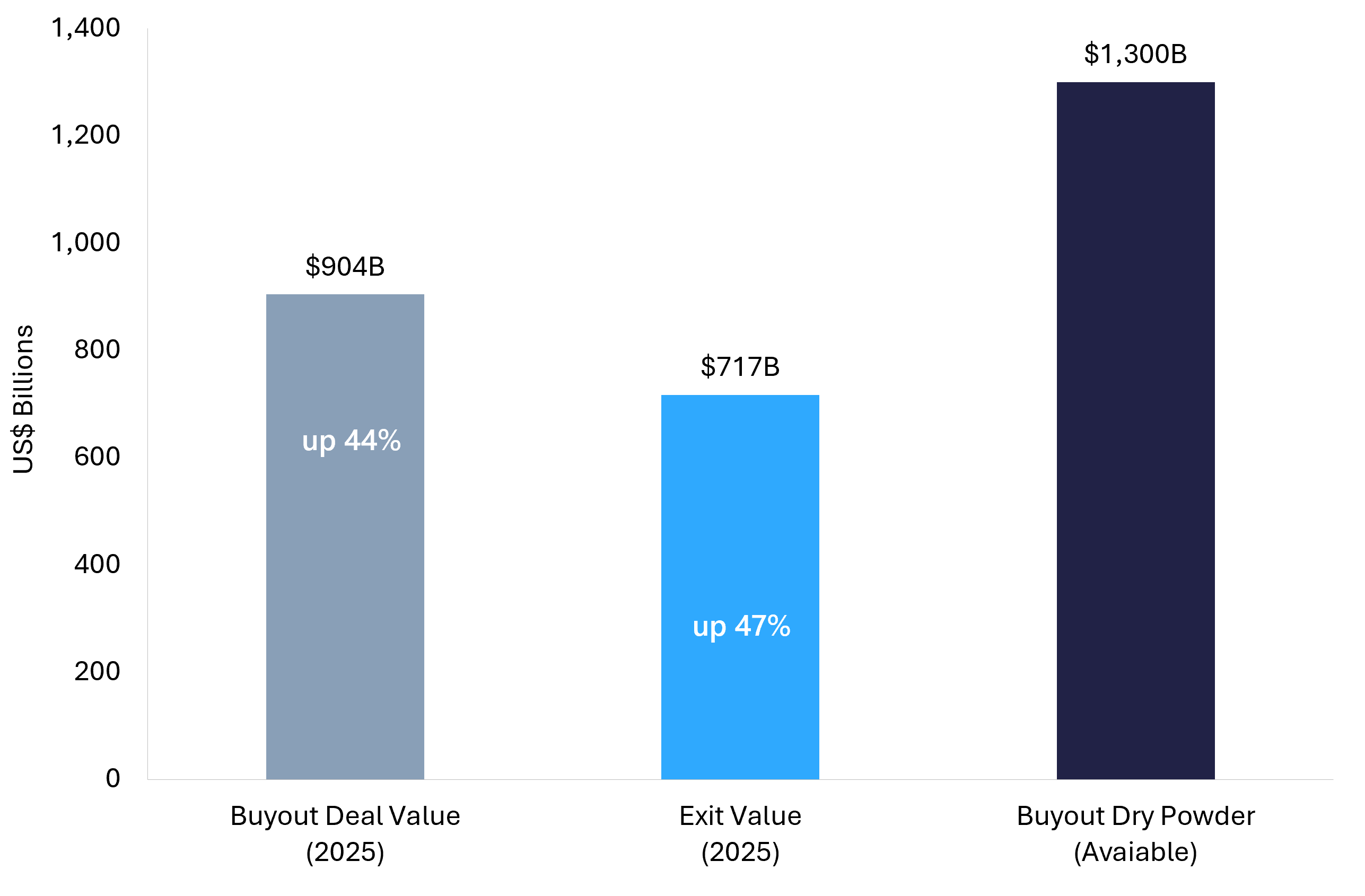
The capital behind that pool is unusually deep right now. Bain's 2026 global private equity report puts buyout dry powder at $1.3 trillion, with 2025 global buyout deal value up 44% to $904 billion and buyout-backed exit value up 47% to $717 billion. Bain also notes that sovereign wealth funds and corporate buyers supplied much of the equity in the largest deals, meaning the total pool of capital chasing assets is larger than the buyout figure alone suggests.
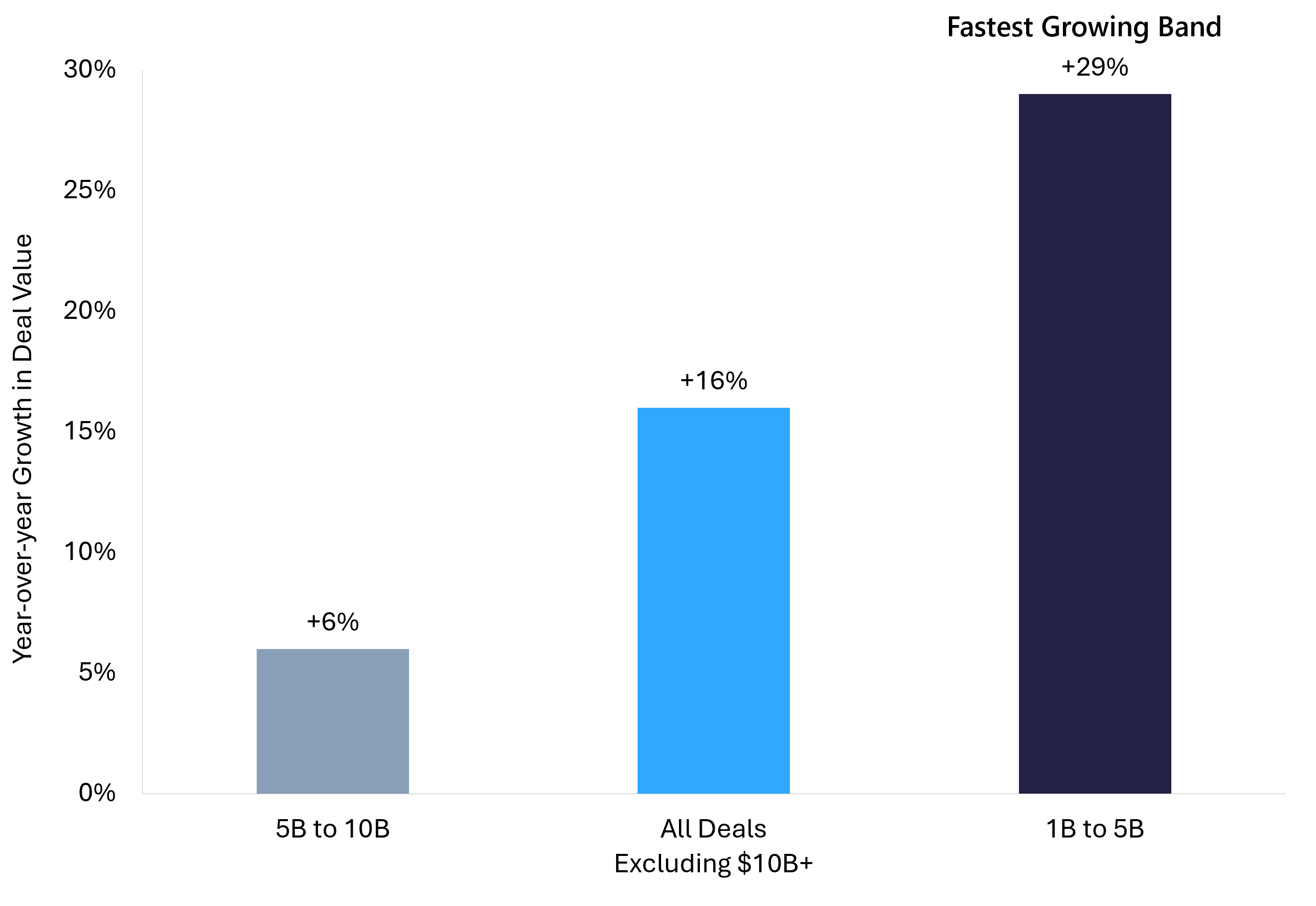
Where that lands for a founder is in the middle of the market. Excluding deals above $10 billion, 2025 private equity deal value grew 16%, and the $1 billion to $5 billion band grew fastest at 29%. Sponsors building platforms in that range acquire smaller technology businesses continuously to do it. A seller in the low seven figures is not competing with a megadeal, they are supplying one.
The route those businesses eventually exit through is worth noting too. Bain records that sponsor-to-strategic exit value rose 66% year over year, reaching 73% growth in North America and 82% in Europe, and that exit value below the $10 billion threshold grew 34%. Corporate acquirers are buying sponsor-owned assets aggressively, which is the same buyer behaviour that sets premium prices further down the market. Reaching those acquirers is an outbound exercise rather than a listing exercise.
Valuation Methodology: How the Number Gets Built
Two firms can look at the same business and produce very different numbers, and the reason is usually method rather than optimism.
FE International values businesses using the metric appropriate to the model: seller discretionary earnings for owner-operated businesses, EBITDA for mature and profitable ones, and revenue or ARR multiples where growth and recurring revenue justify it, cross-checked against comparable transactions. The method by sector is set out in FE's guides on valuing a website or internet business and valuing an agency business. The step that changes outcomes most is preparation. A quality of earnings review tests whether reported profit is real, recurring and sustainable before a buyer's accountants do, which is where headline prices usually get repriced.
The wider market is pricing with discipline, which works in favour of well-prepared sellers. PitchBook's second quarter data has the median EV/EBITDA multiple holding at 10.2x on a trailing twelve month basis, with healthcare commanding a premium at 12.6x and energy at 8x. Stable benchmarks mean a defensible valuation gets accepted rather than argued down.

When comparing firms, ask how the valuation was reached rather than what it is. A number produced before anyone has looked closely at cohort retention, customer concentration or owner dependence is a starting bid, not a valuation. Any advisor should be able to show which comparable transactions the figure rests on and which specific metrics would move it up or down. FE offers a free valuation with no obligation, which is a reasonable way to test that against whatever else you are quoted.
Negotiation and Deal Execution
Price is agreed once. Terms are negotiated repeatedly, and terms are where net proceeds are actually decided.
The FE International process runs in four stages. It opens with a valuation and consultation at no cost. On engagement, the team prepares the Confidential Information Memorandum, sets up a secure deal room and completes pre-marketing diligence, including a financial audit that finds profit and loss issues before buyers do. Outreach then goes to pre-qualified buyers, sponsors, family offices and strategic acquirers under NDA. Finally the advisory and legal teams run multiple offers against each other to create competitive tension, negotiate price and structure, manage buyer diligence, draft the documentation and take the deal to close, with transition support after it. The full sequence is described in FE's guide to selling a business.
The four stages, in order
- Stage one: valuation and consultation. A senior advisor assesses the business and produces a data-backed valuation at no cost and with no obligation.
- Stage two: preparation. On engagement, the team writes the Confidential Information Memorandum, opens a secure deal room and completes a pre-marketing financial audit that surfaces profit and loss issues before a buyer does.
- Stage three: confidential outreach. Pre-qualified buyers, sponsors, family offices and strategic acquirers are approached directly under NDA. Nothing is published and nothing is shared before confidentiality is signed.
- Stage four: negotiation, diligence and close. Multiple offers are run against each other to create competitive tension. The advisory and legal teams negotiate price and structure, manage buyer diligence, draft the documentation and take the deal through to close, with transition support afterwards.
The items worth scrutinising in any negotiation are consistent: how much consideration is cash at close, how much sits in an earnout and against which targets, the size and duration of any escrow, how the working capital adjustment is calculated, what representations and warranties the seller gives, and what post-close involvement is expected. An offer that looks higher on the headline can net less than a lower one once those are settled. This is the single strongest argument for a managed process, and it is covered in detail in FE's comparison of a DIY exit against an advisor-led one.
Two offers at the same headline price can differ by a third in what actually reaches your account. The gap is earnout structure, escrow and working capital, not the number on the front page.
On negotiation specifically, ask any firm who conducts it. Whether the person who valued your business is the person who will sit across from a private equity partner during diligence is a fair question, and the answers differ meaningfully between an advisory model and a brokerage bench.
Confidentiality and Who Is Actually Accountable
For most owners, a leak is a worse outcome than a slow process. Staff, customers and competitors learning about a sale before it closes can damage the business being sold.
FE International runs advisory mandates confidentially. Businesses under advisory are not publicly listed, buyers register and qualify before seeing anything, and information is released in stages behind NDAs rather than published. Prospective buyers work through a registration and enquiry process rather than open browsing, and the buy-side pathway is built around the same screening.
Accountability is the second half of this. In an advisory model, one named senior advisor owns the outcome from valuation to close, with valuation, audit, legal and diligence specialists behind them. In a large brokerage with many brokers across many offices, the experience depends substantially on which broker is assigned, so the question to ask is not what the firm does but what your specific broker has closed. Ask how many active sell-side listings that person currently carries. Long-standing guidance in Entrepreneur on vetting a business broker puts a workable load at roughly three to seven active listings per broker, on the reasoning that a much larger book means individual listings get less attention. A higher number is not disqualifying, but it is worth knowing before you sign.
What It Costs, and What Really Determines Your Net Proceeds
Fee comparison is where most seller research goes first and delivers least, because a headline percentage is not the same as what you keep.
FE International publishes its terms directly for sellers and for buyers, which is the right place to check current figures rather than a third-party summary. Website Closers does not publish a fee schedule publicly, so a seller will need to ask for its terms in writing.
More useful than comparing percentages is comparing what sits inside the engagement against what you will pay for separately. Work through the list:
- Is the valuation included, and is it produced by a dedicated valuation team or by the person who wants your listing?
- Is a financial audit or quality of earnings review done before going to market, or does the buyer's accountant find those issues during diligence?
- Are deal documents drafted in-house, or do you retain outside counsel and pay separately?
- Is buyer outreach targeted and proactive, or is your business presented to an existing list?
- Who manages diligence responses, and how much of that work lands on you while you are still running the company?
- What is the exclusivity period, and what happens at the end of it?
What an advisor actually adds
Set against the fee, the value of a managed process comes from five things a seller cannot easily replicate alone. Competition, because several interested buyers negotiating at once moves price in a way no single conversation does. Preparation, because a business presented with audited financials and documented retention is underwritten faster and repriced less. Reach, because the buyer who pays the most is frequently one the seller has never heard of. Insulation, because handling diligence requests while running the company is where performance slips and slipping performance costs multiple. And structure, because the difference between cash at close and a three-year earnout is worth more than any fee.
Academic work on this is fairly consistent. Research on advisor impact on pricing, premia, returns and deal completion examines exactly these mechanisms, and the Quarterly Journal of Finance study of private sellers finds measurable effects for privately held companies specifically, which is the category every online business falls into.
A lower headline rate on an engagement that leaves legal, diligence and audit to the seller is frequently more expensive in total and considerably more expensive in attention. The variable that dominates all of it is price achieved. A process that generates three competing offers instead of one changes the outcome by far more than any difference in rate, which is the finding that runs through the academic work on advisers and private company sales.
Where the M&A Platform Fits, for Buyers and Sellers
Not every owner wants a full mandate, and not every business needs one. That is the gap FE International built the M&A Platform to fill. It is not a downgrade from advisory and it is not a separate company. It is a second route into the same buyer ecosystem, chosen by need rather than by a dollar threshold.
Choose the Platform when you want control and speed
The Platform suits owners who know their business well, want to stay in the driver's seat, and prefer to move without a full engagement. Sellers create and manage their own listing, update it directly, and deal with buyers who have already been screened through FE's global network. A customer success manager is available when a question comes up, and structured competitive bidding is designed to surface genuine intent rather than enquiries that go nowhere. Published Platform figures include more than $500 million in closed deal volume, over 2,000 businesses sold, more than 500,000 registered entrepreneurs and over $4 billion in verified buyer funds.
Choose advisory when the deal needs to be engineered
An advisory mandate earns its place when the outcome depends on things a listing cannot do: building competitive tension between named strategic acquirers, positioning a business whose value is in intellectual property or contracted revenue rather than trailing profit, handling cross-border tax and regulatory complexity, negotiating earnouts and rollover equity, or drafting documentation for a sponsor-backed buyer. Complexity, not size, is the signal. Owners in that position should start with a valuation and a conversation.
For buyers, both routes lead to the same ecosystem
Buyers can browse listings with live metrics on the Platform and make offers directly, or register through the buy a business pathway for access to advisory opportunities that are never publicly listed. FE also offers standalone due diligence services to buyers running their own processes, and its guide to buying an ecommerce business covers the diligence and post-acquisition work in detail. Businesses sold through FE's ecosystem have been acquired by strategic and financial buyers including Shopify, Stripe, Visma, Summit Partners and Eden Capital.
One company, two routes, the same buyer ecosystem. Pick the route by how much of the process you want to own, not by how big your business is.
What Separates the Strongest Online Business Advisors in 2026
Rankings of the best brokers for online businesses change every year and most are compiled by people who take a referral fee. The criteria that actually correlate with seller outcomes are more stable than the lists are.
- A published, calculable completion rate. Not transaction count, not aggregate value. The percentage of signed mandates that reach a close, and a clear explanation of how it is worked out.
- Sector concentration rather than category breadth. The firm should be able to name the five most likely acquirers for your business in the first meeting, and say what each of them typically pays for.
- Institutional buyer access. Sponsors and corporate development teams do not browse listings. Reaching them requires relationships and outbound work, not a database.
- Financial preparation before going to market. A quality of earnings review or equivalent audit done up front, rather than discovering the issues when a buyer's accountant does.
- Legal capability inside the firm. Documentation drafted by people who have closed hundreds of deals in your sector, rather than by counsel meeting your business model for the first time.
- Senior ownership of your deal. One accountable person from valuation to close, with a workload that leaves room for you.
- Published market research. Firms that release vertical reports annually are staking their analysis publicly, which is a reasonable proxy for whether they actually track the market.
Two of those have become more important in the last eighteen months. Financial preparation matters more because buyers are underwriting selectively, and sector concentration matters more because the premium for genuine differentiation is widening. The retail and consumer view for the year, set out in an independent 2026 retail M&A outlook, describes buyers doubling down on strong brands and scalable platforms while stepping away from assets that lack scale or strategic fit. That is a market that pays for positioning, and positioning is an advisory function.
Seven Questions to Ask Any Advisor Before You Sign
These are the questions that separate firms quickly, and they work equally well on FE International, Website Closers or anyone else.
- What percentage of the businesses you take on actually close? Ask how the figure is calculated and over what period. An answer of "we do not track that" is itself informative.
- Which specific person runs my deal, and what have they closed in my sector? Firm-level credentials are not the same as the track record of the individual assigned to you.
- How many active sell-side listings does that person carry right now? Attention is finite. This is the most revealing question on the list and the one least often asked.
- How did you arrive at this valuation? You want comparable transactions and named metrics, not a formula applied to trailing profit.
- Who drafts the legal documents, and is that included? In-house legal versus outside counsel changes both cost and speed.
- How will you approach strategic buyers who are not already on your list? The best buyer for a technology business often has to be found rather than notified.
- What are the exclusivity terms, and what happens if the business does not sell? Read this clause before anything else in the agreement.
Speak to more than one firm. The conversation itself is informative, and any advisor confident in their process will be comfortable being compared. FE International will run a valuation with no obligation attached, which makes it straightforward to benchmark.
The 2026 Market Backdrop for Technology Sellers
Conditions this year favour prepared sellers, and the data is fairly consistent on why.
The first quarter set a record at $1.6 trillion in global deal value across 13,877 transactions, and the second quarter held at $1.3 trillion, up 35.3% year over year. Deal count barely moved between the two, which tells you the base of activity is steady rather than spiky. Corporate acquirers were the story in the second quarter, with corporate-led M&A holding above $890 billion as a friendlier regulatory posture in Washington, Brussels and London gave strategic buyers more room to pursue scale. For a founder, strategic buyers are usually the ones who pay premiums, because they are buying a capability rather than a cash flow.
Technology sits at the centre of it. PwC's mid-year view of technology, media and telecommunications has AI as the strongest force in dealmaking, with buyers combining acquisitions, minority investments and partnerships to secure position across compute, data, distribution and customer access. On the wider picture, PwC observes that the market is now rewarding strategic clarity, and that the second half of the year offers significant opportunity for those who act with conviction. FE's own mid-year 2026 technology M&A report breaks the same period down by vertical, with multiples and buyer activity by sector.
Two implications follow for anyone considering a sale this year. Buyers have capital and are using it selectively, which rewards businesses with clean financials, documented retention and low owner dependence. And the premium for genuine differentiation is widening rather than narrowing, which means preparation is worth more now than it was two years ago. Bain's reading of the new era in private equity and its ongoing M&A research both point the same way.
Which Route Fits Your Situation
Rather than sorting by revenue, sort by what your sale actually requires.
Choosing Well, and Starting
There is no universal answer to this comparison, and any firm claiming otherwise is selling rather than advising. What there is, is a set of questions with answers that differ meaningfully between models: who runs your deal, what percentage of engagements close, how the valuation was built, who drafts the documents, and how buyers who are not already on a list get found.
The market itself is not the constraint this year. Deal value set a record in the first quarter and held through the second, capital available to buyers is at exceptional levels, and multiples are stable enough that a well-prepared business gets a fair hearing. What separates outcomes is preparation and process.
For a business where the value needs to be engineered, positioned and negotiated, start with a free and confidential valuation or read how FE International approaches selling a business. For owners who want to move faster with more control, and for buyers looking for opportunities, the M&A Platform is open to both sides, with current listings available to browse. Either way, get in touch and ask the seven questions above. Ask them of everyone.