


Cybersecurity M&A in 2026 is moving at a pace the sector has never seen. Buyers announced 426 cybersecurity acquisitions in 2025, with disclosed value reaching $92.5 billion, an 82% jump over the prior year, and that momentum has carried straight into this year. Google closed its $32 billion purchase of Wiz in March 2026, the largest acquisition in its history. Palo Alto Networks completed its $25 billion CyberArk deal in February. By mid-June, deal trackers had already cataloged roughly 190 transactions for 2026.
Three forces sit behind the numbers. Compliance regimes on both sides of the Atlantic are converting security from a discretionary purchase into a legal requirement. AI has become the single biggest driver of change in how organizations defend themselves, and buyers are paying premiums for teams that can secure it. And the largest platforms keep consolidating, buying the capabilities their enterprise customers now expect in one place.
For founders and buyers in the lower middle market, this matters more than the headline figures suggest. Every mega deal creates integration gaps, redirects talent, and sends strategic and private equity buyers hunting for the next tuck-in. This analysis breaks down where demand is concentrated, what acquirers are paying, and how to position a security business whether you plan to transact this year or build toward a stronger exit.
Cybersecurity M&A in 2026: The Numbers Behind a Record Market
The cybersecurity M&A market entered 2026 with record momentum. Trackers cataloged 426 announced deals in 2025, a 5% increase over 2024 and the first annual rise after two quieter years, with 11 transactions clearing the $1 billion mark. Disclosed value hit $92.5 billion, and deals involving pure-play cybersecurity companies alone accounted for $84 billion across 334 transactions. Average deal size expanded sharply as well, since value grew far faster than count: buyers are writing bigger checks for the assets they want most.
The sector is outperforming the broader technology market, which is itself in a strong cycle. Technology M&A value rose 77% in 2025, one of the standout findings in Bain's M&A Report 2026, and the two deals that report highlights first are both security transactions: Wiz and CyberArk. When the flagship deals of an entire technology cycle are cybersecurity deals, sellers in this vertical are negotiating from a position of structural demand.
The 2026 cadence confirms it. June alone produced 37 announced deals, with 1Password, Accenture, Cisco, F5, Rubrik, and SailPoint all active in a single month. Spring roundups held in the high twenties to high thirties of announced deals per month, a pace consistent with another 400-deal year. On the exit side, Q1 2026 cybersecurity exit value in the venture channel reached a record $32.9 billion, anchored by the Wiz close. North America continues to supply the bulk of acquirers and capital, and cross-border interest keeps widening as European sovereignty priorities pull defense and industrial buyers into the market.
The takeaway: cybersecurity is now the most reliably active corner of technology M&A, with deal count, deal value, and average deal size all rising together.

The Deals Setting the Pace: Landmark Acquisitions of 2025 and 2026
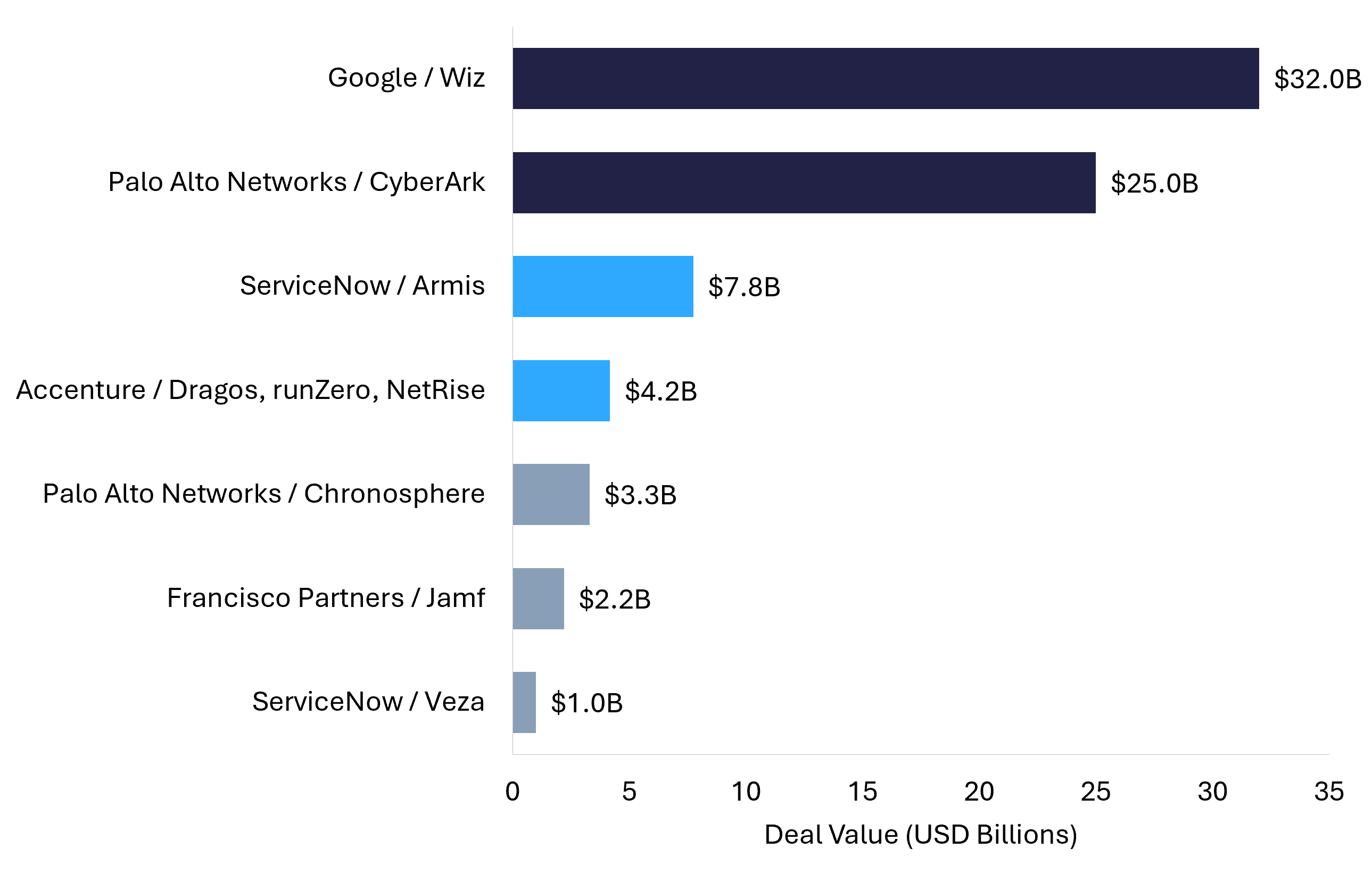
The biggest cybersecurity acquisitions of this cycle are Google's $32 billion purchase of Wiz, closed in March 2026, Palo Alto Networks' $25 billion acquisition of CyberArk, closed in February 2026, ServiceNow's $7.75 billion Armis deal, closed in April 2026, and Accenture's $4.175 billion agreement for Dragos, runZero, and NetRise, announced in June 2026. Each one tells you something specific about where buyers see durable value.
Wiz proves the ceiling. The company crossed $1 billion in annual recurring revenue before the close, and Google paid roughly 32 times that figure in cash for the category leader in cloud security. CyberArk shows identity becoming a core platform pillar: machine identities now outnumber human identities by more than 80 to 1, and Palo Alto Networks built its entire acquisition case on securing human, machine, and AI-agent access. Armis, paired with ServiceNow's Veza close in March 2026, connects asset visibility with identity intelligence. And the Accenture transaction moves a $10 billion consulting security business into software, targeting an operational technology security market estimated at $27 billion in 2026 and projected to near $59 billion by 2031.
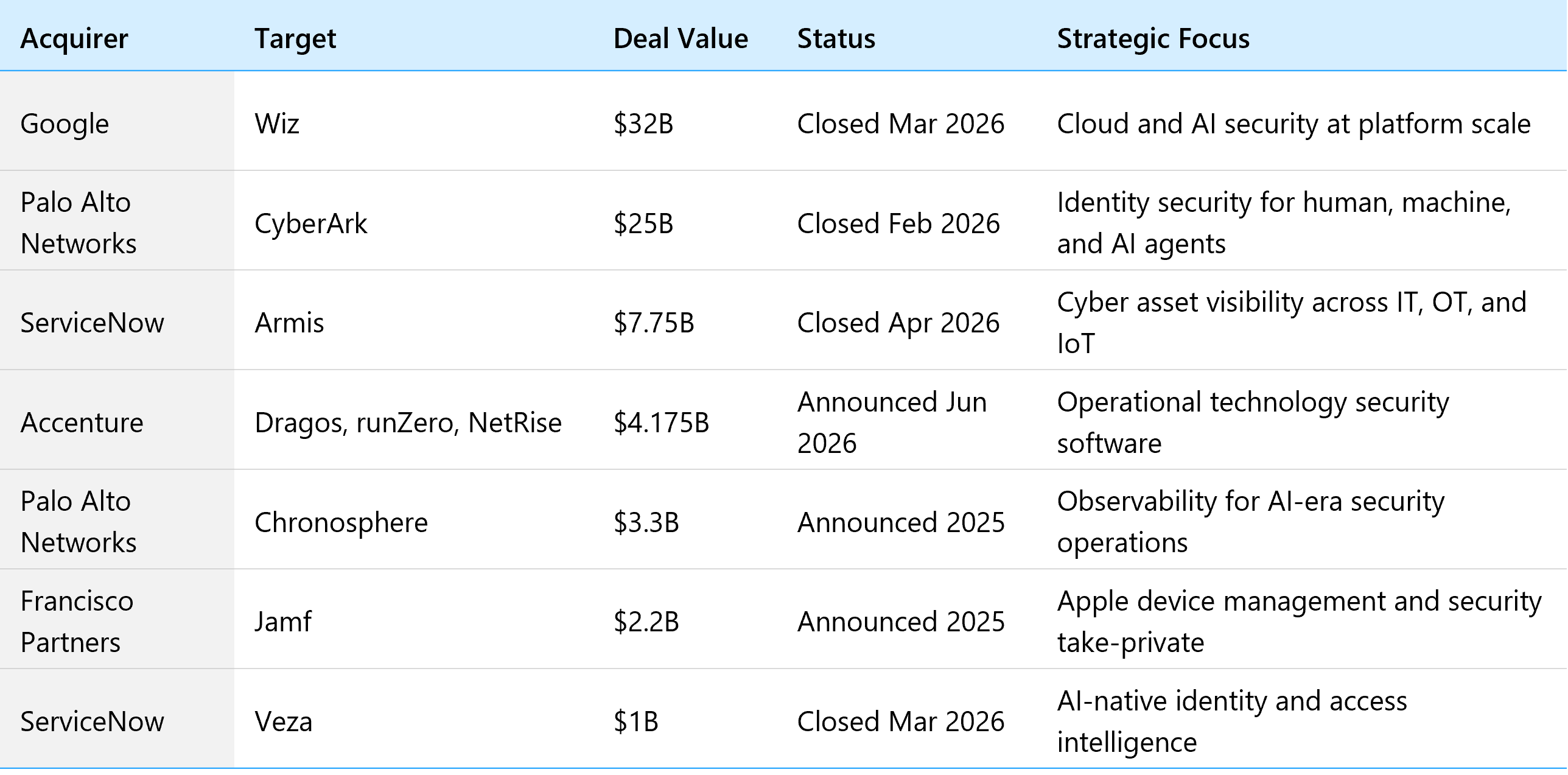
The mid-sized transactions carry signals of their own. Palo Alto Networks' $3.3 billion Chronosphere agreement extends security operations into observability, a reminder that adjacent data infrastructure now trades as security. ServiceNow's $1 billion Veza close in March 2026 shows AI-native identity intelligence commanding platform-level attention at a fraction of megadeal size. And Francisco Partners' $2.2 billion take-private of Jamf confirms that financial sponsors will underwrite scaled security-adjacent software at full valuations. For mid-market sellers, each of these is a comparable, and each one moved the reference point up.
Below the megadeals sits the layer most relevant to founders: a steady stream of tuck-ins. In June alone, 1Password acquired Apono, an access governance specialist, reportedly for $250 million to $300 million, and A10 Networks bought TrojAI to add AI red-teaming and runtime protection. Financial sponsors stayed busy too: Francisco Partners took Jamf private at $2.2 billion, and private equity platforms across managed security and compliance services kept adding bolt-ons throughout the first half of 2026.
Strategic buyers are anchoring the market at the top while sponsors and platforms compete for tuck-ins underneath, which is exactly the structure that supports strong pricing at every deal size.
Compliance-Driven Acquisitions: Regulation as a Growth Engine
Regulation has become one of the strongest demand drivers in cybersecurity M&A. Four regimes now shape buyer behavior: the EU's NIS2 Directive, DORA for financial services, the SEC's cyber disclosure rules in the United States, and CMMC across the US defense supply chain. Each converts security capability from a nice-to-have into a contractual and legal requirement, and acquirers are buying their way to coverage rather than building it slowly.
In Europe, the NIS2 Directive extends binding cybersecurity obligations across 18 critical sectors, from energy and health to digital infrastructure and manufacturing. The transposition deadline passed in October 2024, and the European Commission escalated infringement actions against 19 member states in May 2025, a clear signal that the enforcement phase has arrived. In parallel, DORA has applied since January 17, 2025 to 20 categories of financial entities and their ICT providers, pulling banks, insurers, investment firms, and their technology vendors into a single operational resilience framework.
The United States is running the same play through different channels. Public companies must disclose material cyber incidents on Form 8-K within four business days of determining materiality, which puts board-level attention, and budget, behind detection and response. In the defense sector, the CMMC program formalizes certification requirements for the contractors handling federal contract information and controlled unclassified information, with a phased rollout established by rule and CMMC clauses appearing in new Department of Defense contracts since November 10, 2025, building toward full implementation in 2028. The downstream demand is enormous: every defense supplier handling controlled information needs assessment support, hardened enclaves, and managed services that hold certification, which has turned CMMC-capable security firms into some of the most sought-after tuck-ins in the US middle market. Firms already certified, or already serving certified primes, sell a head start that buyers cannot manufacture quickly at any price.
What does this mean for dealmaking? Compliance creates three kinds of acquisition targets. First, GRC and audit-readiness specialists, because every covered entity needs evidence, not just policies. Second, testing and offensive security firms, since regimes like DORA mandate resilience testing on a recurring schedule. Third, any vendor already certified into a regulated channel: a company holding the right attestations shortens a buyer's time to revenue in that market by years. We see this pattern clearly in the middle market, where certified security firms routinely attract multiple competing offers.
Data privacy regulation compounds the effect from a second angle: the deals themselves. A target's handling of customer data under GDPR, US state privacy laws, and sector rules is now priced into every transaction. Privacy-strong companies clear diligence faster, keep more of their headline price through closing adjustments, and open regulated customer segments the buyer could not previously serve. Privacy-weak companies still sell in this market, but they fund the buyer's remediation out of their own proceeds. Founders who treat privacy engineering as a valuation lever, not a cost center, consistently come out ahead in our processes.
Compliance deadlines have turned security spending into non-discretionary spending, and acquirers pay premiums for companies that shorten a regulated customer's path to audit-ready.

AI Security: The New Center of Gravity for Buyers
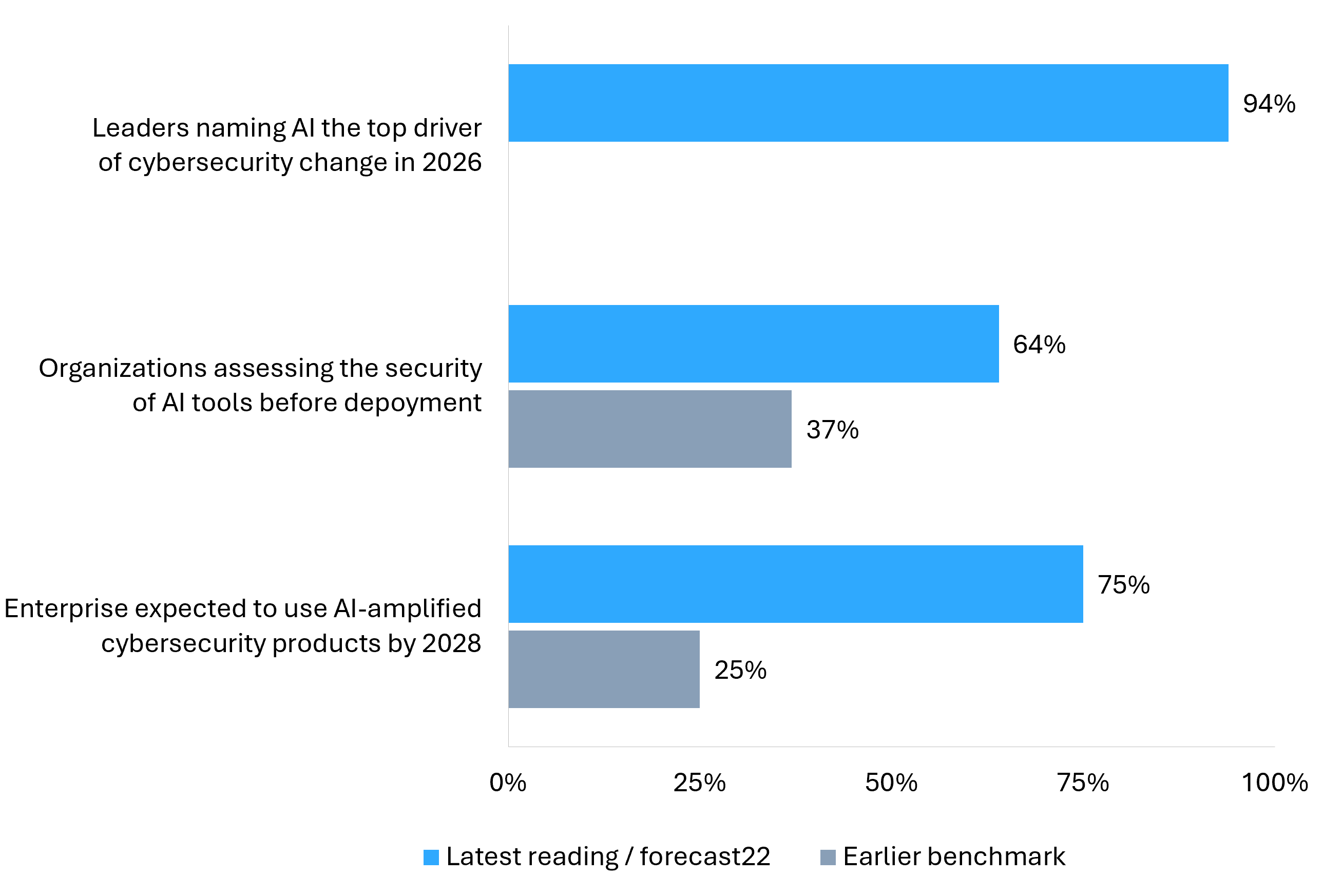
AI security is the fastest-rising acquisition theme in cybersecurity M&A. In the World Economic Forum's Global Cybersecurity Outlook 2026, 94% of surveyed leaders named AI the most significant driver of change in cybersecurity for the year ahead, and the share of organizations that assess the security of AI tools before deployment nearly doubled in twelve months, from 37% to 64%. Buyers read those numbers the same way sellers should: a new, mandatory product category is forming in real time.
The deal data backs it up. Nearly half of strategic technology deal value above $500 million in 2025 came from AI-native companies or deals that cited AI benefits. Inside security specifically, the 2026 megadeals all carry an AI thesis: Wiz for securing AI-era cloud workloads, CyberArk for governing AI-agent identities, Armis for protecting the physical and connected assets that AI systems increasingly touch.
The economics explain the urgency. Organizations that use AI and automation extensively across security operations saved an average of $1.9 million per breach and shortened breach lifecycles by 80 days, against a global average breach cost of $4.44 million and a US average of $10.22 million. At the same time, 63% of breached organizations lacked AI governance policies, and 97% of those reporting AI-related incidents lacked proper AI access controls. Every one of those gaps is a product roadmap for a security company, and a build-versus-buy decision for an acquirer with quarterly deadlines.
Adoption forecasts point the same direction: more than 75% of enterprises are expected to use AI-amplified cybersecurity products by 2028, up from under 25% in 2025. Vendors that can demonstrate real AI capability today, in detection, response automation, model security, or AI governance, are selling into a tripling installed base. What buyers actually acquire under the AI banner is specific: labeled security telemetry that trains better models, engineers who have shipped AI detection in production, runtime protections for models and agents, and governance tooling that turns the 63% policy gap into a purchase order. That is why AI-credible security companies command the widest bidding fields we see in the sector right now.
AI has created the rare situation where the product category, the budget line, and the acquisition thesis all point the same way at the same time.
Market Consolidation: Platformization and the New Competitive Map
Consolidation in cybersecurity is being driven by platformization: large vendors assembling network, cloud, identity, endpoint, and data security into integrated platforms. Enterprise customers want fewer vendors, tighter integration, and a single accountable partner when something breaks. Security teams that once managed 60 to 80 separate tools are actively cutting that number, and acquirers respond by buying the missing pieces rather than building them over multi-year roadmaps.
The competitive effect is healthier than the word consolidation implies. Total spending keeps expanding underneath the deal activity: worldwide end-user spending on information security reached $213 billion in 2025 and is forecast to grow 12.5% to $240 billion in 2026. A growing market that consolidates is recycling capital, not removing it. Acquired founders and early employees re-enter as angel investors and repeat builders, and the venture pipeline keeps refilling the target list for the next cycle.
For large enterprises weighing acquisition against organic growth, the math increasingly favors buying. Trust, certifications, and installed customer relationships take years to earn in security, and a well-chosen acquisition delivers all three on day one. Accenture's move for Dragos, runZero, and NetRise more than triples its addressable market in operational technology security, a jump no internal roadmap delivers on that timeline. Public markets have taken notice as well: regulators cleared the Wiz transaction unconditionally across every major jurisdiction after a twelve-month review, and acquirers have kept announcing security deals through every month of 2026, a strong signal that boards and investors continue to back the strategy.
Innovation benefits too. Point solutions that would have spent five years fighting for enterprise distribution now reach thousands of customers within quarters of being acquired: an access governance startup folded into a password platform's installed base, or an AI red-teaming tool shipped through a network vendor's channel, gets adoption on a scale no independent go-to-market could fund. The exits then finance the next generation of founders. The short answer to the innovation question: consolidation is compressing the distance between a good security idea and global deployment.
Platformization concentrates distribution, not opportunity: the market is growing, capital is recycling, and every platform gap is a target list.
Key Players and Buyer Types in Cybersecurity M&A 2026
Five buyer types are shaping cybersecurity M&A in 2026: hyperscalers, security platform vendors, consultancies and systems integrators, private equity firms, and individual buyers acquiring smaller firms. Each runs a different playbook, pays on a different basis, and hunts in a different part of the market, which is why understanding the buyer map matters as much as understanding your own numbers.
Hyperscalers make the fewest deals at the largest sizes. Google's Wiz purchase is the template: a category leader, bought at a premium, to anchor a cloud platform's security story. Security platform vendors are the volume strategics. Palo Alto Networks, CrowdStrike, Zscaler, Check Point, Cisco, and Akamai all announced acquisitions across 2025 and the first half of 2026, filling gaps in identity, browser security, AI protection, and data security. Enterprise software companies have joined them: ServiceNow's Armis and Veza deals show workflow platforms buying their way into security outright.
Consultancies and integrators are the newest force at scale. Accenture's Dragos, runZero, and NetRise agreement moves a services leader directly into security software, and where one global integrator goes, competitors tend to follow, which adds a whole class of well-capitalized buyers to sell processes. Private equity plays two games at once: large take-privates like Jamf, and quiet platform-building in managed security, compliance services, and testing, where sponsors buy a foundation company and add bolt-ons every few months. Individual buyers and search funds round out the map, typically acquiring consultancies and MSSPs below a few million dollars in value as an entry point into the sector. Geographically, North America remains the center of gravity for acquirers and capital, while Europe's sovereignty push is adding industrial and defense buyers to the field, particularly for operational technology and infrastructure security assets.
How deals get funded follows the buyer type. Strategics pay from the balance sheet, often mixing cash and stock, as Palo Alto Networks did for CyberArk. Sponsors combine fund equity with debt, and the health of credit markets in 2026 is part of why their bolt-on pace has held up. Individual buyers typically blend personal capital, seller financing, and acquisition loans on smaller transactions. For sellers, the practical lesson is that buyer type determines deal structure: a strategic optimizes for speed and certainty, a sponsor for structure and rollover equity, an individual for financeability. A well-run process puts more than one type at the table and lets them compete.
The strongest outcomes in 2026 come from processes that put a strategic, a sponsor, and a platform-backed buyer in the same room, because each values a different part of the same business.
Valuations and Multiples: What Cybersecurity Companies Are Worth in 2026
Cybersecurity valuations in 2026 stratify by business model and growth rate. Small security services firms typically sell for 3x to 5x SDE. Service-led firms with recurring contracts trade at 5x to 9x EBITDA. Profitable product-led companies command 10x to 20x EBITDA. High-growth platform assets transact on revenue multiples: disclosed terms imply roughly 20x annual recurring revenue for Accenture's Dragos group purchase, which brings about $208 million in ARR growing 53% year over year, and about 32x for Google's Wiz acquisition. Our full cybersecurity business valuation guide breaks down each method with worked examples.
Which method applies depends on scale and model. SDE fits owner-operated firms under roughly $5 million in revenue. EBITDA takes over once a management layer exists and profitability is established. ARR multiples apply when growth and retention, not current profit, carry the value, which is why the same growth rate is worth more in a security company with 90%+ gross retention than almost anywhere else in software. Security services also carry a structural premium over generic IT services: the work is harder to substitute, the switching costs are higher, and compliance schedules make the revenue behave like a subscription even when it is billed as a service. A penetration testing firm with annual recurring engagements mandated by a customer's regulator is, economically, closer to SaaS than to staffing, and sophisticated buyers price it that way.
The funding pipeline supports these levels. Cybersecurity venture investment held near $5 billion in Q1 2026, early-stage funding overtook late-stage for the first time since 2022, security operations led all segments with $1.8 billion invested, and Cyera raised $400 million at a $9 billion valuation. Every funded startup is a future target, and every large raise resets comparable pricing upward for sellers in the same niche.
What moves an individual company up its range is consistent across our deal work: net revenue retention above 110%, ARR growth above 20% to 30%, gross margins that reflect real software economics, low customer concentration, current certifications such as SOC 2, ISO 27001, or FedRAMP-aligned controls, and a documented security posture of your own. Buyers in this sector diligence the seller the way the seller's product diligences a network, and preparation shows up directly in price. Evidence beats adjectives every time: a data room with cohort retention curves and signed compliance attestations will outprice a better-sounding pitch without them.
In 2026, the spread between a prepared cybersecurity business and an unprepared one is measured in full turns of EBITDA, not decimal points.

Due Diligence, Legal Considerations, and Integration: How Cybersecurity Deals Get Done
Cybersecurity due diligence in 2026 runs deeper than standard software diligence because the product is trust. Buyers verify the target's own security posture, its software supply chain, its intellectual property chain of title, the assignability of customer contracts, cohort-level churn and retention, and the evidence behind every compliance claim. Sellers who assemble that record before a process starts keep control of the narrative; sellers who assemble it under deadline pressure hand pricing power to the buyer.
The technical review starts with the target practicing what it sells: current certifications, documented incident response, patch discipline, and a clean software bill of materials. Open-source licensing gets particular attention, since a copyleft dependency in a core product can reshape a deal's structure. Buyers also test integration reality early: architecture, multi-tenancy, identity model, and API surface determine how fast the acquired product plugs into the platform that is paying for it, and integration speed is part of what the price is buying. A product that drops into the acquirer's stack in two quarters is worth more than an equivalent one that takes two years.
Legal work concentrates in a few places. Representations around breach history and data handling carry real weight, so a documented, honestly disclosed incident with a clean remediation story is far better than a vague one. Data protection compliance in how customer data is processed follows close behind. On larger transactions, regulatory review is now a planning item rather than an afterthought: the Wiz clearance took twelve months across multiple jurisdictions before closing unconditionally, and deal teams build those timelines into structure and financing from day one. Middle-market deals rarely face that scrutiny, which is one quiet advantage of transacting below the headlines. Representations and warranties insurance has also become a common bridge in security transactions, letting the two sides price breach-history risk into a policy instead of an escrow standoff, which keeps more cash in the seller's hands at close.
For a buyer's-eye view of the full checklist, from financial verification through transition planning, our guide to buying an online business walks through the six diligence workstreams in order. Sellers should read it as a mirror: every item a buyer will check is an item you can prepare, and preparation converts directly into price and speed.
In cybersecurity deals, diligence is the product demo: a seller whose own house is in order has already proven the thing the buyer is paying for.
What Consolidation Means for Founders and Smaller Security Businesses
For founders of small and mid-sized security businesses, the 2026 consolidation wave is an opportunity, not a squeeze. Strategic acquirers and private equity platforms need tuck-ins to fill product gaps, add certified talent, and enter regulated niches, and they are paying for prepared companies at every size band, from boutique consultancies to scaled MSSPs.
Talent is part of the price. Several 2026 transactions were built substantially around teams: acquirers buying engineering groups with rare skills in AI security, offensive testing, or cleared-environment work, alongside the technology itself. If your firm holds scarce expertise, that expertise is an asset line in a buyer's model, and it deserves to be positioned that way in a sale process.
Preparation follows a known checklist, and it is worth starting a year before you plan to transact: clean recurring-revenue reporting with churn and net retention by cohort, current security certifications, signed IP assignments from every contributor, customer contracts that survive a change of control, a documented incident history, and compliance mappings ready for a buyer's first data request. The diligence section above shows why each item matters; the point here is timing. Buyers running a disciplined process, and the serious ones all do, reward sellers who remove friction before being asked.
Positioning levers matter as much as preparation. The smaller security businesses that outperform their size band in our processes share three traits. They own a vertical niche, healthcare compliance or industrial environments or financial services testing, where a buyer inherits domain credibility along with revenue. They hold certifications that function as a moat, because a buyer acquiring a certified firm skips a year or more of audits. And they have productized at least part of the service into a repeatable, priced offering, which lets a buyer model growth instead of guessing at it. None of these requires scale; all of them change the multiple.
The right exit path depends on scale. For security businesses above roughly $1 million in value, a full advisory process with FE International's dedicated cybersecurity and fintech M&A team runs valuation, confidential buyer outreach, negotiation, and close, backed by more than 1,500 completed transactions and a 94.1% success rate. For businesses under that threshold, FE International's M&A Platform gives founders direct access to a vetted global buyer network, and gives buyers curated deal flow across security and other technology verticals. The two lanes are complementary: same firm, same standards, sized to the transaction. Individual buyers and search funds entering the sector often start with a sub-$1 million MSSP or consulting acquisition on the M&A Platform, then scale through add-ons.
The consolidation wave needs feeders, and well-prepared smaller security businesses are exactly what it feeds on, at prices that reward the preparation.
The Outlook: Where Cybersecurity M&A Goes After 2026
The setup beyond 2026 looks like more of the same, compounding. The venture pipeline that overweighted early-stage in Q1 2026 matures into the target lists of 2027 and 2028. Compliance regimes keep phasing upward, with CMMC building to full implementation in 2028 and European enforcement gathering pace, which extends the compliance-driven demand curve for years. Operational technology security alone is projected to more than double to nearly $59 billion by 2031, and AI security is still in the first innings of enterprise adoption.
Two themes are likely to define the next wave of targets. Agentic AI security, protecting autonomous software agents and the identities and permissions they carry, is moving from research topic to procurement line, and the acquirers who bought identity platforms in 2025 and 2026 did so partly to be ready for it. Post-quantum readiness is following the same early path, as cryptographic inventory and migration planning start appearing in enterprise budgets and, eventually, in acquisition theses. Companies building real capability in either area today are building 2028's comparables.
Expect the platform builders to keep buying, sponsors to keep assembling roll-ups in managed security and compliance services, and the tuck-in layer to stay the busiest part of the market by deal count. For sellers, that means the window is not a window at all; it is a runway. For buyers, the menu of maturing, fundable, certifiable assets keeps widening. Positioning early beats timing perfectly in a market with this much structural demand behind it.
Positioning for the Cybersecurity M&A Wave
Cybersecurity M&A in 2026 rests on three reinforcing trends: compliance regimes that make security spending non-negotiable, an AI shift that is creating new product categories and new buyers for them, and platform consolidation that keeps strategic and financial acquirers competing for quality assets at every size. Deal count is rising, disclosed value is at record levels, and the pipeline of future targets is refilling faster than buyers can clear it.
FE International, the global market leader in middle-market technology mergers and acquisitions, has completed more than 1,500 transactions across cybersecurity, SaaS, fintech, AI, and adjacent verticals with a 94.1% success rate. Our dedicated cybersecurity M&A team advises founders through valuation, confidential buyer outreach, negotiation, and close. For security businesses under roughly $1 million, our M&A Platform connects sellers directly with a vetted global buyer network and gives acquirers curated technology deal flow, the same standards applied to earlier-stage transactions, serving both sides of the table.
If you own a cybersecurity business, the strongest seller's market this sector has recorded is a good moment to learn what it is worth. Request a free, confidential valuation from our team and get a clear, data-backed read on where your company stands, and what would move it up the range, before you decide anything. And if you are on the buy side, the same team and the same deal flow work in your favor: tell us the profile you want to acquire, and we will show you what is actually available at your size.