


Knowing what your agency is worth is one of the most consequential things you can do as a founder. Whether you run a digital marketing firm, a staffing solutions company, or an insurance brokerage, the number you arrive at shapes every major decision: when to exit, how to negotiate, and what leverage you bring to the table.
The timing for getting this right could not be better. Worldwide advertising revenue reached $1.14 trillion in 2025, growing 8.8% year-over-year, with a further 7.1% growth projected for 2026. On the M&A side, global deal value hit $4.9 trillion in 2025, up 40% from 2024, marking the second-highest total on record. 80% of M&A executives expect to sustain or increase deal activity in 2026. For agency founders, that means strong buyer demand and competitive offers heading into this year.
An accurate agency business valuation underpins every strategic move: securing investment, planning an exit, managing succession, or simply benchmarking performance. Mispricing your agency, whether too high or too low, can cost millions, deter qualified buyers, or stall your long-term plans.
This guide walks you through how to value an agency business with the latest benchmarks, practical calculation steps, sector-by-sector analysis, and insight from high-authority sources. By the end, you will be equipped to approach valuation with confidence and precision.
What Is Agency Business Valuation and Why Does It Matter?
Agency business valuation is the process of determining what a buyer would reasonably pay for your agency at a specific point in time. It applies to all agency types: digital marketing, staffing, insurance, PR, and hybrid models. The result is not abstract. It directly influences your ability to attract qualified buyers, negotiate favorable terms, raise capital, and plan for succession.
Why Is Agency Valuation Critical for Founders?
Exit Planning: Whether you are considering a full sale or partial exit, a credible valuation shapes your negotiation power and helps set realistic expectations.
Raising Capital: Investors expect rigorous valuation support, particularly as agency markets mature and competition intensifies.
Succession and Internal Transfers: For management buyouts, partner buy-ins, or family transitions, a valuation ensures fairness and transparency for all parties.
Strategic Benchmarking: Even if you are not selling, understanding your agency's value lets you set growth targets, identify weaknesses, and measure progress year over year.
The stakes are real. In a market where the global advertising sector generates over $1.14 trillion annually and is expected to reach $1.30 trillion in 2026, even a small shift in your valuation multiple can mean millions gained or lost. FE International helps founders turn accurate valuation into better outcomes. Get a free business valuation to see where your agency stands.
Key Valuation Terms Defined
Understanding how to value an agency business starts with shared vocabulary. Here are the terms you will encounter throughout this guide:
EBITDA (Earnings Before Interest, Taxes, Depreciation, and Amortization): The standard earnings metric for mid-sized and larger agencies. It isolates core operating profit by removing non-operational financial items.
SDE (Seller's Discretionary Earnings): EBITDA plus owner salary and benefits. Best suited for smaller, owner-operated agencies where founder compensation is a significant portion of expenses.
Valuation Multiple: The factor (e.g., 10x EBITDA) applied to earnings or revenue to calculate enterprise value. Multiples vary by sector, size, growth, and risk profile.
Normalization: Adjusting financials to reflect the true, recurring earnings of the business by removing one-off or owner-specific items.
Enterprise Value (EV): The total value of a business, including debt and excluding excess cash.
Recurring Revenue: Revenue that repeats on a predictable basis (monthly retainers, subscriptions). This is one of the strongest drivers of higher multiples.
Agency Valuation Methods Explained
Agency business valuation typically relies on one or more established methods. The right approach depends on your agency's size, revenue mix, and growth profile.
Earnings Multiples (EBITDA-Based): The most common approach for established agencies. Value equals Adjusted EBITDA multiplied by a market-appropriate multiple. This method dominates agency M&A because it focuses on cash-generating ability.
SDE Multiples: Designed for owner-operated or smaller agencies. Value equals SDE multiplied by a lower multiple that accounts for the owner's personal compensation.
Revenue Multiples: Applied when earnings are volatile or not fully normalized, or for fast-growing digital agencies. Revenue multiples are lower (typically 1-2x) but can provide a valuation floor.
Asset-Based Valuation: Uncommon for most agencies, but relevant when value is tied to tangible assets such as an insurance book of business or long-term staffing contracts.
Market Comparison: Benchmarks value against recently sold agencies with similar characteristics in your sector, geography, and size range.

The most common method for agency business valuation is an EBITDA-based multiple, but the right approach depends on your agency's size, revenue mix, and growth profile. Founders interested in a deeper look at valuation methods can explore FE International's guide on how to value an internet business, which covers earnings-based and DCF approaches in detail.
How to Calculate Your Agency's Value (Step-by-Step)
Here is a worked example for a mid-sized digital marketing agency:
1. Gather Financials
Pull together your last three years of profit-and-loss statements, balance sheets, and cash flow records. Identify owner compensation and discretionary expenses.
2. Normalize Earnings
Adjust EBITDA by removing the owner's salary ($250,000), adding back one-time legal fees ($30,000), and subtracting a non-recurring project windfall ($60,000). Normalized EBITDA: $1,000,000.
3. Determine the Right Multiple
Average strategic deal multiples in 2025 reached 11.6x EV/EBITDA. For a mid-sized digital agency with strong recurring revenue, a range of 9x to 12x is reasonable based on current market conditions.
4. Calculate Value
Low end: $1,000,000 x 9 = $9,000,000
High end: $1,000,000 x 12 = $12,000,000
Estimated Agency Value: $9M to $12M (before debt and cash adjustments)
For a tailored, sector-specific estimate, get a free valuation from FE International, which supports agency businesses across digital, staffing, and insurance sectors.
EBITDA vs. SDE: Which Is Best for Agencies?
EBITDA is the standard for larger, process-driven agencies with formal management and clear separation between ownership and operations. SDE works better for smaller or owner-operated agencies where the owner's compensation is a significant portion of total expenses.

EBITDA remains the gold standard for M&A valuation across the global agency market, but SDE is a practical alternative for agencies with less formal financial structures. FE International's SaaS valuation guide provides additional context on choosing between these methods.
Valuation Multiples: Trends and Benchmarks
Valuation multiples are the most scrutinized numbers in agency M&A. They reflect your agency's internal performance alongside buyer demand, sector growth, and macroeconomic conditions.
Trends in Agency Valuation Multiples
Agency multiples have trended upward over the past six years. Overall strategic deal valuations reached 11.6x EV/EBITDA in 2025, up from roughly 10x in 2022. In the insurance distribution sector specifically, EBITDA multiples averaged 11.8x through H1 2025 for deals exceeding $1 million in EBITDA, consistent with the 11.9x average in 2024.
Several forces are driving this expansion:
Increased buyer demand: Strategic acquirers and private equity firms see agencies as vehicles for digital transformation and recurring revenue. PE now accounts for 30% of total marketing M&A by transaction volume, with PE's influence across the investment landscape continuing to expand in 2025.
Sector growth: Global ad spend grew 8.8% to $1.14 trillion in 2025, and commerce-driven advertising alone surpassed total TV ad revenue for the first time.
Premium for digital and recurring models: Agencies with strong retainer revenue and digital-first capabilities consistently command the highest multiples, reflecting lower risk and more predictable cash flows.
.png)
Agency multiples are near their highest levels in a decade, particularly for digital and recurring revenue models in North America.
Regional Multiples
United States: US targets accounted for nearly half of total strategic deal value globally in 2025. US agencies consistently command the highest multiples due to deeper buyer pools and higher recurring revenue rates. Morgan Stanley expects the multi-year rebound to continue in 2026, with crossborder demand strengthening.
Europe: Deal values in EMEA rose strongly in 2025, with megadeals concentrated in financial services and media. European multiples trail the US by 15-25% on average, though premium digital agencies can still attract strong pricing.
Asia-Pacific: Deal values in APAC rose in 2025, with Japan's M&A market doubling in value to become the third-largest globally. Emerging market multiples tend to be lower but are rising as digital ad spend accelerates across India and Southeast Asia.
Multiples by Agency Type (Digital, Staffing, Insurance)
Not all agencies are valued equally. The type of agency profoundly influences the applicable multiple.
.png)
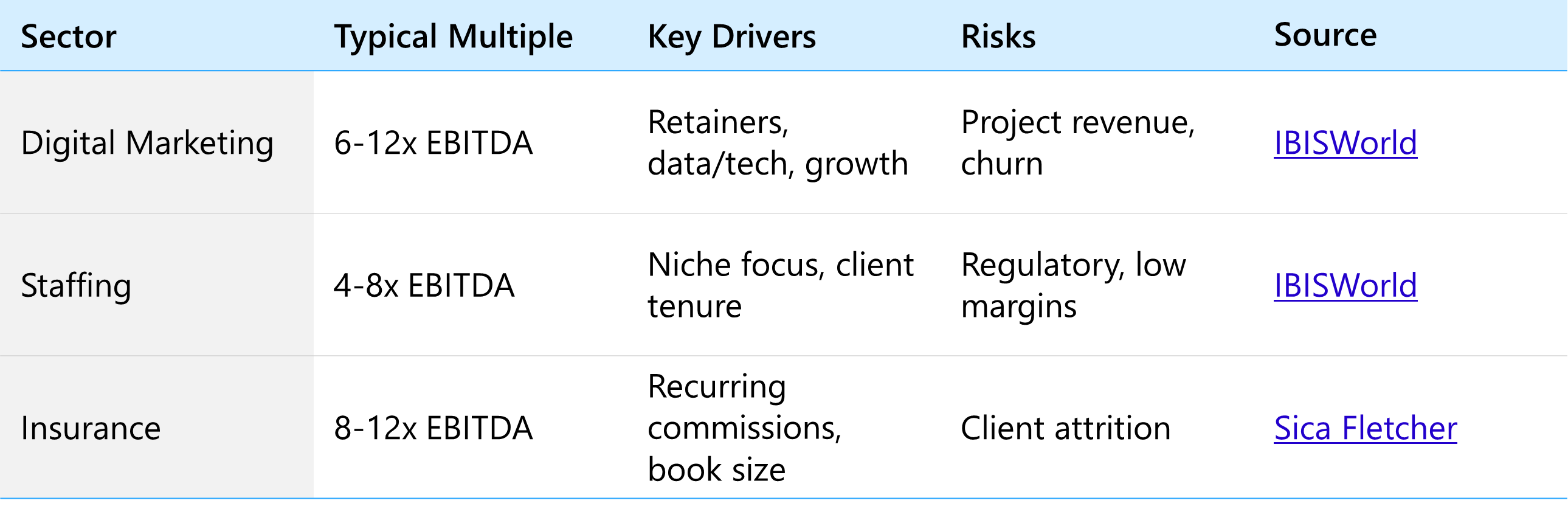
Digital Agencies: 6-12x EBITDA. Agencies at the high end have strong recurring revenue, proprietary technology, or niche expertise. Data and analytics capabilities, performance marketing, and SaaS integration are particular value drivers.
Staffing Agencies: 4-8x EBITDA. Lower multiples reflect shorter contract cycles, regulatory exposure, and tighter margins. Healthcare and IT staffing verticals command premiums within this range. The US staffing industry stood at $260.1 billion in 2025, according to IBISWorld.
Insurance Brokerages: 8-12x EBITDA. Insurance broker EBITDA multiples averaged 11.8x through H1 2025, having expanded 29% from the 2020 low of 9.4x. PE-backed and hybrid firms completed the majority of all insurance agency transactions over the past four years.
What Drives Agency Valuation? Key Factors Buyers Scrutinize
Multiples only tell part of the story. The real drivers of agency valuation are the business fundamentals that buyers examine most closely.
1. Revenue Model: Retainer vs. Project-Based
Agencies with a high proportion of recurring, retainer-based revenue consistently command the highest multiples. Industry data from the 4A's and World Federation of Advertisers suggests a typical revenue model breakdown of roughly 60-70% retainer, 20-25% project-based, and 10% hybrid.
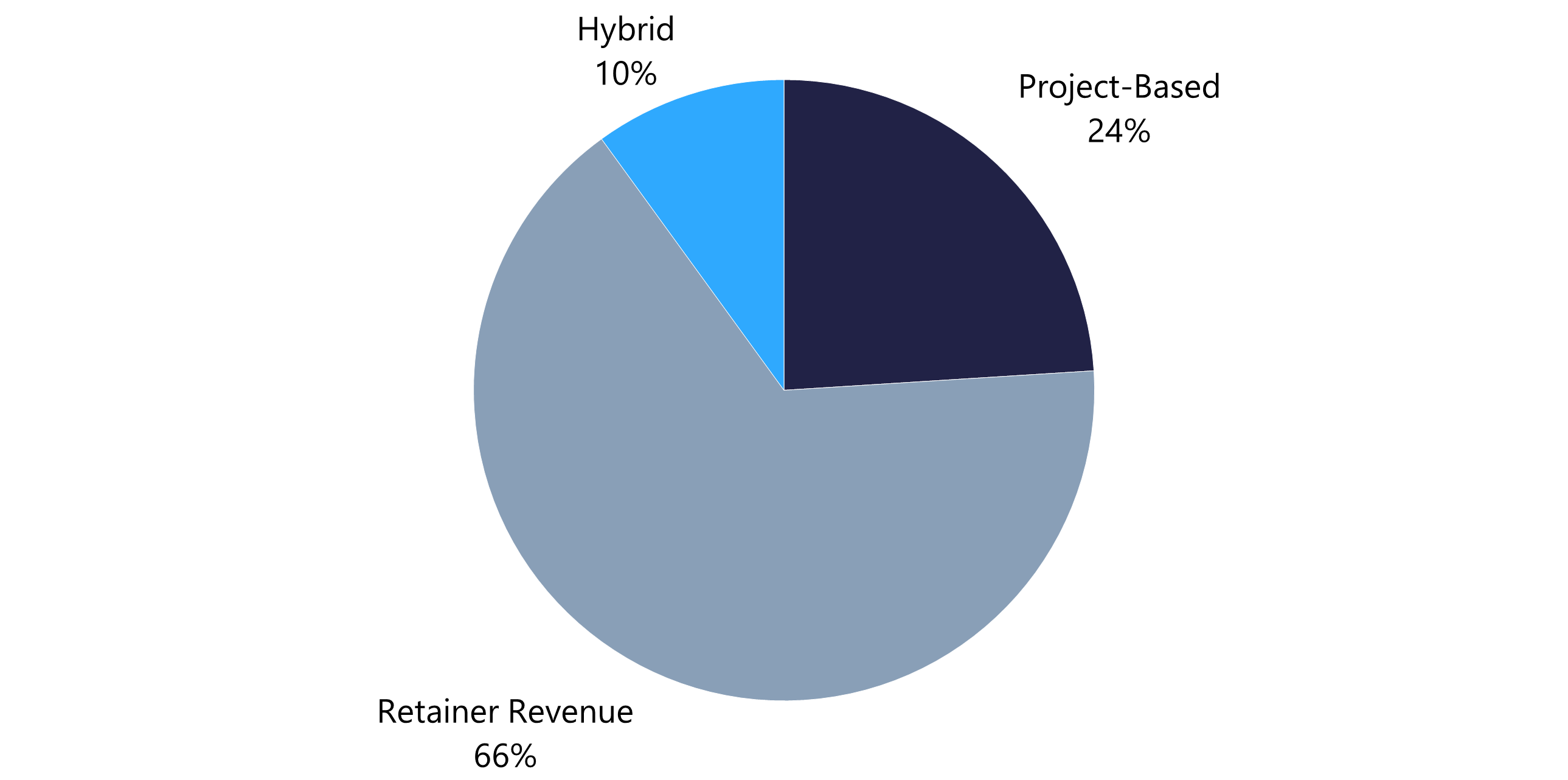
Recurring revenue (retainers, subscription services) increases valuation by 25-40% compared to project-based agencies. Buyers pay a premium for predictability and contractually committed income.
2. Client Concentration and Contracts
A diversified client portfolio is a major value driver. When one client accounts for more than 25% of revenue, buyers apply a discount to the multiple because of concentration risk. Long-term contracts (12 months or more) with auto-renewal clauses strengthen valuation significantly.
3. Owner Dependence and Team Depth
Owner-operated agencies where the founder is the primary rainmaker or client contact face a valuation discount of 15-30%. Buyers pay premiums for agencies with strong, autonomous management teams that can operate independently after a transition.
4. Niche and Sector Specialization
Agencies with defensible niche expertise (healthcare marketing, B2B SaaS, fintech) often command higher multiples. Specialization creates switching costs and deeper client relationships.
5. Profit Margins and Growth Trends
Higher EBITDA margins (above 20%) and consistent year-over-year revenue growth (above 10%) substantially increase value. The US advertising agency industry grew at a 3.6% CAGR from 2019 to 2025, but top-performing digital agencies have significantly outpaced that figure.
How Buyers Evaluate Agency Businesses
Buyers, from private equity to strategic acquirers, follow a disciplined process when evaluating agencies. Here is what sits at the top of their checklist:
- High percentage of recurring revenue (retainers, subscriptions)
- Diverse client base (no single client above 20-25% of revenue)
- Documented, transferable processes (SOPs, playbooks)
- Strong brand reputation and digital footprint
- Key staff retention and non-compete agreements
- Clean, normalized financials with clear add-backs
- Demonstrable growth, both historical and projected
For a full exit readiness review, see how to sell your business with FE International, which covers agency businesses.
Market Trends and Buyer Demand Heading into 2026
Global M&A activity surged in 2025. Total deal value hit $4.9 trillion, a 40% increase over 2024's $3.5 trillion, driven by a record wave of megadeals exceeding $10 billion. Technology, media, and communications were among the fastest-growing sectors, with tech M&A deal value up more than 76%.
.png)
Several dynamics shaped agency M&A in 2025 and carry into 2026:
Deal volume: Overall deal count rose modestly (about 5-7%), but the increase in total value was driven primarily by a surge in megadeals worth $5 billion or more, accounting for roughly 75% of strategic deal-value growth.
Private equity influence: PE-backed and hybrid acquirers now account for approximately 30% of the total marketing M&A market by transaction volume. In insurance specifically, PE-sponsored firms have driven the majority of all broker transactions over the past four years.
2026 outlook: Easing regulations, declining capital costs, and a narrowing buyer-seller valuation gap all contributed to renewed momentum. KPMG forecasts continued deal activity into 2026, supported by significant PE dry powder, and Goldman Sachs expects AI-driven transformation to fuel strategic dealmaking throughout the year.
Sector-Specific Considerations
Each agency sector has distinct value drivers, risk factors, and typical multiples. Here is how the three main categories compare:
Digital Marketing Agencies
Global digital ad spend reached an estimated $740 billion in 2025, making up over 75% of total worldwide ad revenue for the first time. Digital agencies with performance marketing, data/analytics, or SaaS integration capabilities command the highest multiples in the 6-12x EBITDA range. Strong recurring revenue and proprietary technology are the primary value drivers.
Staffing Agencies
The US staffing industry was valued at $260.1 billion in 2025. Staffing agencies typically command 4-8x EBITDA, with healthcare and IT verticals at the higher end. Key risks include short contract cycles, regulatory compliance, and margin compression from temporary labor market fluctuations.
Insurance Agencies
Insurance distribution remains one of the most active M&A sectors. EBITDA multiples for insurance brokers averaged 11.8x through H1 2025, with a steady expansion from 9.4x in 2020. Agencies with strong recurring commissions, high client retention, and a sizable book of business attract the most competitive offers.
Real-World Valuation Examples (Anonymized)
Digital Agency Example
Normalized EBITDA: $1.2M. Revenue model: 80% retainer, 20% project. Growth: 15% YoY. Top client: 12% of revenue. Applied multiple: 10.5x (premium for strong recurring revenue and low concentration). Valuation: $1,200,000 x 10.5 = $12,600,000.
Staffing Agency Example
Normalized EBITDA: $700,000. Revenue model: 60% recurring, 40% project. Growth: 8% YoY. Applied multiple: 6x (mid-range for staffing sector). Valuation: $700,000 x 6 = $4,200,000.
Insurance Agency Example
Normalized EBITDA: $900,000. Recurring commissions: 85%. Applied multiple: 10x (consistent with 2025 averages for agencies with >$1M EBITDA). Valuation: $900,000 x 10 = $9,000,000.
These examples use public benchmarks and anonymized performance data to illustrate what buyers paid in 2025. Actual transaction values depend on the specific characteristics of each agency and the competitive dynamics of the sale process.
Common Valuation Mistakes (and How to Avoid Them)
Founders often leave significant value on the table through avoidable errors. Here are the most common pitfalls:
1. Ignoring Normalization
Failing to properly adjust EBITDA or SDE for one-time, owner-specific, or non-recurring items leads to inaccurate value. One founder included a pandemic-era PPP loan as recurring income, inflating value by $400,000 and turning off serious buyers.
2. Overestimating Multiples
Using top-tier public company multiples for a small, founder-led agency. A 6-person agency once expected an 11x multiple based on holding company data, but real buyer offers came in at 7x. Multiples must reflect your actual size, growth, and risk.
3. Owner Dependence
Agencies where the founder is the main rainmaker suffer a valuation discount of 15-30%. One agency lost a major client after the founder announced their departure, reducing the sale price by $900,000.
4. Weak Documentation
Missing contracts, unclear revenue recognition, or handshake deals erode buyer confidence and invite renegotiation during diligence.
5. Poor Client Concentration
If one client generates more than 25% of revenue, expect a discounted multiple unless you can demonstrate long-term contractual protection.
6. Unrealistic Growth Projections
Overly optimistic forecasts without supporting evidence will dissuade serious buyers who model conservative scenarios.
7. Skipping Professional Advice
DIY valuations frequently miss hidden drivers or risks. Working with a specialist like FE International ensures market-relevant, data-backed outcomes.
Maximizing Value: Actionable Checklist for Founders
The best time to start maximizing your agency's value is today. Here is a practical checklist to prepare for a high-value exit or fundraising round:
Founder's Agency Valuation Preparation Checklist
- Normalize and document all financials (3-5 years)
- Identify and reduce owner dependence; build management depth
- Diversify client base so no single client exceeds 20-25% of revenue
- Lock in long-term contracts (12+ months) with auto-renewal clauses
- Increase recurring (retainer) revenue as a share of total revenue
- Document all SOPs, handbooks, and key operational processes
- Secure non-compete and retention agreements for key staff
- Address legal, tax, and compliance issues early
- Prepare a detailed information package for prospective buyers
Ready for a valuation? Book a free valuation call with FE International for a confidential, market-driven estimate of your agency's value.
How FE International Helps Agency Founders
FE International is a trusted advisor to agency founders worldwide, with a track record of over 1,500 completed transactions and a 94.1% success rate. Services include:
Data-Driven Valuation: Sector-specific, tailored to your unique business model and market positioning.
Exit Planning: Strategic guidance to maximize value, time the market, and minimize risk.
M&A Advisory: Access to a global buyer network, expert negotiation, and deal structuring.
Due Diligence Support: Ensuring clean, credible financials and documentation that stand up to buyer scrutiny.
Succession and Internal Sale Advisory: Fair, transparent processes for family transitions, management buyouts, and partner buy-ins.
Explore how to sell your business with FE International or contact us for personalized agency valuation advice.
Conclusion
Data-driven, market-relevant agency business valuation is essential for founders considering an exit, investment, or succession. With agency multiples near decade highs and buyer scrutiny sharper than ever, founders who understand the drivers, benchmarks, and common pitfalls can position their agency for maximum value.
Use this guide as your roadmap. And keep in mind: the most successful exits start with the right advice and preparation well ahead of the sale.
Ready to take the next step? Book a free valuation call with FE International and find out what your agency is really worth.
