
Regulatory technology has quietly become one of the most durable growth stories in software. The global RegTech market sat at roughly $24 billion in 2025 and is on track to pass $112 billion by 2033, expanding more than 20% a year. The reason is straightforward. Banks and regulators keep adding rules faster than manual compliance teams can absorb them, and the software that automates reporting, validation, and submission has become mission-critical plumbing for any regulated institution.
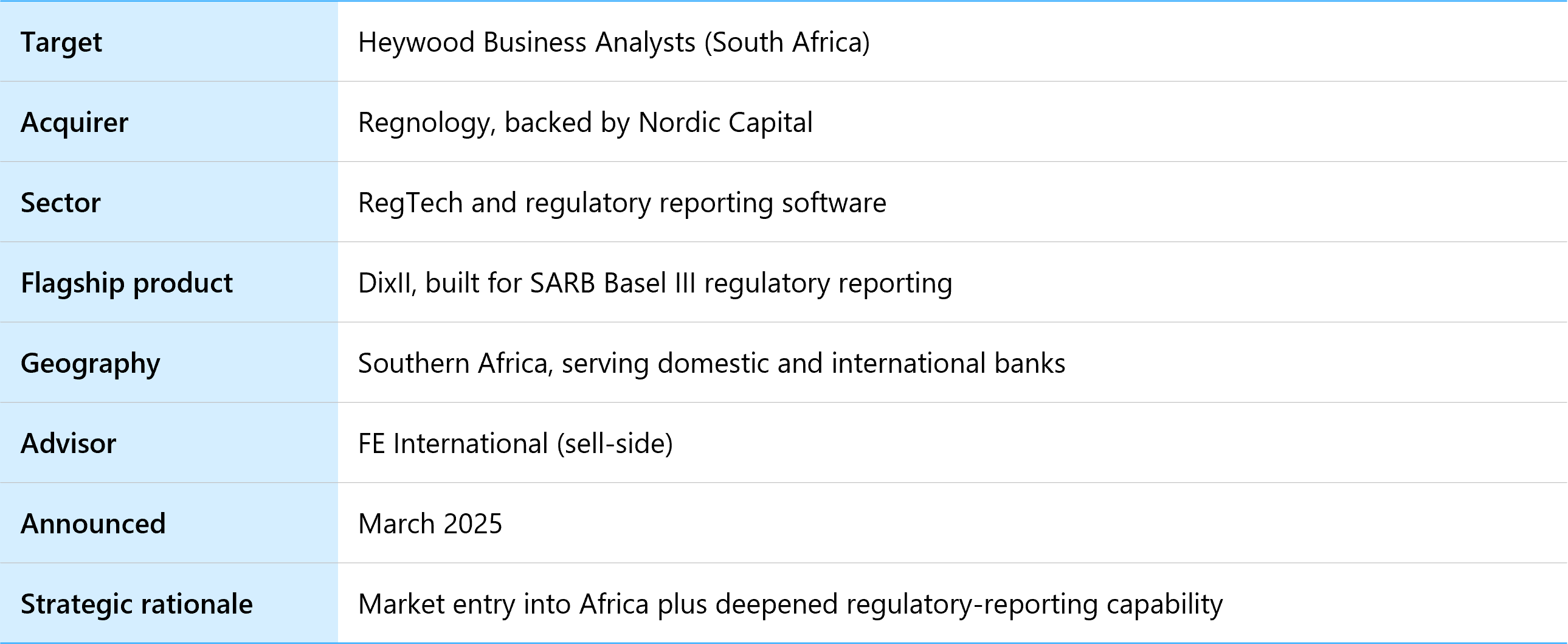
That backdrop framed one of the more instructive transactions of 2025. In March, FE International advised on the sale of Heywood Business Analysts, a South African banking-compliance software company, to Regnology, a regulatory reporting specialist backed by Nordic Capital. The deal handed Regnology an established position in Southern Africa and a proven product line built for South African Reserve Bank reporting. For Heywood’s founder, it delivered a clean exit to a global acquirer with the resources to scale what he had built over nearly three decades.
The numbers behind the headline matter less than the logic. This case study walks through why the deal made sense for both sides, what made Heywood worth acquiring, and what founders of compliance and vertical software businesses can take from how it came together.
Deal Snapshot
What the Deal Involved
Heywood Business Analysts is not a household name, and that is part of the point. Founded in 1996 by Christopher Strangways-Dixon, the company began as the IT partner to Citibank’s South African operation and grew into a trusted supplier to the country’s biggest banks. Its flagship product, DixII, exists to solve a specific, unavoidable problem: making sure banks meet the South African Reserve Bank’s Basel III requirements through accurate regulatory reporting, data validation, and electronic submission of BA returns. Heywood’s client roster reads like a who’s who of Southern African banking, including ABSA, Standard Bank, Discovery Bank, and Old Mutual, alongside international names such as Standard Chartered and Deutsche Bank.
What makes that product valuable is the nature of the obligation behind it. South African banks must file detailed BA returns with the Reserve Bank on a recurring basis, and the data has to reconcile cleanly across systems before it is submitted. Getting those returns wrong carries real regulatory consequences, so the software that validates and files them is not a nice-to-have. It is part of how a bank stays in good standing with its regulator, which is exactly the kind of durable, embedded demand that strategic acquirers prize.
Regnology sat on the other side of the table. The Frankfurt-based firm is one of the larger regulatory, risk, and supervisory technology providers in the world, serving more than 35,000 financial institutions and 70 regulators. With Nordic Capital behind it, Regnology has been building an end-to-end regulatory reporting platform across markets. Acquiring Heywood folded local Basel III expertise and an installed base of bank relationships into that platform, and it gave Regnology a credible launch point for the wider African market. FE International acted as the sell-side advisor, working within its fintech and RegTech practice to position the business and run the process through to close.
Why a Strategic Acquirer Moves on Compliance Software
The Heywood deal is a textbook example of a pattern that defined dealmaking in 2025 and is carrying into 2026. After a quieter stretch, global M&A rebounded to $4.9 trillion, up 40% and the second-highest annual total on record. More telling than the headline figure is what kind of deals drove it. Roughly 60% of transactions above $1 billion were scope deals, the highest share ever recorded, which means buyers were acquiring to enter new markets and add new capabilities rather than simply to get bigger in markets they already knew.
.png)
Technology led that activity, with more announced megadeals than any other sector in 2025, and financial services followed close behind. Capital is increasingly flowing across the line where the two meet, into businesses that sit at the intersection of finance and software. Regnology’s move on Heywood is that same logic in miniature. It was a scope acquisition: Regnology gained a new geography in Southern Africa, a specialized capability in SARB reporting, and a set of bank relationships that would take years to build from scratch. For a strategic acquirer, buying a proven niche platform is almost always faster and lower-risk than building one, and it is why so much of today’s technology dealmaking is about acquiring capabilities rather than chasing scale alone.
There is a deeper reason buyers reach for acquisitions in moments like this. Building a compliance product for a specific regulator means learning that regulator’s rules in detail, earning the trust of risk-averse banks, and proving the software in production over years. An acquirer can shortcut all of that by buying a business that has already done it. When the target also brings live client relationships and local knowledge, the case for buying rather than building becomes hard to argue with, especially in a market the buyer is entering for the first time.
The Market Behind the Deal: RegTech Growth and Africa’s Fintech Surge
Step back from the transaction and the timing looks deliberate. Three forces are pushing demand for compliance technology higher, and all three favor a business like Heywood. The first is the steady expansion of RegTech itself.
.png)
Regulatory technology is growing at more than 20% a year and is projected to more than quadruple by the early 2030s. Every new rule, reporting standard, and supervisory expectation adds to a workload that software handles better than people. The second force is Africa’s emergence as the fastest-growing fintech region in the world.
.png)
Revenues across the continent are projected to grow roughly 13-fold to about $65 billion by 2030, and the next phase of that growth is shifting from consumer payments toward the infrastructure that banks and regulators depend on. Regulatory reporting sits squarely in that infrastructure layer. The third force is South Africa’s strengthening regulatory standing. In October 2025 the country exited the Financial Action Task Force grey list after nearly three years of reform, a milestone that has lifted confidence and created fresh demand for fintech and compliance technology as institutions keep modernizing their reporting and anti-money-laundering systems. With the next FATF review cycle beginning in late 2026, South African banks have every reason to keep investing in the kind of reporting tools Heywood provides. Put together, these trends turned a well-run local compliance vendor into an attractive target with timing on its side.
What Made Heywood Acquisition-Ready
This is the part most relevant to founders, so it is worth being specific. Heywood checked nearly every box a strategic buyer looks for in a vertical software business.
Its revenue was sticky in the way compliance software tends to be. When a product is wired into how a bank meets its regulatory obligations, switching it out is expensive, risky, and rarely worth the disruption. That embedded position produces predictable, recurring revenue, which is the foundation of a strong valuation in any software category.
The product solved a non-discretionary problem. Banks do not get to opt out of Basel III reporting, so demand for DixII does not rise and fall with budgets or sentiment. It is mandatory infrastructure, and mandatory infrastructure holds its value.
The customer base was both blue-chip and diversified. Serving the largest South African banks alongside global institutions like Standard Chartered and Deutsche Bank signals quality and reduces the risk that losing any single client would dent the business. Buyers pay a premium for revenue spread across trusted, long-tenured relationships.
The niche was genuinely defensible. Deep, local knowledge of a specific regulator’s requirements is hard to replicate, which is exactly why acquiring it made more sense for Regnology than building it.
None of this is unique to RegTech. The same drivers, recurring revenue, mission-critical positioning, customer quality, and a defensible niche, are what make any vertical software or compliance business attractive. They are also precisely what a buyer’s team probes during due diligence, where a clean, well-documented business moves through the process faster and protects its valuation.
How FE International Advised the Transaction
Selling a specialized compliance software business is not the same as selling a generic app, and the process reflected that. The work involved understanding exactly what made DixII valuable to a strategic buyer, positioning Heywood against the right pool of acquirers rather than the widest one, and managing a cross-border transaction between a South African founder and a German acquirer backed by a Nordic private equity firm.
FE International ran the sell-side mandate through its investment banking and M&A team, drawing on sector knowledge in fintech and regulatory technology and a global network of strategic and private equity buyers. The aim throughout was the one that matters most to a founder: finding not just a buyer, but the right buyer, on terms that protect the business and the people inside it.
“This deal reflects what we do best, connecting specialized technology companies with strategic acquirers who can take them further. Heywood built something genuinely hard to replicate, deep regulatory-reporting expertise trusted by major banks, and Regnology was the right home to scale it. As financial regulation grows more complex across every market, demand for that kind of compliance capability only increases.” Thomas Smale, Founder and CEO, FE International
The outcome speaks to a wider truth about the current market. Well-prepared, well-run businesses in essential software categories are exactly what today’s selective, strategically-minded buyers are looking for.
What the Deal Signals for 2026
For everyone watching the RegTech M&A market, the Regnology and Heywood deal points to a few things worth holding onto as 2026 unfolds.
Strategic buyers are still active and still selective. The rebound in dealmaking has not made acquirers less disciplined. If anything, it has sharpened their focus on businesses with clear, defensible value, and a focused compliance vendor with sticky revenue fits that brief far better than a generalist software company chasing growth.
Geography is becoming a feature, not a footnote. Acquirers are willing to pay for a credible foothold in fast-growing markets, and Africa’s financial sector is firmly on that list. Founders building strong businesses outside the usual hubs should not assume that distance from the established tech centers limits their appeal. In a scope-driven market, it can be the opposite.
Compliance remains one of the most reliable themes in software. As long as regulation keeps expanding, the tools that help institutions keep up will hold their value, and the businesses behind them will keep drawing strategic interest. For founders in the space, that is a reason for confidence about timing, provided the business is genuinely ready when the right buyer appears.
Routes to Exit for Software and Compliance Founders
Not every exit looks like Heywood’s, and not every founder needs the same path. The right route depends mostly on the size and complexity of the business.
For larger or more complex companies, a full sell-side advisory engagement is usually the better fit. That is the model behind a deal like Regnology and Heywood: hands-on positioning, confidential outreach to a curated set of buyers, detailed diligence preparation, and support through a cross-border close. When a business has employees, sensitive customer relationships, and real scale to protect, that level of involvement earns its keep.
For smaller businesses, typically those under $1 million in annual earnings, FE International’s M&A Platform offers a faster, more flexible route. It lets founders create and manage their own listing, reach qualified buyers screened through FE’s network, and move toward a deal in as little as 90 days, with a customer success manager on hand when human help is useful. Buyers gain from the same structure, with access to vetted businesses and the ability to make offers quickly.
The two work together rather than competing. The M&A Platform widens access for smaller deals and gives founders a self-serve option, while full advisory remains the recommended path for larger assets where complexity, confidentiality, and scale call for a dedicated team. Founders unsure where they fit can start by understanding how a structured sale process actually works and go from there.
The Takeaway
The Regnology and Heywood deal is small in dollar terms next to the megadeals that grabbed headlines in 2025, but it captures where a lot of value is being created right now. Regulatory complexity keeps rising, Africa’s financial sector keeps growing, and strategic buyers keep paying for proven, mission-critical software rather than building it. For founders of RegTech, compliance, and vertical software businesses, the message is encouraging: a focused, well-run company solving an essential problem is exactly what today’s buyers want.
If you are weighing an exit, the first step is understanding what your business is worth. You can request a free, confidential valuation from FE International’s fintech and RegTech advisory team, explore a full sell-side process for a larger business, or take a faster, self-serve route through the M&A Platform if your business earns under $1 million a year.