
.jpg)
What Do Acquirers Look For in an AI Company in FY 2027?
For most of 2023 and 2024, the answer to what do acquirers look for in an AI company had a short version: evidence that the company was genuinely built on AI rather than describing itself that way. That question did useful work at the time, because the label still separated one set of companies from another. Heading into FY 2027 it appears to separate fewer and fewer of them.
Stanford HAI's 2026 AI Index Report records 88% of organisations worldwide reporting AI use in 2025, up from 55% in 2023. On the deal side, Bain & Company found that almost half of strategic technology deals in 2025 carried an AI component, against roughly one in four the year before. A screen that most of the field now passes is no longer doing much sorting.
What follows is a reading of what the published evidence suggests buyers are weighing instead. None of it is a forecast, and none of it is a rule. It is an attempt to trace where the attention of acquirers appears to have moved, based on what consultancies, research firms and deal-terms studies have put on the record through 2026. If you are working through the same question for a non-AI software business, our companion piece on what buyers look for in a SaaS acquisition covers that ground, and the longer view of AI M&A trends sets the market context this sits inside.
The AI label appears to be losing its power as a screen
A screening criterion is only useful while it excludes something. In 2024, saying a company was AI-native excluded a great deal. By the end of 2025, on the figures above, it excluded considerably less.
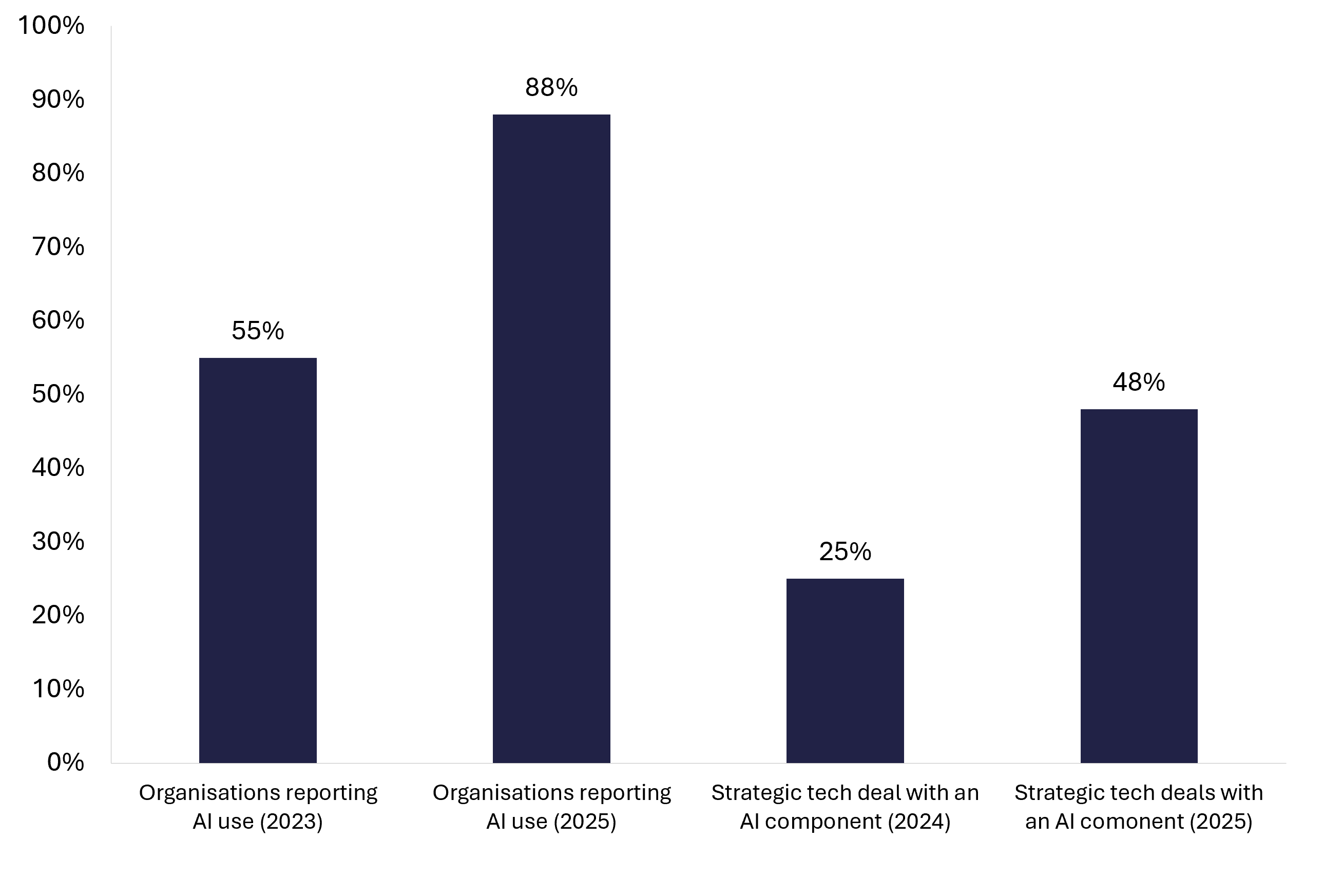
Two cautions on reading that chart. The adoption figure and the deal figure measure different things, and the Bain series runs through 30 September 2025, so it is a partial year. Neither point changes the direction, which is that the presence of AI in a business is becoming a description rather than a differentiator.
Bain's mid-2026 M&A outlook puts a related pressure on buyers. Global M&A was up 41% in the first five months of 2026, with strategic deal value up 36% year to date and technology strategic deal value rising from $140bn in 2024 to an estimated $259bn in 2026. More capital chasing targets in a field where the headline qualifier no longer narrows the list tends to push the qualifying questions further down into the business. Our own tech M&A mid-year 2026 report traces the same activity from the transaction side.
When almost every target can claim the label, the label stops being the question.
What a capable model supplies, and what it does not
The useful way to think about this is to ask what a buyer can obtain without buying you. Frontier model capability is available on commercial terms. So are natural-language interfaces, fast code generation and general-purpose summarisation. A buyer weighing an acquisition against building has those inputs either way.

Bain makes the point directly in its 2026 software M&A work, observing that AI assets "raise a hurdle because they typically don't come with a lot of customers, so cross-selling opportunities are likely to be one-directional." Read from the seller's side, that is a statement about where the scarcity sits. The model is not the scarce part. The customers are.
McKinsey reaches a similar place from a different direction. Its February 2026 piece on technology M&A as AI enters its industrial phase argues that deal rationale is moving toward "access to talent, proprietary data, and model IP rather than traditional scale economics," and that the most active acquirers are pursuing "strategic control of data, access to AI models, and computing efficiency." Capability acquisition, on that reading, is displacing synergy arithmetic as the stated reason for a deal.
Workflow ownership: being where the work actually happens
The first of the three assets in that right-hand column is position in the workflow. A product that sits inside how a job gets done every day is difficult to displace, because displacing it means changing the job. A product that sits alongside the workflow and produces output on request is easier to swap.
Bain's account of the Clio and vLex transaction is instructive on what buyers test here. A stated priority in diligence was validating "the end-to-end workflows and the differentiated data assets," and the attraction was described in terms of context: the case detail, documents, next steps and deadlines a lawyer needs to manage work. The integrated product was targeted for preview roughly 100 days after signing, which says something about how quickly buyers now expect capability to move.
McKinsey observes the same pull on the buy side, noting IT and professional-services firms acquiring specialised AI companies "to accelerate their integration of gen AI into workflows, customer service, and knowledge management." The purchase is of position, not of novelty.
For a founder, the practical question is evidential rather than rhetorical. What in your product usage data shows that the work stops when the product stops? Session frequency against the rhythm of the customer's own operating cycle, the share of a department using it rather than a single champion, the number of downstream systems that read from it: these are the things that tend to be asked for. The same discipline underpins any effort to make your business more attractive for acquisition.
Proprietary operational data, and the rights that travel with it
The second asset is data that a buyer cannot assemble from public sources or purchase on the open market. McKinsey's framing is "proprietary data pipelines, or model optimization capabilities that can scale sustainably." The emphasis on pipelines rather than datasets is worth noting. A static corpus ages. A pipeline that keeps producing fresh, labelled operational data from live customer activity does not.
Two questions tend to follow quickly in diligence, and both are contractual rather than technical. The first is whether your customer agreements actually grant the rights you have been exercising, including the right to train on customer data and the right to assign those rights to an acquirer on a change of control. The second is whether those rights survive the deal without a consent process that touches every customer.
Deals have been reshaped by less. Where the answers are unclear, a buyer's natural response is to move value out of the closing payment and into something contingent, which is the subject of a later section. Our SaaS due diligence checklist sets out the document set these questions are answered from, and FE's due diligence services exist to surface this kind of gap before a buyer finds it.
Customer relationships a buyer can actually inherit
The third asset is the relationship itself, and it is the one most often described in a data room as something it is not. A list of logos is not a relationship. Nor is a cohort chart on its own, although it helps.
What appears to carry weight is evidence that the relationship is institutional rather than personal. Renewals signed by someone other than the original buyer. Expansion into a second department without a founder in the room. Reference customers willing to speak to an acquirer. Support and success handled by a team rather than by the person whose name is on the incorporation documents. Each of these is an answer to the question of whether the revenue continues after the founder's attention moves elsewhere.
This also varies by buyer. A strategic acquirer with its own salesforce may value the relationship chiefly as a distribution beachhead. A financial buyer is more likely to read it as a cash-flow characteristic. The distinction between private equity, strategic and individual buyers shapes which parts of the same evidence pack get the most scrutiny, and it is worth knowing which conversation you are in.
The perimeter question: what exactly is being acquired
A feature of AI transactions that has little precedent in conventional software M&A is that the thing being bought is not always a whole company. Deloitte's work on how AI companies are rewriting M&A describes acquirers "racing to access capability, talent, intellectual property, and inference infrastructure," and notes that "the transaction perimeter is often undefined at close."
That shows up as a wider set of structures than a founder may be expecting: acquihires, non-exclusive IP licensing, minority stakes paired with compute commitments, distribution partnerships. McKinsey makes a related observation, suggesting that open-weight models and cross-border regulation are together pushing some activity toward joint ventures, minority stakes and localised build-outs rather than full acquisitions.
Deloitte frames the operational test crisply: "Can the buyer run the acquired capability on Day 1 and improve it by Day 30?" and adds that "speed-to-retention is not a nice-to-have; it is existential." Both of those put weight on documentation, handover readiness and the retention of the specific people who make the capability work, long before anyone discusses price.
The perimeter is a negotiating variable now, not a given. It is worth deciding your own view of it early.
Evidence rather than assertion
If there is a single thread running through the 2026 material, it is a shift from claims to records. Deloitte argues that AI transactions "require a living, auditable baseline, across IP, data, infrastructure, and talent," rather than a snapshot assembled for the data room. The distinction matters because a snapshot can be prepared in six weeks and a baseline cannot.
Gartner's strategic predictions for 2027 and beyond, published in September 2026, point the same way from the enterprise-buyer side. One prediction holds that by 2030, 80% of Global 500 companies will contractually make the CIO or chief AI officer an "evidence custodian" for AI accountability. Another suggests that by 2029, 25% of Global 500 companies will continuously innovate componentised AI-powered offerings in a way that creates a competitive moat. Predictions are predictions, and should be read as such. But both describe a buyer population that expects to be able to inspect what it is being told.
In practice the useful preparation is unglamorous: model lineage and the provenance of training data, inference cost per transaction tracked over time rather than estimated, evaluation results kept as a series rather than a single screenshot, and a clear record of which third-party components sit where in the stack and on what licence. Companies that keep these as a matter of routine tend to find diligence shorter.
How deal structure tends to follow
Where a buyer cannot verify something, structure usually does the work instead. Deloitte notes that in AI transactions "significant consideration may be held back pending demonstrated completeness of transfer." That is a familiar mechanism wearing new clothing.
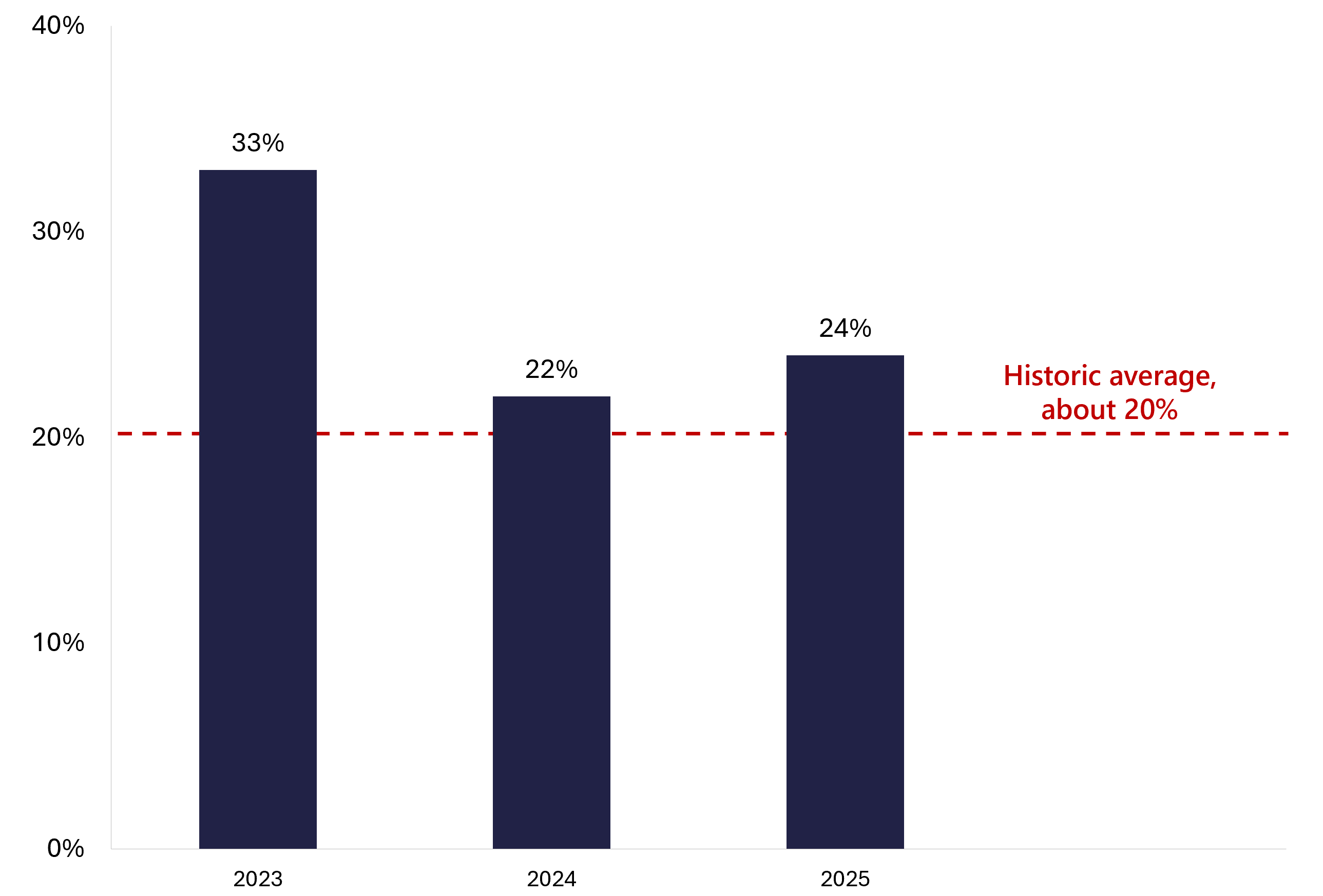
The SRS Acquiom 2026 Deal Terms Study, as summarised by Fasken, covers more than 2,300 private-target transactions closing between 2020 and 2025. Earnouts appeared in 24% of 2025 deals, with a median earnout worth about 34% of the closing payment and most running one to three years. All-cash consideration accounted for 51% of 2025 deals, with cash plus management rollover at 21%.
Read alongside the Deloitte point, the implication for an AI seller is not that earnouts are becoming universal. It is that the share of value sitting behind a condition tends to track how much of the thesis the buyer has to take on trust. Every item of evidence assembled in advance is, in effect, an argument for moving value forward into the closing payment.
What this suggests for a founder planning toward FY 2027
None of the above argues that AI capability has stopped mattering. It argues that the capability is increasingly assumed, and that the questions sitting underneath it are where a process is now won or lost. Four of them seem worth preparing answers to:
- Where in the customer's workflow do you sit, and what evidence shows that the work changes if you are removed?What data do you hold that a buyer could not assemble another way, and do your contracts clearly permit its use and its transfer?Which customer relationships survive your departure, and who can say so on the record?What part of your diligence record exists as a maintained series rather than as something assembled for the process?
Timing interacts with all four. A business that can answer them today has more latitude about when to run a process, which is the practical argument for treating the timing of your business exit as a decision rather than a reaction. The broader sequence is set out in our guide on how to sell my SaaS business, and the valuation mechanics specific to AI businesses are covered in our AI business valuation model.
Where this leaves an FY 2027 seller
The question has moved. Ask what do acquirers look for in an AI company and, through 2024, the answer sat close to "is this an AI company at all?" On the evidence published through 2026 it looks more like "what does this company have that AI capability alone does not give every buyer?" Workflow ownership, proprietary operational data and customer relationships that survive a change of ownership are the three answers that recur across the Bain, McKinsey and Deloitte material, and all three are built over years rather than assembled during a process.
That is the encouraging part of the picture. These are not attributes a seller acquires by repositioning. They are attributes a seller demonstrates, which means the preparation work is largely evidential. If you are considering a process in the coming twelve to eighteen months, the most valuable use of that time is usually to turn what you know about your business into something a buyer can verify.
FE International has advised on more than 1,500 transactions since 2010, with a 94.1% success rate on private sales and acquisitions. If you would like a view on how your business reads against the criteria above, you can start a conversation about selling your business or request a business valuation to establish a baseline.
