


SaaS M&A trends 2026 come down to three things: deal value hit records while deal counts thinned, three buyer groups now compete for quality software assets, and AI has split pricing between durable platforms and replaceable tools. Software companies at or above the Rule of 40 trade at nearly three times the multiple of those below it.
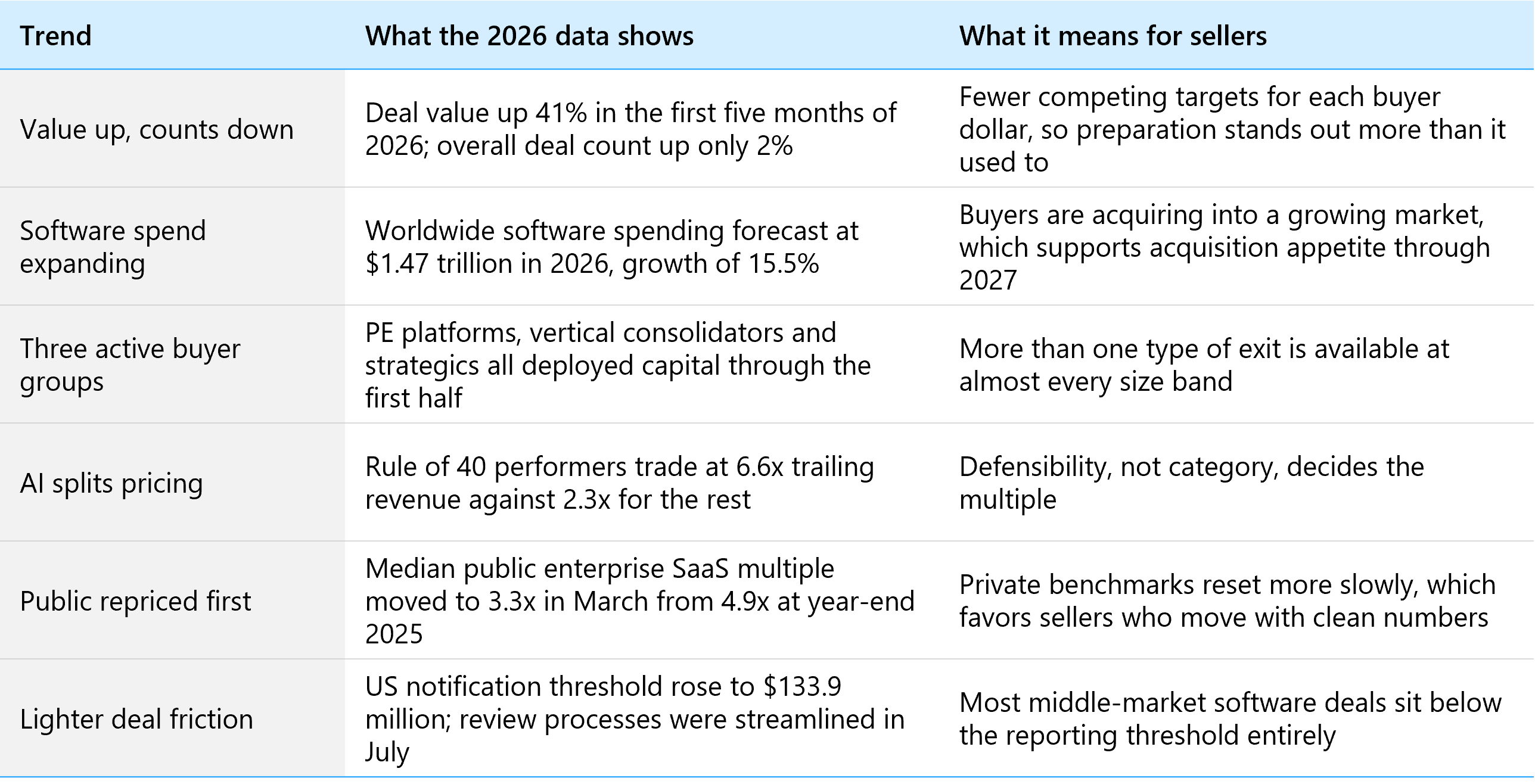
The SaaS M&A trends 2026 that matter to a seller are not the ones in the headlines. Global deal value climbed 41% year over year to $2.4 trillion in the first five months of the year, and technology was the largest sector of all. If you run a $3 million ARR software business, that number tells you almost nothing about what your company is worth or who would buy it.
Here is what actually changed. Public software repriced quickly in the first quarter as investors worked through what agentic AI means for per-seat pricing models. Private buyers moved slower, and for assets with contractual revenue and deep workflow integration, many did not move down at all. The result is a market where two software companies with identical revenue can price nearly three times apart, decided almost entirely by whether a buyer believes the revenue holds.
That is a better market for prepared sellers than the headlines suggest. Benchmarks are clearer than they have been in years, the buyer pool is wider, and the premium for a clean, defensible business has widened rather than narrowed. This guide covers where deal volume went, which buyer groups are writing checks and what each of them pays for, how the AI premium gets calculated in practice, and what all of it means for an exit in 2026 or 2027.
What do the 2026 numbers actually say about SaaS M&A?
Two facts sit side by side this year, and reading only one of them leads sellers to the wrong conclusion. Total value is at or near records. Deal counts are not.
Global M&A rose 40% to $4.9 trillion in 2025, the second-highest annual total ever recorded, and the first five months of 2026 came in 41% ahead of the same period last year. Strategic deal value grew 36%. Transactions above $10 billion increased 52% in number and 53% in value, while overall deal count ticked up just 2% and valuations held flat at a median 11.6 times enterprise value to EBITDA. In other words, the money got bigger, not more widely spread.
Underneath the megadeals, the segment that matters to most software founders held up well. US middle-market deal value reached $103.8 billion in the first quarter, up 10.7% year over year and the strongest start since 2021. Smaller companies in the $25 million to $100 million enterprise value band have returned a pooled 39% gross internal rate of return since 2009, the highest of any size band, which is why the lower middle market is being called the segment to watch this year. Less competition at entry and stronger historical returns make it the part of the market sponsors are being pushed toward, not away from.
Regionally the story has broadened out. European announced deal value ran 82% ahead of 2025 on the back of one of the region's strongest starts ever, with the UK drawing most of the inbound interest, and activity in the middle market has begun to stir on the back of private equity transactions. Technology led every sector globally in the first half, which we broke down in our mid-year tech M&A report.
The capital feeding this market is also being replenished at unusual speed. Global startup investment reached $300 billion in the first quarter of 2026, up 150% quarter over quarter, already 70% of the total venture spending recorded across all of 2025, with roughly 80% of it going into AI. That funding wave matters to sellers for a reason that is easy to miss: every well-funded AI company becomes a future acquirer with a product gap, and the fastest way to close a gap in software has always been to buy the company that already solved it.
Record deal value with thinner deal counts means capital is concentrating on fewer, higher-conviction targets. A well-prepared software business is now competing against a shorter list of alternatives for that capital.
Why is software consolidating faster than the rest of the market?
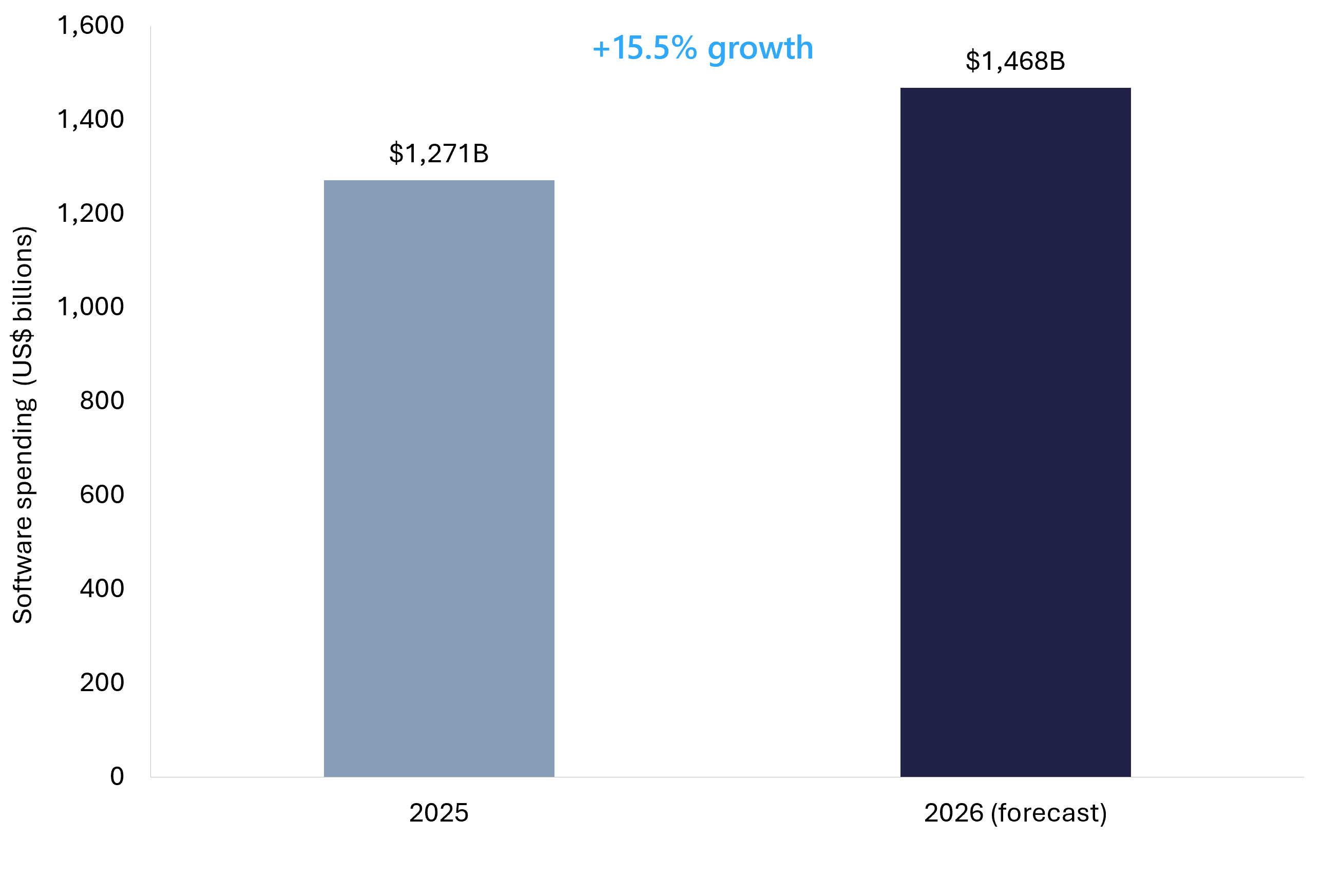
The simplest answer is that the underlying market keeps growing while the number of vendors serving it shrinks. Worldwide software spending is forecast to reach $1.468 trillion in 2026, growth of 15.5%, inside total IT spending of $6.37 trillion. Software is one of the fastest-growing categories in all of technology, and it is growing faster in 2026 than it did in 2025.
At the same time, enterprise buyers are working to reduce the number of vendors they manage. That creates a specific kind of acquirer demand: platform owners buying the adjacent products their customers already run, so they can consolidate spend rather than lose it. Overlooked software assets are still trading as legacy players move to fill white space in their platforms and reduce churn risk in their existing customer bases.
Deal activity has taken on a barbell shape as a result. At one end sit transformational megadeals, at the other smaller capability-driven acquisitions and AI tuck-ins. The first half of 2026 produced clear examples of the pattern: IBM's $11 billion acquisition of Confluent, SAP's agreement to acquire Dremio, ServiceNow's $7.75 billion purchase of Armis in April, and Palo Alto Networks closing CyberArk in February. Each of those buyers went after the same thing, which is platforms with embedded workflows, proprietary data and switching costs that get more valuable in an AI-enabled operating environment. Security specifically has been a consolidation engine, and we covered that market in depth in our cybersecurity M&A analysis.
The middle of that barbell is where the interesting opportunity sits. Large acquirers have been decisive at the top and active on small tuck-ins, while much of the mid-market has stayed thesis-driven and selective as buyers work out which assets hold their position over a five-year hold. Sellers often read that selectivity as weak demand. It is closer to the opposite: when buyers are being careful, the businesses that clear diligence quickly attract concentrated attention and competitive processes, because there are fewer of them on any given buyer's list.
For a founder, the practical read is that consolidation demand is coming from buyers with a product gap and a customer base already asking for the thing you built. That is a stronger negotiating position than a purely financial buyer looking only for cash flow, and it is the reason category fit often matters more than scale in these processes.
Who is buying SaaS companies in 2026?
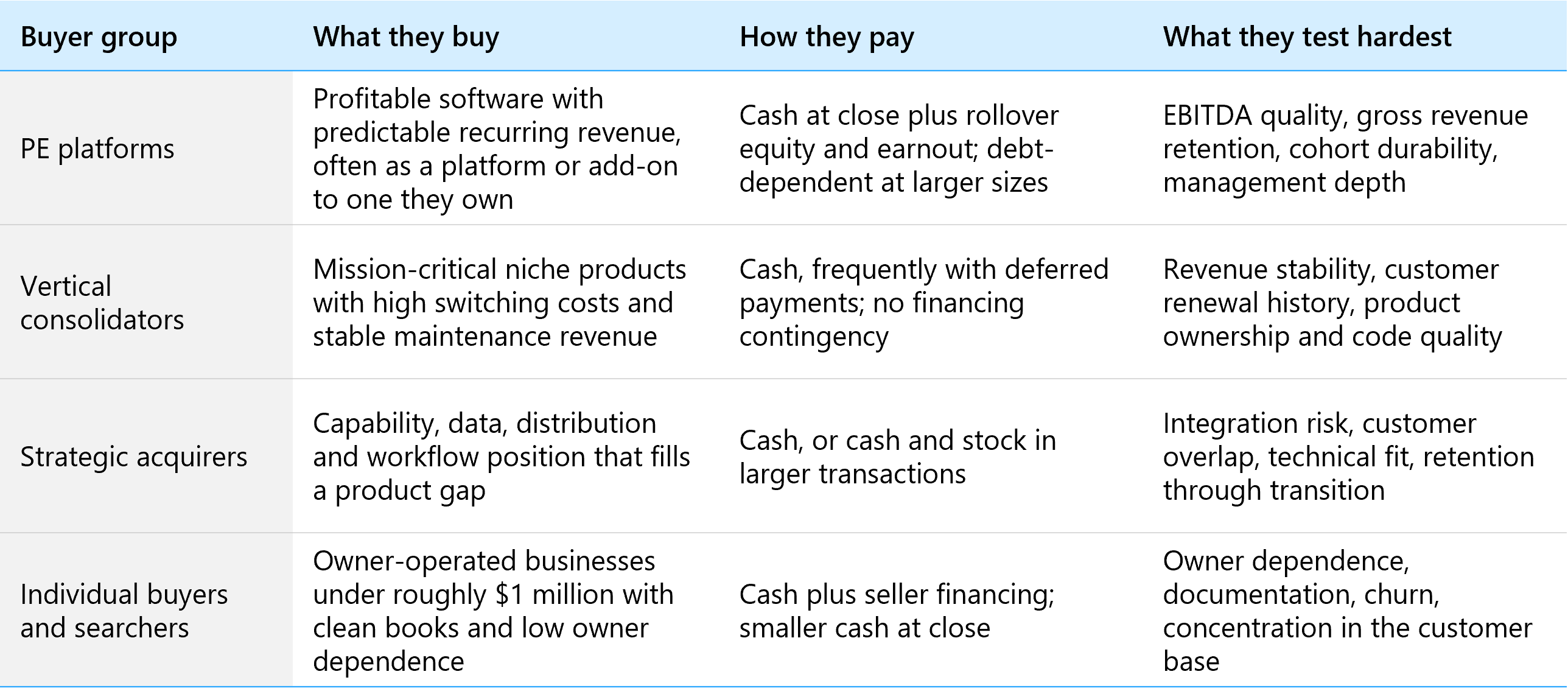
Three buyer groups are active, and they do not want the same things. Knowing which one fits your business changes how you position it, what you prepare, and what a realistic outcome looks like. We compare the buyer types in more detail in our guide to PE, strategic and individual buyers for SaaS.
Private equity platforms
Sponsors spent the first half being selective at the top of the market and steady in the middle. US private equity deal value came in at $177.3 billion in the second quarter, with the sharpest pullback in large, financing-dependent software transactions as investors worked out how quickly AI reshapes legacy vendors. Take-private activity told the other side of that story: public-to-private value rose to $64.3 billion in the first quarter, up 53.3% year over year, as sponsors moved on listed assets that had repriced.
The capital itself has not gone anywhere. Fund investment periods create deployment clocks, and a large share of sponsor-owned technology assets has been held for more than four years, which pushes firms toward both new acquisitions and exits. Fundraising has continued at the top of the market as well, including a $23 billion North America flagship close in the second quarter. For a founder in the $5 million to $50 million range, this is the group most likely to underwrite against EBITDA, ask for a rollover, and want the founder to stay through a transition.
Sector rotation within sponsor portfolios is worth understanding too. Private equity interest in the second quarter concentrated heavily in critical economic infrastructure, including AI infrastructure and energy, which is where the largest checks went. Software did not stop trading; the very large, debt-dependent software buyouts slowed while smaller and mid-sized software transactions continued. If your business sits in the range a single fund can buy with equity and modest debt, that rotation works in your favor rather than against you.
Vertical consolidators
This is the most underrated buyer group for smaller software businesses, and the one that behaved most decisively when public multiples reset. Constellation Software completed acquisitions for $732 million in cash in the second quarter alone, with deferred payments taking total consideration to $893 million, against revenue up 17% year over year. Its first-half deployment came to roughly $1.7 billion, and the first quarter was its largest ever. The buy-and-hold consolidators kept buying while the market debated whether software was investable.
A related group operates below the consolidators' typical deal size: holding companies built to acquire SaaS businesses repeatedly and hold them indefinitely. Unlike the vertical consolidators, they are not limited to niche vertical software; horizontal B2B tools with recurring revenue are squarely in scope. saas.group, founded in 2017 and now operating more than 25 brands including Rewardful, Ayrshare, Picdrop and Prerender, passed $100 million in combined ARR in 2025. It acquires bootstrapped B2B SaaS businesses with at least $1 million in EBITDA and typically $2 million to $10 million in ARR. These buyers want profitable products with low churn and a lean team, and they keep brand and team intact after the deal. For a founder who wants a full exit rather than a rollover, this is often the buyer group with the cleanest process.
These acquirers want mission-critical products in narrow verticals with high switching costs and sticky maintenance revenue. They are price-disciplined, so they rarely pay the top of a range, but they close reliably, they do not need acquisition debt, and they do not resell the business three years later. For an owner who cares where the product and the team end up, that matters.
Strategic acquirers
Corporate buyers are the group paying the highest headline numbers, because they can underwrite revenue synergies a financial buyer cannot. They are buying distribution, data, and workflow position. The scale of the current build-out explains the urgency: data center systems spending alone is forecast at $822 billion in 2026, growth of 62.5%, and that infrastructure race is pulling capability acquisitions along with it across the AI value chain. Strategics test integration risk hardest: how quickly your product plugs into theirs, and whether your customers stay through the transition.
Individual buyers and searchers
At the smaller end, individual acquirers, search funds and family offices remain the most active buyer pool by count. They typically underwrite seller discretionary earnings rather than EBITDA, and they care most about how little the business depends on the founder. For software businesses under roughly $1 million, our M&A Platform connects sellers directly with a vetted global buyer network.
What is the AI premium, and which assets earn it?
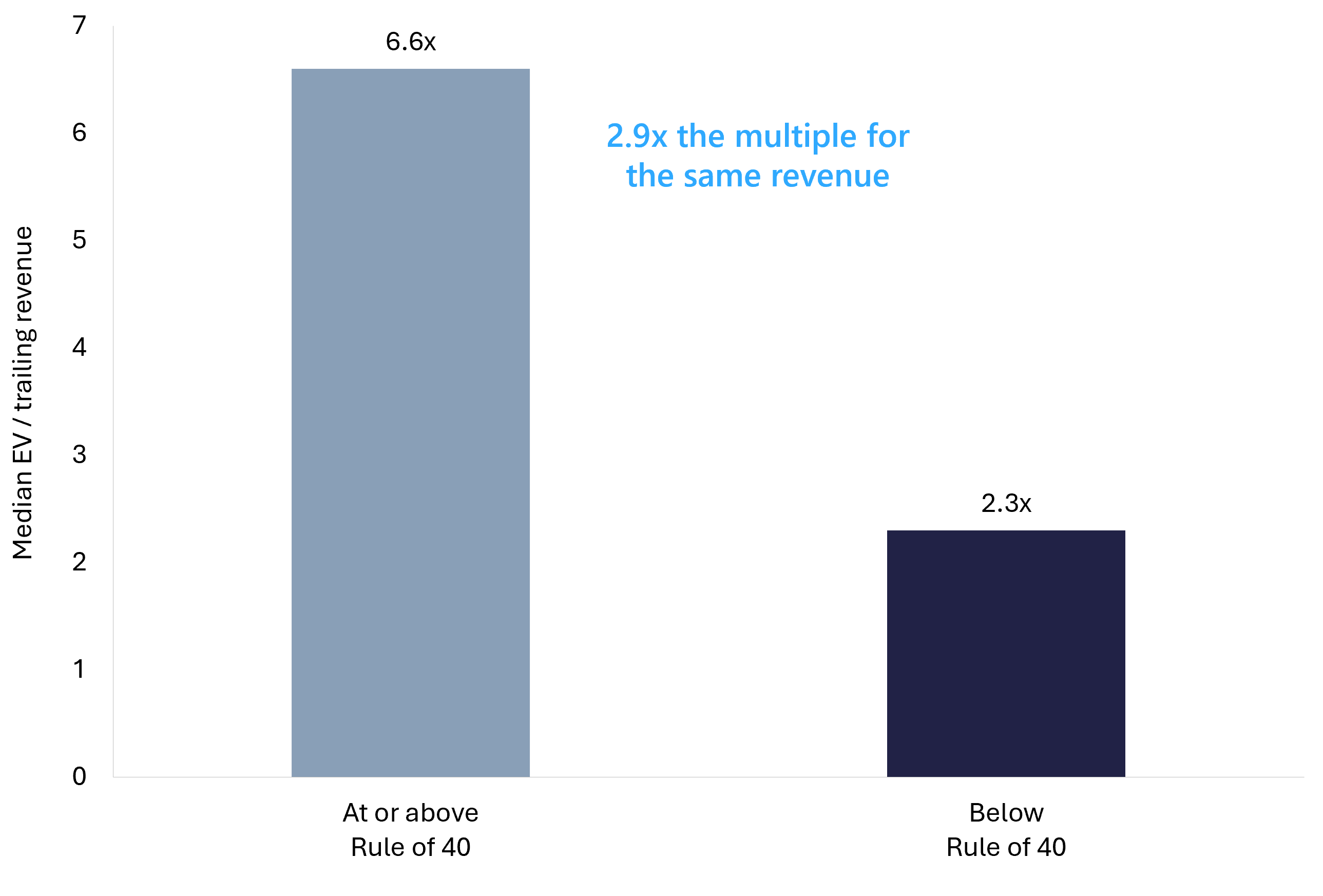
The AI premium is not paid for having AI features. It is paid for revenue a buyer believes AI cannot take away, and in 2026 it is measurable. Public software companies meeting or exceeding the Rule of 40 trade at a median 6.6 times trailing revenue, against 2.3 times for companies below it. Same sector, same revenue line, nearly three times the multiple.
What separates the two groups is defensibility, and the characteristics are consistent. The strongest software assets combine domain depth, proprietary context and workflow gravity: years of accumulated industry expertise and compliance logic that is slow to replicate, curated data and validated playbooks that make the product better over time in ways competitors cannot scrape, and a position as the system of record tied to a financial or regulatory outcome. When a product owns that position, AI agents tend to layer on top of it and drive more volume through it rather than route around it.
The inverse also holds, and sellers should know where they sit. Products competing mainly on interface quality, standalone dashboards, and horizontal tools that an AI copilot can reproduce natively face more pricing pressure. So do narrow AI startups built on top of standard foundation models targeting a single task, which can spend heavily on model access without owning anything hard to rebuild.
Regulated verticals get a structural advantage here. Software serving public sector, financial services, healthcare, energy and aerospace customers carries compliance safeguards that are not easily replicated, and many vertical providers in those industries hold curated domain datasets, embedded compliance logic and partner ecosystems built over years. Security platforms can see outsized acceleration from AI, given proprietary threat intelligence and deeply embedded positions in enterprise infrastructure. We look at how acquirers price AI capability specifically in our AI M&A trends analysis.
AI has also rewritten the build-versus-buy math that used to drive acquisitions of smaller point solutions, and sellers should be ready for the question. When a large competitor can prototype something similar with a small team, the pure capability argument weakens. The counter-argument is the one that holds up in a data room: a prototype is not a product, and a product is not a platform a compliance team will sign off on. Companies that can show the difference in specifics, meaning certifications, uptime history, edge-case handling and named enterprise references, keep their pricing power. Businesses that have become the connection point other systems are built against, through APIs, deep integrations and emerging interoperability standards, create stickiness that sidesteps the build question entirely.
The 2026 pricing question is not whether you use AI. It is whether your revenue survives someone else's AI, and buyers now test that directly.
How are SaaS M&A deal structures changing in 2026?
Consideration mix has shifted, and it shifted at every deal size. Among the largest transactions, stock-and-cash structures accounted for a record 35% of the funding mix as acquirers pursued scale and new capabilities without paying entirely in cash. Hybrid structures are appearing too, blending commercial partnership with acquisition optionality, and capital-sharing arrangements have become common across the AI value chain.
In the middle market the same logic shows up as rollover equity, earnouts and seller notes. A buyer who is confident about your cash flows but less certain about how AI affects your category will often bridge that gap with structure rather than a lower headline price. That is usually a good trade for a seller who believes the business keeps performing, and a poor one for a seller who wants a clean break.
Three things are worth negotiating carefully. First, what the earnout is measured on: revenue is easier to verify than EBITDA, which a new owner can influence. Second, how much control you keep over the levers that drive the earnout after close. Third, the definition of working capital at close, which quietly moves more money than most first-time sellers expect.
Structure also drives after-tax proceeds, and the gap between a good structure and a poor one is often larger than the gap between two offers. Whether a deal is framed as an asset sale or an equity sale, how earnout payments are characterized, and how rollover equity is treated all affect what you keep. Those are questions for your own tax adviser and attorney, and the right time to ask them is before a letter of intent is signed, not after.
What are buyers testing in diligence now?
The diligence playbook changed this year, and the change is specific enough that you can prepare for it. Net revenue retention has been the marquee SaaS metric for a decade, but in an AI-affected market it can mask seat contraction sitting underneath expansion revenue from AI add-ons. Gross revenue retention is more useful for assessing near-term durability, because it strips out upsell and shows what the contract base does on its own.
Expect buyers to disaggregate retention by cohort, by product module, and by revenue that is exposed to AI substitution against revenue that is not. If your reporting only produces a blended company-wide number, that is a gap worth closing before you go to market. Our explainer on net revenue retention and how it drives valuation covers what buyers calculate and why.
Pricing model is the second area of focus. Seat-based pricing is under structural pressure, because a customer running an AI agent does not need three seats to do the work of three analysts. Buyers are looking for evidence that a business can move toward value-based or outcome-based pricing without losing revenue, and they will ask how you have tested it.
The rest of the list is familiar and still decisive: customer concentration, contract assignability, code ownership, security posture, and how much of the business runs through the founder. Retention through the transition is the outcome every buyer is actually underwriting. A seller who can show that renewals do not depend on personal relationships with the founder removes the single biggest source of post-close risk, and that shows up in price.
The artifacts that answer these questions on the first pass are specific, and assembling them early shortens a process considerably:
- Three years of reconciled financials that tie to bank statements, with a monthly recurring revenue waterfall separating new, expansion, contraction and churned revenue
- Gross and net revenue retention by annual cohort, plus the same split by product module where you sell more than one thing
- A customer concentration table showing revenue share for the top ten accounts, with contract end dates and assignment clauses flagged
- An owner-dependence map: which functions run through the founder today, who covers each one after close, and what has already been delegated
- A short defensibility memo covering proprietary data rights, compliance requirements your product handles, integration depth, and where an AI competitor would actually have to start from scratch
None of that requires a bank or a consultant to produce. It does require a few months, which is the argument for starting before you intend to go to market rather than after a buyer approaches you.
Where is SaaS deal activity concentrated by region?
North America remains the deepest buyer pool, and it is where capital-deployment pressure is most acute. US sponsors are working through both new acquisitions and a large inventory of assets held past the four-year mark, and while the very largest transactions paused in the second quarter, smaller and mid-sized deals continued to clear. For a founder anywhere in the world, the likeliest acquirer of a quality software asset is still a North American buyer, which affects how you present financials and which reporting standard you should be ready for.
Europe has been the fastest-improving region. Announced deal value ran 82% ahead of the prior year, with the region posting an eight-year high in the first quarter, driven mostly by inbound interest into the UK. European software assets are drawing US buyers looking for defensible vertical positions at entry points that compare favorably with domestic comparables.
Asia-Pacific has been quieter, with activity down 31% by the end of the first quarter and continuing a multi-year regional contraction. For sellers based in the region, the practical implication is that the buyer pool is more likely to be cross-border than local, and a process built around international outreach will reach more of it. Cross-border interest overall has been one of the stronger features of 2026, which widens the realistic bidder list for founders outside the major markets.
Is the regulatory environment helping or slowing software deals?
For middle-market software sellers, regulatory friction fell in 2026, and most deals in this size range never touch it in the first place. The US size-of-transaction reporting threshold increased to $133.9 million for 2026, up from $126.4 million. Any transaction below that figure is outside premerger notification entirely, which covers the overwhelming majority of software transactions in the lower and middle market.
Above the threshold, the process itself got faster. The Antitrust Division returned to a targeted Second Request process in July 2026, accompanied by a model timing agreement, with the stated aim of quicker and more efficient review of proposed transactions. Filing burden also eased earlier in the year when the agencies went back to the notification form that had governed merger filings for nearly five decades.
In Europe the direction is similar. The European Commission published a draft set of new merger guidelines for consultation in April 2026 and is taking steps to streamline pan-European deal approvals. Sellers of cross-border software businesses should still expect foreign investment screening in some jurisdictions and sector-specific review where customers include government or critical infrastructure, but the general trend through this cycle has been toward clearer, faster processes.
Should you exit in 2026 or wait for 2027?
The honest answer is that the calendar matters less than your metrics, but the structural conditions are worth understanding before you decide.
For private software companies below roughly $100 million, M&A is the liquidity route. The public window has reopened, but narrowly: the near-term IPO market is centered on a small group of scaled, category-defining businesses, with SpaceX's reported filing and expected listings from other large AI names setting the tone. Successful listings at that scale could reset valuation benchmarks and reopen venture-backed liquidity more broadly, which tends to pull acquisition appetite up with it. That is a reason to be ready in 2027, not a reason to wait for it.
Several things point toward continued buyer demand across both years. Software spending growth is accelerating, not slowing. Sponsors are carrying deployment clocks and aging portfolios that need turning over. Vertical consolidators buy through cycles by design and were buying at record pace through the first half. And 80% of the M&A executives Bain surveyed expected to sustain or increase deal activity in 2026, with AI adoption inside deal processes more than doubling in 2025.
What that means in practice for a seller weighing 2026 against 2027:
- If you are at or above the Rule of 40 with clean gross revenue retention, you are in the group earning the premium now. Waiting risks growth decelerating into your process, which is the most expensive timing mistake available.
- If you are below it, the 12 to 18 months before a sale are where the multiple is won. Fixing retention reporting, reducing owner dependence and testing a pricing change are all achievable in that window and all move price.
- If your revenue is exposed to AI substitution, build the defensibility narrative with evidence rather than assertion. Buyers are testing this claim directly, and a documented answer is worth more than a confident one.
- If you want a specific buyer type, prepare for that buyer. A consolidator wants renewal history and code quality; a strategic wants integration proof; a sponsor wants cohort-level durability.
Preparation is the variable you control, and it compounds. A business that can answer the 2026 diligence questions on the first pass runs a shorter process, holds price through negotiation, and retrades less often. That is true in any market and it is more valuable in a selective one.
What to do next
The SaaS M&A trends 2026 that decide seller outcomes are not the headline totals. They are the widening gap between businesses buyers can underwrite and businesses they cannot, the three buyer groups now competing for the first category, and the fact that private benchmarks reset more slowly than public ones. Each of those favors the owner who arrives with clean numbers and a defensible story.
FE International is a global technology M&A advisor with more than 1,500 completed transactions and a 94.1% success rate across SaaS, AI, cybersecurity, fintech, edtech, ecommerce, agencies and marketplace apps. Our SaaS team advises founders through valuation, confidential buyer outreach, negotiation and close, and our M&A Platform serves software businesses under roughly $1 million.
The fastest way to know where you stand in this market is to get a real number based on your own metrics. Get a free valuation and we will benchmark your business against current buyer demand, with no obligation.