

Website and Content Business Valuation Multiples in 2026

Website valuation multiples in 2026 run from roughly 3x to 10x annual earnings for private internet businesses, with content sites, blogs and newsletters usually priced on seller's discretionary earnings toward the lower-to-middle part of that range, and scaled publishers priced on EBITDA. Monetization mix, traffic concentration and audience ownership decide where a specific business lands.
Three questions sit behind almost every valuation conversation we have with content business owners this year. What multiple will a buyer pay? Which earnings number does that multiple apply to? And how much of the price depends on traffic that a search engine controls? This guide answers all three for content sites, niche publishers, newsletters and community sites, whether you are researching content site valuation, blog valuation multiples or how to value a website before a sale. It applies the same discipline as our SaaS valuation multiples benchmarks.
The backdrop is a strong one for sellers who prepare. Global M&A value climbed 41% year on year to $2.4 trillion in the first five months of 2026, with strategic deals clearing at a median 11.6x EV/EBITDA. The budgets that fund content businesses are growing too: global advertising passed $1 trillion for the first time in 2025 and is projected to reach $1.4 trillion by 2030, and US internet advertising hit a record $294.6 billion in 2025, up 13.9%.
What has changed is what buyers pay for inside that growing pool. In 2026 they pay premiums for owned audiences, diversified revenue and traffic that has held through algorithm updates, and they price search dependence with more precision than at any point in the last decade. Every section below is built around that shift: how the multiples work, where each monetization model sits, how buyers adjust for concentration, and what you can do before a sale to capture the top of your range.
What Are Website Valuation Multiples in 2026?
Website valuation multiples are the numbers buyers apply to a business's trailing earnings to arrive at a price. If a content site produced $300,000 of seller's discretionary earnings over the last twelve months and a buyer pays $1.05 million, the multiple is 3.5x. That number is shorthand for everything the buyer believes about risk, durability and growth. A higher multiple says the earnings will keep arriving after the owner leaves. A lower one says the buyer wants to be paid for carrying more uncertainty.
Three earnings bases are in use for websites and content businesses in 2026, and the choice between them says a lot about the size of the business:
- Seller's discretionary earnings (SDE). Pre-tax profit with one owner's compensation, non-cash items, interest and one-off costs added back. This is the basis for owner-operated businesses, which covers most content sites, blogs and newsletters below roughly $1 million in annual profit. Our full guide to valuing a website or internet business sets out the add-backs buyers accept and the ones they challenge.
- Adjusted EBITDA. Used once a management team runs the business and the owner's salary is a real cost that stays after closing. Niche publishers with an editor, a sales lead and contracted writers get priced this way.
- Revenue or ARR. Reserved for subscription businesses growing fast enough that current profit understates future earnings. Paid newsletters and membership communities with strong retention can borrow this logic from software.
Monthly versus annual multiples confuse more sellers than anything else. A quote of "36x monthly profit" and a quote of "3x annual profit" describe the same price. We use annual multiples throughout this guide because that is how buyers, lenders and acquirers talk once deals move past the smallest sizes, and because it allows a direct comparison with public-market benchmarks.
So where do the numbers sit? Across more than 1,500 transactions, we have sold internet businesses at earnings multiples from 3x to 10x, with software and subscription models at the top and content and lead-generation businesses toward the lower end, where buyers apply a discount for search dependence and workload. In one comparison we published, a travel blog sold through FE International at 3.5x while an inventory-management software business sold at 10x. The gap came from site age, financial trends, competition in the niche and the hours each business demanded, not from the label on the business model. Blog valuation multiples follow the same logic: a blog is priced as a content site, and its revenue model and traffic mix decide where it sits.
Scale changes both the earnings basis and the number. Public media companies set the ceiling. In January 2026 data from NYU Stern, publishing and newspaper companies traded at 11.2x EV/EBITDA, advertising companies at 12.0x and information services companies at 11.5x, with EV/Sales of 1.7x for publishing and 2.1x for advertising. A private content business does not receive those multiples, and should not expect to. What the public numbers show is the price buyers pay for scale, diversified revenue and management depth, which is the road from a 3x SDE multiple to a double-digit EBITDA multiple.

How Do You Value a Website in 2026?
If you have been searching for how to value a website, this is the sequence we use. The order matters, because each step feeds the next.
Step 1: Normalize trailing twelve-month earnings. Start with twelve months of revenue tied to platform payouts: ad networks, affiliate programs, subscription processors, sponsor invoices. Deduct every cost a new owner must keep, including hosting, tools, writers, editors, assistants and software. Add back one owner's compensation, one-off costs and personal expenses run through the business. The result is SDE for an owner-run site or adjusted EBITDA for a team-run business. Buyers test each add-back, so keep the schedule short and defensible.
Step 2: Pick the earnings basis that matches your size. Owner-dependent and under roughly $1 million in profit: SDE. Management in place: EBITDA. Fast-growing subscription revenue with low churn: a revenue or ARR multiple can apply to that part of the business.
Step 3: Place the business inside the range. Our internal scorecard runs dozens of factors grouped under three headings: transferability, sustainability and scalability of revenue. The questions buyers ask first are the ones listed in our valuation guide: how old the business is, how revenue and profit have trended over one to three years and over the last few months, what percentage of traffic comes from search, whether the site has been affected by algorithm changes or manual actions, how much owner time the business needs, and whether every revenue stream transfers cleanly to a new owner.
Step 4: Cross-check. For a monetized site, compare the earnings-based website value against what similar businesses sold for and against public benchmarks. For a site with traffic and little revenue, the traffic-value method gives a floor: take the paid-search cost per click for the top keywords and multiply by the organic visits each one delivers.
Step 5: Decide what structure you will accept. Price and structure are two halves of one offer. Cash at close, earnouts, seller financing and holdbacks all move with risk. A business with concentrated traffic can still command a strong headline price if the seller accepts an earnout tied to performance, and a business with diversified traffic can insist on cash.
Here is a worked example. A recipe site generates $240,000 of trailing SDE from display advertising and affiliate links. At 3.5x, the multiple our travel-blog client achieved, the business is worth $840,000. Expressed in monthly terms, that is $20,000 of SDE at 42x. Move the same site to 45% of visits from email and direct traffic, add a membership tier and document the editorial process, and the conversation with buyers starts from a higher point in the range, with more of the price paid at closing.
One warning on shortcuts. Automated website valuation tools price from public traffic estimates and guessed ad rates. When we entered five recent FE International transactions into one popular tool, its outputs missed the real sale prices by between 5x and 90x, undervaluing every one. A valuation that will survive diligence needs real financials and human judgment, which is why our free valuation starts with your numbers rather than a traffic estimate.
Website Valuation Multiples by Monetization Model
Content site valuation in 2026 starts with the revenue model. How a content business makes money is the strongest single predictor of where it lands inside the range, and the same is true of website valuation multiples for newsletters and communities. Buyers price each revenue type on how reliably it transfers, how much it depends on a third party and how well it scales without the owner. The table below sets out how we see the models in 2026.
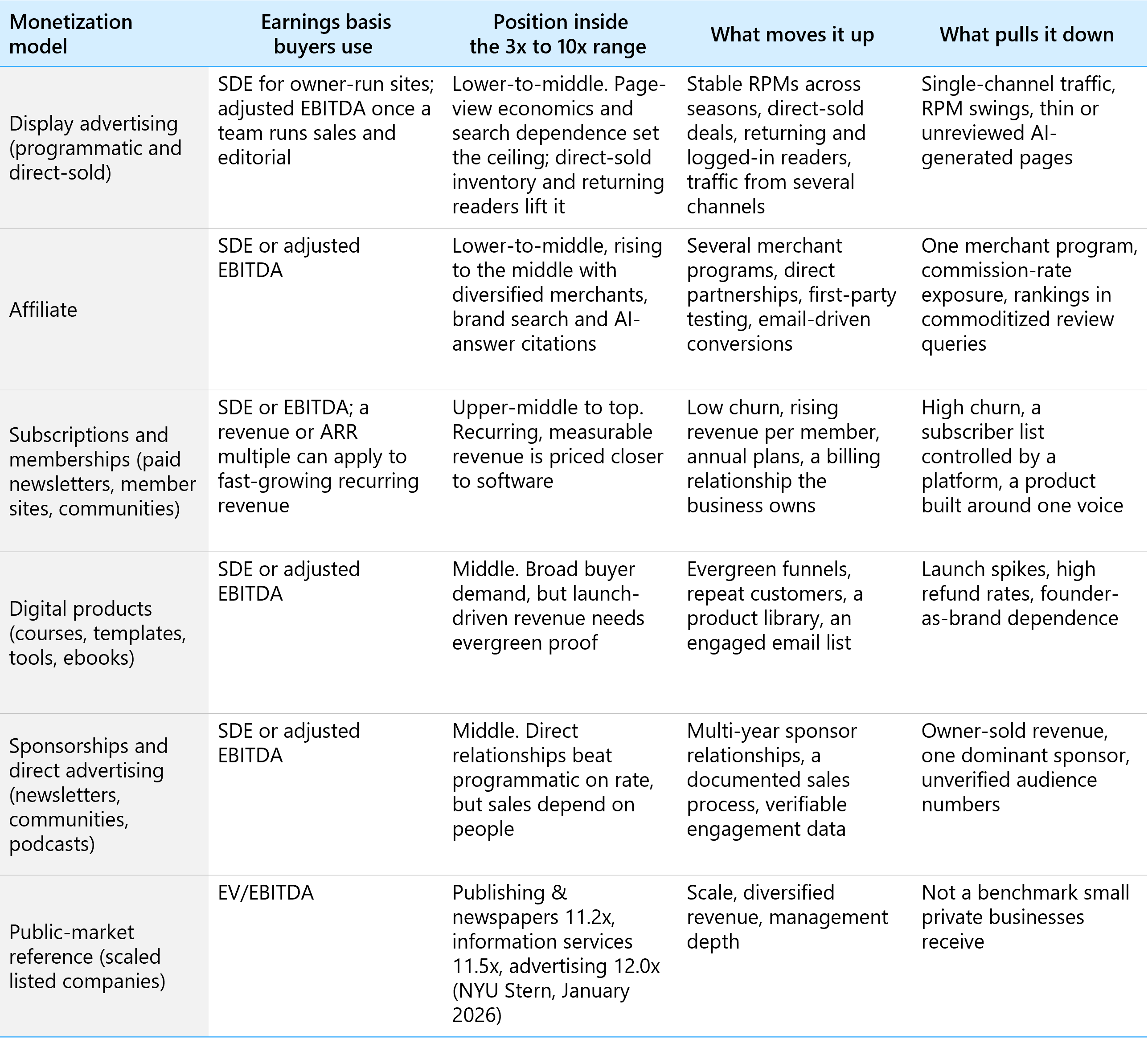
Display advertising. Display is the largest and most liquid revenue type for content sites, and the budget behind it keeps growing. US display revenue reached $81.6 billion in 2025, up 9.8%, inside a record $294.6 billion internet advertising market where programmatic buying rose 20.5% to $162.4 billion. The model's limitation is that revenue is a function of page views and RPMs, and both can move without the owner doing anything. A display site earns a premium when it can show stable RPMs across seasons, some direct-sold inventory, returning readers and a traffic mix that does not depend on one source.
Affiliate. Affiliate revenue turns intent into commissions, and the channel keeps expanding. US affiliate spending is forecast to grow 11.4% in 2026, with brands showing growing interest in affiliate publishers as a way to be visible inside AI search results. That last point is new, and it works in a seller's favor: a review site that answer engines cite becomes a distribution channel brands will pay to be part of. Buyers discount merchant concentration, exposure to commission-rate changes and rankings in commoditized "best of" queries. They pay up for first-party testing, direct partnerships and email-driven conversions. Our affiliate website valuation guide goes deeper on the metrics that matter.
Subscriptions and memberships. Recurring revenue is why subscription models sit at the top of the content range. Publishers are voting the same way: subscription and membership revenue is the biggest revenue focus for 76% of media leaders in 2026, ahead of display (68%) and native advertising (64%). A paid newsletter or membership community with low churn, rising revenue per member and a billing relationship the owner controls is priced closer to software than to a blog. Churn, platform dependence and a product built around a single voice pull it back toward the middle.
Digital products. Courses, templates, tools and ebooks carry software-like margins and attract a broad pool of buyers, including operators who come from outside web publishing. Our 60-transaction comparison found that digital product and ecommerce businesses draw a wider audience of buyers, which creates a halo of demand around them. Launch-driven revenue is the issue to manage: buyers want evergreen funnels, repeat customers and a product library that sells without the founder on camera.
Sponsorships and direct advertising. Newsletters and communities sell their audience directly, and sponsor budgets are rising fast. Creator advertising spend reached $37 billion in 2025 and is projected to reach $44 billion in 2026, growing faster than the wider market. Direct relationships beat programmatic on rate and durability. The diligence question is whether the sales motion survives the owner. Multi-year sponsor relationships, a documented sales process and verifiable engagement data earn the premium; owner-sold revenue and one dominant sponsor cost multiple.
How Are Niche Publishers, Newsletters and Community Sites Valued?
The four business types in this guide share a valuation method and differ in what buyers test hardest.
Niche publishers and content sites
A niche publisher is a content site that has grown past one operator: an editor, a handful of contracted writers, perhaps a sales lead. Content site valuation at this stage moves from SDE to adjusted EBITDA, and buyers treat the content library as an asset with a maintenance cost. Three things earn a premium in 2026.
The first is performance through the year's ranking updates. Google's Search Status Dashboard lists a February Discover update, a March spam update, a March core update, a May core update, a June spam update and an August spam update so far in 2026. A site that held or grew through all six has proof that few competing listings can offer, and buyers reward it.
The second is content that answer engines cannot replace. Media leaders surveyed for the Reuters Institute's 2026 trends report plan to invest more in original reporting and analysis and less in evergreen and service content that chatbots summarize easily. The same logic applies to a niche site: first-party data, product testing, expert authorship and a recognizable editorial voice are the moat, and a buyer can see them in the pages.
The third is licensing optionality. In the same survey, 37% of publishers see payments from platforms for content as their most significant new growth opportunity, and interest in that revenue has almost doubled in two years. A niche publisher with a clean archive and clear rights holds an option that did not exist in prior cycles.
Newsletters
A newsletter is a content business where the audience is owned rather than borrowed, and that is exactly what buyers want in 2026. Three in ten US adults get news from email newsletters at least sometimes, with similar shares across age groups, which makes email one of the few channels with a stable, cross-generational audience.
Buyers value a newsletter on SDE or EBITDA like any other content business, then cross-check with per-subscriber math: what a paid subscriber is worth over an expected lifetime, and what a free subscriber is worth in sponsorship revenue. The items they test are open and click rates by cohort, paid conversion, churn, where list growth comes from, and whether the list sits on infrastructure the owner can export. A newsletter whose subscribers live inside a platform account the buyer cannot migrate is priced lower than one on an owned domain with an exportable list, even at identical revenue. Sponsorship-funded newsletters price like direct-advertising content sites; subscription-funded newsletters price toward the top of the range.
Community sites
Forums, membership communities and niche social platforms are the least understood content asset and, in 2026, one of the most interesting. Reddit's second-quarter 2026 results show the scale community economics can reach: revenue of $804.9 million, up 61% year on year, 130.3 million daily active uniques and a 91.3% gross margin, with other revenue that includes AI data licensing up 24% to $43 million. A private community will not post those figures, but the drivers translate.
Buyers pay for members who return without a search engine sending them, for an archive that keeps growing because members write it, for data that AI developers and researchers may license, and for moderation systems that keep the community healthy after the founder steps back. They discount communities hosted on platforms the owner does not control, communities whose activity depends on one personality, and member counts that cannot be verified against logins and posts. Membership-funded communities are priced like subscription businesses; ad-funded communities are priced like display sites with better retention.
How Does Traffic Concentration Change Website Value?
Every buyer runs the same calculation before making an offer: if the largest traffic source changed tomorrow, how much revenue would be left? Traffic concentration is the factor that moves website valuation multiples most within a single business model. The answer sets the position inside the range and, often, the deal structure. Concentration shows up in more places than most owners expect, so we check it in several forms.
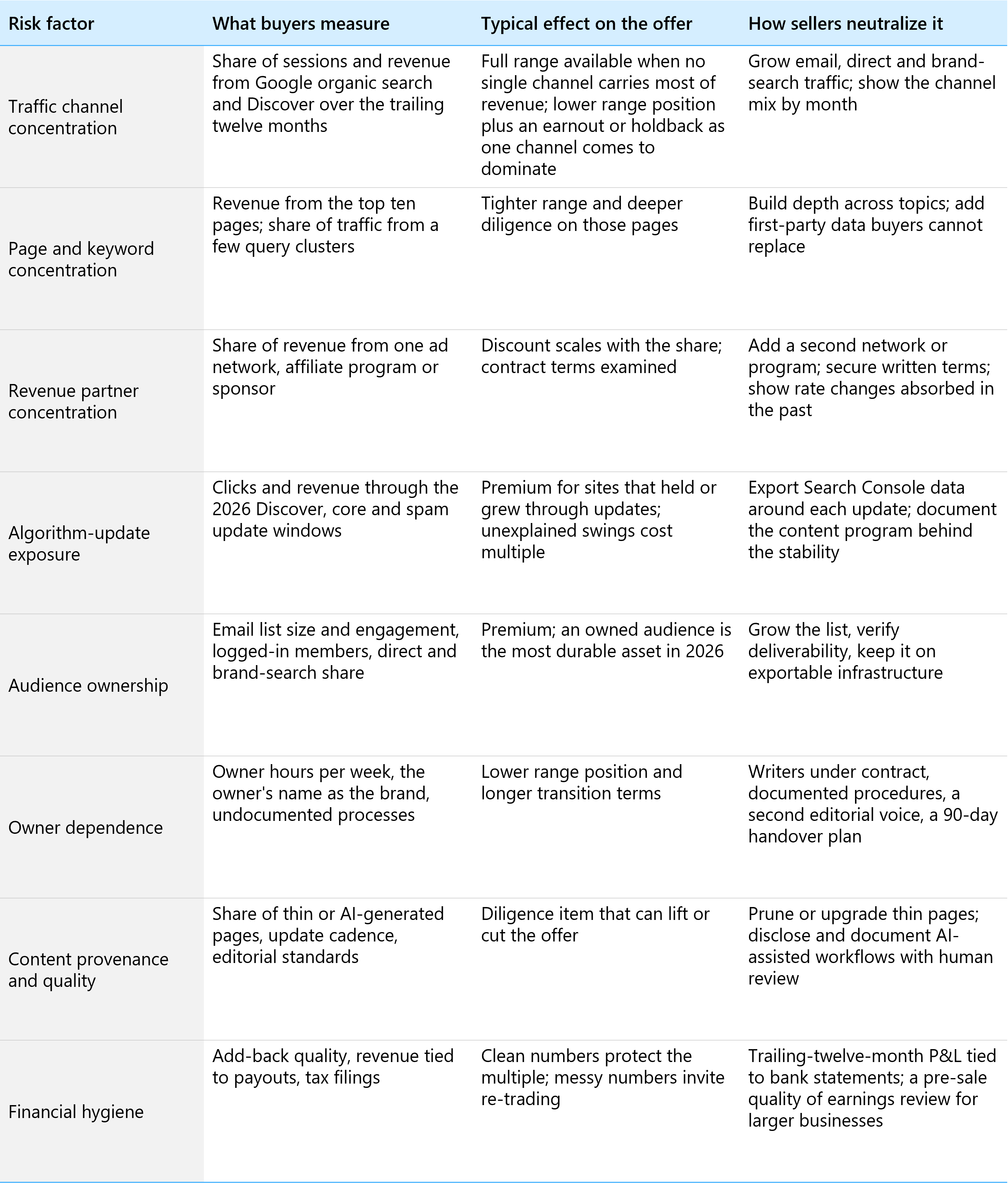
Channel concentration is the headline risk, but page concentration can be just as sharp. A site where ten articles produce 70% of revenue is a ten-article business with a long tail attached, and buyers will examine those ten pages the way they would examine a product line. Partner concentration follows: one ad network, one affiliate program or one sponsor paying most of the revenue hands pricing power to that partner. Owner concentration is quieter and costs just as much. A site whose readers come for one person's voice needs a succession plan before it needs a buyer.
The encouraging part of this analysis is that every item on the list is fixable before a sale, and most of the fixes compound. Building an email list reduces channel concentration, lifts direct traffic and creates a sponsorship asset at the same time. Adding a second monetization stream reduces partner concentration and raises the earnings base. Documenting the editorial process reduces owner dependence and turns the content program into a transferable system rather than a personal habit.
How Steep Is the Discount for Algorithm-Dependent Revenue?
In 2026 the question is not whether buyers price search dependence. It is how. The data behind their caution is public. Aggregate Chartbeat figures in the Reuters Institute's 2026 trends report show that Google organic search traffic to more than 2,500 news sites was a third lower in November 2025 than a year earlier, and 38% lower in the United States, with lifestyle and utility publishers most affected after AI Overviews began appearing on around 10% of US results. Media leaders expect search referrals to be a further 43% lower in three years, and a fifth expect a reduction above 75%. The same report carries the other half of the story: 53% of those leaders are confident about their own business, and upmarket subscription publishers with strong direct traffic see a clear path to long-term profitability.
For a content seller, those two findings combine into one rule. Buyers separate revenue a search engine controls from revenue the business controls, and they price the two differently.

The chart shows how exposure scales. Under the observed one-year scenario, a business with 30% of revenue from organic search has roughly 10% of revenue exposed; at 60% search share the exposure is about 20%; at 90% it approaches 30%. Under the three-year scenario publishers expect, a site with 90% search dependence has close to 39% of revenue exposed. A buyer may not expect either scenario to land in full, but they underwrite against it, and the price reflects that in two ways:
- Position in the range. The higher the exposure, the lower the multiple a buyer can defend to an investment committee or a lender.
- Structure. Once exposure is material, buyers move part of the price into an earnout or holdback tied to traffic and revenue over the following year.
Two kinds of evidence move a buyer back up the curve. The first is history: Search Console exports around each 2026 update window, including March 27 to April 8 for the March core update and May 21 to June 2 for the May core update, showing clicks and revenue holding or growing. The second is mix: direct, email, brand-search and referral traffic that would carry the business through a weak quarter in search. Sites that can show both tend to trade at a premium to sites with identical earnings that cannot.

The discount, in other words, is not a penalty on content businesses. It is a price on uncertainty, and sellers who remove the uncertainty keep the value. We see the strongest outcomes from owners who treat each update window as a data point to collect rather than an event to fear.
What Are Buyers Paying a Premium for in 2026?
The 2026 market rewards specific, demonstrable qualities, and website valuation multiples follow them. The buyers we work with, from individual operators to private equity-backed publishers, ask for the same things in a slightly different order.
- An owned audience. Email subscribers, logged-in members and brand searches are assets a buyer cannot be locked out of. In a year when platforms became a more popular source of news than both television and news websites for the first time, a finding of the Reuters Institute's Digital News Report 2026, a direct line to readers is the scarcest thing a content business can own.
- Diversified monetization. Two or more revenue streams with the second stream growing, so that no single partner or rate card controls the outcome.
- Traffic that has been tested. Stable or rising performance through the 2026 update calendar, documented and annotated.
- Visibility in AI search. Brands are starting to pay affiliate publishers to be present in AI answers, and buyers notice when a site is the one that answer engines cite for its category.
- Licensable content and data. Archives, member conversations and first-party datasets with clear rights, now that publishers' interest in platform payments for content has almost doubled in two years.
- Operations that run without the founder. Writers under contract, documented processes, an editorial calendar and a sales motion a new owner can run from the first week.
- Clean financials. A trailing-twelve-month profit and loss statement that ties to payouts and bank statements, with add-backs a buyer's accountant will accept. For larger businesses, a sell-side quality of earnings review done before launch shortens diligence and protects the multiple.
None of these qualities requires a large business. A single-operator site with 40,000 engaged email subscribers, two revenue streams and a documented content system is a more valuable business than a site twice its size that depends on one query cluster and one ad network. The macro picture rewards that preparation: with global deal value tracking toward its second-highest year on record, buyers have capital to deploy, and they deploy it fastest into businesses that have already answered their questions.
How Can You Raise Your Website Valuation Before a Sale?
Most of the value in a content business sale is created in the year before the process starts. This is the sequence we recommend to owners who come to us early.
- Measure concentration first. Pull twelve months of data on traffic by channel, revenue by page, revenue by partner and hours by owner. You cannot fix what you have not measured, and buyers will measure it anyway.
- Build the list. Email capture on every high-traffic page, a consistent send cadence and a clean, exportable list on your own domain. This single asset reduces channel concentration, raises direct traffic and creates sponsorship inventory.
- Add a second revenue stream that fits the audience. Sponsorships for a newsletter, a membership tier for a community, a digital product for an expert site, direct-sold placements for a display site.
- Prune and upgrade the content. Remove or improve thin pages, add first-party data and author expertise, and record how AI tools are used with human review so a buyer sees a defensible editorial standard rather than an open question.
- Assemble the update-window evidence. Search Console and revenue exports around each 2026 update, annotated with what changed and what did not.
- Reduce owner hours. Contract writers, document procedures, introduce a second editorial voice and let the brand carry the relationship with readers.
- Get the numbers ready. Tie revenue to payouts, keep a short add-back schedule, and commission a quality of earnings review if the business is large enough to justify it.
- Time the process. Strong buyer demand and a prepared business is the combination that attracts multiple bidders. Our mid-year 2026 tech M&A report sets out where demand sits by vertical and what the second half of the year looks like.
Each step moves website value up its range and, just as important, moves price from earnout into cash at close. Owners who complete the list rarely need to argue about the multiple, because the evidence does the arguing for them.
Know Your Number Before a Buyer Does
Website valuation multiples in 2026 reward preparation more than size. The range for private internet businesses runs from roughly 3x to 10x annual earnings, and the position of a content site, niche publisher, newsletter or community inside that range comes down to four things buyers can verify: how the business makes money, how concentrated its traffic and revenue are, how its traffic has behaved through the year's algorithm updates, and how much of the audience the business owns. Each of those can be improved in the year before a sale, and each improvement shows up as a higher multiple, more cash at close, or both.
The buyers are there. Deal value is on course for one of the strongest years on record, advertising budgets have passed $1 trillion globally, and affiliate, subscription and creator spending are all growing faster than the wider market. The sellers who capture that demand are the ones who walk into a process knowing their number, with the evidence to defend it.
If you own a content site, blog, newsletter or community and want to know where it sits in the 2026 range, get a free valuation from our team. We will start with your real financials and traffic data, show you the multiple the market supports today, and map the steps that move it higher.
