


A sell-side due diligence checklist is the set of financial, legal, technical and commercial checks a seller runs on its own business before going to market. For technology companies it covers revenue quality, contracts and IP, code and security, and customer data, so buyers verify what you present rather than discover it. It protects price and shortens the deal.
Technology deal values rose 67% to $420 billion in the first five months of 2026, and technology accounted for 15 of the 16 megadeals announced across technology, media and telecom in that window. Buyers have capital and conviction. They are also more disciplined than at any point in the last cycle: 90% of private equity dealmakers and 80% of corporate acquirers expect to do more deals this year, and they are putting more effort into pre-deal financial and commercial diligence before a transaction is announced. That rewards one type of seller above all others: the one who has already done the work.
This guide is the seller-side flip of our due diligence checklist for buying a SaaS business. Where that post explains what acquirers test, this one explains how to pass those tests before the first management call: the four workstreams, the documents to assemble for each, the issues that surface late and what they cost, and how quality of earnings work done before launch compresses the timeline from letter of intent to close.
What Is Sell-Side Due Diligence, and How Is It Different From Vendor Due Diligence?
Sell-side due diligence is the review a seller performs on its own business before buyers do, using the lens an acquirer's accountants, lawyers and engineers will apply later. Buy-side due diligence happens after a letter of intent, usually under exclusivity, when every finding becomes negotiating material for one party. Sell-side work happens before the process starts, while every finding is still yours to fix quietly.
Vendor due diligence is a related but distinct product. In a vendor due diligence (VDD) engagement the seller commissions an independent firm to produce a report that bidders can rely on, which removes the need for each buyer to run substantial diligence of their own and helps the seller keep pace and initiative through the sale. Vendor assistance is the lighter version: the same specialists prepare the seller, but the output is for the seller's benefit only. Full-scope VDD suits auctions with several institutional bidders. Vendor assistance suits a targeted process with trade buyers, or a founder-led company that wants the preparation without the shareable report.
For most technology businesses in the $2 million to $100 million enterprise value range, the practical package is three things: an internal checklist review across all four workstreams, a sell-side quality of earnings report, and a structured data room built before launch. Our quality of earnings guide for tech sellers covers the QoE piece; this post covers the rest. None of it replaces buyer diligence. What changes is its character: confirmatory rather than exploratory, reconciling against a package you built rather than reconstructing the business from scratch.
Sell-side due diligence is the review a seller runs on its own business, before buyers do, using the lens buyers will use.
Why Does Sell-Side Due Diligence Matter More in 2026?
Three things about the 2026 market make preparation worth more than it was two years ago. First, the capital is there. Global M&A was up 41% in the first five months of 2026 and is tracking toward the second-highest year on record, and technology generated more first-half deal value than any other sector. Our mid-year 2026 tech M&A report breaks down who is buying and at what multiples. Buyers competing for quality assets pay for certainty, and a prepared business is the definition of certainty.
Second, buyers run deeper diligence and run it faster. Nine in ten M&A organizations now use generative AI in their deal process, and more than a third apply it across several stages. A buyer's team can reconcile every customer contract in your data room against your ARR schedule in hours, so inconsistencies that once took weeks to find now appear on day two. Sellers whose numbers tie out get the same speed working for them: confirmatory diligence finishes early and the deal moves to documentation.
Third, the payoff from preparation is now quantified. Preparation quality is the largest driver of value in a sale, shaping proceeds, time to close and buyer engagement. Among sellers surveyed globally, the share meeting their own expectations on timing and proceeds rose from one-third in 2024 to nearly half by the end of 2025, and the share reporting at least one abandoned deal fell from 98% to one-third. Where deals are abandoned it most often happens before signing, and the leading causes (unmet value expectations and limited early buyer interest) are both things a prepared seller addresses before launch.

In a market where buyers are selective and move fast, the prepared seller gets both the premium and the shorter timeline.
What Does a Sell-Side Due Diligence Checklist Include? The Four Workstreams
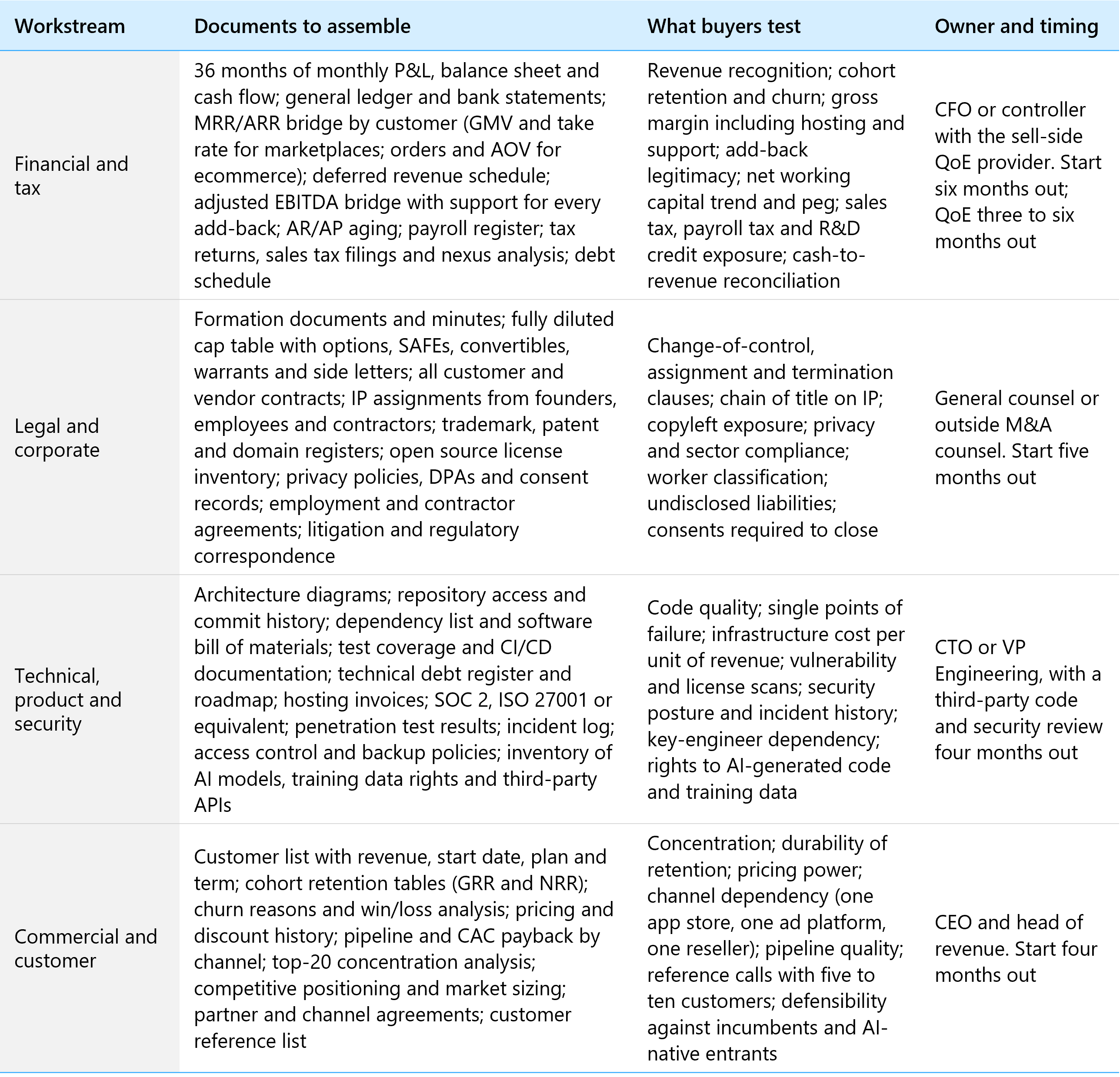
Every buyer organizes diligence into workstreams, and the cleanest way to prepare is to mirror them. For a technology business a sell-side due diligence checklist has four: financial (including tax), legal (including corporate, IP and privacy), technical (product, code, infrastructure and security) and commercial (customers, market and go-to-market). People and operations cut across all four: the org chart, key-person retention plans, process documentation and the tool and vendor inventory belong in every data room.
Treat the table as a working checklist: assign each row an owner, set a completion date three to six months before launch, and track it weekly. Start with the financial row, because valuation depends on it and its findings often change what the legal and commercial rows need to say.
Financial Workstream: How Do You Prove Revenue Quality Before a Buyer Tests It?
Start with revenue, because every valuation conversation begins there and because it is where post-close disputes concentrate. Financial statement breaches account for 38% of paid losses on representations and warranties insurance policies placed since 2019, more than any other category, and the leading driver is improper revenue recognition. In software and technology deals, misstated churn, renewal rates and pricing sit right behind it. That is the buyer's starting assumption. The financial workstream exists to replace it with evidence.
Build the revenue bridge first. For a SaaS business that means a monthly MRR bridge by customer showing new, expansion, contraction and churn, reconciled to invoices and to cash. For a marketplace it means GMV, take rate and net revenue by cohort. For an ecommerce brand it means orders, average order value, returns and contribution margin after advertising. For an agency it means retainer revenue separated from project revenue, with client tenure. Whatever the model, the test is the same: can a stranger start from your bank statements and arrive at your revenue figure without asking you a question?
Then address recognition. Annual prepayments, multi-year contracts, implementation fees and usage-based components all create timing questions, and deferred revenue should sit on the balance sheet with a schedule that reconciles to contracts. If you have been recognizing annual contracts upfront, fix it now; otherwise a buyer's accountants will restate it, and their restatement will be larger than yours. Adjusted EBITDA is next, and every add-back needs a document: the invoice for the one-time legal matter, the payroll record behind the founder's above-market salary, the contract for the discontinued product line.
Net working capital deserves its own line. Purchase price adjustments appear in more than 90% of private-target deals, buyers open with a buyer-favorable claim in 57% of them, and 51% of final adjustments land in the buyer’s favor. The seller's defense is a 24-month trend of monthly working capital with seasonality explained, so the peg is set on your data rather than the buyer's model. Where activity spikes before a sale (annual billings pulled forward, say), document it, because a working capital figure that looks inflated at close becomes an adjustment against you.
Finally, tax. Sales tax nexus for software sold across US states, VAT on digital services in Europe, payroll tax on contractors who look like employees, and R&D credits claimed without support are the four exposures we see most often. A nexus study and, where needed, a voluntary disclosure cost a fraction of the escrow a buyer will demand to cover an unquantified exposure.
Unsupported add-backs are not negotiated down. They are removed.
Legal Workstream: Which Contracts and IP Documents Must Be Clean?
The legal workstream is where deals lose weeks, not because the problems are large but because fixing them involves third parties. A change-of-control clause in your largest customer's contract means a consent request, which means that customer learns about the sale on the buyer's timetable rather than yours. Find those clauses now.
Start with the contract register. Pull every customer agreement above a revenue threshold (we use the top 20 customers plus any contract over 2% of revenue) and tag four things: assignment restrictions, change-of-control triggers, termination for convenience, and non-standard terms such as most-favored-nation pricing, exclusivity, uncapped liability or source code escrow. Do the same for vendor, hosting, data and reseller agreements, since a buyer integrating your product needs those to transfer. Material contracts are the most frequent breach type in technology deals at 20% of claim notifications and produce 21% of paid losses across all deals, most often because a material customer had signaled a reduction before closing that was not disclosed or because a required consent was never obtained; intellectual property losses, meanwhile, doubled to over 10% of paid losses, a third of them from disputes over license and royalty fees. A contract register and a third-party license inventory, built before launch, close both gaps.
Intellectual property chain of title is the second item. Buyers want to see that every founder, employee and contractor who wrote code, designed the product or produced content has signed an assignment, and that the company (not an individual, not a prior entity) owns the trademarks, patents and domains. For businesses that used offshore development shops or early freelancers this is the gap we find most often, and it is fixable with confirmatory assignments as long as you start before the data room opens.
Corporate records and the cap table come next. Old option grants, SAFEs and convertible notes, warrants, side letters and verbal promises of equity have a way of surfacing in the final week. Reconcile the fully diluted cap table to the signed documents, confirm vesting and acceleration triggers, and quantify what every instrument pays out across a range of exit values so the funds flow holds no surprises.
Privacy and compliance sit at the end of the legal list but near the top of a buyer's. Your privacy policy, data processing agreements, consent records and sub-processor list should match what the product actually does with data. Fintech sellers add licensing and KYC records; edtech sellers add student data protections; cybersecurity sellers add their own certifications and any security commitments made to customers. Compliance questions tend to arrive late, often after closing, which is why buyers price unquantified compliance risk into escrows rather than wave it through.
Buyers do not fear the problems they can see. They price the ones they cannot.
Technical Workstream: What Will a Buyer's Code and Security Review Find?
Technical diligence used to be a conversation with the CTO. In 2026 it is a scan. Strategic acquirers and private equity platforms routinely commission third-party code reviews, and those reviews run automated license, vulnerability and dependency analysis across the whole repository before anyone reads a line by hand. Run the same scan first.
Open source is the headline. Two-thirds of commercial codebases audited in 2025 (68%, up from 56% the year before) contained open source license conflicts, 87% contained at least one known vulnerability, and 93% contained components with no development activity in the past two years. The sharpest rise came from what the audit calls license laundering: AI coding assistants reproducing snippets derived from copyleft sources without the license attached. If your engineers use AI assistants, and most now do, assume your proprietary code contains some of this and find it before a buyer does. A software composition analysis, documented remediation of any GPL or AGPL conflicts in shipped code, and a software bill of materials are now table stakes for a software or AI company going to market.
Security comes next. Buyers ask for SOC 2 Type II or ISO 27001 where the customer base expects it, recent penetration test results with remediation evidence, an incident log with root-cause analysis, and access control and backup policies that match reality. The reason is simple: the global average cost of a data breach reached a record $4.99 million in 2026, up 12% in a year, and a buyer inherits any breach that has already happened but not yet surfaced. An undisclosed incident discovered in diligence is a trust problem. The same incident, disclosed with a remediation record, is a line item.
Infrastructure and unit economics are the third area. Hosting, API, model inference and third-party data costs should map cleanly to cost of goods sold so that gross margin is defensible line by line. For AI-native businesses, buyers will want compute cost per unit of revenue, rights to training data, dependency on a single model provider, and what happens to margin if that provider changes its pricing. For marketplaces and consumer apps the equivalent question is platform dependency: what share of revenue flows through one app store or one advertising channel.
Finally, people and process. Document the architecture, the deployment pipeline, the on-call rotation and the test coverage. Identify the two or three engineers who hold critical knowledge and put retention arrangements in place before launch, because a buyer who concludes the product lives in one person's head will structure the deal around that person, usually with a longer earnout or a rollover requirement.
An undisclosed incident discovered in diligence is a trust problem. The same incident, disclosed with a remediation record, is a line item.
Commercial Workstream: Can Your Customer Data Survive a Buyer's Cohort Analysis?
Commercial diligence answers one question: will the revenue still be there in three years? Buyers answer it with cohorts, concentration and conversations, and your job is to run all three before they do. Cohorts first. Build monthly retention tables by acquisition cohort showing gross and net revenue retention, and be ready to explain every cohort that breaks the pattern. Our buyer checklist sets out the benchmarks acquirers use: net revenue retention above 100%, annual customer churn below 10% and gross margins above 75%. If your numbers sit below those lines, the preparation is not to hide them but to explain them with churn-reason data and show what you changed. A seller who can say “we lost SMB accounts in 2024, repriced in Q1 2025, and the 2025 cohorts retain eight points better” is presenting a trend. A seller who cannot is presenting a risk.
Concentration second. List the top 20 customers with revenue, contract term, renewal date and relationship owner. Anything above 10% of revenue from one customer will be tested, and the test is a reference call, so prepare the customer. For agencies, concentration is the valuation variable, and buyers will want retainer revenue separated from project revenue and the tenure of each client. For ecommerce brands, concentration shows up as channel dependency: the share of orders from one platform or one paid channel, and what happened to acquisition cost the last time that channel repriced.
Pipeline and pricing third. A buyer will rebuild your forecast from your CRM, so the pipeline needs stage definitions, conversion rates by stage and an honest aging of stale opportunities. Every discount in your pricing history is a data point about pricing power, and a promotion run to hit a number before the sale process will be found and modeled as a drag on forward revenue. Better to explain it on page one of the commercial section than to defend it on a management call.
Market and competition round out the workstream. Buyers in 2026 ask every software seller the same question: what does an AI-native entrant do to your category, and why do your customers stay anyway? The answer is a defensibility narrative supported by data: proprietary datasets, workflow embedment, switching costs, integrations and distribution. Vertical SaaS sellers with deep workflow integration, cybersecurity sellers with certifications and installed-base trust, fintech sellers with licenses and transaction history, and edtech sellers with institutional contracts tend to answer this well. Answer it in writing, in the data room, before it is asked.
Commercial diligence asks whether the revenue will still be there in three years. Your cohorts answer before you do.
Which Issues Surface Late and Cost Sellers Money?
Every advisor keeps an informal list of the findings that arrive in week four of diligence and reprice the deal. The table below is ours, drawn from our own transactions and from the post-close claims data insurers publish. The pattern is consistent: the issues that cost the most are rarely the ones a seller considers sensitive. They are the ones the seller never looked at.
Two numbers frame the cost. Half of all post-close claims on insured deals are now notified more than 12 months after closing, led by compliance with laws, tax and financial statement breaches, and in 2025, 68% of the money paid out was calculated on a multiple of the issue rather than dollar for dollar. In plain terms, a $200,000 revenue recognition error in a business sold at 8x is argued as a $1.6 million loss. Before closing, the same error is a price negotiation. After closing it is a claim against your escrow, and most private-target deals carry an escrow or holdback, at a median of 10% of transaction value across all 2025 deals. A sell-side due diligence checklist exists to move every one of these findings into the first category, where it is yours to explain and often to fix.

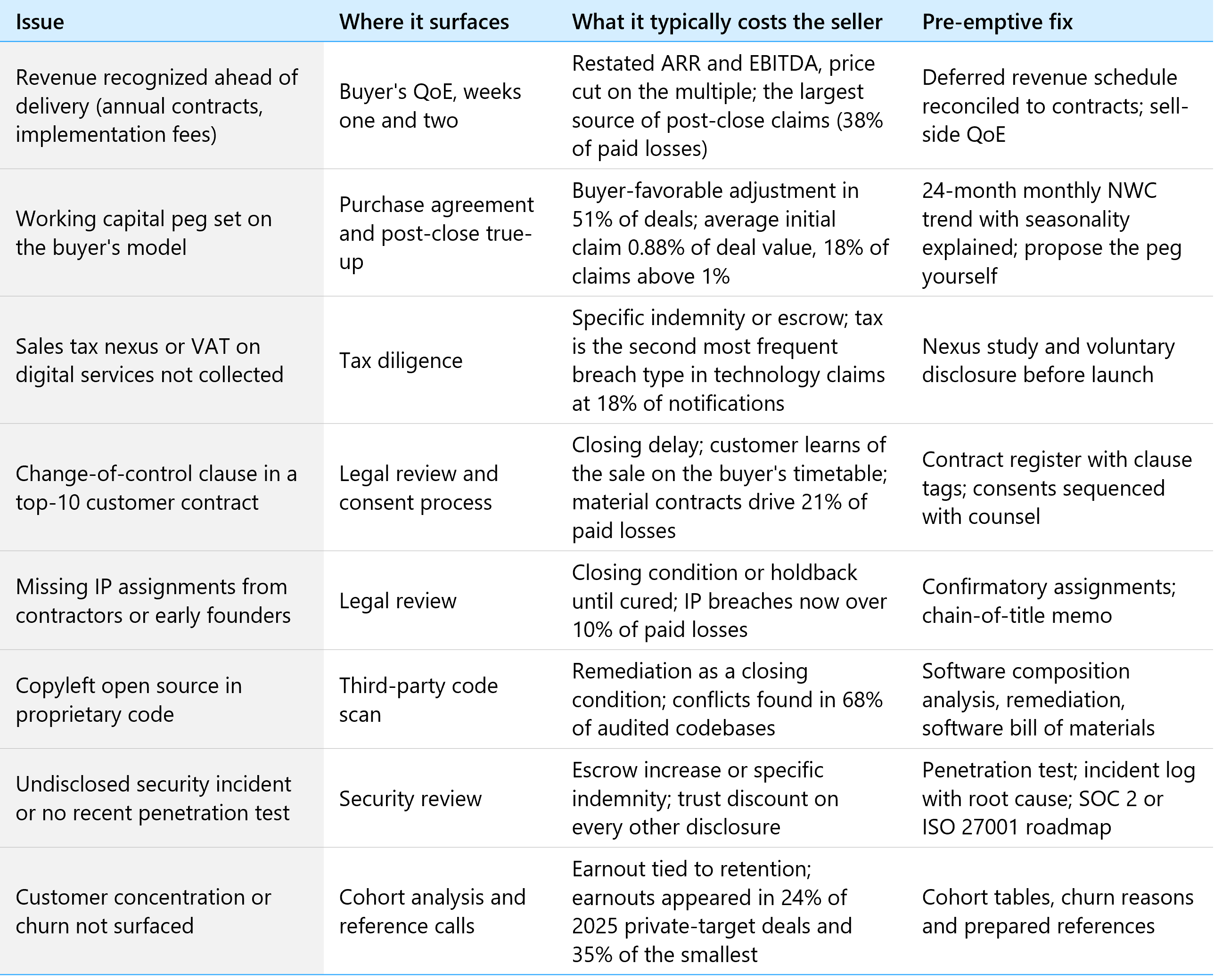
Notice that the fixes column is almost entirely paperwork and process. None of it requires changing the business. It requires looking at the business the way a buyer will, roughly six months before the buyer does.
Before closing, a finding is a negotiation. After closing, it is a claim.
How Does Pre-Emptive Quality of Earnings Work Compress the Timeline?
A sell-side quality of earnings report is the single most useful document on this checklist, because it converts the financial workstream from a set of internal checks into an independent package buyers can rely on. Our quality of earnings guide explains what the analysis examines. Here, the point is what it does to the clock, and to the price.
The valuation effect first. In an analysis of 360 transactions completed since the third quarter of 2024, published in December 2025, sellers with a sell-side QoE achieved average TEV/EBITDA multiples of 7.4x against 7.0x for those without, with the lift concentrated in deals above $50 million in enterprise value, and the practitioners interviewed estimate the report moves the deal faster in more than nine cases out of ten. Adoption is close to universal among private equity-backed sellers and closer to half among founder-led lower-middle-market businesses, which is the gap this post is written to close.
The timeline mechanics work like this. A buyer's confirmatory QoE typically runs four to six weeks after a letter of intent. When the seller arrives with an independent report, buy-side accountants describe starting 25% to 30% ahead: they test the adjusted EBITDA bridge and sample the revenue data rather than rebuild both, and their questions are specific rather than exploratory. Our buyer checklist puts formal SaaS due diligence at four to six weeks when the seller is prepared, and the sell-side QoE is the main reason the shorter end of that range is achievable. Without it, in our experience, the same process often stretches past eight weeks, and every extra week of exclusivity is a week in which the buyer's price is firm and yours is not.
The second effect is on terms. Targets that come through diligence with few or no findings are seeing shorter survival periods for their representations, with roughly 20% of recent deals carrying escrow survival under 12 months, about a third above historical norms, and escrows on insured deals running at a median of 2.8% of transaction value against 10% across all deals. Clean diligence buys cleaner terms as well as a cleaner close.
Timing is the last variable, and the one sellers most often get wrong. Commission the QoE three to six months before launch, not after the first inbound call. The analysis takes several weeks, the findings take time to remediate, and the output needs to flow into the confidential information memorandum so buyers see verified numbers from first contact. Our exit planning service exists for exactly this window: the period before launch when the business can still be changed rather than just described.

A sell-side QoE does not change the numbers. It changes who has to prove them.
How Should You Sequence the Work? A 90-Day Sell-Side Preparation Plan
The checklist above is long, and the natural reaction is to start everywhere at once. Don't. Sequence it so that the findings from each phase feed the next.
Days 1 to 30: financial foundation. Close the books for the last 36 months, build the revenue and adjusted EBITDA bridges, pull the working capital trend, and engage the sell-side QoE provider. Run the nexus study in parallel, because tax findings take longest to remediate. Decide the valuation range you are targeting; a free valuation from FE International gives you an evidence-based starting point before you have spent a dollar on advisors.
Days 31 to 60: legal and technical remediation. Build the contract register and tag every clause that matters. Issue confirmatory IP assignments. Run the open source and vulnerability scans and start remediation. Commission the penetration test. Reconcile the cap table. Put retention arrangements in place for key people. The QoE's early findings arrive in this phase, so expect to loop back to the financials.
Days 61 to 90: commercial package and data room. Build the cohort tables, the concentration analysis, the pipeline review and the defensibility narrative. Prepare customer references. Assemble the data room using the workstream table as its folder structure, so a buyer's request list maps one-to-one to what is already there. Draft the confidential information memorandum from verified numbers and rehearse the management presentation against the questions you now know buyers will ask.
Three months is a working minimum for a business with reasonably clean books. Companies with multiple entities, international operations or a history of inconsistent accounting should allow six, which is why the first conversation with an advisor is best held a year before the intended exit rather than a quarter.
Sequence the work so that every finding feeds the next phase, and start with the financials because valuation depends on them.
Complete Your Sell-Side Due Diligence Checklist Before Buyers Look
The buyers active in technology M&A in 2026 have capital, conviction and better tools than any previous cycle. They will find what is in your business. The only question a sell-side due diligence checklist settles is whether they find it in your data room, explained and often already fixed, or in their own analysis, priced against you. Preparation quality is the largest driver of value in a sale, and every item in this guide is a component of it: a revenue bridge that ties to cash, a contract register with the consents already mapped, a codebase that has been scanned, cohorts that explain themselves, and a quality of earnings report that lets the buyer's accountants start a third of the way through.
Start with the number. Get a free valuation from FE International and you will know, within days, where your business sits in the current market and which items on this checklist move the figure most. From there, our exit planning team works with you through the three to six months before launch, so that when buyers look, the work is already done.