

How to Sell a FinTech Company in 2026: Buyers, Regulation, and Process

How to sell a fintech company in 2026: get licences, compliance records and net-revenue data ready before you go to market, run a competitive process across banks, private equity, strategics and infrastructure consolidators, and structure the deal around regulatory approvals: sign first, then close once change-of-control consents arrive. Prepared sellers are closing at strong prices.
Fintech is being bought again, and at scale. Global fintech investment across venture, private equity and M&A reached $103.1 billion across roughly 2,100 deals in the first half of 2026, up from $72.2 billion in the second half of 2025, with a single payments acquisition worth $24.3 billion leading the tally. Fintech revenues passed half a trillion dollars in 2025, growing 22 percent, more than four times the rate of incumbent financial institutions, and 74 percent of the largest public fintechs were profitable, up from 68 percent a year earlier. The buyer mix has changed too: scaled fintechs completed 659 acquisitions in 2025 against 589 by incumbents, reversing the previous year's pattern.
That is the backdrop for anyone working out how to sell a fintech company this year. The opportunity is real, and so is the homework. A fintech sale is not a software sale with extra paperwork. Regulators sit at the table, licences carry both value and conditions, customer funds and card data raise the bar on diligence, and the buyer universe runs from a national bank to a payments platform closing its tenth add-on.
This guide is written for owners of payments companies, lenders, banking and compliance infrastructure, wealthtech and embedded-finance businesses who want the whole picture in one place: who buys, what they pay for, what regulators require, how to prepare data and compliance, and how to design a sale process when a regulator has a say in the outcome. It is the first pillar in our fintech sell-side series and pairs with our benchmarks on fintech valuation multiples in 2026 and our guide to how to value a fintech business.
What Does the FinTech M&A Market Look Like in 2026?
Short version: bigger cheques, fewer but better targets, and more active buyer types than at any point in the last five years.
Start with the money. Both M&A and private equity investment in fintech grew between the second half of 2025 and the first half of 2026. The Americas took $86.9 billion of the first-half total, with the US alone at $80.8 billion, and M&A activity in the Americas more than doubled from $27.4 billion to $64.6 billion. Private equity, which had been sitting out while valuation gaps closed, started deploying again in the Americas mid-market. Cheque sizes tell the same story: the global median fintech M&A deal size climbed to $80.9 million in 2026 to date, from $44.0 million across 2025, which is what a market paying up for quality looks like.

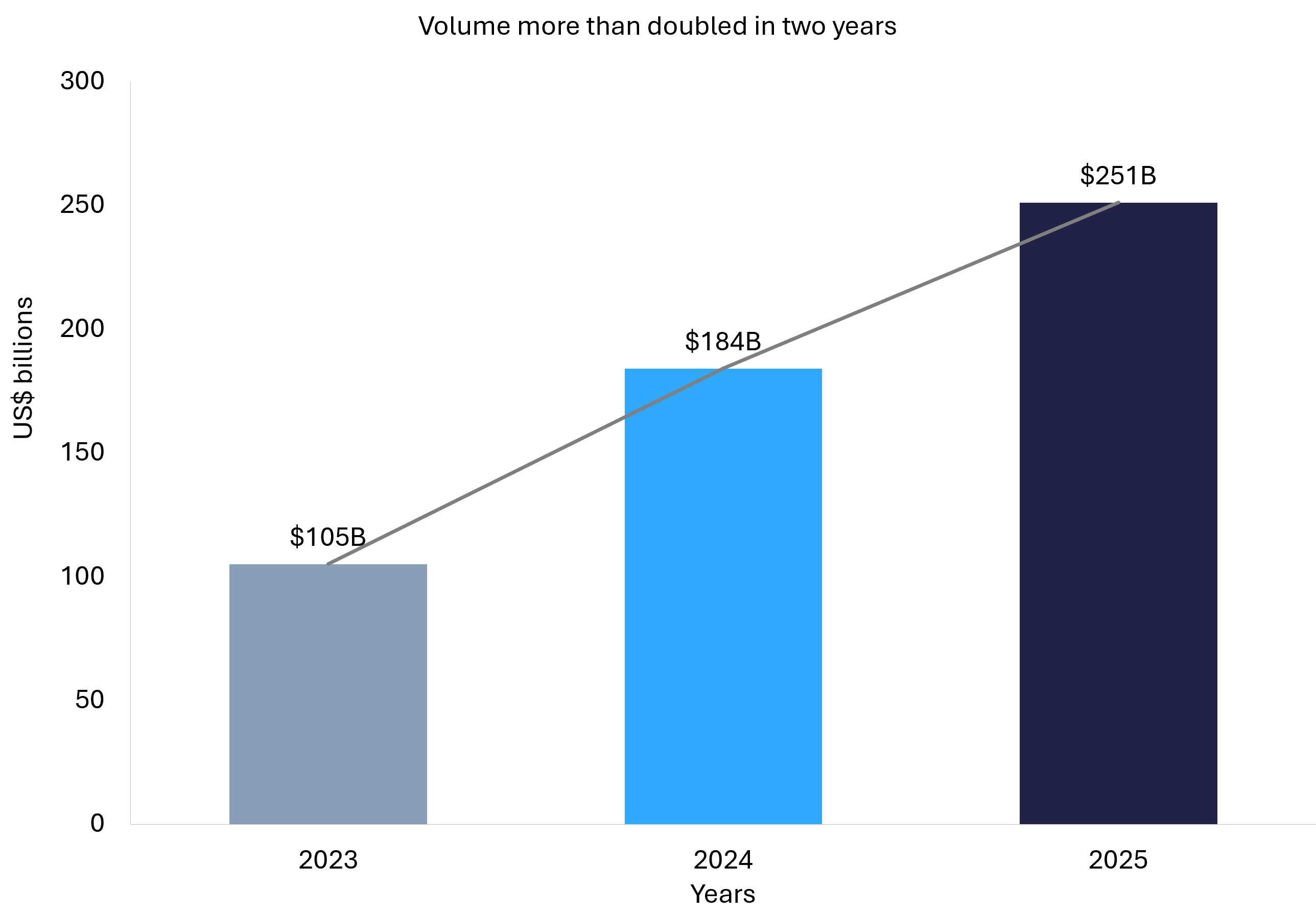
The longer trend is just as clear. Fintech M&A volume climbed from $105 billion in 2023 to $184 billion in 2024 and $251 billion in 2025, fintech IPOs rose 50 percent in 2025, and exit momentum is now driven by structural need rather than sentiment, which makes this cycle more durable than the bursts of 2021. Across financial services as a whole, deal value rose roughly 40 percent in 2025 to $499 billion on flat deal volume, which tells you where the energy is: scale and capability acquisitions, priced accordingly.
Sentiment for the year ahead matches the data. More than 80 percent of private equity and corporate dealmakers expect their organisations to do more deals, with greater total value, over the next twelve months than in 2025, and the same research points dealmakers toward the middle and smaller deal markets, where most fintech sellers sit. On the venture side, payments led third-quarter fintech funding, early-stage valuations hit record highs, and Stripe's $8 billion purchase of OpenRouter showed that large, technology-forward incumbents will pay up for AI-native capability.
Two things follow for a seller. First, the demand is there, and it is concentrated in payments, infrastructure, compliance technology and anything with proven unit economics; the watchwords for financial-services M&A in 2026 are smaller and more strategic, with fintech deals centred on fraud prevention, identity verification and embedded finance. Second, buyers are selective. Deal counts have moved toward quality, so the companies that show up with clean licences, audited numbers and a clear regulatory story are the ones commanding attention and price.
In 2026, fintech buyers are paying for scale, licences and profitable growth, and they are paying more for fewer, better-prepared companies.
Who Buys FinTech Companies in 2026?
Four buyer groups are active, and each one values a fintech differently, runs diligence differently and treats regulators differently. Knowing which group your company fits is the single biggest driver of how you should design the process.
Banks and incumbent financial institutions
The defining bank-fintech deal of the year is Capital One's agreement to acquire Brex for $5.15 billion in a stock-and-cash transaction announced in January 2026, with Brex's founder staying on to run the business inside the bank. The logic is the logic of most bank acquisitions: distribution into a customer segment the bank wants, software the bank would take years to build, and payments volume that complements its balance sheet. Banks are also back in the market as buyers, not just as partners: commercial and retail banking M&A activity rose 129 percent in 2025 on a 96 percent jump in deal value, and modern integration tooling is easing the work that used to make bank-led fintech deals hard to execute.
What a bank wants to see is bank-grade compliance: a mature AML programme, third-party risk management that would survive its own examiners, and clean regulator history. A bank buyer brings its own supervisor into the deal, so its internal approvals and board committees take longer than a strategic's. The trade-off is certainty of funds and a willingness to pay a strategic premium for the right asset.
Private equity
Private equity is back in the fintech market with capital to deploy. Global buyout deal value rose 44 percent to $904 billion in 2025, exit value rose 47 percent to $717 billion, and the industry is still holding roughly $1.3 trillion of dry powder. Fintech's improved profitability does the rest: with three-quarters of the largest public fintechs now profitable, the sector offers the earnings profile a sponsor can underwrite with debt, and US private equity deal activity improved in the third quarter of 2026 with most deals coming from the middle market, which is where the majority of founder-owned fintechs sit.
PE buyers price durable net revenue and EBITDA, and they pay for platform potential: a business they can grow through add-ons. Expect management rollover, earn-outs and a sharper focus on working capital. One point many sellers miss: a PE fund is a controller in the regulator's eyes too. The FCA assesses the suitability of every proposed controller, and US state regulators approve the persons acquiring control, so fund structures and look-through ownership need to be mapped early.
Strategic acquirers: scaled fintechs, software platforms and payments companies
This is the fastest-growing buyer group. In 2025, scaled fintechs completed 659 acquisitions against 589 by incumbents, and the strongest fintechs are now consolidators rather than targets. Strategics pay for capability they can cross-sell, licences that shorten time to market in a new geography, engineering teams and customer books. Vertical software is a close cousin here: the sale of Clubmate to FishPal is a good illustration of a vertical SaaS business with embedded payments attracting a strategic that already owned the audience and wanted the workflow and payment rails underneath it.

Strategics move quickly, often offer stock as part of the consideration, and, when they are already licensed, can qualify for streamlined change-of-control routes in some US states. Their diligence focuses on product, integration and overlap rather than on first-principles compliance.
Infrastructure consolidators
Payments and financial infrastructure are consolidating into scaled platforms. Global Payments completed its acquisition of Worldpay in January 2026 at a $24.25 billion enterprise valuation, creating a merchant-solutions business handling roughly 94 billion transactions a year across more than 175 countries. Below the mega-deals, PE-backed processors, issuer-processors and banking-infrastructure platforms are rolling up ISOs, payment facilitators, vertical software and compliance tooling. These buyers price volume, net revenue retention, scheme and sponsor-bank relationships and vertical distribution. They are experienced with multistate licensing filings, and their diligence is data-heavy: attrition cohorts, chargeback ratios, residual contracts and reserve accounting.
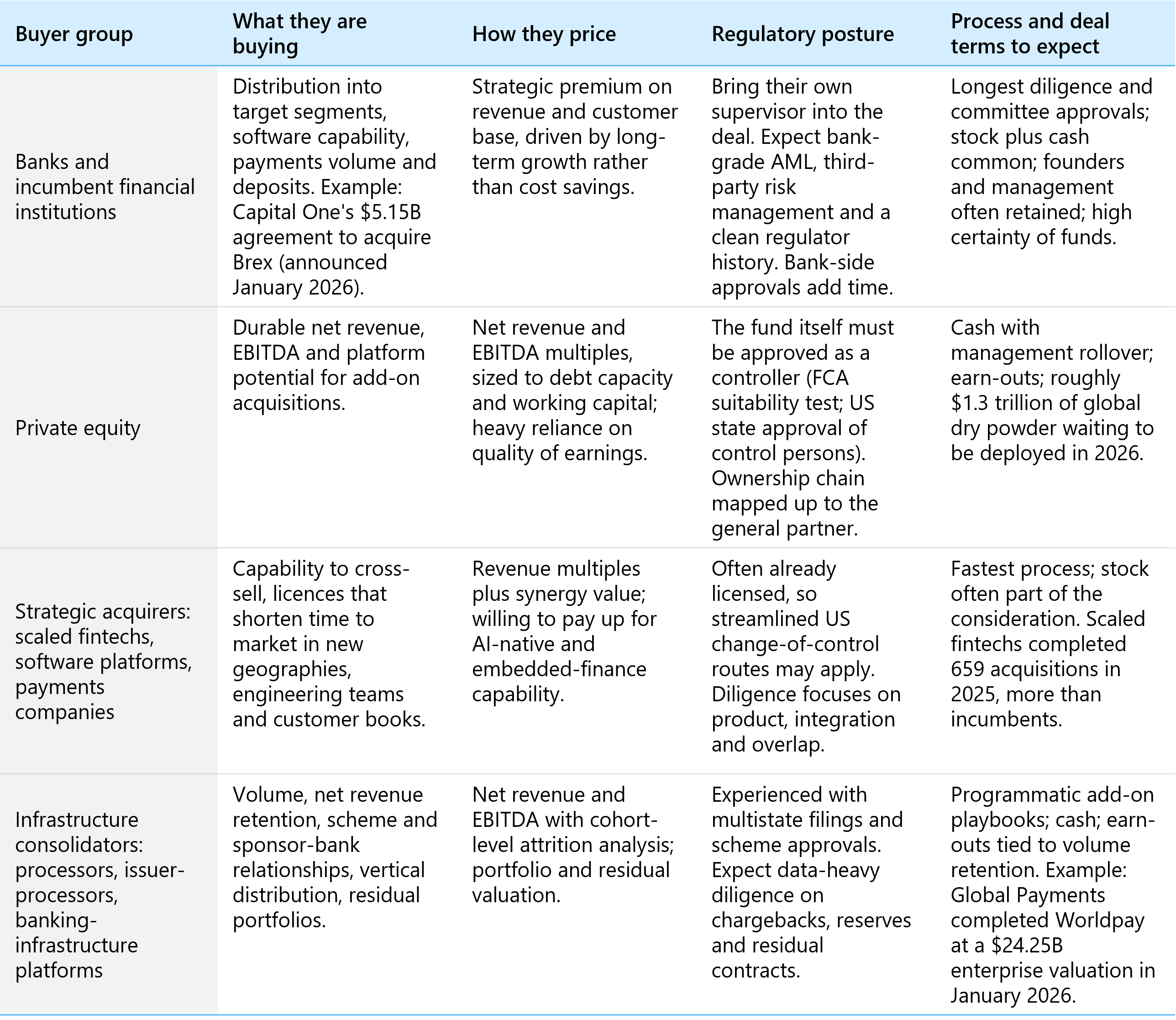
The buyer you pick sets the diligence you face, the regulator you answer to and the structure you sign. Choose the process to fit the buyer, not the other way round.
How Do Buyers Value a FinTech Company?
Buyers price net revenue they can underwrite, not gross volume they can admire. That one sentence explains most valuation disputes in fintech M&A.
Start with the right revenue line. For a payments company, gross processing volume is a vanity metric; net revenue after interchange, scheme fees and processing costs is what gets multiplied. For a lender, the question is net interest or fee income after expected losses and funding costs, not originations. For an infrastructure or compliance platform billing per API call or per seat, revenue looks more like software, and it is priced like software. Our 2026 benchmarks put fintech valuation multiples at roughly 1x to 3x net revenue for balance-sheet lenders and volume-only processors, and 5x to 10x or more for software-led payments and infrastructure businesses. The spread is wide because the risk a buyer takes on is wide.
Four things move a company from the bottom of that range to the top:
- Regulatory posture. A clean, current licence with no open findings is priced as an asset. An undocumented licence perimeter, or a business that relies on a partner bank with a thin contract, is priced as a project.
- Unit economics. Gross margin after processing or funding costs, net revenue retention, customer acquisition payback and loss rates (for lenders) are the metrics buyers model. Profitability is now the sector norm, so a company that cannot show a path to it is competing against peers that can.
- Interchange and rate exposure. Revenue that depends on a single interchange regime, one card scheme or one rate environment carries a discount; diversified, contracted revenue carries a premium.
- Concentration. One merchant, one sponsor bank, one lending partner or one channel above 20 to 30 percent of revenue is the first thing a buyer will try to price down.
Model type matters too. Subscription-style fintech revenue (compliance software, banking cores, data platforms) attracts the highest multiples because it behaves like SaaS. Transaction-based revenue is valued on its durability: multi-year contracts, embedded distribution and low attrition close the gap. B2B models with contracted customers generally price above B2C models with marketing-driven acquisition. If you want a fuller walk-through of methods, from SDE and EBITDA to revenue multiples by subsector, our guide on how to value a fintech business covers it in detail.
One more lever is new in 2026: compliance operations that run on AI. The nearest-term AI gains in fintech are in operations such as fraud, AML and KYC, and buyers are starting to credit a target whose compliance cost per account is falling while its control quality improves. If you have that data, put it at the front of the management presentation.
Net revenue, regulatory readiness and retention set a fintech's multiple. Growth alone no longer does.
What Regulatory and Licensing Diligence Should You Expect?
If one thing separates fintech M&A from the rest of technology M&A, it is this section. A buyer of a software company checks contracts and code. A buyer of a fintech also has to be approved to own it.
Change of control: the UK, the EU and the US
In the UK, anyone proposing to acquire or increase control of an FCA-authorised firm must notify the regulator and get approval first, and the FCA has up to 60 working days from a complete notification to assess the case, excluding any period in which it has asked for more information. Completing without approval is a criminal offence. The regime applies to payment and e-money institutions as well as investment firms, and the FCA's pre-application support service lets prospective controllers meet the regulator before they file. For dual-regulated firms the PRA runs the same 60-working-day clock and can stop it while it seeks further information.
In the EU, the acquisition of a qualifying holding in a payment or e-money institution runs through the national competent authority. In the Netherlands, for example, anyone holding 10 percent or more of the shares or voting rights in a licensed payment institution needs a declaration of no objection from the central bank. Other member states apply the same thresholds under the payment services directive, with assessment windows comparable to the UK's.
In the US, state money transmitter licences are the long pole. Under the Money Transmission Modernization Act now adopted in full or in part by a majority of states, any person seeking to acquire control of a licensee must obtain the regulator's written approval before acquiring control, with "control" set at 25 percent of voting interests and a rebuttable presumption of control at 10 percent. The act, released by the Conference of State Bank Supervisors to replace fifty sets of state rules with one standard, also creates a streamlined route for an acquirer that is already approved to engage in money transmission or was previously vetted as a control person, which is one reason licensed strategics can close faster than first-time buyers. Each licensed state approves separately, so a company licensed in forty states files forty times, usually through the multistate process coordinated by a lead investigative state.
Bank charters sit above all of this. A fintech that is itself a bank, or that is buying one, needs federal approval, and the current tempo is favourable: Nubank filed for a US national bank charter on 30 September 2025 and received conditional approval from the OCC on 29 January 2026, 121 days later. The regulatory gap between banks and fintechs is narrowing on both sides of the Atlantic, with clearer licensing routes in the UK and parts of Europe, which means more buyers can hold the licences they acquire.
Licence perimeter and partner banks
Most fintechs do not hold every licence they rely on. Card issuing, deposits and lending frequently sit with a sponsor or partner bank under a programme agreement. Buyers will read every one of those agreements for change-of-control consent clauses, exclusivity, termination rights, revenue share and the compliance obligations the bank pushes down to the fintech. A programme agreement that terminates on a change of control is a price reduction waiting to happen; one that transfers cleanly with a consent process already mapped is a selling point.
Safeguarding and customer funds
For UK payment and e-money firms, the FCA's new safeguarding regime took effect on 7 May 2026, bringing daily reconciliation expectations, a new monthly safeguarding return, annual safeguarding audits for firms above the threshold and resolution packs. A buyer in late 2026 will ask for the reconciliation records and the first safeguarding return, and a firm that implemented the regime on time walks into diligence with an advantage. US money transmitters face the equivalent questions on permissible investments and outstanding liabilities.
AML, card data and privacy
Expect a full review of the AML and KYC programme (risk assessment, transaction monitoring, suspicious activity reporting, independent testing), of card-data controls and of privacy compliance. On card data, the 51 future-dated requirements in PCI DSS v4.0.1 became mandatory on 31 March 2025, so a buyer will want to see an attestation under the current standard, not the retired one. On privacy, GDPR and the US state privacy laws, led by California, define how customer data can be transferred in a sale and what notices customers must receive.
A licence is an asset in a sale only when it is clean, current and transferable on a timetable the buyer can underwrite.
How Do You Prepare Data and Compliance Before Going to Market?
Preparation is where fintech exits are won. Every item below is something a buyer will ask for anyway; the only question is whether you answer from a prepared data room or scramble for it under exclusivity, when every surprise becomes a price negotiation.
Start with the regulatory file, because it takes the longest to assemble and is the hardest to fix late.

Then turn to the financial data, which buyers in 2026 scrutinise through a fintech lens:
- A net revenue bridge. Walk from gross volume or gross receipts to net revenue, showing interchange, scheme fees, processing costs, partner bank revenue share and pass-through items on separate lines. Buyers will build this anyway; building it first lets you control the definitions.
- Cohort and retention data. Monthly cohorts of merchants, borrowers or accounts, with volume retention, revenue retention and attrition. For payments, show same-store volume growth separately from new logos.
- Unit economics by product and channel. Acquisition cost, payback, contribution margin and, for lenders, loss curves by vintage.
- Reserve, chargeback and loss accounting. Buyers test whether reserves are adequate and whether chargebacks or credit losses are recognised consistently. Inconsistent treatment is one of the most common reasons an offer gets re-traded.
- A sell-side quality of earnings review. An independent review that normalises EBITDA, reconciles revenue recognition and identifies debt-like items puts your adjusted number on the table before the buyer's accountants put theirs.
If you are the head of finance preparing for this, the practical order is: regulatory inventory first, revenue bridge second, cohorts and unit economics third, then the quality of earnings review once the first three are stable. Fix what you find. A regulator finding that is closed with evidence, a partner-bank consent that is pre-negotiated, or a PCI attestation that is current costs little before launch and a great deal after a letter of intent.
Finally, structure the data room so that each workstream (legal, regulatory, financial, technical, commercial) has its own folder and question thread. Buyers run parallel teams; a data room that mirrors that structure shortens diligence by weeks.
Buyers reward sellers who have already answered the questions. In fintech, the regulatory file is the first thing they open and the last thing they close.
How Does Process Design Change When a Regulator Is a Stakeholder?
In an ordinary technology sale, two parties have to agree. In a fintech sale, a third party has to approve, and that party does not care about your timetable. Good process design accepts this and builds around it in six ways.
1. Screen buyers for approvability, not just price. Before you shortlist, ask whether each bidder can be approved as a controller in every jurisdiction where you hold a licence. Ownership transparency, source of funds, prior regulatory history and, for funds, the chain of control up to the general partner all matter. A high bid from a buyer who cannot clear the FCA or a state regulator is not a bid.
2. Sign first, close later, and size the gap correctly. Because approvals cannot be obtained before a buyer is identified, licensed fintech deals sign with closing conditional on regulatory approval. The long-stop date should be built from the statutory windows (60 working days in the UK, state-by-state windows in the US) plus a realistic allowance for the clock to stop while regulators ask questions. Deals that set a four-month long-stop on a six-month approval path create needless renegotiation.
3. Engage early. The FCA's pre-application support service and pre-filing calls with lead state regulators let the buyer understand what a complete file looks like before the clock starts. Incomplete notifications are the most common cause of delay, because the assessment period only begins once the regulator considers the file complete.
4. Keep the business steady between signing and closing. The streamlined approval route under the US model act is only available where the licensee will not make material changes to its business plan as a result of the acquisition, and every regulator expects management continuity. That argues for stay bonuses for the compliance team, no product or pricing changes that would need re-notification, and interim covenants that protect normal operations rather than freeze them.
5. Allocate regulatory risk in the contract. Who bears the cost if one state objects? Can a licence be surrendered before closing if that state is immaterial, and does the price adjust? What efforts standard does the buyer owe, and is there a reverse termination fee if approval fails for reasons on the buyer's side? These clauses are negotiated in parallel with price, and they are often worth more than the headline multiple.
6. Run the regulatory workstream as its own track. Counsel, compliance and the advisor should run a filing calendar alongside the commercial process: which regulator, which form, which thresholds, which documents, which owner. A buyer who sees that calendar in the data room reads it as a reason to pay for certainty.
Confidentiality deserves a word. Sellers worry that a regulatory filing announces the deal. In practice, notifications are confidential and are filed by the buyer after signing, though the regulated entity itself has obligations to keep its regulator informed of material developments. Agree with counsel, before launch, what the regulator will be told and when.

When a regulator is a stakeholder, certainty of closing is part of the price. Design the process to prove it.
How to Sell a FinTech Company: The Step-by-Step Process
The mechanics follow a familiar M&A arc, with regulatory steps threaded through it. This is the sequence we run:
- Readiness and valuation (weeks 1 to 4). Regulatory inventory, net revenue bridge, cohort data, a view on value by buyer group and a decision on whether to fix issues before launch. A confidential valuation at this stage sets realistic expectations and flags what a buyer will price down.
- Positioning and materials (weeks 3 to 6). A teaser, a confidential information memorandum built around net revenue and regulatory readiness, a management presentation and a structured data room.
- Buyer mapping and outreach (weeks 5 to 8). A targeted list across the four buyer groups, screened for strategic fit and approvability, approached in waves to create competitive tension without over-exposing the company.
- Indications of interest and management meetings (weeks 8 to 12). First-round bids, management presentations and a short list.
- Letter of intent (around week 12 to 14). Price, structure, consideration mix, exclusivity period, and the regulatory risk allocation principles that will go into the purchase agreement.
- Confirmatory diligence (weeks 14 to 22). Financial, legal, regulatory, technical and commercial workstreams in parallel, with the buyer's regulatory counsel preparing change-of-control filings.
- Signing (around week 22 to 26). Share purchase agreement with regulatory approval as a condition precedent, interim operating covenants and the long-stop date.
- Regulatory approvals (two to six months after signing, depending on jurisdictions). Buyer files; seller supports with information; both sides respond to regulator questions.
- Closing and integration. Funds flow, licence records updated, customer and partner communications executed to a plan agreed before signing.
How long does it take to sell a fintech company? In our experience, a well-prepared company reaches signing in five to seven months, and regulatory approvals add two to six months after that. Companies with licences in many US states, or with both UK and EU authorisations, sit at the longer end; a strategic buyer that is already licensed sits at the shorter end.
Treat regulatory approval as a stage of the process with its own calendar, owner and budget, not as an afterthought to signing.
How Should You Structure and Negotiate a FinTech Exit?
Structure matters more in a fintech exit than in most technology deals, because licences, customer funds and regulatory consents all respond differently to different structures.
Share sale versus asset sale. Licences are issued to a legal entity and generally do not travel with assets, so licensed fintechs are almost always sold as share deals, which keeps the licence, the sponsor-bank agreements and the customer relationships in place and triggers a change-of-control process rather than a fresh authorisation. Asset sales are used for carve-outs of unregulated software, merchant portfolios or residual streams. Tax treatment differs between the two in every jurisdiction, and this is one of the places where early tax advice pays for itself.
Consideration mix. Strategics and banks often pay partly in stock; Capital One's agreement to acquire Brex was structured as a combination of stock and cash. Stock can be attractive if you believe in the acquirer, but it adds a second valuation question and sometimes a lock-up. Private equity typically pays cash with management rollover.
Earn-outs. Tie earn-outs to operating metrics you control (net revenue, volume retention, product milestones), not to regulatory approvals or integration decisions the buyer controls. Define the accounting precisely, including how interchange, reserves and pass-through items are treated.
Escrow, warranty insurance and indemnities. Regulatory warranties are the most heavily negotiated in a fintech deal: that licences are valid, that there are no undisclosed regulator findings, that customer funds are properly safeguarded, that AML and data obligations have been met. Expect specific indemnities for any known issue and a holdback or escrow against it. Representations and warranties insurance is widely used, but policies frequently exclude known regulatory matters, which is another reason to close findings before launch.
Conditions and covenants. The purchase agreement will carry regulatory approval as a condition precedent, an efforts standard for the buyer to obtain it, and interim covenants on how you run the business between signing and closing. Negotiate carve-outs for ordinary-course actions, including routine regulatory filings, so the covenants do not freeze operations.
Evaluating offers. Compare bids on certainty, not just price: approvability, financing, the length of exclusivity, the strength of the efforts clause and the reverse termination fee. A slightly lower bid from a licensed strategic who can clear approvals in three months can be worth more than a higher bid with a nine-month regulatory path and a thin commitment to see it through.
The best fintech exit is the one that closes. Price the certainty of approval into every term you negotiate.
How Do You Sell a Payments Company?
Payments remains the largest fintech revenue vertical and the busiest category in fintech M&A, so it deserves its own treatment. The consolidation story is visible at the top of the market: the Worldpay transaction created a merchant-solutions business processing roughly 94 billion transactions annually across more than 175 countries. Below that, PE-backed processors, vertical software platforms and bank-owned acquirers are all buying.
To sell a payments company well, present the business in the terms those buyers use:
- Net revenue and take rate. Show total payment volume, gross revenue, net revenue after interchange, scheme and processing costs, and net take rate by segment. Buyers price net revenue; they treat volume as context.
- Attrition and same-store growth. Monthly merchant cohorts with volume retention. Low attrition and positive same-store growth are the two numbers that move a payments multiple most.
- Concentration and channel mix. Merchant concentration, referral partner concentration, direct versus ISO or agent sales, and the residual obligations attached to each.
- Model and licence position. Whether you operate as an ISO or agent (no licence, but reliant on a processor and sponsor bank), a payment facilitator (sponsored under a bank and scheme registration, with underwriting and settlement responsibilities), or a licensed payment or e-money institution (direct regulatory authorisation, safeguarding and change-of-control approval). Each model attracts a different buyer set and a different diligence list.
- Scheme, sponsor and PCI status. Registrations, sponsor-bank agreements with change-of-control terms, chargeback and fraud ratios against scheme thresholds, and a current PCI DSS attestation.
- Embedded and software-led revenue. Payments monetised inside a vertical workflow earns a higher multiple than stand-alone processing because it retains better and sells with the software. If a share of your volume comes through embedded integrations, break it out.
Regulatory diligence follows the model. An ISO sale is mostly contractual: processor agreements, residual rights and sponsor consents. A payment facilitator adds scheme and sponsor-bank approval of the new owner. A licensed institution adds the full change-of-control process described above, and, in the UK, the new safeguarding returns and audits.
Payments buyers in 2026 pay for net revenue that stays: low attrition, embedded distribution and clean sponsor and scheme relationships.
What Separates a Premium FinTech Exit From an Average One?
We see the same handful of differences again and again, and most of them are fixable a year before a sale.
- Net revenue is defined before the buyer defines it. Sellers who present gross volume and let the buyer compute net revenue lose the definitions argument, and often a turn of the multiple with it.
- The licence perimeter is documented. A one-page map of every licence, registration, sponsor agreement and exemption the business relies on, with change-of-control triggers marked, is the most valuable document in a fintech data room.
- Regulator findings are closed with evidence. Open findings are not deal-breakers, but unresolved ones become indemnities and escrows. Closed ones become a credibility point.
- Partner-bank dependency is managed. Two sponsors or a consent already negotiated turns a risk into a non-issue.
- The process is competitive across buyer groups. A bank, a sponsor and a strategic will each price the same business differently. Sellers who talk to one group leave the spread on the table.
- Founder dependency is reduced. A compliance officer, a head of risk and a finance lead who can run diligence without the founder in every call makes the business look like a platform rather than a project.
- Timing follows readiness, not headlines. The market is open and buyers are paying for prepared companies, so the right time to launch is when the regulatory file, the numbers and the team are ready.
A word on sale versus IPO, since it comes up with larger companies. Public listings remain selective: just 18 US venture-backed companies went public in the third quarter of 2026, most of them in healthcare, and public fintechs are judged on durable profitability and clear revenue streams. Most mid-market fintechs will find a strategic or sponsor sale offers more certainty, speed and control over the outcome. For the majority of founder-owned fintechs, the realistic question is not IPO or sale but which buyer and which structure.
Premium fintech exits are prepared, documented and competitive. Average ones are discovered in diligence.
Conclusion: Selling a FinTech Company in 2026
Learning how to sell a fintech company comes down to three disciplines. Know your buyer, because banks, private equity, strategics and infrastructure consolidators each value a fintech differently and face different approval paths. Prepare the regulatory and financial file before launch, because in fintech the licence inventory, safeguarding records, AML programme and net revenue bridge are the diligence. And design the process around the regulator, because certainty of closing is part of the price.
The market is rewarding that discipline. Investment is back above $100 billion a half-year, M&A volume has more than doubled since 2023, and the buyer universe is wider than it has ever been. Fintech owners who walk in with a clean licence perimeter, a defensible net revenue number and a competitive process across buyer groups are the ones closing at the top of the range.
If you are weighing a sale in the next year or two, the first step is knowing what your company is worth to each type of buyer and where diligence would press. Get a free, confidential valuation from FE International and we will walk you through the buyer groups, the likely regulatory path and the preparation that moves your multiple. Our team has advised on more than 1,500 completed technology transactions with a 94.1 percent success rate, and the first conversation costs nothing.
