
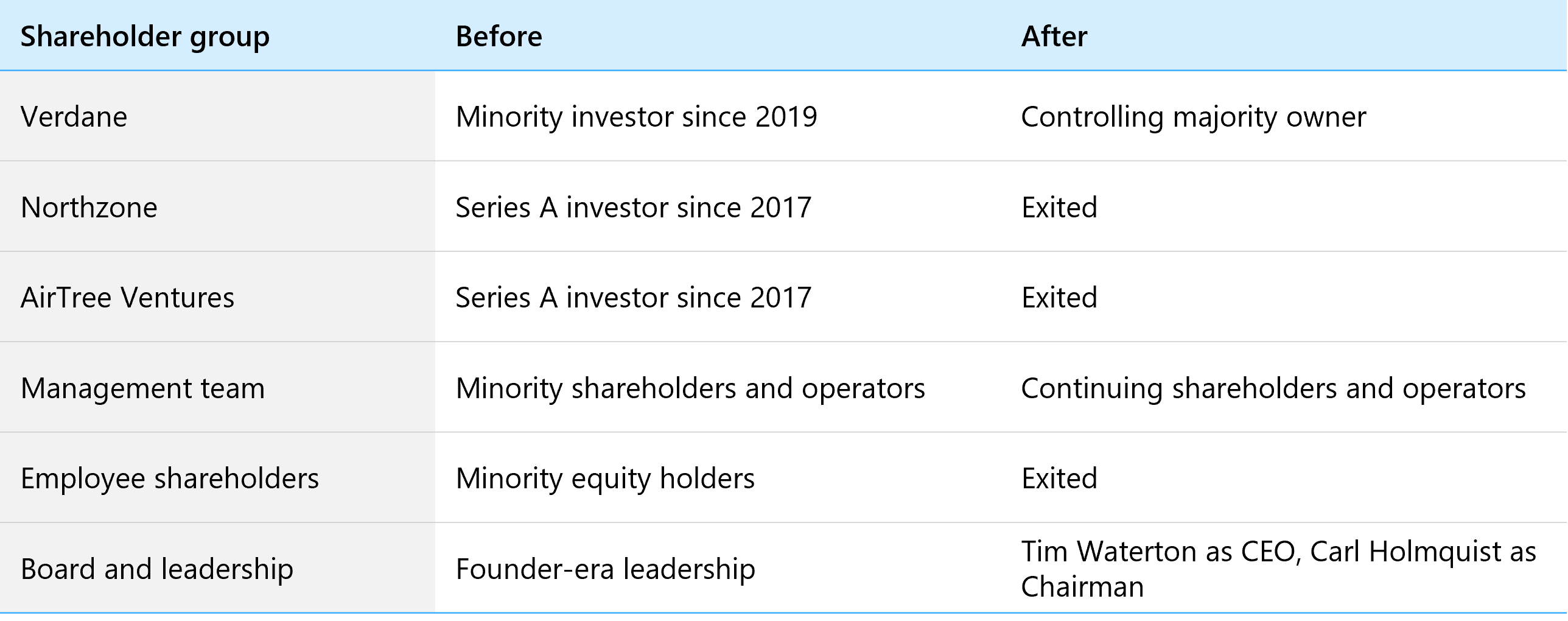
Most technology exits end with a new name on the share register. The HappyOrNot acquisition ended with an old one. Verdane, the European growth buyout firm that first backed the Finnish company in 2019, bought out its co-investors and moved from minority holder to controlling majority owner. FE International advised HappyOrNot on the process and separately advised the selling shareholders, a group made up of Verdane, Northzone, AirTree Ventures, members of the management team and employee shareholders.
The structure is what makes this one worth studying. A single signing had to work for a company, three institutional investors, an operating management team and a group of employees holding equity, with the eventual buyer already sitting inside the cap table. Transactions shaped like this are becoming more common as ownership horizons stretch and investors look for ways to deliver liquidity to early backers without disturbing a business that is performing.
The asset is unusual too. HappyOrNot built its position on four physical buttons, then turned fifteen years of button presses into one of the largest in-person feedback datasets anywhere: more than two billion responses gathered at supermarket exits, airport gates, hospital corridors and bank branches.
The Transaction at a Glance
HappyOrNot is a customer experience and operational intelligence company headquartered in Tampere, Finland, with a US office and a global reseller network. Its Smiley touchpoints capture microfeedback at the moment of service and convert those signals into operational data. More than 4,000 organisations across 135 countries run on the system, including Amazon, Sodexo, Heathrow Airport and Aramark.
Verdane is a specialist growth buyout firm backing tech-enabled and sustainable businesses across Europe. Its funds have raised EUR 10 billion and completed more than 200 investments since 2003, supported by over 180 investment professionals and operating experts across Berlin, Copenhagen, London, Helsinki, Munich, Oslo and Stockholm. Verdane is a certified B Corporation and invests as either a majority or minority holder.

Four Buttons, Two Billion Responses
The origin story is smaller than the outcome. Heikki Vaananen had a bad afternoon in an electronics shop as a teenager, got poor service, and realised there was no way to tell anyone about it. Two decades later he and Ville Levaniemi founded HappyOrNot in Tampere in 2009 around a device with four buttons and four faces. They started with two. Customers told them four worked better.
A Finnish supermarket group signed first. Heathrow Airport followed. The terminal went on to become one of the most recognised feedback devices in retail and other customer-facing environments, which is the part most people know. The part that matters commercially is what happened underneath.
Smiley Terminal, Smiley Touch, Smiley Digital and Smiley Sign now produce a continuous stream of in-the-moment operational data. Feedback stops being a quarterly report and becomes a signal that can be analysed, activated and pushed into the systems teams already use to run a shift. Over two billion responses have been collected at the point of experience rather than through retrospective surveys sent days later, and the company reached that scale on comparatively modest capital: a USD 25 million growth round led by Verdane in 2019 followed a USD 14.5 million Series A in 2017 backed by Northzone and AirTree Ventures.
The transaction arrived alongside a change at the top. Tim Waterton, Chief Revenue Officer since 2021, stepped up to Chief Executive Officer, and Carl Holmquist took over as Chairman. Waterton brings more than 30 years in enterprise software, including a business he co-founded that was later acquired by BMC Software, plus senior roles at M-Files and RainStor and earlier positions at the London Stock Exchange and Accenture. His stated plan is to push the company beyond measurement and into real-time operational intelligence, so frontline teams can act while there is still time to change the outcome.
Why the Buyer Was Already on the Cap Table
Selling to an investor who already owns part of your business looks simple from the outside and rarely is. The buyer knows the numbers, which shortens diligence. The buyer also knows the weak spots, which changes the negotiation. And because that buyer holds shares, every other shareholder needs independent confidence that the price and terms they receive are the right ones.
The wider market explains why more of these deals are appearing. Ownership periods have extended, with the average holding period for private equity assets at exit now running to roughly seven years, compared with five to six years through the 2010s. Longer horizons have made shareholder liquidity a design question rather than an afterthought, and the routes for delivering it have expanded quickly. Secondary transaction volume across GP-led and LP-led vehicles rose 41% year over year, while GP-led continuation vehicles grew 62%.
For a founder or an early investor, that is a genuinely good development. It means a shareholder wanting to realise value no longer has to wait for a full sale of the business or push the company into a process it is not ready for. An insider moving to control is one of the cleanest versions of this: the business keeps its strategy, its board continuity and its capital partner, while the shareholders who want out get a real price from a buyer who understands exactly what they are buying.

What Two Billion Responses Are Worth in 2026
Buyers in this category are no longer paying for survey software. They are paying for evidence that a dataset cannot be rebuilt. The global customer experience management market is set to grow from USD 15.5 billion in 2025 to USD 47.7 billion by 2033, a compound annual rate of 15.2%, with North America holding a 42.4% revenue share in 2025. Growth at that pace attracts capital, and capital in a maturing category tends to concentrate.
That concentration is already visible. The 2026 Gartner Magic Quadrant for Voice of the Customer Platforms, published in March 2026, evaluates a category that has consolidated meaningfully since its enterprise feedback management origins. In May 2026, Qualtrics completed a USD 6.75 billion acquisition of Press Ganey Forsta, a transaction underwritten explicitly on the scale and specificity of the combined experience dataset rather than on the software layer sitting above it.
The physical footprint is the moat, which is not obvious until you try to replicate it. Online feedback is easy to collect and easy for anyone else to collect. Feedback captured at a supermarket exit as someone walks out, or at an airport gate two minutes after a delay, is not. It requires installed hardware, service relationships and years of accumulated placements in locations that are genuinely difficult to reach any other way. We see the same pattern across AI-era technology M&A, where acquirers pay premium multiples for proprietary data assets rather than for features that a capable engineering team could replicate inside a year.
"HappyOrNot is a rare asset. It is a category-defining business with a physical footprint no pure software company can replicate, sitting on a proprietary dataset that gets more valuable every year. Two billion responses collected at the point of service is not something a competitor can buy or scrape."
Max Alderman, Partner at FE International

How a Multi-Party Process Gets to One Signing
Four separate constituencies had to reach agreement on the same day: the Company itself, three institutional investors with different fund vintages and different return expectations, a management team with operating responsibilities that continue after closing, and employee shareholders whose holdings are smaller but whose treatment sets the tone for everyone who stays.
Each of those groups wants something different. An early venture backer is measuring the outcome against a 2017 entry price and a fund clock. A growth investor moving to control is underwriting the next five years, not the last nine. Management is negotiating a transaction and a future role at the same time. Employee shareholders need clarity and speed more than they need optionality. Run those conversations through a single channel and the process slows to the pace of its most complicated participant.
"Running a process for the Company and coordinating multiple selling shareholders with an existing investor moving to control is not trivial, and it is why we structured separate advisory workstreams for each party to get to one clean signing."
Max Alderman, Partner at FE International
Separate workstreams solve a structural problem rather than a scheduling one. They allow each party to receive advice calibrated to its own position, they keep information flowing where it should and only where it should, and they let sequencing questions be resolved in parallel instead of in a queue. The output is a single set of documents that every shareholder can sign without any of them feeling that their interests were folded into someone else's. That discipline is the core of what our private sales and acquisitions team does on complex, multi-stakeholder mandates.
Cap Table Simplification Is a Value Event
Fifteen years of building produces a share register with a lot of history in it. Different rounds, different rights, different entry prices, different expectations about when and how each holder gets paid. Founders tend to treat this as administration. Buyers treat it as risk, and they price it.
A crowded register slows every stage of a transaction. Consents take longer to gather. Preference stacks need modelling before anyone can say what a headline number actually delivers to each holder. Small holders with outsized consent rights can hold up a signing. Resolve those issues before or during a process and the business becomes materially easier to underwrite, which shows up in both price and terms.
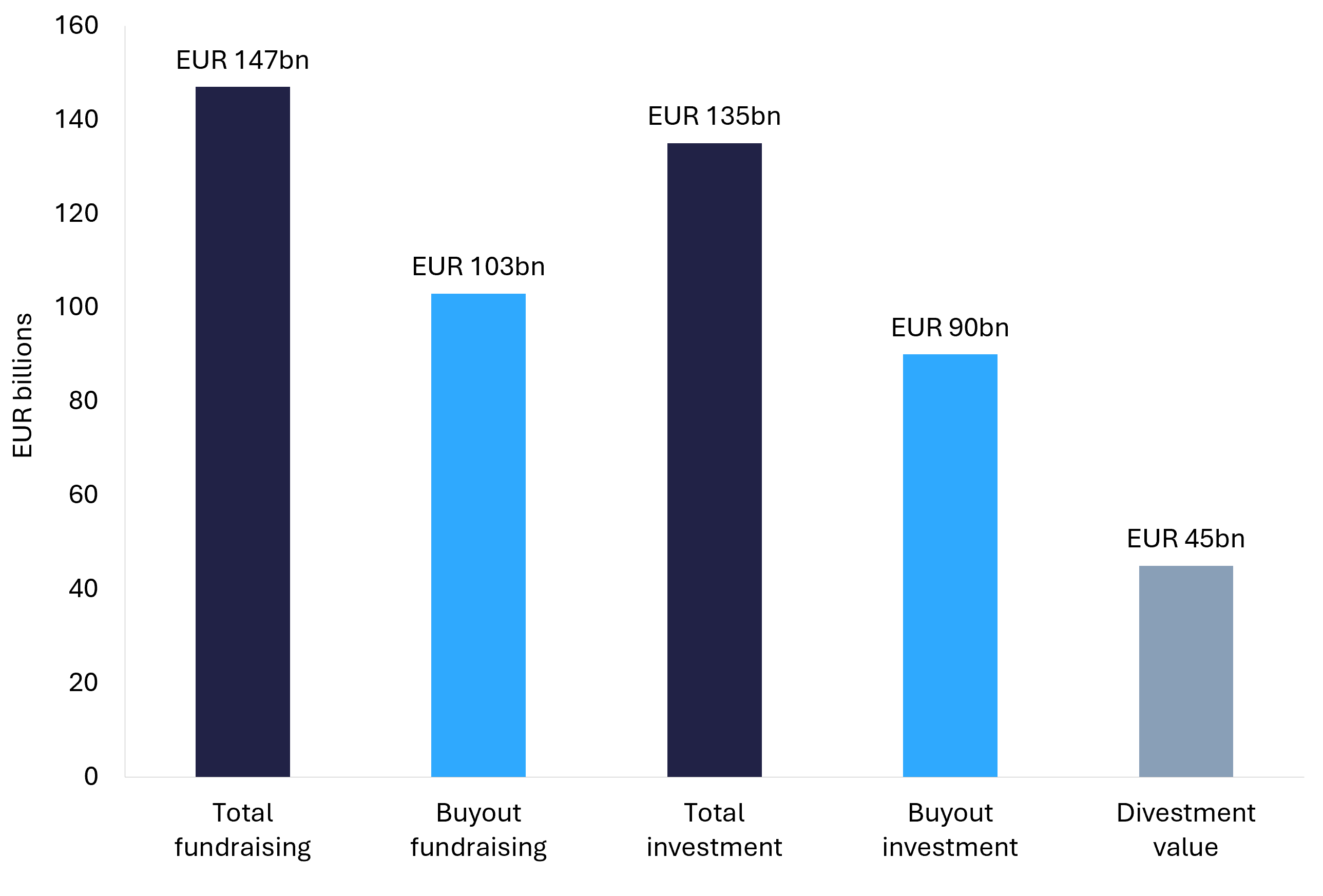
There is capital available to fund exactly this kind of resolution. European private equity and venture capital firms raised EUR 147 billion in 2025, a 16% increase and the second-highest total on record, with buyout fundraising reaching EUR 103 billion. Total investment came in at EUR 135 billion and divestment value held at EUR 45 billion. Continuation funds, tracked separately for the first time, attracted EUR 19.8 billion against EUR 9.3 billion the prior year. Sentiment matches the capital: three quarters of European private equity specialists expect more M&A activity involving private equity in 2026 than in 2025.
The Nordic Context Behind the Deal
Finland keeps producing companies that reach global scale on small domestic bases, and the deal infrastructure around them has matured to match. Nordic M&A activity held a solid pace through the first half of 2026, with portfolio optimisation, carve-outs and targeted acquisitions expected to keep driving transactions into the second half, supported by stabilising financing markets and converging valuation expectations. Nordic-based managers raised EUR 8.5 billion in 2025.
The strategic logic sits inside a broader shift. Global M&A is being driven by strategic necessity as AI reshapes competitive dynamics, with activity concentrated in targeted acquisitions of software and digital capabilities. A company sitting on a decade and a half of point-of-service behavioural data, in a category where AI models are cheap and training inputs are not, fits that thesis precisely. Our mid-year 2026 technology M&A report covers how that repricing is playing out across verticals, and why prepared businesses are capturing a widening premium.
What Founders Should Take From the HappyOrNot Acquisition
Five things carry over to almost any technology business with more than one investor on the register.
- Your existing investors are potential buyers. The party that already knows your business most intimately may also be the one willing to underwrite the next phase. A well-run process tests that properly rather than assuming it.
- Cap table complexity is priced, not forgiven. Map consents, preferences and transfer restrictions long before you go to market. Every unresolved right is leverage sitting on the other side of the table.
- Separate interests need separate advice. When shareholders want different outcomes, giving each of them a dedicated workstream is faster than forcing consensus through one channel.
- Defensibility beats features. Buyers are underwriting what cannot be rebuilt. Physical distribution, regulated access, installed relationships and accumulated behavioural data all qualify. A feature set on its own increasingly does not.
- Employee shareholders deserve the same rigour. How small holders are treated at signing shapes retention and culture long after the money lands. It is worth structuring properly.
Where a business is generating under USD 1 million in annual earnings, our M&A Platform gives both buyers and sellers a self-directed route covering valuation, listing, buyer discovery and deal management. It runs alongside full advisory rather than replacing it, and the same preparation principles apply on either path.
Advising on Complex, Multi-Shareholder Transactions
The HappyOrNot acquisition is a good illustration of what a well-structured process can deliver when the shareholder base is genuinely complicated. A fifteen-year register with venture investors, a growth investor, management and employees resolved into a single clean signing, with the business retaining its capital partner and stepping into a new leadership chapter at the same time.
FE International has completed over 1,500 transactions with a combined value of over USD 50 billion since 2010, across SaaS, ecommerce, agencies, AI, cybersecurity, edtech, fintech and marketplace apps. If you are weighing a full exit, a partial liquidity event, or a change of control involving investors already on your register, our team can help you understand what your options are worth. Start with a confidential valuation and a conversation about the right way to sell your technology business. If you want a sense of where pricing sits before you talk to anyone, our guide to SaaS valuation multiples in 2026 sets out current private deal benchmarks by size band.