


The Apple App Store ecosystem alone facilitated over $1.4 trillion in developer billings and sales during 2025, and developers kept every cent of more than 90% of it. Shopify merchants moved $115.6 billion in gross merchandise volume in a single quarter. Sitting on top of those two numbers is a category of business that almost never makes the headlines and changes hands constantly: marketplace apps.
These are the checkout tools, review widgets, subscription engines, mapping extensions, mobile games, and vertical platforms that live inside somebody else’s ecosystem. They are small enough to be bought without a board fight and specific enough to be worth more to an acquirer than to their founder. In 2026, that combination has made them one of the most consistently transacted corners of technology M&A.
The market backdrop helps. Global dealmaking posted a record $2.8 trillion first half, technology led every sector with $649 billion in announced transactions, and the structure of software dealmaking shifted decisively toward exactly the deal size marketplace app founders occupy. Add-on acquisitions expanded to roughly 45% of US software private equity deal value in the first five months of 2026, more than double their share a year earlier. Smaller, focused, capability-rich businesses are what buyers are shopping for.
This guide covers what a marketplace app actually is in valuation terms, where 2026 deal activity is concentrated, the transactions setting the benchmarks, the buyers writing checks, how each business model gets priced, what diligence looks like, how agentic commerce is changing distribution economics, and the sequence founders should run before going to market. At FE International, marketplace apps are a dedicated vertical with its own advisory team, and what follows is drawn from both public market data and what we see in live processes.
What Counts as a Marketplace App Business in 2026
A marketplace app is any consumer or enterprise application sold through a digital marketplace owned by another company. In practice that covers a Shopify checkout tool, an AWS cloud storage plugin, a Salesforce geo-mapping extension, an Etsy payment processor, and an iOS mobile game. It also covers the marketplaces themselves, which is where most of the confusion starts.
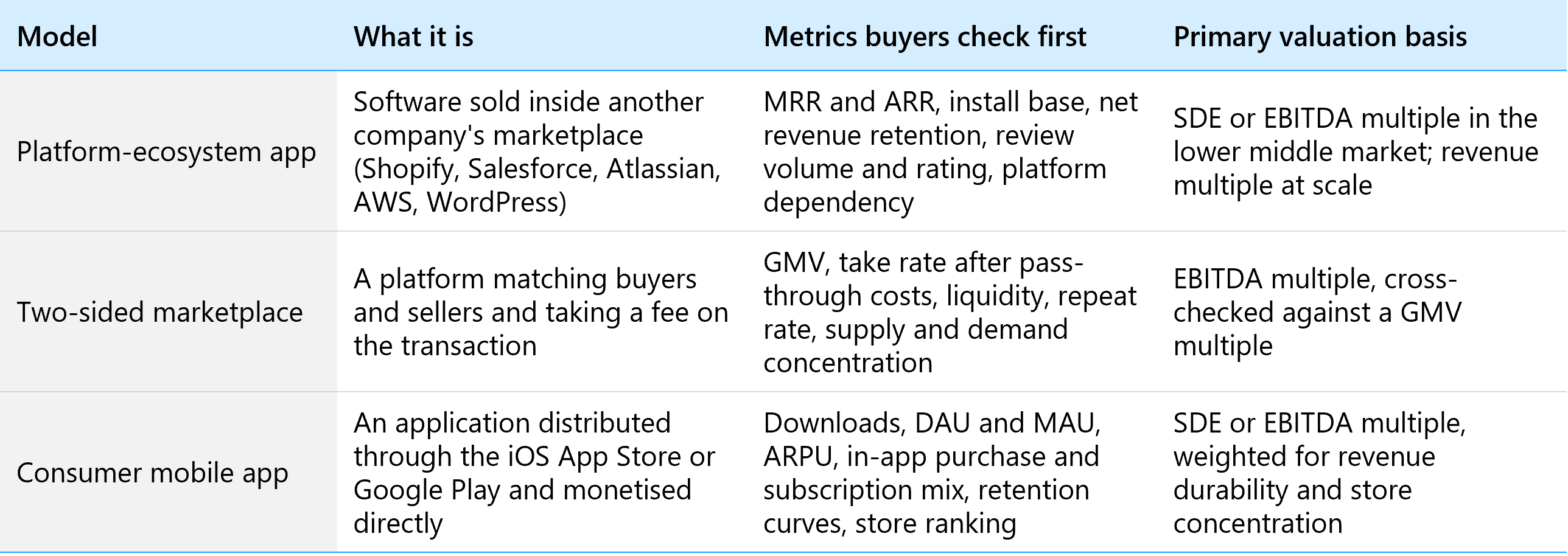
The label groups three businesses that earn revenue in completely different ways and get priced on completely different metrics. Classification is the first decision in any valuation, and a buyer makes it in the first ten minutes of reading a teaser. Get it wrong in your own materials and you invite a repricing conversation later, which is the worst time to have one.
Platform-ecosystem apps
Software sold inside a host platform’s marketplace. Revenue is subscription-based, billing usually runs through the host, and distribution comes from the platform’s own discovery surfaces. Shopify, Salesforce AppExchange, Atlassian Marketplace, AWS Marketplace, HubSpot, and the WordPress plugin economy all produce these. Buyers price them like SaaS, then apply judgement on how much of the growth belongs to the app and how much belongs to the host.
Two-sided marketplaces
A platform that matches buyers with sellers and takes a fee on the transaction. The headline metric is gross merchandise volume, but GMV is a scale measure rather than a revenue measure. A platform doing $100 million in GMV at a 10% take rate is a $10 million revenue business, and buyers underwrite the $10 million. What separates a good marketplace from a large one is liquidity: how reliably a buyer who shows up with intent gets what they came for.
Consumer mobile apps
Applications distributed through the iOS App Store or Google Play and monetised through subscriptions, in-app purchases, or advertising. Retention curves and store ranking do most of the valuation work here, because both determine whether revenue continues without continuous paid acquisition.
A marketplace app is any consumer or enterprise application sold through a digital marketplace such as Shopify, Salesforce, Google Play, or the iOS App Store. The category splits into three models: platform-ecosystem apps priced on recurring revenue, two-sided marketplaces priced on earnings and cross-checked against GMV, and consumer mobile apps priced on retention-adjusted earnings.
Marketplace App M&A Trends in 2026
The first half of 2026 was the strongest six months of dealmaking ever recorded. Global M&A value rose 41% through the first five months to $2.4 trillion, extending a 2025 that itself finished at $4.9 trillion. A survey of 300 M&A executives found 80% expect to sustain or increase deal activity this year, and almost half of all technology deals now carry an artificial intelligence angle.
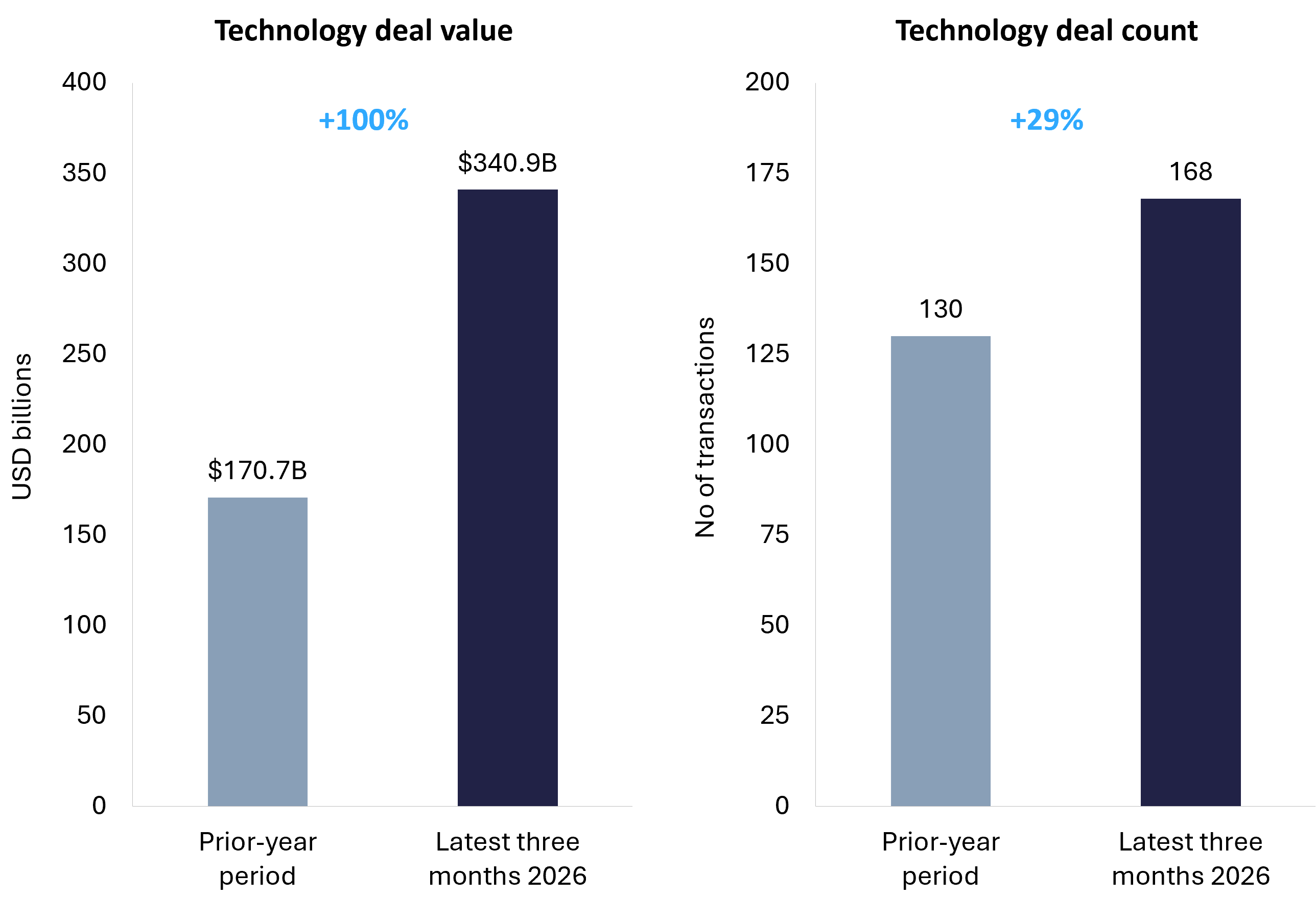
Technology is where that money went. US transactions of $100 million or more rose 88% in value and 29% in volume year over year between April and June, with the technology sector alone doubling in deal value to roughly $341 billion across 168 transactions. Value grew faster than count, which tells you buyers concentrated capital rather than spread it.
For marketplace app founders the more useful signal sits underneath the headline. Spending on the software these apps extend keeps expanding: worldwide IT spending is forecast to reach $6.31 trillion in 2026, up 13.5% from 2025, with software spending up 15.1%. Acquirers are not buying into a flat market. They are buying into the fastest expansion in enterprise technology budgets in years, and every dollar added to a host platform’s budget widens the addressable market for the apps built on top of it.
Market expansion is the most common stated rationale, and in this category it means something specific. An acquirer buying a marketplace app is usually buying entry into a customer segment, a geography, or a workflow it does not currently touch. A payments company that acquires a subscriptions app reaches merchants at a moment in the buying cycle it previously missed. A marketplace that acquires a niche vertical platform inherits a supply base it would have spent years recruiting. The revenue is the proof; the access is the purchase.
Three trends define marketplace app M&A specifically in 2026. Consolidation inside mature ecosystems is accelerating as leading app vendors buy adjacent categories to build suites. Strategic acquirers are paying for distribution they cannot build, which is why an app with 30,000 installed merchants is worth more than its revenue line suggests. And the arrival of agent-driven commerce has made machine-readable product and transaction data a defensible asset rather than a technical detail.
Marketplace app M&A in 2026 is being driven by three forces: suite-building consolidation inside mature platform ecosystems, strategic demand for installed distribution, and the premium now attached to machine-readable commerce data.
Platform Ecosystems Are Producing the Supply of Targets
Every acquisition needs a target, and platform ecosystems have spent a decade manufacturing them at scale. The economics are unusual: a host platform invests in merchant acquisition, payments, and infrastructure, then hands third-party developers a distribution channel most of them could never build alone. The result is thousands of small, profitable, subscription-based software businesses concentrated in one place, each solving a narrow problem for a known customer base.
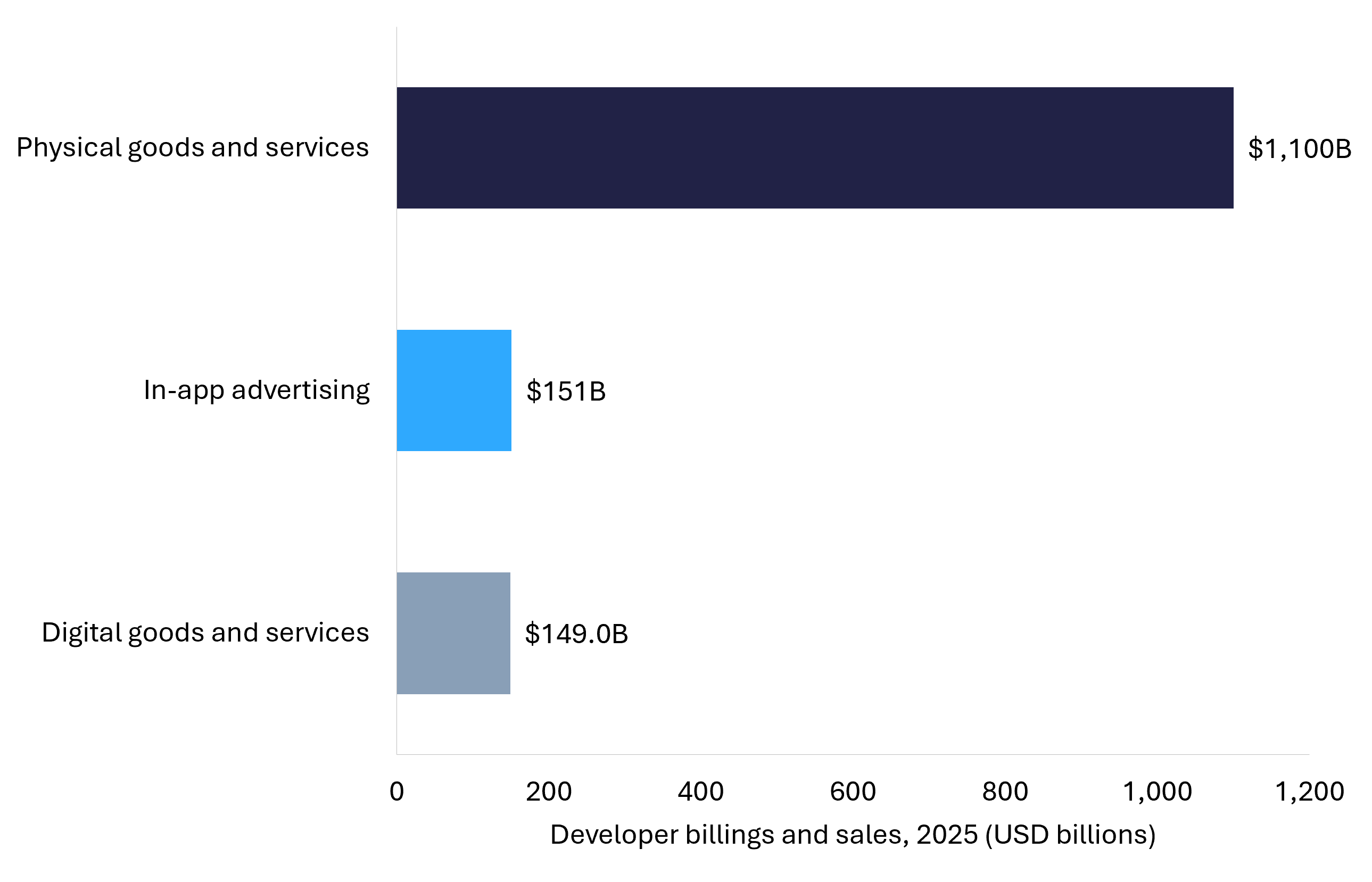
The Apple App Store shows the scale of what that produces. The ecosystem has nearly tripled in size since 2019, reaching more than $1.4 trillion in facilitated developer billings and sales in 2025 with over 850 million average weekly users across 175 countries. Physical goods and services accounted for $1.1 trillion of that, in-app advertising $151 billion, and digital goods and services $149 billion. More than 40 of the top 100 apps now ship consumer-facing AI features, and those apps grew billings faster than the rest of the top 100.
Enterprise ecosystems follow the same pattern at a different scale. Salesforce built AppExchange into an economy where partners deliver services worth several times the platform’s own revenue. Atlassian Marketplace turned issue tracking into a multi-billion-dollar third-party software market. AWS Marketplace made procurement itself a distribution channel. In each case the host benefits from breadth it does not have to build, and the developer gets a customer list it does not have to buy.
This is why the supply of acquirable marketplace apps keeps growing while the buyer pool concentrates. Founders build inside an ecosystem because distribution is cheap there. Acquirers buy inside the same ecosystem because installed base is expensive to replicate. The gap between those two positions is where the deal gets done, and it has widened every year that platform spending has grown.
Platform ecosystems create the supply of acquisition targets: distribution is cheap for the founder building inside one and expensive for the acquirer trying to replicate it, and that gap is what a marketplace app exit monetises.
Shopify Apps Are the Most Actively Traded Sub-Sector
No ecosystem produces more transactable app businesses than Shopify’s, and the underlying platform keeps compounding. In the quarter ended 30 June 2026, Shopify reported revenue of $3.58 billion, up 34%, on gross merchandise volume of $115.6 billion, up 32%, with net income of $1.5 billion and an 18% free cash flow margin. Shopify Payments processed $78.1 billion of that volume at 68% penetration. Merchant retention runs at 92% for merchants above $1 million in GMV and 97% above $10 million.
Those retention figures matter more to an app founder than the growth numbers. When merchants stay, the apps attached to them stay, and recurring revenue built on a retained merchant base is what buyers underwrite. A Shopify app with strong install retention is effectively renting durability from the host platform, and diligence will test exactly that.
Developer economics have also been moving in the founder’s favour. Shopify charges no revenue share on the first $1 million in lifetime app earnings, and a further set of changes to the partner earnings model announced on 7 July 2026 took effect on 10 August 2026. Higher retained earnings translate directly into higher seller discretionary earnings, and since lower-middle-market apps are priced on earnings, platform fee policy feeds straight through to valuation.
Four buyer types compete for Shopify apps right now:
- Adjacent app companies building suites. An operator with 30,000 merchants buys a complementary product to widen its footprint inside accounts it already serves.
- Private equity-backed software platforms. Sponsors running add-on programmes acquire apps as tuck-ins to an existing commerce-software platform.
- Ecommerce infrastructure strategics. Payments, logistics, retention, and marketing vendors buy apps to own the merchant relationship at a new touchpoint.
- Individual and operator-buyers. At the smaller end, experienced operators and first-time acquirers buy apps outright, often with seller financing in the structure.
The practical implication is that a well-run Shopify app rarely has one natural buyer. It has four categories of them, each underwriting a different thesis, and a competitive process is what converts that into price. Founders who take the first inbound offer almost always leave the strategic premium on the table.
The Biggest Marketplace App Mergers and Acquisitions of 2026
Disclosed deals do the work that benchmark tables cannot, because they show what a buyer actually paid for a defined set of metrics. Four transactions frame the category this year.
eBay and Depop: $1.2 billion for a two-sided marketplace
In February 2026 eBay agreed to acquire Depop from Etsy for $1.2 billion in cash. Depop generated approximately $1 billion in gross merchandise sales in 2025 with nearly 60% year-over-year growth in the United States, and finished the year with 7 million active buyers, close to 90% of them under 34, and more than 3 million active sellers. The UK Competition and Markets Authority cleared the transaction on 15 July, and it closed on 30 July with total consideration of roughly $1.4 billion once net purchase price adjustments were included.
The announced price sits at roughly 1.2 times gross merchandise sales. That is the single most useful public reference point for anyone valuing a two-sided marketplace this year, with two qualifications: Depop was bought for a demographic that eBay could not reach organically, and it arrived with a category-leading position in resale. Both command a premium a generic marketplace should not assume.
G2 and Gartner’s software discovery properties
In January 2026 G2 agreed to acquire Capterra, Software Advice, and GetApp from Gartner, bringing four of the largest B2B software review platforms under one owner. The combined business holds 6 million verified reviews, reaches more than 200 million annual software buyers, serves over 10,000 vendors, and spans more than 2,000 categories. Terms were not disclosed and the deal was expected to close in the first quarter.
The strategic logic is worth reading closely if you own a discovery or review asset. The buyer was not paying for software. It was paying for a proprietary dataset that becomes more valuable as AI systems increasingly mediate software selection. Data that answers a question an AI model needs to answer is now an acquirable asset class in its own right.
Bending Spoons and Airtable: $1.285 billion enterprise value
On 4 August 2026 Bending Spoons entered a definitive agreement to acquire Airtable in an all-cash transaction at an enterprise value of $1.285 billion, which implies an equity value of approximately $2.25 billion once Airtable’s net cash is included. Airtable reported annual recurring revenue of roughly $480 million as of June 2026, growing more than 20% year over year. The deal remains subject to customary closing conditions and regulatory approvals.
Those figures give the category its cleanest public software multiple of the year. An enterprise value of $1.285 billion against roughly $480 million of ARR prices the business at about 2.7 times recurring revenue, which sits below the 3.3 times median for public enterprise SaaS and reflects what a disciplined serial acquirer will pay for a large, established platform it intends to operate rather than integrate. Bending Spoons has built its model on acquiring established app and platform businesses and running them with tight cost control, and it is worth noting the equity and enterprise numbers separately: quoting the $2.25 billion headline without the net cash adjustment overstates what was actually paid for the operating business by more than 70%.
StarApps and AppMaker: consolidation inside the Shopify ecosystem
The most instructive deal of the year for founders was one of the smallest. StarApps, a bootstrapped Shopify app developer with products used by more than 30,000 merchants including over 2,500 Shopify Plus stores and generating in excess of $6 million in annual recurring revenue, acquired AppMaker to expand from product merchandising into native mobile commerce. No outside funding, no auction, no headline valuation. Just an operator with distribution buying a product that extended it.
What these deals have in common
Four transactions across four size bands, and the same three properties show up in every one of them.
- The buyer wanted something it could not build quickly. eBay wanted a Gen Z seller community. G2 wanted a review dataset with a decade of accumulated depth. StarApps wanted native mobile capability. In none of these cases was the acquirer short of engineering talent. They were short of time and accumulated position, which is the asset a marketplace app actually sells.
- The target arrived with a defensible number. Depop had $1 billion in gross merchandise sales and nearly 60% US growth. G2’s targets brought 6 million verified reviews and 200 million annual buyers. StarApps itself was doing more than $6 million in ARR before it became an acquirer. Specific, auditable metrics move a process; narrative does not.
- Independence was preserved where the community mattered. Depop kept its brand, platform, and chief executive. AppMaker kept its open architecture. Acquirers in this category have learned that stripping out what made an app work destroys the thing they paid for.
The lesson founders should take from past marketplace app deals is that price follows position, and position is built long before a process starts. An app with a clear category rank, a specific customer segment nobody else serves as well, and metrics that survive an auditor is worth more than a faster-growing app with none of those things. That is a reassuring conclusion, because every one of those attributes is something an operator can work on deliberately over 12 to 24 months.
The benchmark marketplace app deals of 2026 span every size band: eBay paid roughly 1.2 times gross merchandise sales for Depop, G2 bought a review dataset from Gartner for its AI-era value, Bending Spoons agreed to buy Airtable at about 2.7 times ARR, and a bootstrapped $6 million ARR Shopify app developer bought a complementary product outright. In all four, the buyer was purchasing accumulated position rather than technology.
Who Is Buying Marketplace Apps, and Why
The composition of software dealmaking shifted meaningfully in 2026, and the shift favours founder-led app businesses. Add-on acquisitions reached roughly 45% of US software private equity deal value in the first five months of the year, totalling about $18 billion and more than doubling their share from a year earlier. Platform buyouts accounted for 41% and growth equity made up the remainder. Add-ons are now the largest single category of software deal value in the market.
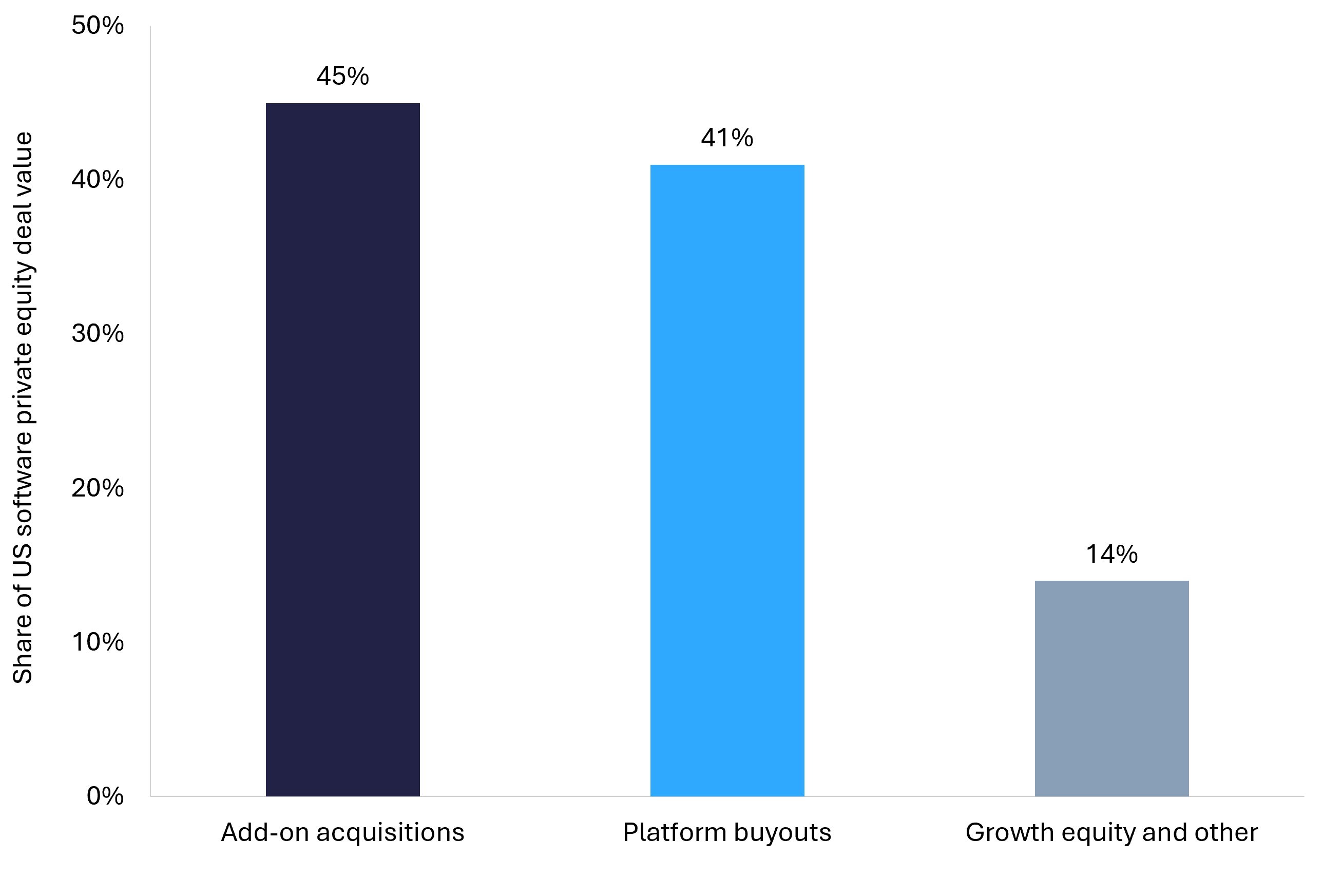
Read that chart from a seller’s chair and it is unambiguously good news. Add-ons require smaller equity checks and less debt, they close faster, and they are underwritten on strategic fit rather than standalone scale. A $2 million ARR app that plugs a gap in a sponsor-backed platform can clear a diligence committee in weeks. The same business marketed as a standalone platform investment would struggle to get a meeting.
The active buyer pool for marketplace apps in 2026 breaks down as follows:
- Strategic acquirers. Host-adjacent software companies and ecommerce infrastructure vendors buying capability, category coverage, or installed distribution. They pay the highest multiples because they can underwrite revenue synergies.
- Private equity platforms running add-on programmes. The most systematic buyers in the market. They move quickly, they know the category, and they buy repeatedly, which makes them a reliable second and third bidder in a competitive process.
- Serial acquirers and app holding companies. Operators whose entire model is buying established apps and improving unit economics. Predictable process, disciplined pricing, high close rates.
- Individual and first-time buyers. Highly active at the smaller end, often funding acquisitions with a mix of cash, seller notes, and acquisition finance.
Capital availability supports all four. Private equity entered the second half with $1.3 trillion in buyout dry powder, and 34% of sponsor portfolio companies had been held for more than five years as of March 2026, up from 28% a year earlier. Sponsors are actively monetising mature assets and redeploying into new ones, and both halves of that cycle create demand for well-run add-on targets.
Acquisition strategy varies by buyer type in ways that are useful to recognise from the seller’s side. Strategics run a capability gap analysis and buy the shortest path to closing it, which means they will pay for fit and move fast when they find it. Sponsors run a thesis-led programme, mapping a category and approaching every credible target in it, which is why a well-positioned app often hears from three sponsor-backed platforms in the same quarter. Serial acquirers run screens on financial characteristics and buy repeatedly against a template. Individual buyers optimise for owner earnings and transferability above all else. A process that presents the same business four different ways, each speaking to one of those theses, generates far more competitive tension than a single generic memorandum.
What consolidation does to competition and smaller operators
Founders often ask whether an ecosystem consolidating around a handful of large app suites narrows the opportunity for everyone else. The evidence from mature marketplaces points the other way, for three reasons.
First, consolidation creates space at the edges. When a category leader is acquired and folded into a broader suite, its most demanding customers frequently want a focused alternative, and the acquirer’s attention shifts to integration for two or three quarters. That window is reliably when the next independent app in the category grows fastest.
Second, suite-building raises the value of specialisation. A merchant running fifteen apps does not want a sixteenth generalist tool. It wants the one product that solves a specific problem better than any bundled equivalent. Every acquisition that converts a best-in-class point solution into a suite component increases the return on being the best remaining point solution.
Third, an active acquisition market changes what building an app is worth. When a founder knows there are four categories of buyer with capital, a documented playbook, and a track record of preserving what they buy, the calculus on starting and scaling an app improves. Liquidity attracts builders, and more builders is what keeps an ecosystem competitive. Consolidation and innovation in app marketplaces have run together, not against each other, and 2026 is the clearest example of that so far.
Consolidation in app ecosystems has expanded the opportunity for smaller operators rather than narrowing it: suite-building raises the premium on specialisation, integration periods open growth windows for independents, and a liquid acquisition market attracts more founders into the category.
How Buyers Value Each Marketplace App Model
Public market comparables set the mood music for private deals without setting the price. Median public enterprise SaaS traded at 3.3 times trailing twelve-month revenue at the end of Q1 2026, against 4.9 times at year-end 2025 and 6.2 times at year-end 2024. Multiples have normalised into the clearest benchmark buyers and sellers have had in years, and underneath them the operating picture improved: median EBITDA margins across the same cohort are projected at 22.6% for 2026, up from 20.0% in 2025 and 17.4% in 2024, on median revenue growth of 12.7%.

Private lower-middle-market deals price differently and move less. Businesses below roughly $5 million in earnings transact on a multiple of seller discretionary earnings or EBITDA, and the multiple is set by transferability, revenue durability, and how many buyers are at the table. When public multiples settle while private buyer demand deepens, the bid-ask spread narrows and more deals close. That is the pattern running through 2026.
Platform-ecosystem apps
Priced on recurring revenue quality. Net revenue retention above 100% is the strongest single lever, followed by install-base durability, review depth and rating on the host marketplace, gross margin after platform fees, and the degree of founder dependency in support and development. Apps that can show a retention cohort chart going back 24 months hold their multiple through diligence. Apps that cannot, negotiate from behind.
Two-sided marketplaces
Priced on EBITDA and cross-checked against a GMV multiple, with the Depop transaction at roughly 1.2 times gross merchandise sales as the most recent public anchor. The number that decides the outcome is take rate after pass-through costs. A platform reporting a 15% take rate that pays away 9% in payment processing, shipping subsidy, and seller incentives is a 6% business, and buyers will find that in the first week. Liquidity metrics come next: search-to-transaction conversion, time to first transaction, repeat rate, and the buyer-to-seller ratio.
Consumer mobile apps
Priced on earnings, weighted heavily for revenue durability. Subscription revenue is worth materially more than in-app purchase revenue, which in turn is worth more than advertising revenue, because each step down the list is more sensitive to store ranking and paid acquisition. Buyers model what happens to revenue if user acquisition spend goes to zero for six months, and the answer sets the multiple.
Public enterprise SaaS multiples normalised to 3.3 times trailing revenue by Q1 2026, but private marketplace app deals price on SDE or EBITDA, with two-sided marketplaces cross-checked against a GMV multiple anchored around the 1.2 times gross merchandise sales that eBay paid for Depop.
The Marketplace App M&A Due Diligence Checklist
Diligence in 2026 is deeper and faster at the same time. AI-assisted review compresses timelines, which means fewer months of questions but more pointed questions per week. Businesses that answer with documentation rather than assurances protect their price. Here is what buyers examine in a marketplace app process, roughly in the order they ask for it.
- Normalised financials, 24 to 36 months. Monthly, accrual-based, with owner expenses separated and any related-party transactions disclosed. A quality of earnings review commissioned early pays for itself in negotiating position.
- Revenue by contract type. Recurring subscription, usage-based, one-time, and services revenue separated, because each is valued differently.
- Take rate after pass-through. For marketplaces, the net rate the platform actually retains once processing, refunds, incentives, and subsidised logistics are removed.
- Cohort retention. Logo churn, gross revenue churn, and net revenue retention, calculated monthly and reconciled to the billing system rather than to a dashboard.
- Liquidity evidence. Search-to-transaction conversion, time to first transaction for new users, repeat purchase rate, and supply-side response times.
- Concentration. Revenue by customer, by acquisition channel, and by geography. Any single input above roughly 20% of revenue gets modelled as a risk and priced accordingly.
- Platform dependency. Terms of service compliance, billing method, app store standing, review history, and a documented view of what the host has and has not built natively in your category.
- Data rights and privacy posture. What personal data you hold, on what lawful basis, where it sits, which processors touch it, and whether it transfers cleanly to a new owner.
- IP ownership and code provenance. Assignment agreements for every contributor including contractors, open-source licence inventory, and documentation of any AI-assisted code generation.
- Team and transferability. Who runs support, who ships code, what breaks if the founder steps back, and which processes are documented rather than held in someone’s head.
The through-line is that every item above is a price input, not a compliance exercise. Transferability lowers perceived integration risk, and lower perceived risk shows up directly in headline price and deal terms. Founders who want the full picture before going to market can commission independent due diligence services and fix what surfaces while there is still time to fix it.
Agentic Commerce Is Rewriting App Distribution Economics
The single biggest change to marketplace app businesses in 2026 is not a valuation shift. It is a distribution shift. Shopping is moving from search-and-browse toward intent expressed to an agent that discovers, compares, and transacts on the shopper’s behalf, and the infrastructure to support it arrived this year.
At the National Retail Federation conference in January, Google introduced the Universal Commerce Protocol, an open standard co-developed with Shopify and backed by Etsy, Wayfair, Target, Walmart, and more than 20 retailers and payment networks. It gives AI agents a common language for discovery, checkout, and post-purchase across any merchant that supports it. OpenAI’s Agentic Commerce Protocol, built with Stripe, runs a parallel approach. Between them, the transaction layer for agent-driven buying moved from proposal to production inside twelve months.
The demand side is moving with it. Agentic commerce could reach up to $1 trillion in orchestrated US business-to-consumer retail revenue by 2030, with global projections as high as $3 trillion to $5 trillion. Shopify reported a threefold year-over-year increase in AI-driven traffic and orders in its most recent quarter. This is no longer a forecast about consumer behaviour. It is a measured change in it.
For marketplace app founders, three consequences follow directly:
- Structured data became an asset. An app that exposes clean, complete product, pricing, inventory, and fulfilment data through APIs is agent-ready. One that does not is invisible to a growing share of demand. Buyers now diligence this.
- Protocol support is a due diligence question. Whether your app works inside agentic checkout flows is a forward-looking revenue question, and acquirers with a stated AI thesis will ask it.
- Merchant-facing apps gained a new value driver. Any product that helps a merchant become discoverable and transactable by agents sits in one of the most actively bid corners of commerce software right now.
This is the clearest example of how consolidation drives innovation in app ecosystems rather than suppressing it. Acquirers buying agent-ready products are funding the teams that built them, and those teams keep shipping inside larger platforms with more distribution than they had alone. The same pattern shows up in our analysis of AI M&A trends and the premiums acquirers are paying.
Agent-driven commerce turned structured product and transaction data into a diligence line item. Marketplace apps that are readable and transactable by AI agents are being underwritten on a different growth curve than those that are not.
Regulation, Privacy, and User Data in Marketplace App Deals
The regulatory picture for middle-market technology deals in 2026 is a process item rather than an obstacle, and the approval environment has been easing. That said, marketplace apps carry two specific considerations worth planning around.
The first is merger review at the larger end. The eBay and Depop transaction ran through a UK Competition and Markets Authority merger inquiry before clearing on 15 July 2026, roughly five months after announcement. Deals of that size in consumer marketplaces attract scrutiny because regulators look closely at concentration in two-sided markets. For the overwhelming majority of marketplace app transactions below the notification thresholds, this simply does not apply, but cross-border sellers with material user bases in the UK or EU should plan filings early rather than late.
The second is data. Marketplace apps typically hold personal data on two sides of a transaction, sometimes across many jurisdictions, and frequently through the host platform’s own data pipes. Buyers now treat this as a valuation input. The questions that come up in every process are consistent: what is the lawful basis for each category of data you hold, do your privacy notices actually describe what you do, can the data transfer to a new controller without fresh consent, which subprocessors touch it, and what does the host platform’s API agreement permit a new owner to do with it.
User data integration after close is where the answers get tested. An acquirer folding an app into a larger suite wants to unify identity, billing, and support records. That is straightforward when data rights are clean and documented, and slow when they are not. Sellers who prepare a data inventory before going to market convert what could be a three-week diligence delay into a one-day answer, and that speed is worth real money in a competitive process.
Users themselves are usually affected less than founders expect, provided the data work is done properly. In a well-run marketplace app transaction, accounts, subscriptions, and transaction history carry across unchanged, pricing is held for an agreed period, and the support channel stays open through the transition. The changes users do notice tend to be additive: faster support, new features funded by the acquirer, and infrastructure the standalone business could not afford. Where transitions go poorly, the cause is almost always undocumented data rights discovered late rather than any deliberate decision, which is another reason the inventory work pays for itself.
Platform terms deserve the same treatment. Host marketplaces set rules on billing method, data handling, and permitted integrations, and compliance history transfers with the business. An app in good standing with a clean review record and no policy warnings is a materially easier asset to underwrite than one carrying unresolved platform issues.
What Happens After the Deal: Users, Teams, Brand, and Technology
Founders selling a marketplace app almost always ask the same question before they ask about price: what happens to the product and the people. The 2026 evidence is encouraging, and it is also commercially relevant, because buyers who plan integration well pay more for businesses that make it easy.
Brand and independence are frequently preserved. Depop kept its name, brand, platform, and chief executive after joining eBay, with the stated intention of running it as a complementary business while connecting backend systems so Depop users gain access to eBay’s shipping, verification, and compliance infrastructure. That is the modern template for consumer marketplace deals: keep what made the community work, add what the acquirer does better.
For users, the practical effect of a well-executed marketplace app acquisition is usually more investment in the product, not less. A small app team constrained by its own cash flow suddenly has engineering support, security resources, and a roadmap budget. StarApps acquiring AppMaker kept the platform’s open architecture so merchants, internal technology teams, and development partners could keep building custom features on top of it, which is precisely the choice that protects an existing user base through a transition.
Cultural and team integration is where acquirers increasingly focus, because the people who built the product are frequently the reason it works. Deals in this category are commonly structured to retain the technical team through earnouts, retention packages, or equity rollover. For a founder, that structure is worth understanding early: a buyer offering a lower headline price with meaningful rollover may deliver more total value than a higher all-cash number, depending on the acquirer’s trajectory.
Technology integration follows a predictable sequence in app deals: authentication and billing first, data and reporting second, product surface last. The businesses that integrate fastest are the ones with documented APIs, clean environment separation, and infrastructure that does not depend on one person’s knowledge. Those same properties raise the multiple before the deal closes, which is a useful thing to remember when deciding whether documentation work is worth the time.
Marketplace app acquisitions in 2026 typically preserve brand and product independence while adding acquirer infrastructure. Deals are increasingly structured to retain the founding technical team, which means integration readiness is both a price input and a personal outcome.
Acquisition, Partnership, or Organic Growth: Choosing the Right Path
The same question faces both sides of this market. A buyer weighing whether to acquire an app or build the capability, and a founder weighing whether to sell, partner, or keep compounding, are running versions of the same calculation.
Acquisition wins on speed and certainty. Buying an app with 30,000 installed merchants delivers distribution, revenue, and a proven product in one transaction. Building the same position organically means a multi-year product cycle, a marketplace listing that starts at zero reviews, and no guarantee of category ranking. In a market where almost half of all technology deals now carry an AI angle and capability demand is running ahead of internal build capacity, most acquirers conclude that time is the scarcer resource.
Partnership makes sense when the strategic value is real but the integration cost is high, or when neither party wants the other’s cost base. Integration partnerships, revenue-share arrangements, and co-selling agreements let two app businesses test commercial fit without a transaction. In practice, a successful partnership is one of the most common precursors to an acquisition, because it removes most of the execution risk a buyer would otherwise price in.
Organic growth remains the right answer when the business still has an unexploited channel, a pricing change it has not made, or a product line it has not built. Selling a business that has not yet done the obvious things means selling the acquirer’s upside rather than your own. The strongest exits we run are for founders who executed the obvious improvements first and then went to market from a position of demonstrated momentum.
A simple way to decide:
- Sell when growth requires capabilities or capital you are not positioned to add, or when a strategic buyer can generate more value from your asset than you can.
- Partner when the commercial thesis is unproven, integration is expensive, or you want to test buyer fit before committing.
- Keep building when there are known, executable improvements that would move the multiple, and you have the time and appetite to make them.
How to Prepare a Marketplace App for Sale in 2026
Preparation is the multiple. Buyers using AI-accelerated diligence move faster and dig deeper, so the work you do before going to market determines both the price you achieve and the certainty of closing. A 90-day sequence covers most of it.
Month one: get the numbers right. Move to monthly accrual accounting if you are not there already. Separate owner expenses. Split revenue by type. Rebuild your retention cohorts from billing data rather than from a dashboard. Calculate take rate net of every pass-through cost. This month is unglamorous and it does more for your valuation than anything else on the list.
Month two: build the data room and commission the quality of earnings review. Contracts, IP assignments, contractor agreements, open-source inventory, privacy documentation, platform agreements, security posture, and churn cohorts all go in. Commission an independent quality of earnings review early, because a buyer-commissioned one that surfaces surprises mid-process weakens your negotiating position at exactly the wrong moment.
Month three: value the business and choose the channel. Get a professional valuation benchmarked against real transaction comparables, agree your target buyer profile across the four buyer types, and decide which process fits. Then go to market on your own schedule rather than in response to an inbound approach.
The right channel depends on size. For marketplace app businesses valued above roughly $1 million, FE International’s full advisory service runs the complete sell-side process: valuation, positioning, a competitive process drawn from more than 80,000 pre-vetted investors, and negotiation through close. For businesses under $1 million, our M&A Platform offers a faster, streamlined route with verified financials and vetted buyers. Two doors into the same market, sized to fit.
One final point on timing. Buyer demand across marketplace apps is deep, financing is available, valuation benchmarks are clear, and add-on acquisitions are the largest share of software deal value in the market. Founders who prepare now will meet motivated buyers with capital to deploy. Detailed model-by-model valuation mechanics are covered in our guide to building, valuing, and selling an app, and the wider market picture sits in our mid-year 2026 tech M&A report.
The Bottom Line on Marketplace Apps M&A in 2026
Marketplace apps are having their best year as an asset class, and the reasons are structural rather than cyclical. Platform ecosystems keep manufacturing acquirable businesses at scale, with the App Store ecosystem alone facilitating more than $1.4 trillion in developer billings and sales. Technology M&A doubled in value year over year. Add-on acquisitions became the largest share of software deal value, which puts founder-led app businesses directly in the path of the most active capital in the market. Valuation benchmarks have normalised into something both sides can work with, and agentic commerce has created a new premium for products built on clean, machine-readable data.
The founders who capture that will be the ones who classify their business correctly, prepare their numbers before going to market, document what a buyer will ask for, and run a competitive process rather than accepting the first approach. Every one of those is within your control, and together they routinely account for more value than any market timing decision.
FE International advises founders and investors across the marketplace apps vertical with a dedicated sector team, and has completed more than 1,500 transactions with a 94.1% success rate across SaaS, ecommerce, AI, cybersecurity, edtech, fintech, agencies, and marketplace apps. Whether you are twelve months from a process or fielding an approach this week, the starting point is the same: know what your business is worth today.
Get a free, confidential valuation of your marketplace app business. It is obligation-free, benchmarked against real transaction data from our own closed deals, and it is the fastest way to find out where you stand before you decide anything else.