
.jpg)
.jpg)
Global advertising spend will pass $1 trillion for the first time in 2026, and the buyers of marketing services have noticed. Private equity firms are consolidating recurring, tech-enabled services businesses, strategic acquirers are paying premiums for AI capability, and the largest agency combination in industry history closed in late 2025. For founders, that turns how to sell a digital marketing agency from an abstract someday question into a practical one with a seven-figure answer. This guide is written for the founder asking it: whether you run a five-person performance shop or a 60-person full-service firm, the mechanics of a strong exit are the same.
The short version: get a credible valuation, spend 12 to 24 months strengthening the things buyers actually pay for, run a competitive process with the right buyer pool, and structure the deal so the headline number reaches your bank account. Agencies that prepare deliberately exit at 1.5x to 2x the multiple of unprepared peers on the same underlying earnings.
The long version is this guide. It covers how digital marketing agencies are valued in 2026, the value drivers that move multiples, a step-by-step preparation playbook, who the buyers are, the full M&A process from first valuation to closing day, deal structures including earnouts and equity rollovers, and how to choose between a full advisory process and the FE International M&A Platform based on the size of your business. Everything here draws on current market data and FE International's experience across 1,500+ closed technology transactions.
Why 2026 Is a Strong Market to Sell a Digital Marketing Agency
Three forces are working in sellers' favor right now: client demand, acquisition capital, and consolidation pressure.
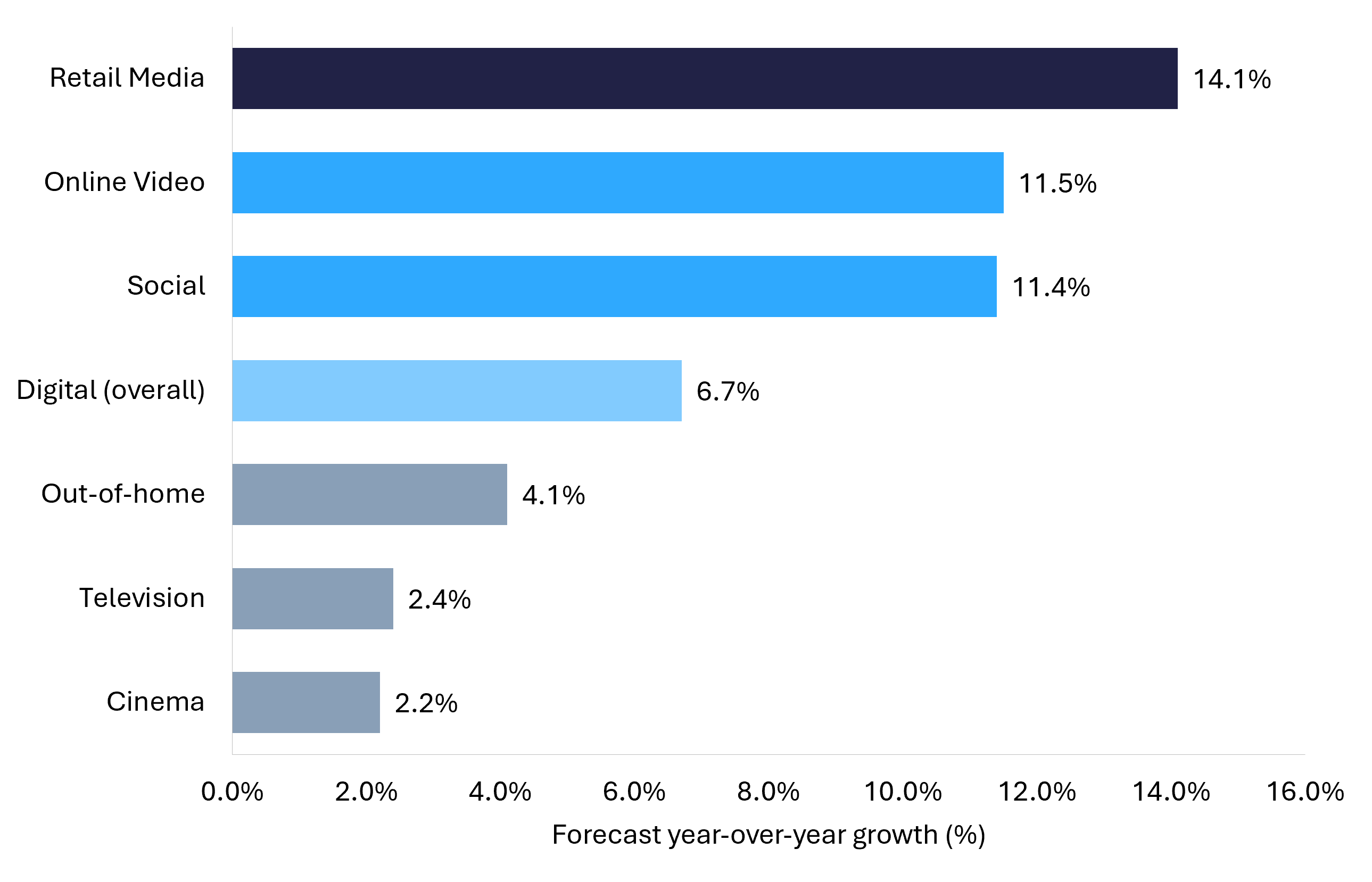
Start with demand. Ad spend is forecast to grow 5.0% in 2026, well ahead of the 3.1% projected for the global economy, with digital channels carrying roughly 69% of total investment. The fastest-growing channels, retail media at 14.1%, online video at 11.5%, and social at 11.4%, are exactly where independent digital agencies tend to live. Major 2026 events, from the FIFA World Cup to the US midterm elections, add incremental spend on top. The work your agency sells is the work the market is buying more of.
Client budgets reinforce the same point. Marketing budgets are holding at 7.7% of company revenue, with paid media taking 30.6% of the total, and CMOs are concentrating that spend with fewer, better-performing partners. Roster consolidation rewards agencies that can document results: when a client trims five vendors to two, the two that remain win larger scopes and longer contracts. That same dynamic is what makes a proven agency attractive to an acquirer.
Then there is the capital side. Global buyout deal value rose 44% to $904 billion in 2025, with roughly $1.3 trillion in dry powder still waiting to be deployed. Deal values are expected to hold at high levels through 2026, with AI reshaping deal strategy across industries, and marketing services sits squarely in the consolidation zone: fragmented, cash-generative, and rich in the AI and data capabilities buyers want.
Consolidation at the top of the market sends the signal down-market. When the industry's largest holding company completed its acquisition of Interpublic Group in November 2025 to form the biggest marketing services group in the world, every mid-market platform and PE-backed group recalibrated around scale and capability. Just as helpfully, the buyer-seller valuation gap that stalled deals a few years ago has narrowed as both sides recalibrate to stable rates and available capital. The result is a deep, motivated buyer pool for independent agencies, a trend we cover in detail in our analysis of agency M&A consolidation and AI-driven exit opportunities.
None of this is only a mega-deal story. The same conditions reach a ten-person SEO shop: acquirers that once defaulted to building capability in-house are buying it instead, and AI has shifted from a diligence question mark into a reason to transact. Sellers under $1 million in revenue feel it as deeper buyer demand for smaller listings; sellers above it feel it as more competitive processes and stronger terms. The window favors the prepared at every size.
Capital is available, demand is growing faster than the economy, and acquirers need the capabilities independent agencies have already built. That combination is what a seller's window looks like.
How Much Is a Digital Marketing Agency Worth in 2026?
Buyers do not pay for revenue. They pay for transferable, predictable earnings, and they express the price as a multiple of those earnings. Two earnings measures matter for agencies.
Adjusted EBITDA (earnings before interest, taxes, depreciation, and amortization, normalized for one-time costs and owner-related expenses) is the standard for established agencies with management depth. SDE (seller's discretionary earnings, which adds the owner's full compensation back to profit) is the right lens when the founder is central to delivery or sales, typically at revenue under $2 million.
Add-backs are where adjusted EBITDA is won or lost. Legitimate ones include above-market owner compensation, personal vehicle or travel costs run through the company, genuinely one-time legal or rebrand expenses, and family members on payroll who will not transfer. Buyers accept add-backs they can verify and reject the ones they cannot, so document each with the underlying ledger entries. Revenue multiples (applied to fee revenue, never to pass-through media spend) come into play mainly for high-growth agencies whose current-year earnings are depressed by hiring ahead of demand.
On 2026 benchmarks, most digital marketing agencies trade between 3x and 7x adjusted EBITDA, with strategic outliers reaching 8x to 12x, while founder-operated agencies valued on SDE typically land between 2x and 4x. Where you fall inside those bands depends on the value drivers covered in the next section, not on how hard you negotiate.
A worked example makes the spread concrete. An agency with $800,000 in adjusted EBITDA, mostly project-based revenue, and one client at 40% of billings might price at 3.5x, or $2.8 million. The same earnings with 75% of revenue on rolling retainers, no client above 15%, and a general manager running delivery could credibly command 6x, or $4.8 million. Same profit. Two million dollars of difference. That gap is why the preparation window matters more than the negotiation table.
The mirror image matters too. The detractors that compress multiples are the inverse of the drivers: project-heavy revenue, a founder who is the sales pipeline, books a buyer cannot reconcile, and key clients on handshake terms. None of them is fatal. All of them are priced.
For the full method-by-method breakdown, including revenue multiples for high-growth agencies and discounted cash flow for unusual situations, see our 2026 guide to digital marketing agency valuation and the broader walkthrough on how to value an agency business.

The Value Drivers Buyers Pay a Premium For
Every multiple band has a floor and a ceiling, and eight drivers decide where your agency sits. What we see across agency transactions is consistent: the same levers founders pull to grow are the levers buyers underwrite at exit. If the questions founders ask about growing an agency feel familiar (how to retain clients, how to price services, how to scale past yourself, how to differentiate), good: every one of them is also a diligence question. Strengthen these drivers and you compound twice, once in earnings and again in the multiple.
1. Recurring revenue and pricing model
How you price digital marketing services shapes how a buyer prices you. Rolling retainers and productized subscriptions read as durable cash flow; one-off projects read as revenue you have to re-earn every quarter. Agencies with the bulk of revenue on retainers consistently price ahead of project shops with identical profit, because the buyer's first-year forecast is already signed. Before a sale, convert project clients to retainers where the relationship supports it, formalize informal month-to-month arrangements into 12-month agreements, and separate pass-through media spend from fee revenue so buyers can see your true earnings base.
2. Client retention
Retaining clients in a digital marketing agency is the single clearest proxy for service quality, and buyers treat it that way. Gross revenue retention above 90% signals that the cash flow survives the transition; retention in the 70s signals a treadmill. The pre-sale fixes are operational, not cosmetic: quarterly business reviews tied to outcomes, expansion into a second or third service line per client, and renewal conversations completed before the business goes to market so the buyer inherits fresh contracts rather than expiring ones. The math is blunt: an agency billing $3 million with 92% gross retention starts each year with $2.76 million already secured, while the same agency at 75% starts $510,000 behind it. Buyers model exactly that difference into price.
3. Client concentration
Concentration is the discount buyers apply fastest. If one client represents 40% of revenue, the buyer is pricing the risk that a single email erases nearly half the business, and the multiple drops accordingly. The comfortable zone is no client above 15% to 20% of revenue. If you are concentrated today, the path is additive rather than subtractive: grow the rest of the book over 12 to 24 months so the anchor client shrinks as a percentage while staying happy in absolute terms. We see the effect in live processes: two agencies with identical $600,000 EBITDA can sit a full turn or more apart on multiple purely because one has a 40% anchor and the other tops out at 14%.
4. Owner independence and team depth
Scaling a digital marketing agency past the founder is what makes it transferable. Buyers ask three questions: who runs delivery, who owns the client relationships, and who closes new business. If every answer is you, the buyer is acquiring a job, and jobs trade at lower multiples than systems. Build a second tier of leadership, document standard operating procedures for every core workflow, move client relationships to account leads, and train a sales function that can run the pipeline without the founder's calendar. A simple test: take two consecutive weeks off with your phone on silent. Whatever breaks is your pre-sale to-do list.
5. Niche specialization and differentiation
Differentiating a digital marketing agency pays at exit even more than it pays in pitches. Specialists, whether by vertical (healthcare, ecommerce brands, B2B fintech) or by channel (retail media, paid social, technical SEO), command stronger pricing, defend retention better, and attract strategic buyers who need that exact capability. The roster-consolidation trend among CMOs sharpens this further: when brands cut their vendor lists, the specialists with documented proof keep the seats. A clear answer to "what are you the best in the world at" is worth real money in a sale process.
6. AI integration
Using AI in a digital marketing agency has moved from experiment to valuation driver. Revenue gains from AI are reported most often in marketing and sales use cases, and acquirers are paying up for agencies that have built AI into delivery rather than bolted it onto proposals. Genuine AI integration is producing a measurable premium of roughly 1x to 2x EBITDA in 2026 agency deals. The bar is operational: AI-assisted production workflows with quality control, margin data showing improved output per head, and client-facing reporting that demonstrates the gain. A slide that says "AI-powered" earns nothing; a delivery cost curve that bends does. In diligence, expect buyers to ask for before-and-after delivery hours per engagement, the prompt libraries and review workflows behind the output, and proof that clients accepted AI-assisted work at full rates.
7. Clean financials and measurable results
Measuring success for a digital marketing agency means two scoreboards: client outcomes and your own unit economics. Buyers want accrual-based books, gross margin by client and by service line, utilization rates, and pipeline data they can trust. They also want proof the work works, which is where case studies earn their keep: three to five documented client results with hard numbers do more in diligence than any deck. Disorganized financials do not just lower the price; they stall deals entirely.
8. A growth engine that is not the founder
Generating leads for a digital marketing agency through systems rather than the founder's network is the final transferability test. An inbound engine (search visibility, a referral program, partnerships, an email list that converts) with documented acquisition cost per client tells the buyer growth continues after you leave. Trends matter here too: agencies positioned in the 2026 growth channels, retail media, short-form video, AI-assisted search visibility, give buyers a forward story, not just a trailing one.
Every lever that grows an agency is the same lever that makes it sellable. Buyers underwrite the system, not the founder.
How to Prepare a Digital Marketing Agency for Sale: The 12-24 Month Playbook
Preparation is where the 1.5x to 2x multiple difference is earned, and the reason the window is 12 to 24 months is simple: buyers price trailing-twelve-month performance, so a change you make today only shows its full weight in the numbers a year from now. Here is the sequence we recommend, ordered by lead time.
- Get a valuation baseline now. You cannot manage what you have not measured. A free, confidential valuation tells you today's number, the drivers holding it down, and the realistic ceiling, which turns the next 12 to 24 months into a plan instead of a hope.
- Recast your financials. Build a clean adjusted EBITDA bridge: identify add-backs (above-market owner salary, personal expenses run through the business, true one-time costs), move to accrual accounting if you have not, and produce monthly P&Ls a buyer's analyst can reconcile in an afternoon.
- Shift revenue toward retainers and renew contracts. Convert project relationships where the work is genuinely ongoing, push renewals so contracts are fresh at the time of sale, and confirm agreements are assignable so they survive a change of ownership.
- Reduce client concentration. Set a target of no client above 15% to 20% of revenue and grow the rest of the book toward it. This is the slowest lever, which is exactly why it starts first.
- Take the founder out of daily delivery. Promote or hire a delivery lead, document SOPs, reassign client relationships to account managers, and build a sales process that books meetings without your personal brand carrying every deal.
- Clean up legal and IP hygiene. Employment agreements with non-solicits, contractor agreements that assign IP to the company, client contracts with clear ownership and assignability terms, and trademark registrations where relevant. Buyers' lawyers will look for all of it.
- Build the data room early. Three years of financials, client contracts, retention and concentration analyses, team org chart and compensation, SOPs, case studies, and tech stack documentation, organized before anyone asks. Prepared sellers keep momentum; momentum protects price.
- Keep growing through the process. Buyers re-check the numbers right before close. An agency that grows during the sale defends its multiple; one that stalls invites a renegotiation. Run the business like you are keeping it until the wire hits.
Two workstreams run alongside the eight steps. First, tax and entity planning with your CPA and attorney: asset versus stock sale treatment, state exposure, and small business stock considerations can move after-tax proceeds by six figures, and that planning only works in advance. Second, decide your own next chapter early. Buyers read founder clarity as deal certainty, and sellers who know what comes after closing negotiate from a steadier place.
The best time to prepare an agency for sale is 12 to 24 months before you want to close. The second best time is now.
Who Buys Digital Marketing Agencies?
What buyers look for when buying a marketing agency is remarkably consistent across every type: durable client revenue, a team that stays, and systems that transfer. Where they differ is what they do with it afterward, and that difference determines your multiple, your deal structure, and your life after closing. Match the buyer to your goal rather than chasing the loudest offer.
Strategic acquirers (larger agencies, holding company networks, and adjacent services firms) buy capability: your clients, your team, your systems. They pay the highest multiples, including the 8x to 12x outliers, when your agency fills a specific gap. Speed can be striking when the fit is right: a 24-person podcast production agency with Fortune 500 clients and 45% year-over-year growth went from engagement to close with a strategic buyer in about six weeks, because the buyer needed exactly what the business had already built.
Private equity platforms acquire an agency as the foundation of a buy-and-build strategy. The founder often stays on, rolls a portion of proceeds into equity in the new platform, and gets a second payday when that platform exits at a larger multiple. PE-led consolidation in recurring, tech-enabled services is an explicit 2026 theme, and marketing services fits the profile.
PE-backed add-ons are sales to an existing platform rather than the start of one. Multiples are usually a notch below platform deals, but the process is faster, integration support is real, and competition among platforms hunting for the same capabilities keeps pricing honest.
Individual operators and first-time acquirers are the most active buyer pool for agencies under $1 million in revenue, often valuing on SDE and frequently using financing. This segment transacts most efficiently on the FE International M&A Platform, where sellers list vetted businesses and curated buyers browse live opportunities, with human support available on both sides of the deal.
Choosing between buyer types is a goals question before it is a price question. Want the cleanest break at the strongest headline number: prioritize strategics. Want a second bite and a platform to keep building: PE deals reward founders who stay. Want speed and certainty on a smaller transaction: add-ons and individual buyers close fastest. A well-run process puts more than one of these at the table at the same time, which is exactly what competitive tension means.
The M&A Process Step by Step: From Valuation to Closing
A well-run agency sale follows seven stages. With preparation done, the whole arc typically runs six to nine months; without it, due diligence alone can consume that long.
- Valuation and goal setting. Establish the defensible number, the realistic range by buyer type, and your personal targets: proceeds, timeline, and what role (if any) you want post-close. Every later decision keys off this stage.
- Positioning and the CIM. The confidential information memorandum is your agency's case to buyers: financial recast, client and retention analysis, team structure, growth story, and the specific reasons this business earns the top of its multiple band. Strong positioning here is the difference between buyers anchoring high or anchoring low.
- Confidential buyer outreach. A managed process approaches strategics, PE platforms, and qualified individuals in parallel, under NDA, without your name in public. FE International runs this against a network of 80,000+ vetted buyers, which is what creates the competitive tension that moves price and terms in your favor.
- Offers and the letter of intent. Indications of interest arrive, management calls follow, and the strongest parties submit LOIs covering price, structure, and exclusivity. Negotiate structure as hard as price here: cash at close, earnout terms, exclusivity length (60 to 90 days is standard, and shorter favors you), and your post-close commitment are all set in this document.
- Due diligence. The buyer verifies everything: financial, commercial, legal, and operational. On a prepared agency this runs six to ten weeks; the next section covers exactly what gets examined.
- The purchase agreement. Lawyers convert the LOI into binding terms: representations and warranties, indemnification caps, working capital targets (the level of receivables and prepaid client funds that must transfer with the business, a frequent late-stage friction point), non-compete scope, and employment or consulting terms for the founder. Experienced deal counsel earns its fee in this stage.
- Closing and transition. Funds move, ownership transfers, and the transition plan you negotiated begins: client introductions, team onboarding, and your agreed involvement, which for most agency founders means 3 to 12 months of structured handover.
Two disciplines protect value across all seven stages. Confidentiality first: a leak to clients or staff mid-process is the most common self-inflicted wound in agency sales, which is why outreach starts with anonymous profiles and full information flows only after NDAs. Momentum second: every week a deal idles, the odds of a retrade rise, so prepared sellers answer diligence requests in days, not weeks, and keep the calendar full of forcing functions.

Deal Structures: Cash, Earnouts, Seller Notes, and Equity Rollovers
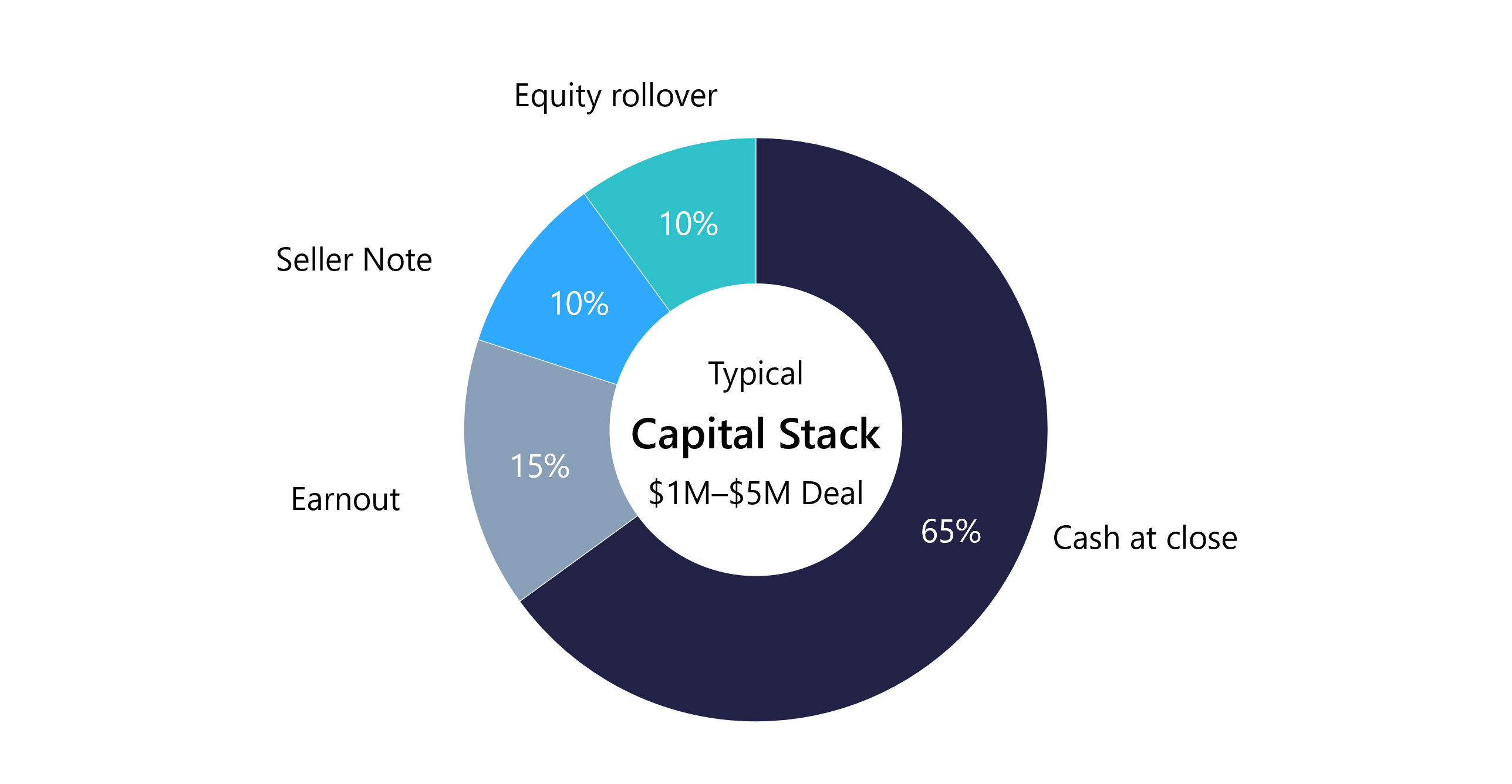
The headline price and the money you actually receive are different numbers, and structure is the bridge between them. Agency deals in the lower middle market are rarely 100% cash at close. A typical 2026 structure runs 60% to 70% cash at closing, 10% to 20% in an earnout tied to client retention or revenue targets over 12 to 24 months, with the balance in a seller note. PE deals frequently add an equity rollover, where you keep a minority stake in the combined platform and participate in the next exit.
A seller note is financing you extend to the buyer: a slice of the price paid over one to three years with interest, common in smaller deals where it bridges a financing gap. Equity rollover works differently. Rolling a minority share of your proceeds into a platform deal means holding a stake in a larger, professionally capitalized group, and founders who rolled into a growing platform can earn a second payment that rivals the first when the platform itself sells. The trade is liquidity now for upside later, and it only makes sense if you believe in the buyer's plan.
Earnouts deserve the most negotiating attention because they shift risk onto you. Three protections matter: tie the earnout to metrics you can influence after close (client retention rather than the buyer's consolidated profit), cap the duration at 12 to 24 months, and write in safeguards if the buyer changes pricing, staffing, or strategy in ways that affect the targets. An earnout structured this way aligns both sides; one structured loosely becomes a discount in disguise.
Evaluate offers on risk-adjusted value, not face value. A $4.5 million offer with 85% cash at close can beat a $5 million offer with half the price tied to a three-year earnout. Run every offer through the same lens: what do I receive at close, what do I control, and what depends on someone else's decisions.
Structure is price. Two offers with the same headline number can differ by seven figures in what the seller actually keeps.
Due Diligence: What Buyers Examine and How to Pass Cleanly
Due diligence is verification, not negotiation, and sellers who treat it that way keep their price. Buyers work through four tracks in parallel.
Financial diligence reconciles your adjusted EBITDA claim: revenue recognition by client, gross margin by service line, the legitimacy of every add-back, and working capital patterns. Commercial diligence tests the durability of revenue: contract terms and assignability, retention history, concentration, pipeline quality, and conversations with key clients late in the process. Legal diligence covers entity records, IP ownership (especially work produced by contractors), employment agreements, and any disputes. Operational diligence examines the tech stack, data handling, SOPs, and how dependent delivery is on specific individuals.
The document list is predictable, which is the good news: three years of P&Ls and balance sheets, tax returns, client contracts and amendments, revenue by client by month, employment and contractor agreements, IP assignments, insurance policies, and the SOP library. The red flags are equally predictable: cash-basis books that will not reconcile, revenue recognized before work is delivered, contracts that terminate on a change of control, and IP produced by freelancers who never signed assignment clauses. Every one of them is fixable before a process and expensive during one.
Passing cleanly comes down to two habits. First, the organized data room you built in preparation: when answers arrive in hours instead of weeks, the deal keeps momentum and momentum protects terms. Second, disclose known issues early. A churned client or a pending dispute surfaced by you in week one is context; the same item discovered by the buyer in week eight is a price reduction. Buyers renegotiate surprises, not problems.
Choosing Your Exit Path: Full Advisory or the M&A Platform
FE International runs two complementary channels, and the right one depends on the size and complexity of your agency. They are one firm and one process philosophy with two routes to the same outcome: a strong, clean exit.
For agencies above $1 million in revenue, and especially above $1 million in EBITDA, the full advisory process earns its place: in-house financial recasting, a competitive process across strategics and PE, hands-on negotiation of structure, and legal support through closing. At this scale, the value created by competitive tension and deal structuring is typically several multiples of the fee.
For agencies under $1 million, the FE International M&A Platform is built for the way smaller deals actually move: founders list a vetted business, curated buyers engage directly, and the process runs faster and leaner, with human support available whenever a deal question needs an expert. Buyers use the same Platform to browse live, verified opportunities, which keeps demand deep on the other side of every listing. The two channels feed each other: many founders start on the Platform, grow past $1 million, and graduate to full advisory for the next exit. Buyers move between them the same way, browsing Platform listings for smaller acquisitions while working with the advisory team on larger searches.
Both paths start the same way, with a free, confidential valuation that tells you which route fits today.
Sell Your Digital Marketing Agency on the Strongest Possible Terms
Knowing how to sell a digital marketing agency comes down to a sequence: understand your valuation, spend 12 to 24 months strengthening the eight drivers buyers pay for, run a competitive process with the right buyer pool, and negotiate structure with the same energy as price. The 2026 market supplies the rest: record advertising demand, deep acquisition capital, and consolidation pressure that makes well-built independent agencies genuinely scarce assets. Founders who treat the exit as a project rather than an event capture the difference, often measured in full turns of EBITDA.
FE International has advised on 1,500+ technology transactions with a 94.1% success rate, with a dedicated agency vertical team and a buyer network of 80,000+ vetted investors. If your agency generates more than $1 million in revenue, request a free, confidential valuation and our advisory team will map your realistic range and the path to the top of it. If your agency is under $1 million, list it on the FE International M&A Platform and put it in front of curated, active buyers, and if you are on the other side of the table, the same Platform is where you can browse vetted agencies for sale. Either way, the first conversation costs nothing: get in touch with FE International and find out what your agency is worth.