


To sell a mobile app in 2026, price it on a multiple of trailing net earnings (or revenue if growth is fast), assemble cohort, install, and financial evidence, run a confidential process with the buyer pool that fits your size, agree terms, then transfer the app through App Store Connect and Google Play Console.
Consumers spent $167 billion inside apps in 2025, up 10.6% on the year, and for the first time non-game apps out-earned games. That spend is why a working app is now a sellable asset with a deep buyer pool, from individual operators up to a Nasdaq-listed acquirer whose entire model is buying software products. It is also why "how to sell a mobile app" gets two very different answers online. One is about selling products through an app. This guide is the other one: selling the app itself, as a business, to a buyer who pays for the revenue it produces.
We have advised on more than 1,500 technology transactions at FE International, and app businesses follow a pattern. Value is set by earnings quality, not download counts. Buyers check the same handful of things every time: retention by cohort, where installs come from, how exposed revenue is to a single platform, and whether the app keeps running once the founder steps away.
The backdrop rewards sellers who prepare. Global M&A was up 41% through the first five months of 2026 and on track for the second-highest year ever, and subscription revenue keeps concentrating in the apps that execute well: the top quarter of subscription apps grew 80% year over year, which is exactly the performance buyers pay a premium for. Buyers are selective, and selectivity is what separates a prepared app from an average one at the negotiating table.
What Is a Mobile App Worth in 2026?
The short answer is a multiple of adjusted earnings. The longer answer is that the multiple moves with retention, growth, channel mix, platform exposure, and how much of the business lives in the founder's head, which is why two apps with identical profit routinely sell for very different prices.
Owner-operated apps valued under roughly $5 million are priced on seller's discretionary earnings, or SDE: net profit with the owner's compensation and any one-off or personal expenses added back. Above that size, once a paid team runs the business day to day, buyers switch to EBITDA. Our guide to building, valuing and selling an app walks through both calculations. The distinction matters because EBITDA assumes management is already paid for inside the cost base, so the buyer is acquiring a system rather than a job, which is typically worth a full turn on the multiple by itself.
Revenue multiples still apply, but only where growth is fast enough that current profit understates the asset: in practice, growth above roughly 20% a year with gross margins above 70%. Whichever base applies, buyers underwrite the revenue you keep, net of Apple and Google commission, refunds, and the ad network's share. Presenting gross store revenue as if it were yours invites a correction in diligence, and corrections in diligence cost multiple turns.
Here is where mobile app valuation multiples sit in 2026, drawn from FE International transaction data across more than 1,500 closed deals. Subscription mobile apps with genuine retention trade at 3.5x to 6.0x adjusted earnings. Advertising-monetised and single-platform utility apps run from 1.8x to 3.5x. Apps that live inside another platform's ecosystem, such as Shopify or Salesforce applications, land at 4.0x to 7.0x. Three patterns stand out. Revenue model beats category, so a language-learning app with strong annual renewals prices above a viral casual game with weekly churn. Size compounds within every band, because larger earnings bases attract institutional buyers who pay in cash. And the spread inside each band is wider than the gap between bands.
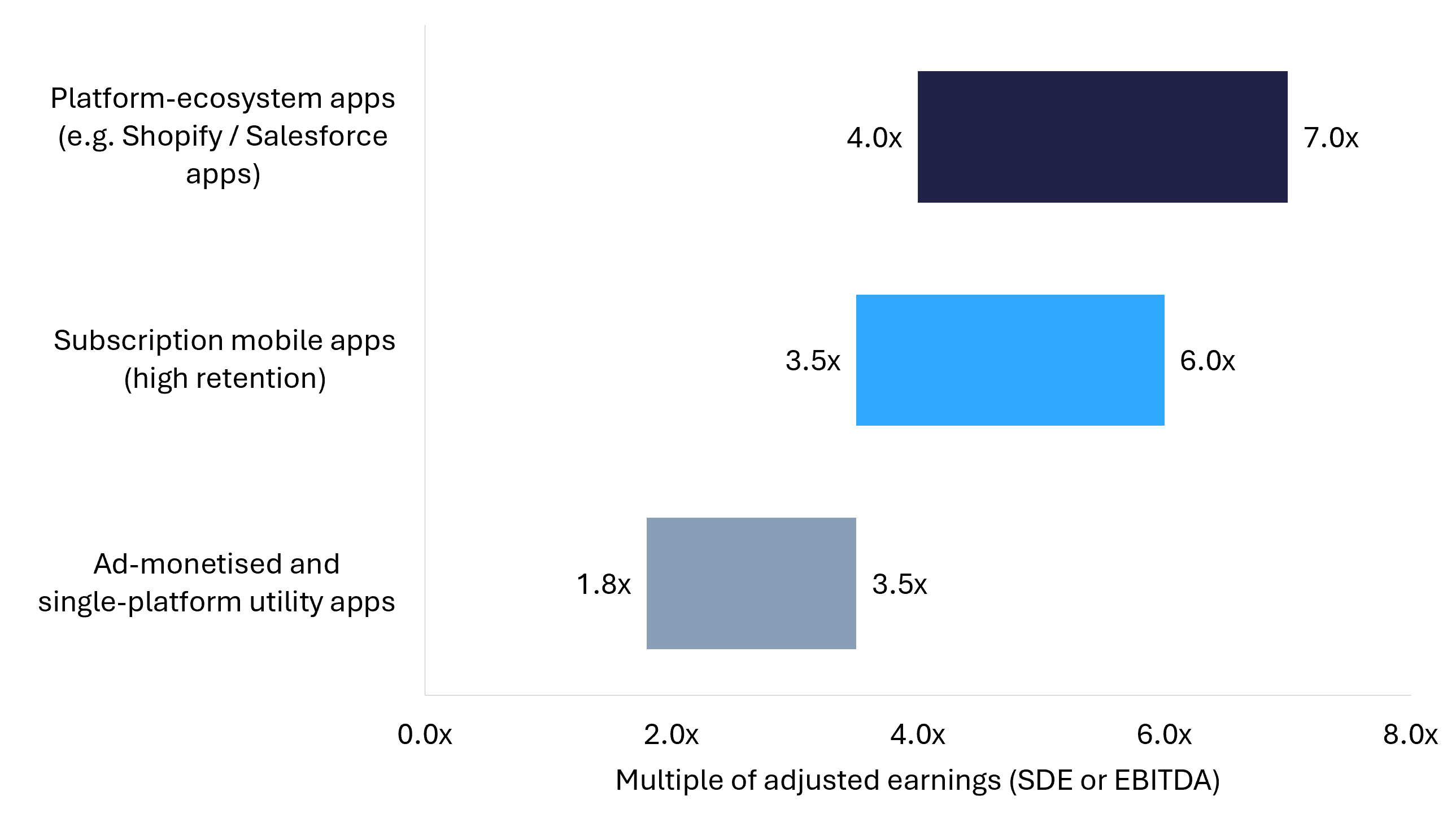
A worked example makes the ranges concrete. Take a subscription app with $600,000 in trailing net revenue after store commission and $220,000 in adjusted earnings once hosting, support, paid acquisition, the founder's salary, and a one-off legal bill are accounted for. If 40% of subscribers sit on annual plans, year-one retention beats the category median, and six installs in ten arrive from store search, that app supports the upper half of its band: 5.0x to 5.5x, or $1.1 million to $1.2 million. The same $220,000 produced by weekly plans and a paid-install engine on one ad channel sits nearer 3.5x, or roughly $770,000. Identical profit, a gap of roughly $330,000 to $440,000, and every factor in it is something a founder can work on before going to market.
Buyers price the earnings you keep after Apple and Google take their share, then adjust for how likely those earnings are to still be there in three years.
Subscription vs Ad-Supported Apps: How Does the Valuation Basis Differ?
Subscription apps are priced on the durability of renewals. Ad-supported apps are priced on the durability of attention. That explains most of the gap between the two multiple bands above, and it tells you what evidence each seller needs to bring.
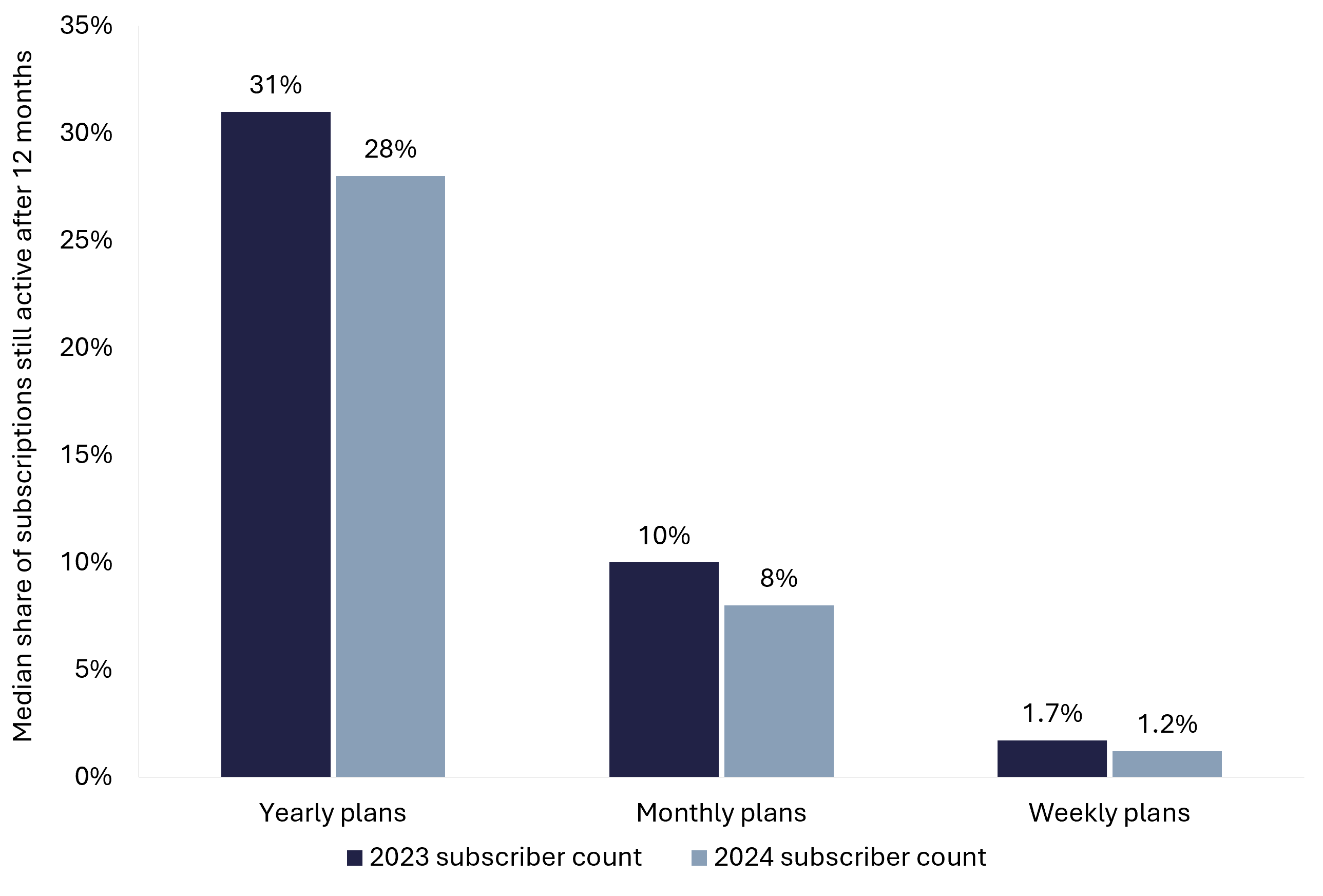
For a subscription app, the buyer's model starts with monthly recurring revenue and asks how much of it survives. Plan mix comes first. Yearly plans retain a median 28% of subscribers at the one-year mark, against 8% for monthly plans and 1.2% for weekly plans, so an app selling mostly annual plans has a visible revenue base twelve months out, while a weekly-plan app re-earns its revenue every seven days. Renewal behaviour compounds in the seller's favour: subscribers who clear the first annual renewal renew at much higher rates afterwards, so three-year-old cohorts show a floor under revenue that a two-year-old app cannot. Buyers also separate conversion from retention. Hard-paywall apps convert downloads to paid at five times the freemium rate, yet year-one retention is nearly identical for both, so a paywall change is a cash-flow lever, not a churn fix. Involuntary churn gets its own line: nearly a third of subscription cancellations on Google Play are billing failures, more than double the App Store rate, and a seller who has already deployed grace periods and retry logic has margin a buyer can bank on.
Ad-supported apps are valued on trailing net profit, and the underwriting question is whether the audience holds. Revenue is a function of daily active users, session frequency, ad load, and the price advertisers pay per thousand impressions, so buyers look for a retention curve that flattens, ad network diversification, and evidence that the app owns its traffic rather than renting it. The demand side is healthy: US digital ad revenue reached $294.6 billion in 2025, up 13.9%, with programmatic buying up 20.5%. What buyers reward most is a large organic install share plus a hybrid upside, meaning a subscription or in-app purchase layer not yet switched on; portfolio operators pay for that because they can cross-promote and add premium tiers on day one. The multiple runs lower than for subscription apps not because the model is weaker but because the forecasting horizon is shorter, and a seller who lengthens that horizon with owned audiences and diversified networks moves up the band.
The table below sets out the two models side by side.
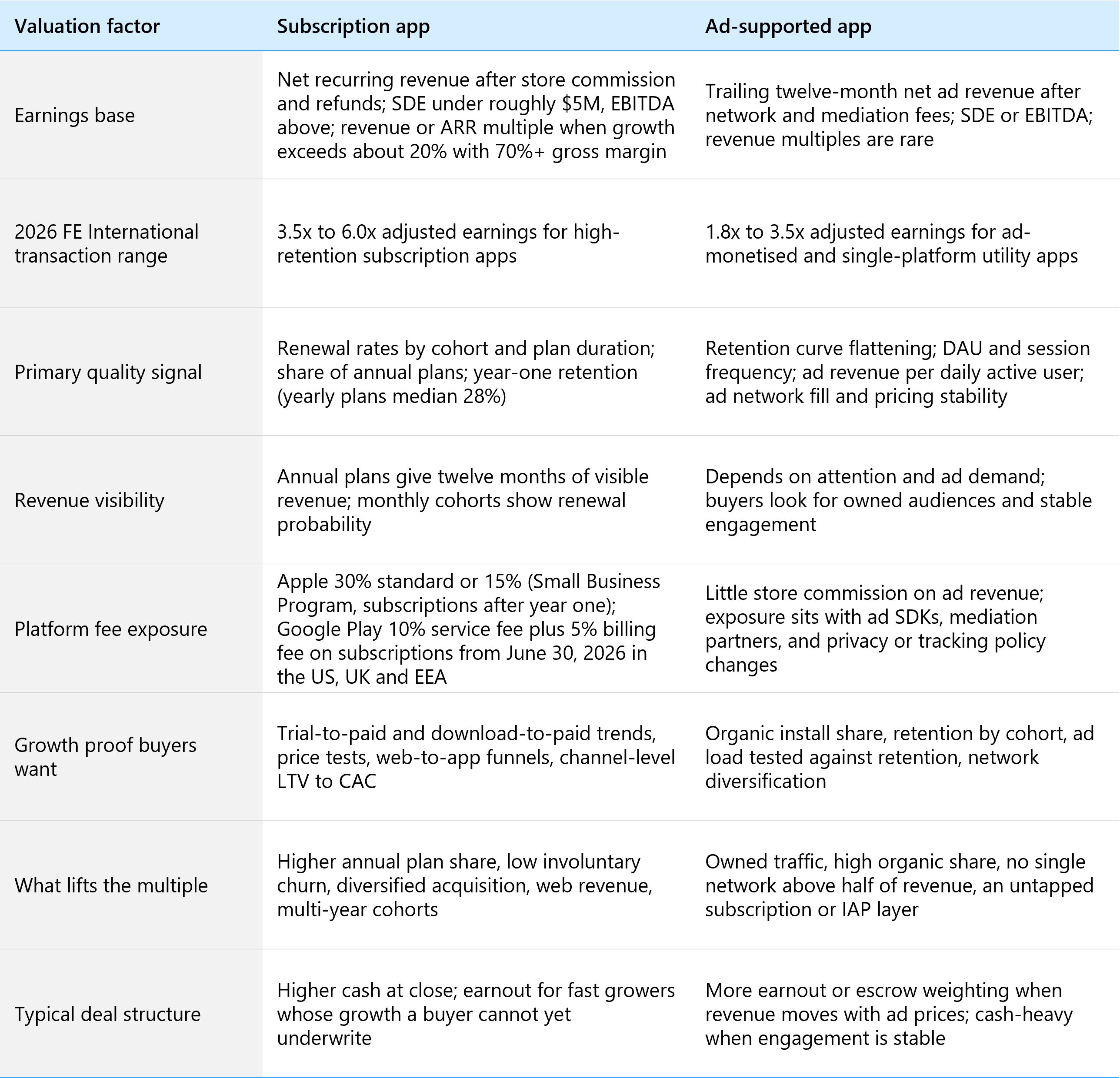
Subscription apps are priced on the durability of renewals; ad-supported apps are priced on the durability of attention. Bring the evidence that matches your model.
What Do Buyers Check Before They Buy a Mobile App?
Every serious app buyer runs the same diligence checklist, whether they are an individual writing a $300,000 cheque or a portfolio company writing a $30 million one. Diligence red flags such as earnings quality and customer churn were among the two most common reasons deals failed to complete in 2025, so a seller who arrives with those questions already answered removes the main obstacle between an offer and a closing.
Retention cohorts
Buyers ask for monthly install cohorts with day-1, day-7, day-30, and day-90 retention, plus subscription retention by plan and renewal number. They are looking for where the curve flattens. Flat by day 30 is evidence of product fit. Still decaying at day 90 tells them the growth on the revenue chart is acquisition spend, not habit. For subscription apps, the renewal sequence matters as much as the headline rate: first annual renewals land at 23% to 40% by category, second renewals at 44% to 64%, and third renewals at 56% to 70%, so a cohort that has survived two renewals is worth far more per subscriber than a fresh one.
Paid vs organic installs
Where installs come from decides how much of your profit is really margin. Paid acquisition has become the default on Android: Android paid installs made up the majority of all Android installs for the first time in data running through February 2026, driven by new paying consumers in India, Latin America, and the Middle East. That is good for growth, but a buyer wants the economics channel by channel, because blended figures hide problems. One efficient organic channel subsidising three unprofitable paid ones is a margin risk a buyer will price for, whereas an app that ranks for its category keywords and pulls thousands of installs a month from store search is showing the buyer free distribution. Expect requests for ad account history, attribution exports, payback by channel, and the share of installs with no attributed spend.
Platform risk
Concentration is the risk buyers most consistently discount. It shows up as an iOS-only app with no Android revenue, a single ad network above half of ad income, one social channel driving most paid installs, or a core feature that depends on a third-party API the app does not control. Buyers also check policy exposure: privacy labels, SDK inventory, account standing with Apple and Google, and any history of rejections. Commission has become a live diligence item since the 2026 fee changes covered later in this guide. Diversification does not have to be complete to be rewarded; evidence that the app converts on a second platform or channel is often enough to move the multiple.
Transferability and the owner
The rest of the list is about whether the business moves cleanly: code quality and documentation, who owns the backend and third-party accounts, whether the trademark, domain, and social handles are registered to the business, refund and chargeback rates, revenue concentration by country, and how many hours a week the founder puts in. An app that runs on five to ten owner hours a week with documented processes is a transferable asset. One that needs the founder answering support tickets at midnight is priced as a job with a product attached.
A retention curve that flattens is proof of product fit. A curve that keeps decaying at day 90 is marketing spend dressed up as growth, and buyers know the difference.
How Do You Prepare an App for Sale?
Preparation is where most of the value in an exit is created, and every step that raises the multiple also raises profit; there is no conflict between running the app well and selling it well. Give yourself six to twelve months before going to market if you can, because cohort data needs time to mature and buyers pay for trends, not snapshots.
Fix the financial foundation first: accrual accounting, personal and business spending separated, every App Store Connect and Play Console payout reconciled to the bank statement, and each add-back documented. Report revenue net of commission and refunds, and treat prepaid annual subscriptions as deferred revenue rather than cash to spend, because a buyer inherits the obligation to serve those subscribers and will adjust for it at closing. Then assemble the package buyers ask for anyway: cohort exports, subscription event history, attribution and ad account records, crash and review metrics, privacy declarations, and an SDK list.
Next, pull the monetization levers that show up in the multiple. Shift plan mix toward annual where the category supports it: apps whose most popular plan is yearly earn roughly twice the revenue per install of monthly-led apps by day 14, and annual plans give a buyer visible revenue. Test trial length, since trials of 17 to 32 days convert at 42.5% against 25.5% for trials of four days or fewer, yet nearly half of apps still default to the short version. Fix involuntary churn on Android with grace periods and retry logic. Grow the organic share with a store listing that ranks for category keywords, and build a web-to-app funnel, because web revenue is a hallmark of scale: 41% of top-tier subscription apps earn it, against 1.3% of hobby-tier apps. One caution from our own deal work: do not push discounted annual plans before a sale to inflate cash. Buyers see the deferred obligation and it does not add to the price.
Finally, make the business transferable. Document processes for releases, support, and ad operations. Register the trademark, domain, and social accounts to the company. Make sure a second developer understands the codebase, and demonstrate a quarter where the app ran without daily founder involvement. If you are unsure which of these will move your number most, an early independent valuation tells you where to spend the effort; FE International provides a confidential app valuation for exactly this purpose.
Every preparation step that raises your multiple also raises your profit. Sellers who start six months early sell at the top of their band; sellers who start at offer stage sell at the bottom.
Where Do App Deals Happen by Size, and Who Is Buying?
The buyer pool changes with size, so the process has to change with it. A $400,000 app and a $40 million app should never be sold the same way, and a common mistake is using a process built for one tier to sell an app that belongs in another.
Under $500,000. Buyers are individual operators, indie studios, and first-time acquirers looking for a profitable product they can run themselves. Deals are priced on SDE, structured as simple asset purchases, usually paid in cash at close with the occasional seller-financed portion, and can complete in weeks, typically through self-serve listings and direct approaches. Apple's own transfer documentation describes moving an app "when you've sold the app to another developer," which is how thousands of small app store business sales close every year.
$500,000 to $5 million. This is the owner-operated middle, still priced on SDE, where the buyer list widens to app portfolio operators, studios backed by private capital, search funds, and experienced individuals with financing. It is also the tier where dispersion inside a band is widest, so competitive tension becomes the main driver of price. A confidential, advisory-led process that puts several qualified buyers in front of the same data at the same time is what pulls an app from 3.5x to 5.5x. FE International's private sales and acquisitions team runs this process for technology businesses from $1 million upward.
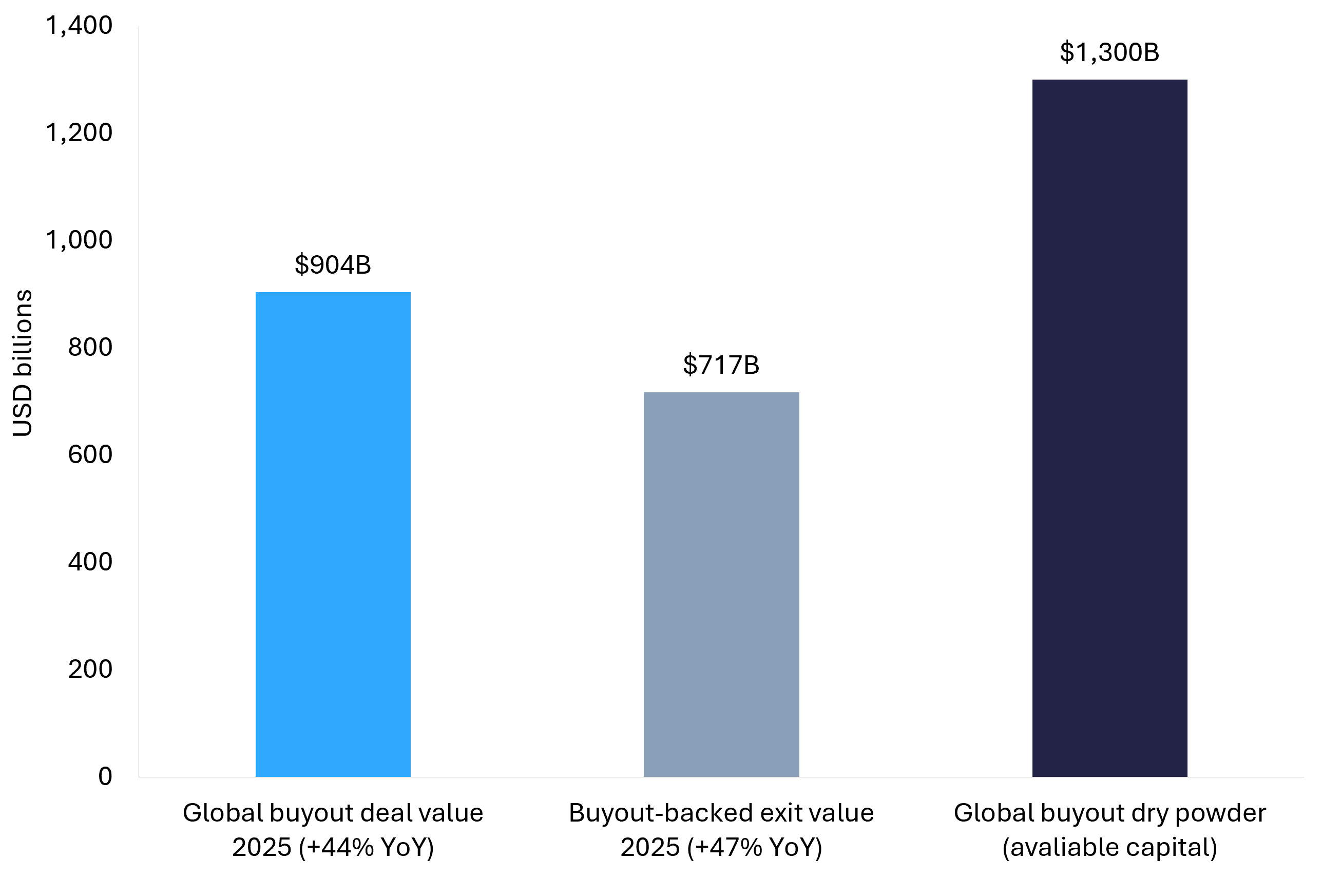
$5 million to $50 million. Valuation moves to EBITDA and the buyers become institutional: app consolidators, both public and private, lower-middle-market private equity, and strategic acquirers adding a category. The capital is there. Buyout deal value rose 44% to $904 billion in 2025, exit value climbed 47% to $717 billion, and $1.3 trillion of buyout dry powder is waiting to be deployed, much of it raised in 2022 and 2023 and under pressure to be put to work. Processes at this size look like investment banking mandates: a quality-of-earnings review, a formal information memorandum, staged bidding, and negotiated structures with earnouts and escrow. FE International's average transaction value is $48 million, and this tier is where most of that activity sits.
Above $50 million. Strategics and large sponsors dominate, and the ceiling is high. The clearest 2026 illustration of a dedicated software acquirer is Bending Spoons, which listed on Nasdaq on July 1, 2026, serves more than 500 million monthly active users and over 9 million paying customers, bought AOL in January and Eventbrite in March, and agreed in August to acquire Airtable for an enterprise value of $1.285 billion in cash. A company whose entire model is buying and operating digital products is now public, which shows how institutional demand for well-run apps has become. At the far end, the $56.6 billion take-private of Electronic Arts set a buyout record, and strategic technology M&A reached $259 billion in the first five months of 2026 in the Bain data above. None of that bears directly on a $2 million app, but the buyer universe extends all the way up.
The buyer pool changes with size, so the process has to change with it. Match the process to the tier and the multiple follows.
How Does the Sale Process Work, Step by Step?
Whatever the size, how to sell an app comes down to the same seven stages. What changes is how formal each one becomes.
- 1. Valuation and readiness review. Establish the earnings base, the likely multiple range, and the three or four preparation items that would move the number. Decide whether to sell now or spend six months fixing what a buyer would otherwise discount.
- 2. Information memorandum. A document that presents financials, cohort data, channel economics, technology, team, and the growth plan, positioned for the business model. A subscription app leads with renewal curves; an ad-supported app leads with engagement and organic share.
- 3. Confidential buyer outreach. A short anonymous teaser goes to a targeted list under non-disclosure, sized to the tier. The goal is several qualified buyers reviewing the same data at the same time, because competitive tension sets price more than any formula does.
- 4. Offers and the letter of intent. Compare offers on cash at close, structure, and certainty of closing, not on the headline. An LOI fixes price, structure, exclusivity, and timeline before diligence starts.
- 5. Due diligence. Financial (store payouts reconciled to bank), commercial (cohorts, acquisition efficiency, concentration), technical (code, dependencies, security, SDKs), and legal (IP ownership, contracts, privacy compliance). FE International's due diligence services exist because reconstructing clean cohort and financial evidence is specialised work, often worth more than a full turn on the multiple.
- 6. Definitive agreement. Most app deals are asset purchases: the app, code, accounts, brand assets, and customer relationships move to the buyer's entity. Larger deals may be share purchases. The agreement covers representations and warranties, escrow, transition support, and a non-compete.
- 7. Closing and transfer. Funds go to escrow, code and backend access move first, the store transfers follow, and the escrow releases once the buyer confirms the app is live and building under their account.
Timelines scale with the tier. Small direct sales can close in four to eight weeks. An advisory-led process for a $1 million to $10 million app typically runs three to six months from launch to closing, and larger institutional processes take six to nine months because diligence and legal work deepen. In every case the calendar is driven by preparation: sellers who arrive with reconciled financials and exported cohorts spend weeks in diligence; sellers who build them during diligence spend months.
Cash at close, structure, and certainty of closing matter more than the headline number. An offer that never closes is worth nothing.
How Do App Store and Google Play Transfers Work?
This is the step most guides skip. In an app store business sale, the transfer is the final act of closing, and both platforms provide a formal process for it: both keep the app live throughout, and both come with a list of things that do and do not travel with the app. Plan it like a release.
Apple App Store
On Apple's side, an app transfer keeps the app available for download, retains its reviews and ratings, keeps users on the update path, and preserves the Bundle ID. The membership Account Holder of the selling account initiates it in App Store Connect, and the receiving Account Holder must accept within 60 days or the transfer expires. Before it can start, the app must meet Apple's transfer criteria: both accounts active and not in a pending state, the latest agreements accepted on both sides, at least one released version, no live pre-order, nothing sitting in review, and in-app purchases in an approved or ready state. If the seller has accepted Apple's EU alternative terms, the buyer must accept them too.
The detail lives in the capabilities. Apps with auto-renewable subscriptions must generate an app-specific shared secret and hand it to the buyer before the transfer. TestFlight builds and testers must be removed and Xcode Cloud data cleared first. Push certificates stay valid until expiry, then the buyer needs new keys; the Apple Pay merchant ID does not transfer; Sign in with Apple requires per-user transfer identifiers generated through Apple's endpoint. iCloud containers move with the app, and keychain sharing must be rebuilt with the buyer's Team ID at the first update. The seller keeps sales and payment data for the period before the handover; the buyer receives only what comes after. One more item buyers model carefully: under the App Store Small Business Program, a transferred app's calendar-year proceeds are associated with every account that initiates or accepts the transfer when eligibility for the 15% rate is assessed.
Google Play
Google Play's process runs through a transfer request in Play Console. Both developer accounts must be registered and active, the original account and every app being transferred must comply with policy, the request needs the registration transaction IDs for both accounts, and apps with paid downloads or in-app products require an active payments profile on the receiving side. Users, download statistics, ratings and reviews, store listing, subscriptions, past policy declarations, and registered package names with their developer-verification keys all move with the app. Bulk export, payout, and earnings reports do not, so download them first, and orders created before the transfer stay in the original account, which matters for refunds. Firebase, Google Analytics, and Play game services must be re-linked, and ad SDK integrations, including AdMob, need updating in the build so ad traffic credits the new owner. If the receiving account uses a different default currency, an app monetised only through in-app purchases is unpublished until the buyer verifies prices and republishes. Google's support team replies to transfer requests within two business days.
Sequence the closing so nothing is left exposed: funds into escrow first, then code, backend access, third-party accounts, and signing materials, then the Apple and Google transfers in parallel, and escrow releases once the buyer confirms both apps are live and building under their accounts. The checklist below makes sure nothing tied to the old developer accounts gets missed.
Table 2: App Store and Google Play transfer checklist
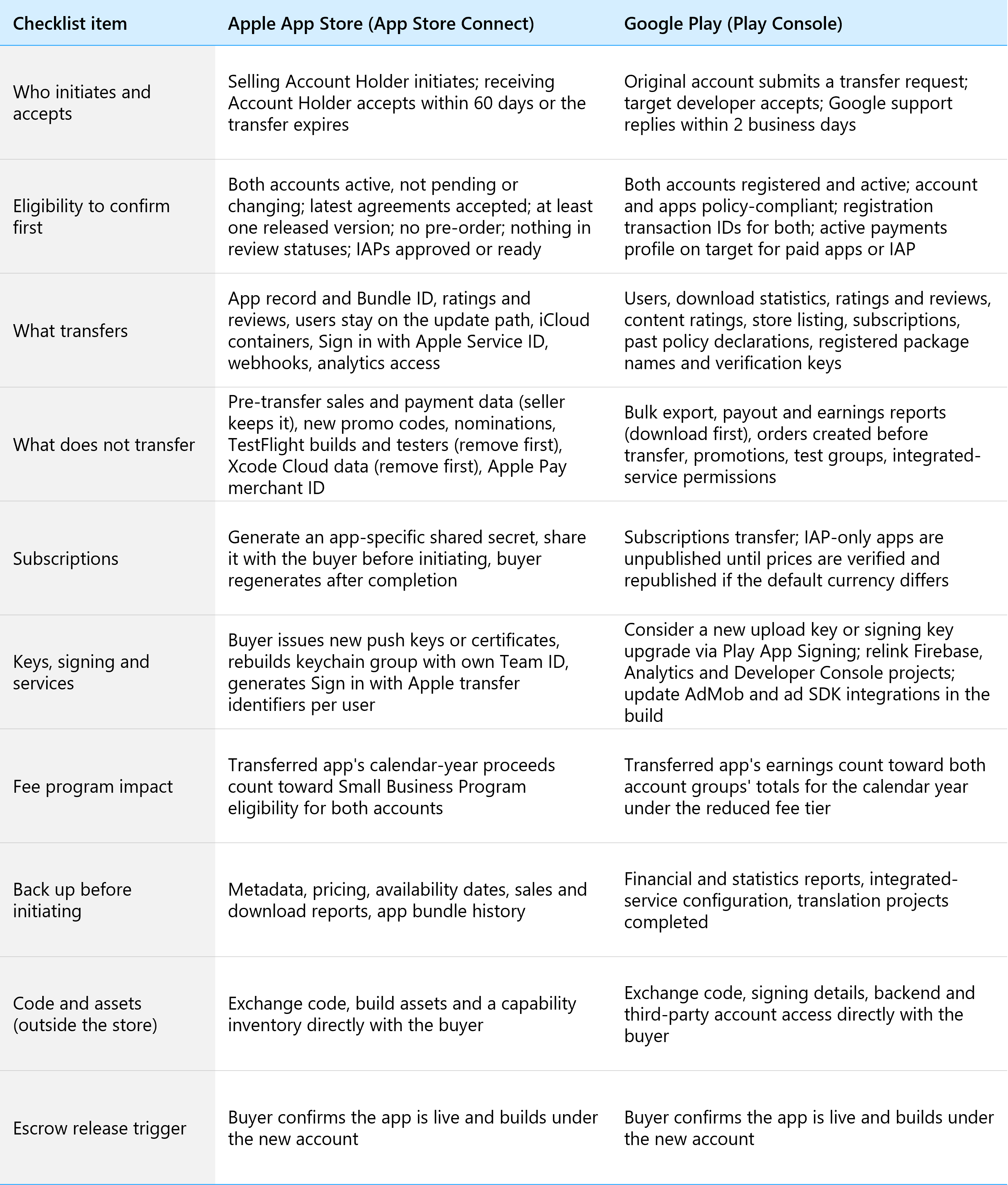
Inventory every capability tied to the old developer account before anyone taps Transfer App. The transfer itself takes days; the preparation is what keeps subscribers renewing on day one under the new owner.
What Deal Structures and Terms Should App Sellers Expect?
Price is only one line in the term sheet. The others decide how much of it you actually receive and when.
Cash at close and earnouts. Stable, mature apps close mostly in cash. Fast-growing apps often carry an earnout, where part of the price is paid over one to three years if revenue or subscriber targets are met. Earnouts are how buyers bridge a valuation gap on growth they cannot yet underwrite, and they are reasonable when the metrics are ones you control after closing. Negotiate the metric definition, the measurement period, and what happens if the buyer changes pricing or acquisition spend, with the same care you apply to the headline figure.
Escrow and holdbacks. A portion of the price, commonly 5% to 15% in smaller deals, sits in escrow after closing to cover representations and warranties and to make sure the store transfers complete; larger deals may use warranty insurance instead. Tie the release to verifiable events, such as both apps building under the buyer's accounts.
Transition support and non-compete. Expect to provide 30 to 90 days of transition help covering releases, support, ad operations, and platform accounts, and to sign a non-compete covering your app's category for a defined period. The more documented the business is, the shorter and lighter both become.
Working capital and deferred revenue. Prepaid annual subscriptions are an obligation the buyer inherits, so purchase agreements usually adjust for deferred revenue at closing. Sellers who understand this in advance price it into their expectations rather than discovering it in the final week.
Asset sale versus share sale. Most app transactions under $10 million are asset sales, where the buyer's entity takes the app, code, accounts, and brand. Share sales are more common at scale and where the app sits inside a company with contracts and staff. Tax treatment differs by jurisdiction and structure, so take advice early, before the LOI fixes the form of the deal.
Read a term sheet in this order: cash at close, escrow terms, earnout definition, transition obligations, then the headline. The headline is the least informative number on the page.
Platform Fees and Policy in 2026: What Changed and Why Prepared Sellers Benefit
Store economics moved more in 2026 than in the previous decade, and every change favours sellers who understand it, because commission is now a margin variable buyers model line by line rather than a fixed cost they assume.
On Google Play, the March 2026 announcement separated a 5% billing fee from a new set of lower service fees: 20% on in-app purchases from new installs, 15% for developers in the new Apps Experience Program, and 10% on recurring subscriptions. The new rates rolled out in the European Economic Area, the UK, and the US by June 30, 2026, reach Australia by September 30, Korea and Japan by December 31, and the rest of the world by September 30, 2027, alongside expanded billing choice and a program for registered alternative app stores. For a subscription app with meaningful Android revenue, that is a structural improvement in net margin a buyer can see arriving, precisely the kind of forward earnings uplift that supports the top of a valuation band.
On Apple's side, the standard commission remains 30%, with the App Store Small Business Program reducing it to 15% for developers with up to $1 million in annual proceeds and for auto-renewable subscriptions after a subscriber's first year. Buyers check which rate applies to each cohort and model the pooling of a transferred app's proceeds when assessing eligibility after closing. In the European Union, Apple's updated terms take effect on October 1, 2026 and replace the per-install Core Technology Fee with a 5% Core Technology Commission on transactions in apps distributed outside the App Store, while allowing alternative payment methods alongside Apple In-App Purchase, with App Store commission at 26% (15% for program participants and subscriptions after year one) on Apple-processed sales and 20% (or 10%) on sales processed through an alternative provider in the app.
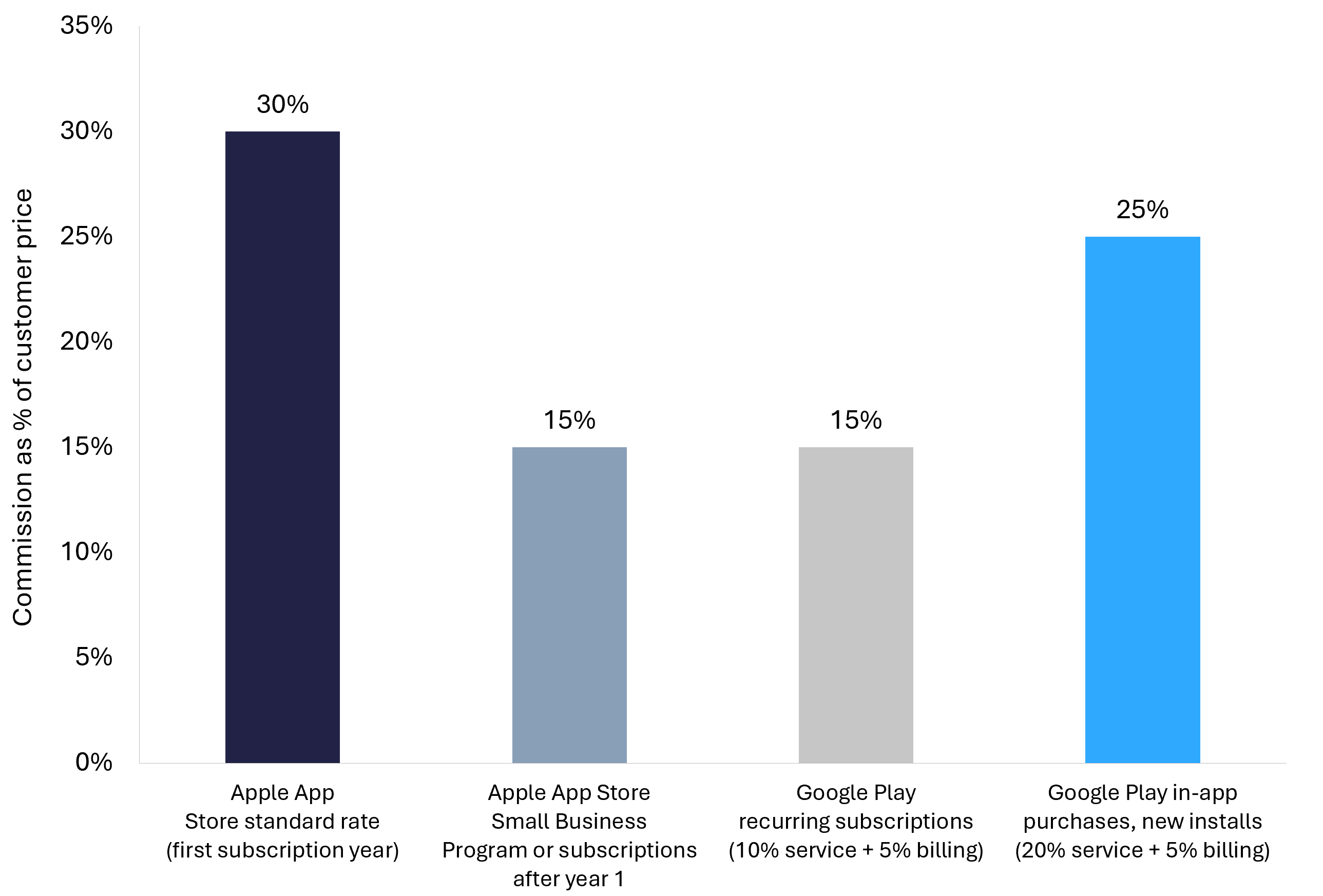
The practical implication is simple. Map every dollar of revenue to a storefront, a commission schedule, and a cohort, and present that map in the information memorandum. A subscription app that has routed eligible transactions through lower-cost paths, or that can show where Android margin expands under the new fees, carries a structurally better earnings line than an identical app paying standard commission on everything. Buyers pay for that difference.
Fee structure is now a margin variable buyers model line by line. A seller who has already done the math sets the frame; a seller who has not lets the buyer set it.
Selling Your Mobile App in 2026: The Next Step
Knowing how to sell a mobile app in 2026 comes down to five things: price it on the earnings you keep, bring the cohort and channel evidence that matches your monetization model, match the process to your size tier, negotiate structure with as much care as price, and plan the App Store and Google Play transfers before anyone initiates them. The market is doing its part: consumer app spend set a record in 2025, global M&A is on track for one of its strongest years, and a dedicated app acquirer just became a public company. Buyers are selective, and that selectivity is why preparation converts directly into price.
The most useful next step is knowing your actual number rather than a range from an article. FE International provides a confidential, no-obligation valuation drawing on comparables from more than 1,500 completed transactions across mobile apps and every other technology vertical. Ready to find out what your app is worth? Get a free valuation from FE International.
Founders weighing timing can also read our mid-year 2026 technology M&A report for the wider market picture, or the guide to building, valuing and selling an app for the operational detail behind each valuation driver.