

How to sell a cybersecurity company in 2026: prove recurring revenue and retention, get your certifications and your own security record in order, then run a confidential, competitive process across platform consolidators, private equity and defense-adjacent strategics. Buyers pay premiums for ARR mix, certifications, retention and threat coverage, and prepared sellers are closing at strong prices.
Security is where technology buyers are putting their money in 2026. 84% of security and finance leaders expect their cyber budgets to rise over the next twelve months, up from 78% a year ago, and acquirers follow budgets. In October, Proofpoint, which is owned by Thoma Bravo, agreed to buy Varonis for about $6.3 billion in cash, a 52% premium to the share price before sale rumors began.
That is the backdrop for any founder working out how to sell a cybersecurity company this year. Demand is deep, the buyer pool is the widest we have seen, and the difference between an average outcome and a premium one comes down to preparation and process.
This guide is the sell-side companion to our cybersecurity business valuation guide and our analysis of cybersecurity M&A in 2026. Those cover multiples and market data. Here we cover the key factors to consider when selling a cybersecurity company: who is buying, what they pay extra for, what they test in due diligence, and how to design a process that keeps more than one buyer at the table. It applies to security software companies, managed security service providers (MSSPs), consultancies and testing firms alike.
One note on scope. If you were looking for advice on selling security products to customers, that is a different subject. This article is about selling the company. And if you want a number before reading further, you can get a free valuation from our team at any point.
What Does Cybersecurity M&A Look Like for Sellers in 2026?
Cybersecurity M&A in 2026 is shaped by three trends: budgets that keep growing, platforms that are absorbing point products, and a second wave of buyers from outside the security industry. For a seller, the market analysis is short. There are more bidders, and each has a different reason to buy.
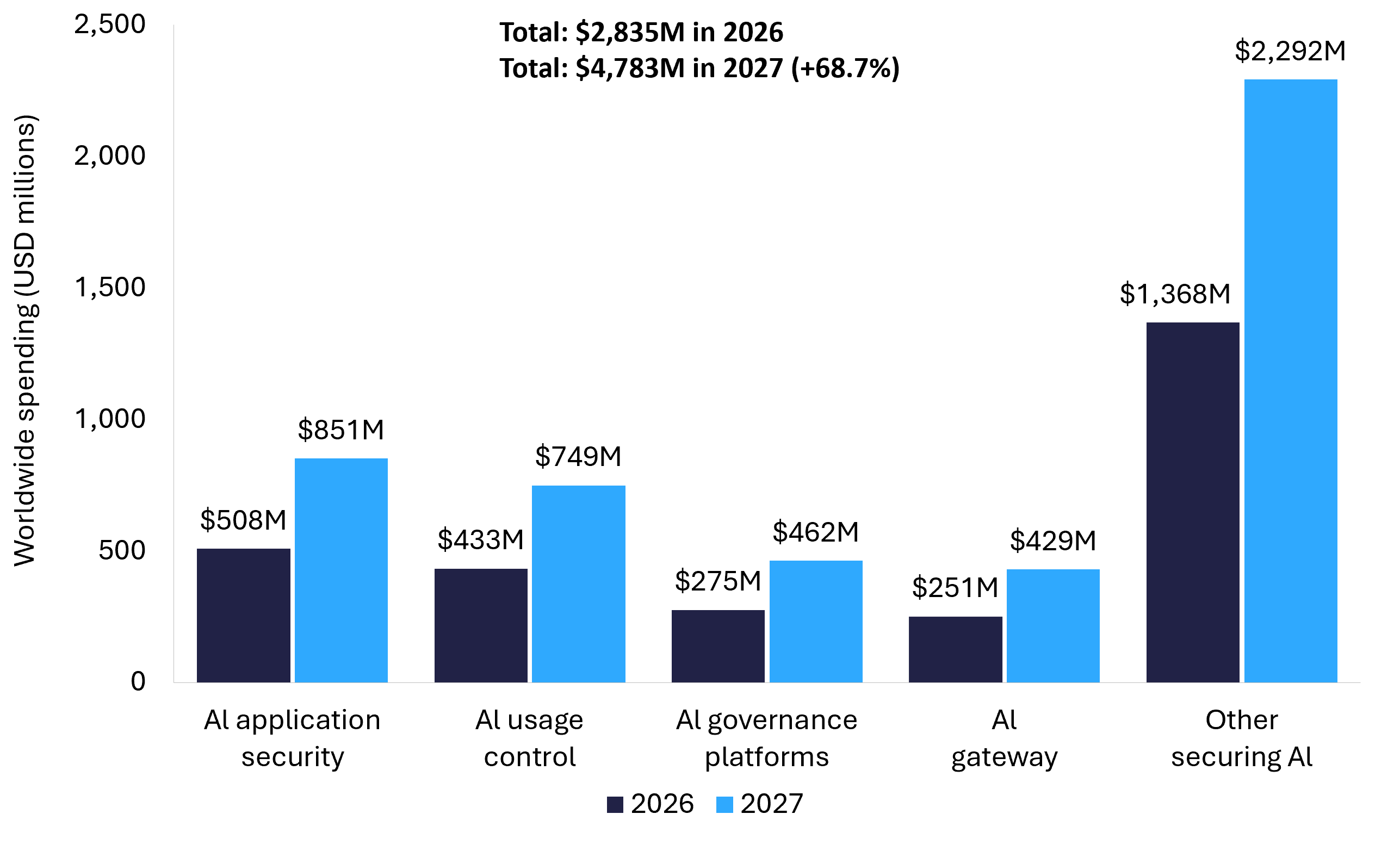
Start with the industry growth projections for 2026. Worldwide information security spending is forecast to reach $244 billion in 2026, growing 11.6% in constant currency. The fastest line inside that total is new. Spending on securing AI itself is projected to reach almost $4.8 billion in 2027, up 68.7% in a single year, and to approach $7.7 billion by 2028.
Threat data points the same way. Cybercrime losses reported to the FBI reached $20.9 billion in 2025, up 26% on the year before, across more than one million complaints. Each of those incidents is a reason for a board to approve security spend, and each budget line is a reason for an acquirer to own the product or service behind it.
Consolidation is the second trend. Point-solution vendors are being absorbed faster than new ones launch, and platform players are buying their way to end-to-end security stacks: Palo Alto Networks closed its CyberArk acquisition in February and ServiceNow completed its purchase of Armis in April. Google's $32 billion acquisition of Wiz closed in March.
Capital is the third trend. Software valuations reset early in the year, which gave buyers and sellers clearer benchmarks and pushed investors toward categories with mandated demand. Private equity has ample dry powder to do deals and is concentrating it where conviction is strongest. The Varonis agreement, funded with equity from Thoma Bravo and committed debt financing, shows where that conviction sits. Our cybersecurity M&A analysis tracks deal counts and landmark transactions in more depth.
In 2026, budgets, platform strategy and private capital all point at security, and the trends in cybersecurity mergers and acquisitions favor prepared sellers.
Who Buys Cybersecurity Companies in 2026?
Four groups buy cybersecurity companies in 2026: platform consolidators, private equity firms and the platforms they back, defense-adjacent strategics, and adjacent strategics from payments, consulting and enterprise software. Knowing how to find buyers for a cybersecurity firm starts with knowing which of the four has a reason to own your product, your customers or your team.

Platform consolidators
Platform consolidators are the large security vendors and cloud providers buying products to complete a stack. If you plan to sell a cybersecurity company to a competitor or a larger peer, this is the group across the table. They buy category leaders and gap-fillers in identity, data, cloud and AI security, they pay in cash or stock from the balance sheet, and they move fast when the fit is obvious. What they pay for is time. A product that slots into their platform in two quarters is worth more to them than one they would need two years to build. Because these buyers are often competitors, what you share and when needs planning, which we cover in the process section.
Private equity and PE-backed platforms
Knowing how to sell a cybersecurity company to private equity starts with what a sponsor is buying: cash flow it can grow and sell again. A private equity firm underwrites retention, margin and the add-on pipeline, uses debt alongside equity, and often asks founders to roll part of their proceeds into the new company. Sponsors buy at two levels. At the top they fund platform deals such as Proofpoint's agreement for Varonis. Below that, PE-backed platforms in managed security, testing and compliance add smaller firms regularly, which is where most MSSP and consultancy owners will meet them. Sponsors are sellers too. BioCatch was owned by Permira and other investors when Visa agreed to buy it, so a private equity deal today can be a step toward a second security company exit later.
Defense-adjacent strategics
Defense-adjacent strategics are defense primes, government technology integrators and critical-infrastructure specialists buying sovereign and mission-grade security. They have been active through the second half of 2026. Airbus Defence and Space completed its acquisition of Quarkslab on October 1, after buying Infodas in 2024 and Ultra Cyber in March 2026. Days later, SAIC completed its purchase of Information Security Corporation, a maker of encryption and credential management software. And the $3.25 billion Dragos transaction, in industrial security, was the largest M&A deal of the third quarter in defense technology. These buyers pay for cleared people, cryptography, operational technology expertise and customers inside government. They also bring approval steps, which belong in your timetable.
Adjacent strategics
The fourth group comes from outside the security industry. Visa agreed in August to buy BioCatch, a fraud-detection company. ServiceNow paid $7.75 billion for Armis, the largest acquisition in its history. Accenture, which has grown its security business from $700 million of revenue in 2016 to $10 billion, was the buyer in the Dragos deal, taking a majority stake, and bought two smaller security software firms alongside it. IonQ, a quantum computing company, agreed in October to acquire Elisity, a zero trust company. Payments networks, consultancies, workflow platforms and hardware companies are buying security because it makes their core product safer and harder to replace. They often value a target on what it does for their own revenue, which can put them at the top of the bidding.
How do you choose the right buyer for a cybersecurity company?
Choose the buyer whose reason for owning the company still holds two years after closing. Price matters. So do certainty of closing, how much of the price is cash, what happens to the team, and whether the product keeps its roadmap. The practical rule is to avoid picking a buyer type in advance. Build the list across all four groups and let the process show who values the business most.
Selling a cybersecurity company internationally adds a review step, not a barrier. In the United States, CFIUS reviews certain foreign investments for their effect on national security. In the United Kingdom, cryptographic authentication, data infrastructure and defence sit among 17 types of acquisition that must be notified. Airbus closed Quarkslab only after regulatory approvals. Cross-border buyers are a real part of the pool, and the approval path simply belongs in the plan from the first day.
The widest buyer pool the security industry has had is only an advantage if your process reaches all of it.
What Commands the Premium in a Cybersecurity Company Sale?
Four things command the premium: ARR mix (the share of annual recurring revenue in total revenue), certifications, retention and threat coverage. Each one removes a specific risk from the buyer's model, and each can be improved in the year before a sale. If you are asking how to increase the value of a cybersecurity company before selling it, start with these four.

ARR mix
Buyers do not price revenue. They price types of revenue. Expect yours to be split into contracted recurring revenue from software and managed services, repeat services such as annual testing tied to a compliance calendar, one-off projects, and resale of third-party licenses and hardware. The first group earns the highest value and the last earns the least, because resale margin belongs mostly to someone else. Report revenue and gross margin by type for the past three years, move repeat project clients onto retainers or subscriptions, and lengthen contract terms where customers will agree. Two companies with identical revenue can end up valued on different methods, one on recurring revenue and one on earnings.
Certifications
Certifications raise value in a sale because they transfer. A buyer that acquires a certified company skips the audit queue and inherits the right to sell into regulated customers. SOC 2 and ISO 27001 are the baseline for commercial buyers. Government-facing credentials carry more weight, and the rules moved in 2026. FedRAMP, the US federal cloud security program, has declared that the pilots are over and its simplified 20x route is in wide-scale adoption. On CMMC, its certification scheme for defense contractors, the Pentagon suspended Phase 2 third-party certification requirements in July while the program is reviewed, with Phase 1 self-assessments still in force. Sellers serving defense customers should present what they hold today: assessment scores, any Level 2 certificates and their NIST SP 800-171 implementation. In Europe, NIS2 sets a common security framework across 18 critical sectors, so customers in those sectors need suppliers that can evidence their controls. To use certifications well in a sale, show the certificate, its scope, the latest audit report and the revenue that depends on it.
Retention
Retention is the number buyers trust most, because it is the hardest to dress up. Show gross revenue retention, net revenue retention and logo churn by annual cohort, built from billing data instead of a summary slide. In our deal work, net revenue retention above 110% and gross retention above 90% are the levels that move a security company toward the top of its range. Services firms should show the repeat rate of their top clients and the share of revenue under multi-year agreement. If retention dipped in one period, explain it before a buyer asks. A known cause with a fix is a footnote. An unexplained dip is a price discussion.
Threat coverage
Threat coverage is the breadth and relevance of what you protect against, measured against where budgets are heading. In 2026 that means AI systems, identity for people, machines and agents, data, cloud and operational technology. AI application security and AI usage control are forecast to be the two largest segments of securing-AI spend in 2027, at $851 million and $749 million, and both are drawing a wave of new entrants. A company that covers a threat category an acquirer cannot yet address is worth more to that acquirer than its revenue alone suggests. Prove coverage with evidence: a map of the attack techniques you detect, independent test results, detections per customer, and for managed services, measured time to detect and respond.
Intellectual property and team
Intellectual property in a cybersecurity company sale adds to the price when you can prove you own it. That means signed invention assignments from every employee and contractor, a clean open-source inventory, and clear title to detection content, models and the data used to train them. People are priced too. When IonQ agreed to buy Elisity, it set aside $100 million in restricted stock units for continuing Elisity employees on top of the purchase price. Scarce security engineers are an asset line in a buyer's model, and a seller who can show low attrition and a second layer of leadership gets paid for it.
How do buyers value a cybersecurity business for sale?
Buyers value a cybersecurity business for sale with one of three methods, chosen by size and growth. Owner-operated firms are valued on a multiple of seller's discretionary earnings, the profit available to a single owner after adding back their pay and one-off costs. Profitable companies with a management team are valued on a multiple of EBITDA. High-growth companies with recurring revenue are valued on a multiple of revenue or ARR. The premium drivers above decide where you sit inside the range. Our valuation guide sets out the methods and the 2026 ranges in full.
Premiums in security are paid for proof: revenue split by type, certifications a buyer inherits, retention shown by cohort, and coverage of the threats budgets are moving toward.
What Do 2026 Cybersecurity Company Sales Case Studies Show?
Four cybersecurity company sales from 2026 show how the buyer groups behave in practice and what each one paid for.
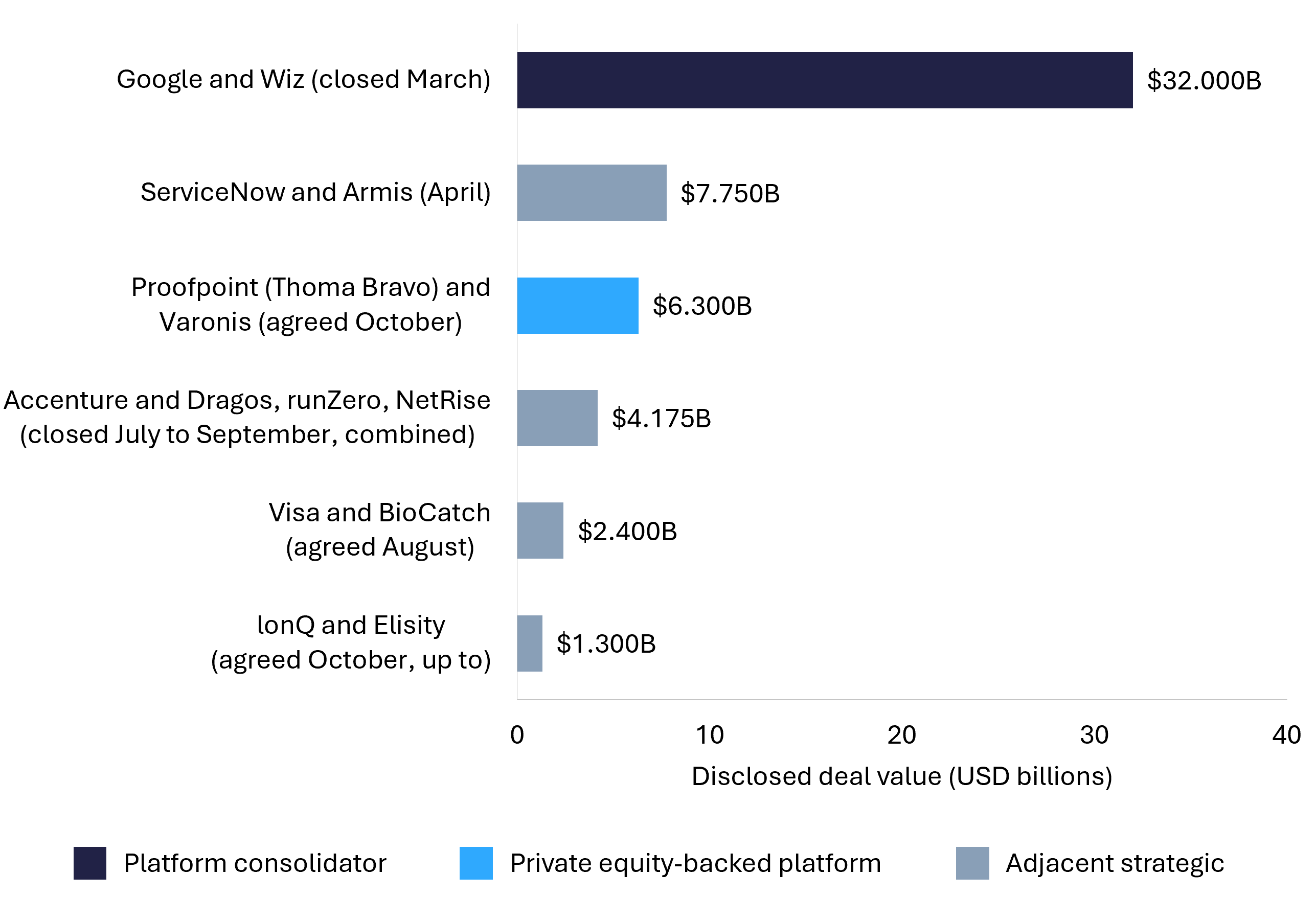
- Varonis and Proofpoint (private equity-backed platform). Varonis accepted $49.75 per share in cash, about 8.4 times trailing revenue, after a board-led evaluation that included outreach to a range of strategic and financial buyers. The lesson for smaller sellers is the process, not the size. A listed company with two decades behind it still ran a broad, competitive process, and competition set the price.
- BioCatch and Visa (adjacent strategic). A payments network agreed to pay $2.4 billion in cash, with closing expected by the end of its fiscal second quarter of 2027 once regulators approve. Buyers outside security pay for capabilities that protect their core business, and sponsor ownership was a step toward that exit, not the end of the road.
- Quarkslab and Airbus (defense-adjacent strategic). A company of about 100 people, founded in 2011, was bought by Airbus Defence and Space and closed after regulatory approvals. Team size was not the constraint. Sovereign capability was the asset, and approvals were part of the calendar.
- Elisity and IonQ (structure). The headline was an all-stock deal worth up to $1.3 billion. The detail was that up to $150 million of it is an earnout tied to performance. Headline value and value at closing are different numbers, and the negotiation lives in the gap.
The 2026 deals teach the same lesson four ways: buyers pay most for capability they cannot build in time, and structure decides what the seller keeps.
How Do You Prepare a Cybersecurity Company for Sale?
The steps to prepare a cybersecurity company for sale are the same at every size: put the financials in order, prove retention, document your own security, clean up contracts and intellectual property, reduce dependence on the founder, and build the data room before the first buyer call. Start about a year ahead. Here is the order we would work in.
- Prepare the financials. To prepare financials for selling a cybersecurity firm, assemble three years of monthly, accrual-basis statements, a bridge from booked revenue to recurring revenue, deferred revenue schedules and gross margin by revenue type. For larger companies, a sell-side quality of earnings report finds the adjustments before a buyer does.
- Prove retention. Build cohort tables from billing data and a renewal calendar for the next four quarters.
- Document your own security. Collect policies, penetration test reports, the incident log, certifications and a software bill of materials. A security company is expected to practice what it sells.
- Clean up contracts. Check every customer and supplier agreement for assignment and change-of-control clauses, termination rights, liability caps and renewal terms.
- Confirm ownership of intellectual property. Close any gaps in invention assignments and open-source compliance.
- Reduce dependence on the founder. Hand customer relationships and technical decisions to a second layer of leaders, and make sure the security operations team does not rest on one or two people.
- Build the data room and the story. Organize the documents above into a staged data room, and write down why the company wins, in numbers.
The common challenges in selling cybersecurity companies are predictable: project-heavy revenue, a founder who holds the key relationships, thin documentation of the company's own controls, and contracts that need consent to transfer. Each one is fixable with lead time. Each one becomes a price conversation if the buyer finds it first.
Preparation is cheaper than a price reduction, and it is the only part of a sale you can finish before a buyer is involved.
How Do You Handle Cybersecurity Company Due Diligence?
Handle cybersecurity company due diligence by running it on yourself first. Buyers of security businesses test six areas: revenue quality, the company's own security record, product and intellectual property, customer contracts, compliance evidence, and people. A seller who has the answers assembled sets the pace of the deal.
- Revenue quality. Recurring versus resale revenue, retention by cohort, customer concentration and how revenue is recognized.
- Your own security record. Controls, testing history and every incident. Disclose past incidents in full. A documented incident with a clear remediation record is a diligence item. One that surfaces after signing is a breach of the purchase agreement.
- Product and intellectual property. Code scans, open-source licenses, architecture, and how much work it takes to integrate the product into the buyer's platform. For AI features, expect questions on model provenance and rights to training data.
- Customer contracts. Assignment, change of control, service levels and liability. Government contracts bring their own transfer rules.
- Compliance evidence. Certificates with their scope, auditor reports and assessment scores, checked against what your sales materials claim.
- People. Key employees, retention risk, clearances where relevant, and restrictive covenants.
What are the legal considerations in selling a cybersecurity company?
The legal considerations in selling a cybersecurity company concentrate in five places: representations about breach history and data handling, ownership of intellectual property, assignability of customer and government contracts, approvals for foreign or defense-related buyers, and employment terms such as non-competes and equity. Representation and warranty insurance is now common in technology deals and can replace part of the escrow, which keeps more cash in the seller's hands at closing. Bring in an M&A lawyer with security deal experience before the letter of intent, because the terms set there are hard to reopen.
How do cybersecurity regulations affect a company sale?
Cybersecurity regulations affect a company sale in three ways. They create demand a buyer can underwrite, because customers in regulated sectors must keep buying. They turn your certifications into transferable assets. And they can add an approval step between signing and closing when the buyer is foreign or the customers are governments. Regulation rarely blocks a well-prepared deal. It rewards the seller who mapped it early.
In cybersecurity due diligence, buyers read your own controls as a preview of your product. Show them a company that practices what it sells.
How to Sell a Cybersecurity Company: Designing the Process
The best strategy for selling a cybersecurity company is a confidential, staged and competitive process. Prepare first, approach a researched list across all four buyer groups at the same time, and keep at least two credible bidders engaged until the letter of intent is signed. The stages run in this order.
- Valuation and positioning. Agree a realistic range and the two or three facts that make the company worth more to specific buyers.
- Marketing materials. To market a cybersecurity company for sale you need an anonymized teaser, a confidential information memorandum, a financial model and a management presentation. The marketing is targeted and private, never a public listing.
- Buyer outreach. Contact strategic, private equity and adjacent buyers in parallel, under non-disclosure agreements.
- Indications of interest and management meetings. Compare early offers on price, structure and certainty, then give the strongest bidders time with the team.
- Letters of intent. Negotiate price, structure and exclusivity while more than one buyer is still active.
- Confirmatory diligence and the purchase agreement. The buyer verifies what it was told, and the lawyers turn the letter of intent into a contract.
- Signing, approvals and closing. Funds move once conditions are met, including any regulatory approvals.
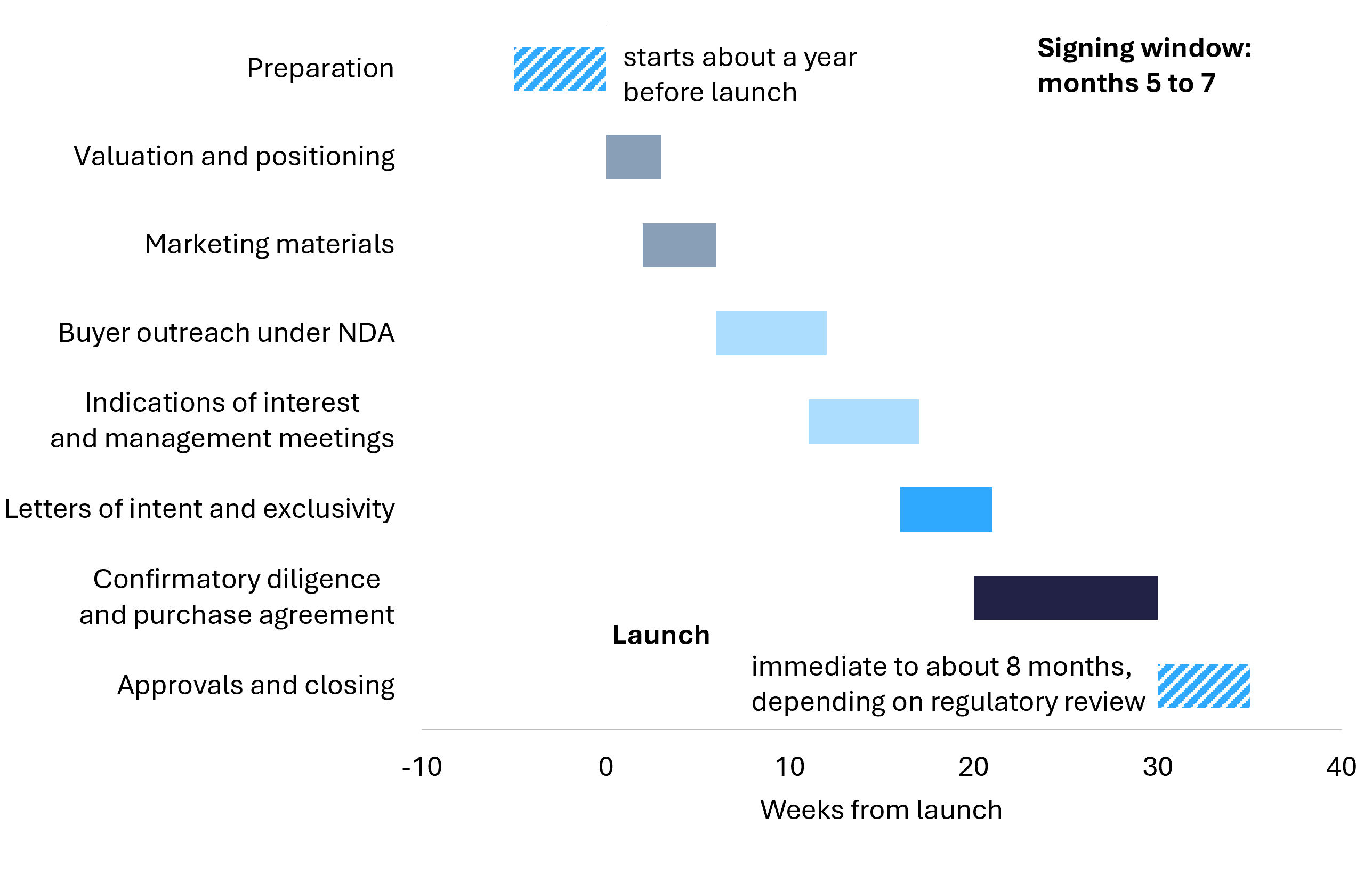
In our experience, a well-prepared company reaches signing five to seven months after launch. Closing can follow at once when no approvals are needed: SAIC announced its Information Security Corporation deal as already complete. It takes longer when regulators are involved. Airbus agreed to buy Quarkslab in April and closed in October, and Visa expects its BioCatch purchase, signed in August, to close by the end of its fiscal second quarter of 2027.
How do you maintain confidentiality when selling a cybersecurity firm?
Maintain confidentiality with an anonymized teaser, a signed NDA before any identifying detail, a staged data room and a hold list for direct competitors. In security the stakes are higher than usual, because customer lists, detection logic and vulnerability data are sensitive in their own right. Release them last, in summary form first, and to the smallest group that needs them. Inside the company, limit knowledge of the sale to the people required to run it until a deal is signed.
Do you need a broker or an M&A advisor to sell a cybersecurity company?
If you are working out how to choose a broker for selling a cybersecurity company, start with the difference in roles. A business broker typically lists smaller companies and fields inbound interest. An M&A advisor or investment bank runs an outbound, competitive process with buyers that have corporate development teams and diligence advisers of their own. Most security companies with meaningful recurring revenue need the second. Ask any adviser how many technology transactions they have completed, which of the four buyer groups they can reach, who runs the process day to day, and how they protect confidentiality. FE International's investment banking team runs sell-side processes for technology companies through FE Capital Markets, an SEC-registered broker-dealer, with sell-side quality of earnings work, a network of strategic, private equity and family office buyers, and a process built to create competitive tension.
Process design is the one premium driver that sits entirely in the seller's hands.
How Do You Negotiate the Sale of a Cybersecurity Business?
Negotiate the sale of a cybersecurity business on structure and certainty as well as price, and do the hard negotiating before you grant exclusivity. Once the letter of intent is signed, your alternatives leave the room. These are the terms that move the outcome.
- Cash at closing. Ask what you receive on the day, not what the announcement will say.
- Earnouts. Deferred payments tied to performance are common in security deals. Tie them to revenue or recurring revenue, define the measurement in the agreement, and limit the buyer's ability to change the business in ways that affect it.
- Rollover equity. Private equity buyers often ask founders to reinvest part of the proceeds. It can be worth more than the first payment, so diligence the buyer's plan as carefully as they diligence yours.
- Stock consideration. When a strategic pays in shares, negotiate how the share count is set. IonQ's offer for Elisity fixes it by an average trading price inside a floor and a cap.
- Retention. Pools for key staff sit alongside the price. Agree who is covered and on what terms.
- Representations, escrow and insurance. Disclose thoroughly, cap your exposure, and move breach-history risk into an insurance policy where you can.
- Approvals. Agree who carries the cost if a regulator takes longer than planned.
What exit strategies are open to cybersecurity business owners?
A security company exit can take several forms. The main exit strategies for cybersecurity business owners are a full sale to a strategic buyer, a majority sale to private equity with rollover equity, a minority growth investment, a merger with a peer, and the sale of a single product line. Accenture took a majority stake in Dragos, not full ownership. The right structure depends on how much risk you want to take off the table and how long you want to keep building.
The headline price is what gets announced. Structure is what gets paid.
How Do You Sell an MSSP, a Startup or a Mature Security Company?
The process is the same for every security business. The emphasis changes with the model and the stage.
How do you sell an MSSP?
To sell an MSSP, lead with the quality of recurring revenue. Buyers separate managed service revenue from license and hardware resale, check gross margin by service line, and read every contract for term, renewal and assignment. Demand is on your side. Organizations are turning to managed services, with AI the leading focus area, as they face a shortage of specialist cyber and AI talent. The most active MSSP buyers are PE-backed platforms adding regional scale or specialist skills, alongside larger service providers building a security practice. They pay more for a round-the-clock operations center that does not depend on two or three analysts, measured detection and response times, compliance capability, and multi-year agreements in place of month-to-month terms.
Selling a cybersecurity startup versus an established company
Selling a startup cybersecurity company is a sale of product, team and trajectory. Revenue is small, so buyers price the gap you fill and the engineers who built it, and the structure usually includes stock, retention packages and earnouts. Selling a mature cybersecurity company is a sale of cash flow and customers. Earnings quality, retention and management depth carry the price, and private equity is usually at the table. Information Security Corporation had more than three decades behind it when SAIC bought it. Elisity was founded in 2019. Both found buyers in the same month.
How do you sell a cybersecurity company in a competitive market?
In a crowded category, sell the niche. Own a vertical such as healthcare, industrial operations or financial services, a regulated customer group, or a single threat category, and report the numbers for that segment on their own. A buyer comparing five similar vendors pays for the one with a defensible position in a market it wants to enter. A saturated market for products is still a seller's market for the few companies that can show a position nobody else holds.
How Do You Handle Employees and Clients During a Sale?
People and customers are the two things a buyer cannot replace after closing. Plan for both before the deal becomes public.
How to handle employee transitions during a cybersecurity company sale
Plan employee transitions before the letter of intent. Decide who needs to know and when, agree retention terms for key people as part of the negotiation, and ask every bidder what they intend for the team. In security, people are a large part of what is being bought. Analysts, researchers and cleared staff are scarce, and serious buyers budget to keep them. Tell the wider team at signing, with the buyer present and with answers on roles, pay and reporting lines ready.
How to communicate a cybersecurity company sale to clients
Communicate the sale to clients after signing and in a planned order. Obtain any contractual consents first. Call the largest accounts next, with the founder and the buyer on the line together. Then send a written notice to every customer that covers what stays the same: service contacts, service levels, data handling and certifications. Security customers ask one question before any other, which is whether their data and their coverage are affected. Have that answer in writing before the first call.
Conclusion: Planning a Security Company Exit in 2026
Knowing how to sell a cybersecurity company comes down to three disciplines. Know the buyer pool, because platform consolidators, private equity, defense-adjacent strategics and adjacent strategics each value a security business differently. Build the proof behind the premium, because ARR mix, certifications, retention and threat coverage only count when a buyer can verify them. And design the process, because competition between buyer groups is what turns a good company into a strong price.
Cybersecurity M&A is rewarding that discipline. Budgets are rising, platforms are buying, private capital is selective and well funded, and the pool of acquirers now reaches well beyond the security industry.
If you are considering a security company exit, start with a number. Get a free valuation from FE International and we will walk you through the likely buyer groups, the premium drivers that apply to your business and the preparation that moves the price. Our team has advised on more than 1,500 completed technology transactions with a 94.1% success rate, and the first conversation is confidential and costs nothing.