


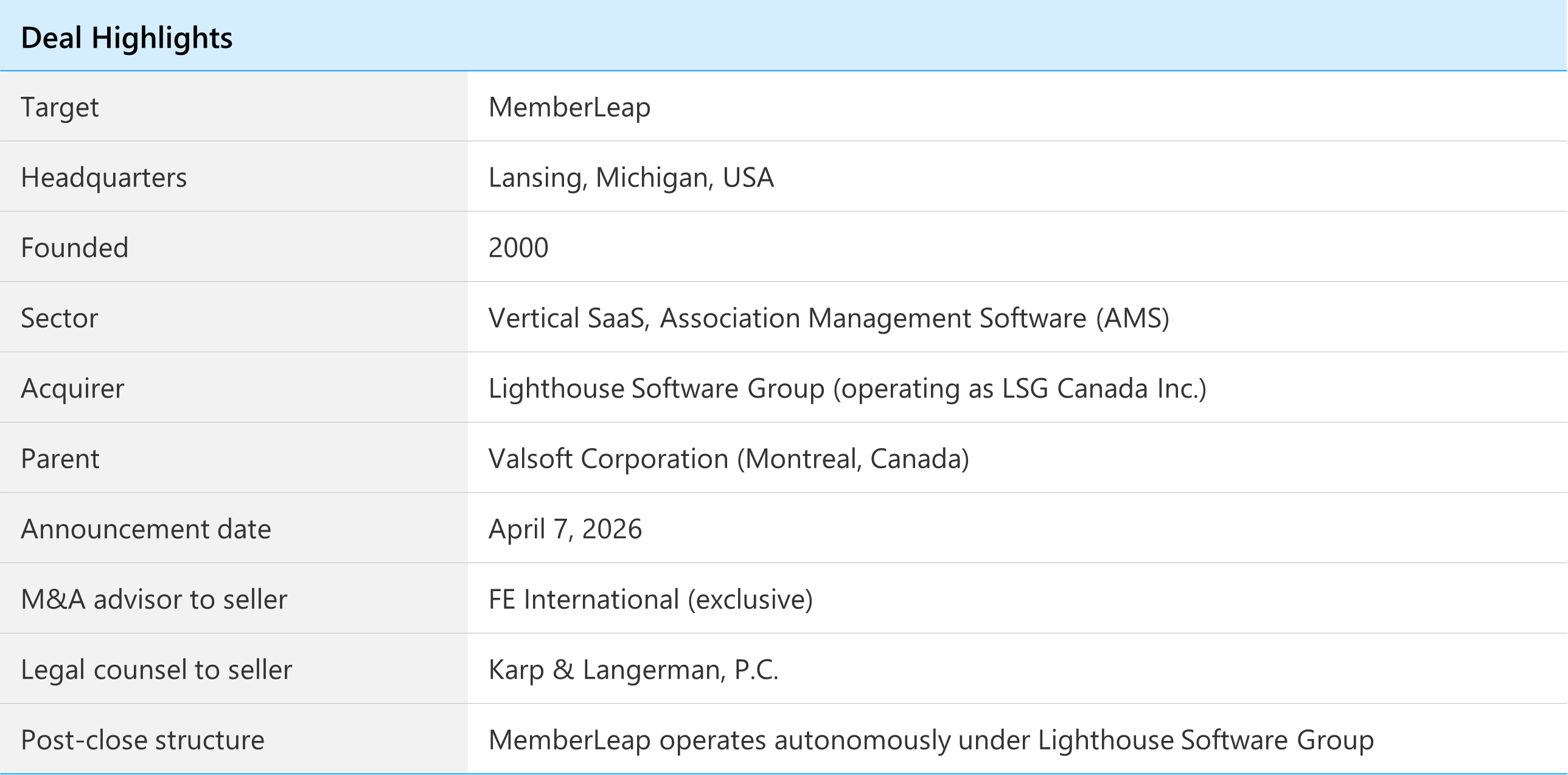
On April 7, 2026, Valsoft Corporation's Lighthouse Software Group announced the acquisition of MemberLeap, a Michigan-based association management software (AMS) company that has spent 25 years becoming the operating backbone for hundreds of nonprofits, trade associations, and membership organizations across North America. For founder and CEO Chris Vieth, the transaction marks the culmination of a quarter-century building one of the more quietly durable companies in vertical SaaS.
FE International acted as the exclusive M&A advisor to MemberLeap throughout the process, leading buyer engagement, valuation work, and transaction execution. The deal closed with Lighthouse Software Group, a decentralized operating entity of Montreal-based Valsoft Corporation, which specializes in acquiring vertical market software businesses and holding them for the long term. MemberLeap's legal counsel on the transaction was Karp & Langerman, P.C.
This case study walks through what made MemberLeap a compelling acquisition target, how Chris Vieth approached a career-defining exit, why Lighthouse Software Group and Valsoft proved to be the right home for the business, and what the transaction signals for other vertical SaaS founders thinking about a sale in the current market.
The Deal at a Glance
The transaction closed on April 7, 2026 after a competitive process managed by FE International. MemberLeap's leadership team and employees remain in place post-close, and the business continues to operate autonomously under the Lighthouse Software Group umbrella, with long-term capital and operational support from the broader Valsoft ecosystem.
Inside MemberLeap: 25 Years of Building a Category-Defining AMS
MemberLeap was founded in 2000 in Lansing, Michigan, with a focused thesis: membership-based organizations needed software purpose-built for how they actually operate. That meant member databases, dues billing, events, communications, websites, online learning, and commerce delivered in one integrated platform, not stitched together from a handful of horizontal SaaS tools that were never designed with an association executive's workflow in mind.
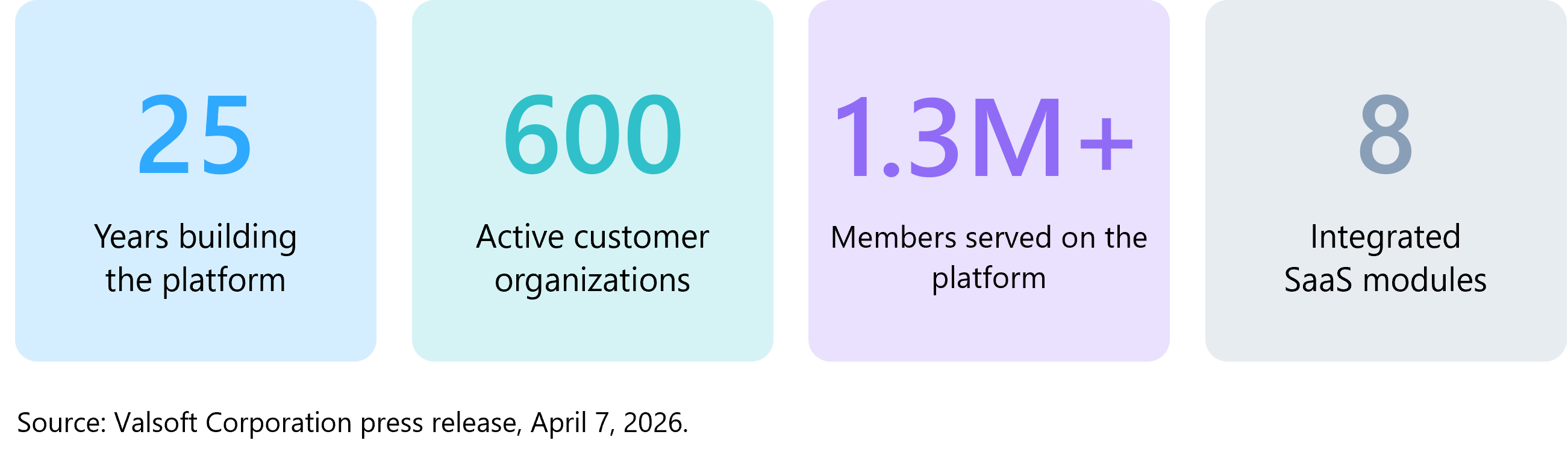
Over 25 years, Chris Vieth and his team turned that thesis into a proprietary, fully integrated AMS platform used by nearly 600 organizations, from small local chapters to large national associations. The platform reaches over 1.3 million members, according to the acquisition announcement, which gives a sense of the real-world footprint the software has built up across the nonprofit and membership sector.
The business fits a profile that is increasingly attractive to strategic acquirers in vertical SaaS. It serves a defined customer base with clear operational needs. Its platform is deeply embedded in daily workflows, which translates into high retention and reliable recurring revenue. And because the software spans so many functions in a single stack, switching away is genuinely hard for customers, which is a structural advantage very few horizontal SaaS businesses can claim.
AMS as a category rewards exactly this kind of depth. Associations are complex organizations with nonstandard billing cycles, multi-tier membership structures, committee governance, event and conference logistics, continuing education programs, and regulated nonprofit reporting obligations. Generalist CRM or marketing tools cover a fraction of that surface area, which means associations that try to build their operations on horizontal software tend to end up with a sprawl of subscriptions and a fragile set of integrations. A purpose-built AMS replaces that sprawl with a single system of record, and the customer who adopts one rarely wants to revisit the decision later.
Shaan Patel, Portfolio Manager at Lighthouse Software Group, captured that dynamic when announcing the deal. He described MemberLeap as an "exceptional product that has become a mission-critical operating system for hundreds of associations," and credited Chris Vieth with cultivating deep customer relationships over the business's 25-year history. That language reads almost like an acquirer's checklist for what makes a vertical SaaS business worth owning at premium terms.

Why Chris Vieth Chose to Sell Now
For founders who have built and run a company for two decades or more, the decision to sell is rarely about a single trigger. It is usually about alignment: finding a buyer whose long-term plans for the business match the founder's sense of responsibility to customers, employees, and the product itself.
In his own words, Chris Vieth framed the decision this way:
Building MemberLeap over the past 25 years and watching it grow into the platform it is today has been the highlight of my career. Valsoft and Lighthouse share our commitment to long-term thinking and putting customers first. I am confident that MemberLeap is in the right hands to continue serving the association community for decades to come.
That framing is common among founders we work with at FE International. The financial outcome matters, of course, but for a business like MemberLeap, where the customer relationships have been built over decades, cultural and operational fit often carries equal weight. Founders who have spent their careers answering directly to customers know exactly what happens when the wrong acquirer comes in: service quality drops off, product investment stops, long-tenured employees leave, and the customer goodwill that took years to build gets spent in a matter of months.
The commercial signals also supported the timing. MemberLeap had reached a level of product maturity, customer scale, and operational stability where a strategic acquirer could step in without disrupting the underlying business. That kind of readiness is what differentiates a premium sale process from a reactive one, and it is one of the reasons the transaction attracted strong interest from specialized vertical SaaS acquirers who evaluate dozens of opportunities before committing to one.
Running a Competitive Process for a Category-Leading AMS
When FE International engaged with MemberLeap, a few characteristics of the business shaped our approach to the sale. First, AMS is a vertical software category that specialized strategic acquirers understand well. The buyer universe for a business of MemberLeap's profile is narrower than a typical horizontal SaaS sale, but the buyers in it are sophisticated, well-capitalized, and actively looking for category-defining assets.
Second, Chris Vieth's priorities extended beyond price. He wanted a process that would surface serious buyers quickly, preserve confidentiality throughout, and ultimately place the business with an acquirer that would keep the team intact and continue investing in the product. That required careful positioning and disciplined buyer selection, not a brute-force outreach.
Our team leaned on the MemberLeap story in two ways during the process. On the qualitative side, we emphasized the depth of customer relationships, the mission-critical positioning of the platform in associations' daily operations, and the integrated breadth of the product suite. On the quantitative side, we highlighted the retention economics, the structural switching costs baked into an AMS deployment, and the recurring revenue profile that comes with serving an installed base of long-tenured nonprofit customers.
Positioning is where a vertical SaaS sale is genuinely different from a generalist one. A horizontal SaaS business often competes against a dozen close substitutes, and the sale story becomes a comparison exercise against a familiar set of benchmarks. A category-leading AMS does not have close substitutes in the same way. The story for buyers is not "here is another SaaS company with good metrics" but "here is one of a small number of platforms with a durable position in a defined niche." Getting that framing right in the buyer materials, in the management meetings, and in the diligence responses changes who engages and how seriously.
The outcome was a competitive process that produced strong buyer engagement and a definitive transaction with Lighthouse Software Group, an acquirer whose stated investment philosophy lined up with what Chris was looking for. The MemberLeap team remains in place, customers continue to be supported by the people they have always worked with, and the product roadmap continues under new ownership with long-term capital behind it.
For founders reading this, the lesson is straightforward. The value a well-run sale process captures is rarely just about the headline number. It is about running the right process to sell your technology business, with a buyer universe that actually understands what you have built and is prepared to back it for the long run. That work starts with a clear-eyed view of the business's defensibility, its likely acquirer set, and the founder's own non-financial priorities, all of which we help our clients articulate before the first conversation with a buyer.
Why Valsoft's Lighthouse Software Group Was the Right Home
Valsoft Corporation is a Canadian vertical market software specialist that acquires and holds software businesses for the long term, operating them through a set of decentralized operating entities. Lighthouse Software Group is one of those entities, with a specific focus on vertical software companies that deliver mission-critical solutions in their markets.
That model matters for sellers like Chris Vieth. Traditional private equity typically operates on a fund clock, which means businesses are often repositioned for a secondary sale within a defined hold period. Long-term vertical market software holders operate differently. They buy businesses with the intention of owning and growing them indefinitely, which lets the acquired company plan further out and avoid the disruption of another ownership transition in three to five years.
The practical implications for an acquired business are significant. Budget cycles can support multi-year product investments rather than quarter-to-quarter margin management. Hiring decisions can prioritize long-term capability building over short-term cost optimization. Customer relationships are insulated from the kind of churn that often follows a change of ownership, because the same people continue to answer the phones and run the implementations. And the leadership team can think about the business as something they still plan to be running in ten years, not something they are preparing for the next sale.
In practice, Valsoft and Lighthouse Software Group committed to MemberLeap continuing to operate autonomously under new ownership. Shaan Patel made this explicit when he said the group looks forward to "investing in the product, supporting the team, and expanding MemberLeap's reach under the Lighthouse umbrella." The leadership team stays, the employees stay, the product roadmap stays, and the customer relationships stay. What changes is the capital behind the business and the operational expertise that comes with being part of a larger group of vertical software companies.
For the AMS category specifically, the fit is also strategic. Lighthouse Software Group has been building its presence in the community and membership management vertical software space, and MemberLeap strengthens that portfolio with a proven integrated platform serving a well-defined customer base. Our role at FE International was to surface that strategic logic clearly during the process so that buyers who shared Chris's long-term view would see MemberLeap as the right fit for their platform, not a one-off acquisition.
This kind of alignment, between founder intent, acquirer philosophy, and business fundamentals, is what defines a clean exit. When all three line up, the transaction tends to close faster, close cleaner, and produce better outcomes for customers and employees on the other side of the transition. The MemberLeap deal has all three lined up, which is why it reads as a textbook example of a well-positioned vertical SaaS exit.

What This Exit Signals for Vertical SaaS Founders
The MemberLeap transaction reflects a broader pattern we see across vertical SaaS. Mission-critical niche platforms with long customer tenures, integrated product suites, and durable recurring revenue continue to attract strong interest from specialized acquirers who understand the category. Buyers are increasingly sophisticated about the difference between horizontal SaaS exposure and genuine vertical defensibility, and they are willing to pay for the latter.
Founder-led businesses that have built quietly for a decade or more, without aggressive growth capital and without the operational drag that often comes with it, are well-positioned in this environment. Profitability, retention, and product depth all translate into acquirer confidence, which translates into stronger processes and better outcomes at close. A business that has never needed outside capital to survive sends a very different signal to an acquirer than one that has been propped up by successive funding rounds, and that signal matters at the valuation table.
The other signal worth noting is the continued availability of long-term, operationally-aligned capital for founders who want to sell but want to see their business stewarded well afterward. Vertical market software specialists like Valsoft are actively looking for opportunities where the founder has built something worth keeping, and they have the patience to do it. That widens the set of viable acquirers for founders whose priorities extend beyond a pure financial outcome, and it changes what a well-run process can deliver.
For founders in SaaS, ecommerce, agencies, AI, cybersecurity, EdTech, FinTech, and marketplace apps who are thinking about an exit in the next 12 to 36 months, MemberLeap's transaction is a useful reference point. A well-built business, well-positioned in its category, engaged with the right advisory team at the right time, remains one of the most reliable paths to a high-quality sale in any market environment.
Conclusion
The MemberLeap transaction is a clean illustration of what happens when a founder-built, vertically-focused SaaS business meets the right acquirer at the right moment, supported by a process designed around the founder's priorities. Chris Vieth spent 25 years building a platform that became mission-critical to hundreds of associations, and the exit to Valsoft's Lighthouse Software Group places the business where it can keep serving those customers for the decades ahead.
If you are a founder in SaaS, ecommerce, agencies, AI, cybersecurity, EdTech, FinTech, or marketplace apps thinking about an exit, the value of working with an advisor who knows your category, understands your buyer universe, and can run a process designed around your specific priorities is hard to overstate. That is the work FE International does every day, and the MemberLeap transaction is one of many examples of what a well-matched process can deliver. If you would like to explore what your business might be worth, you can request a free SaaS valuation, or read more case studies and deal announcements from recent FE International transactions for a founder at the right stage of the business.