
Global dealmaking is running hot. M&A activity reached a record $4.93 trillion in 2025, the most active year ever measured by both deal count and value, and the momentum carried straight into the new year with a record $1.6 trillion in the first quarter of 2026, up 50.6% year over year. Technology led the way. For founders of SaaS, ecommerce, agency, AI, cybersecurity, edtech, fintech, and marketplace app businesses, the window to a strong exit is wider than it has been in years.
The opportunity only turns into a result when the seller picks the right path to market. Two names come up often when tech founders research how to sell: FE International and Quiet Light Brokerage. They can look similar at a glance, but they run on different models, serve different ends of the market, and tend to produce different outcomes for sellers in the $1M to $100M+ range.
This guide compares the two across every dimension that moves a final sale price: service model, track record, vertical depth, buyer quality, confidentiality, and deal execution. It also covers where the FE International M&A Platform fits for smaller businesses, for buyers and sellers alike, and what the 2026 market means for anyone considering a sale this year. The short answer up front: FE International gives founders a full-service home for the entire size range, an advisory practice for larger and more complex deals and a dedicated M&A Platform for businesses under $1M.
One more thing is worth saying before the comparison. A market this active is also a selective one. Buyers have more options and are disciplined about where they commit, which means a generic listing competes against everything else for attention, while a well-prepared, well-positioned business stands out. The path a seller chooses shapes which of those two a buyer sees. That is what this comparison is really about.
.png)
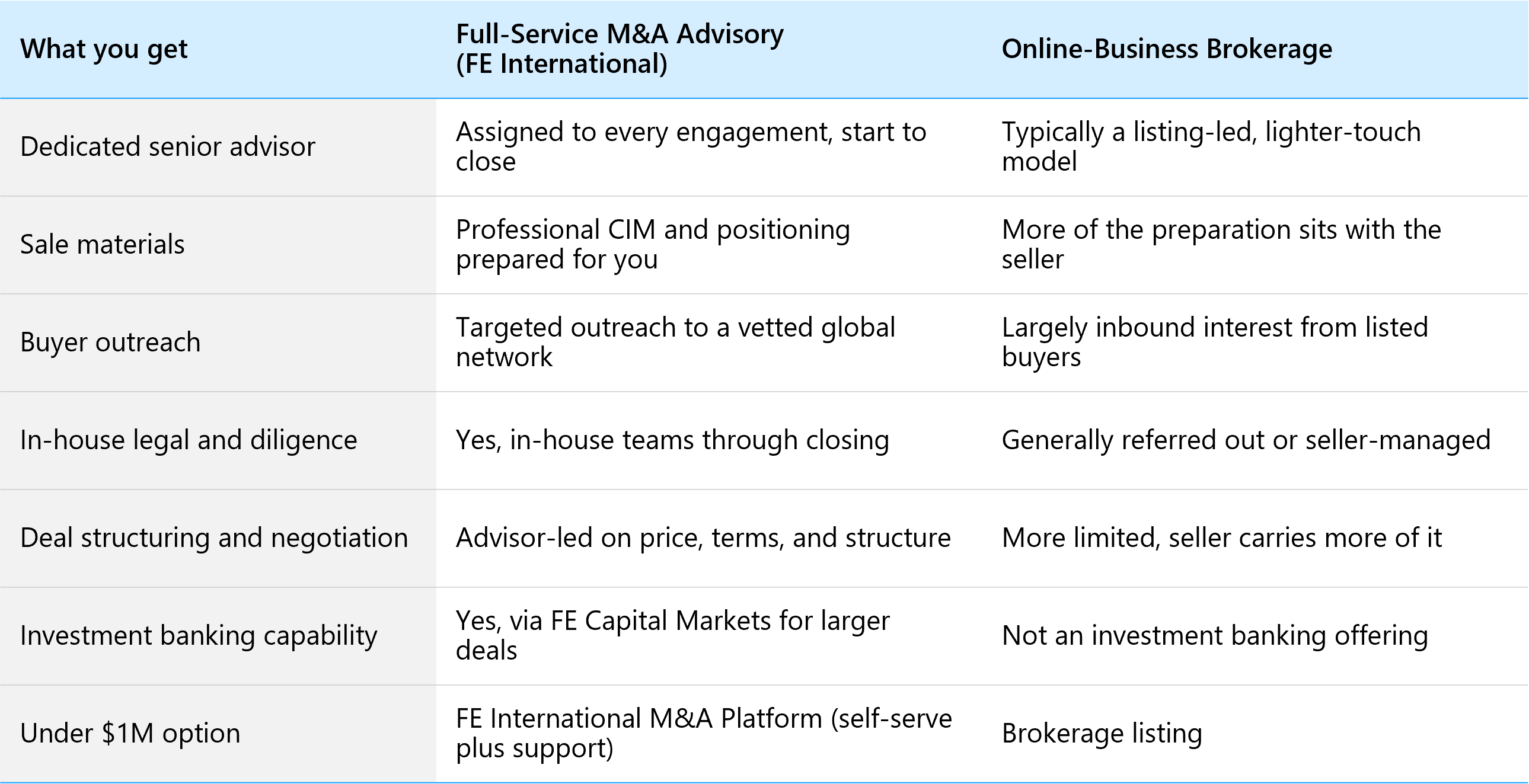
Two Different Models: Full-Service M&A Advisory vs Online-Business Brokerage
The headline difference is structural. FE International is a full-service M&A advisory firm founded in 2010, with a dedicated senior advisor assigned to every engagement. The firm has completed over 1,500 transactions with a combined value exceeding $50 billion, operates with a 94.1% success rate, and runs offices across three continents in New York, San Francisco, Miami, London, Mumbai, and Warsaw. For businesses worth $1M to $100M+, FE International's advisory practice manages the whole transaction end to end: senior advisor assignment, professional Confidential Information Memorandum (CIM) preparation, buyer outreach across a vetted global network, negotiation, deal structuring, in-house legal, due diligence, escrow facilitation, and post-close transition.
Quiet Light Brokerage operates as an online-business brokerage. The brokerage model centers on listing a business and connecting it with interested buyers, with the seller carrying more of the process. It is a recognized name in the online business space, particularly at the smaller end of the market.
Here is the simplest way to frame it. A full-service advisor runs the sale for you, including the parts most founders have never done before, and stakes its own reputation on the outcome. A brokerage gives a seller a listing and visibility, then leaves more of the execution to the seller. One owns the result. The other supports it.
For a tech business worth $1M or more, that gap has direct financial consequences, and the academic evidence is consistent. Across thousands of private company sales, sellers who hired M&A advisers received significantly higher acquisition premiums, even after accounting for who chooses to hire one. More recent deal-level data points the same way: advisor effort has a measurable influence on the prices buyers and sellers agree to. Better preparation, broader buyer outreach, and stronger negotiating position show up in the final number.
The mechanism behind that finding is simple. A structured sell-side process puts a business in front of multiple qualified buyers at once and runs them on a timeline, which creates genuine competition. When buyers know they are not the only party at the table, they sharpen their offers on price and terms. A single inbound buyer, by contrast, has every incentive to move slowly and anchor low. The advisor's core job is to create that competitive tension and hold it through to signing, and it is difficult to replicate without a dedicated team and a deep buyer network.
FE International built the M&A Platform channel precisely because not every business needs the full advisory experience. For tech businesses under $1M, the M&A Platform gives founders a faster, more flexible path to a sale, with curated, pre-screened buyers and human support on hand when questions come up. The two channels work together: one company, two paths to the right outcome, sized to the business.
Scale is the other piece. The largest and most complex deals call for investment banking, not just a listing or standard advisory, and FE International has that capability in house through FE Capital Markets, its investment banking division for the middle market. That covers competitive auction processes, detailed financial modeling, private capital placement, and the multi-party negotiations a brokerage is not built to run. For a founder whose business has grown into eight figures, having that depth under one roof, rather than starting over with a different kind of firm, removes friction at exactly the wrong time to add it.
Track Record: The 94.1% Success Rate That Sets the Benchmark
The most useful number in any M&A conversation is the one most platforms avoid: how often does a business that goes to market actually close? FE International reports a 94.1% success rate across more than 1,500 completed transactions, with combined deal value above $50 billion. That figure is not a slogan. It reflects an operating model built around quality control at every stage, starting with selectivity about which mandates the firm takes on in the first place.
Selectivity is part of why the number holds. FE accepts engagements that pass real pre-marketing diligence, which protects both the seller and the firm's close rate. The same discipline shows up in outside recognition: FE International has been named an Inc. 5000 honoree and a Financial Times fastest-growing company in the Americas across multiple years, a track record that points to consistency rather than a single strong cycle.
Track record matters in practical terms because buyers, especially institutional buyers, pay attention to which advisor brought them a deal. A database of 1,500+ closed transactions gives FE International two real advantages. The first is pricing precision: every valuation draws on actual comparables across SaaS, ecommerce, agency, AI, cybersecurity, edtech, fintech, and marketplace apps. The second is buyer signaling. When FE brings a deal to a private equity firm, family office, or strategic acquirer, the buyer knows it has already cleared rigorous diligence, which shortens their evaluation and raises competitive tension. Recent FE International client outcomes span verticals, from SaaS and HR tech to content tooling, with businesses acquired by strategic and financial buyers.
The market backdrop reinforces the point. In 2026, buyers are focused on quality over volume, and sentiment among dealmakers has improved heading into the year. A selective market rewards sellers represented by an advisor whose name carries weight and whose process delivers clean data, clear positioning, and credible buyer competition. That is exactly the environment a 94.1% close rate is built for.
A high close rate also protects something founders rarely price in: their time and momentum. A process that drags on, or collapses late and has to restart, pulls a founder away from running the business, and a weaker trailing twelve months can quietly lower the valuation a buyer is willing to pay. A process that is well prepared and well run, by a team that has closed hundreds of deals, keeps the business on track while the deal moves. The close rate is the visible proof of that discipline; the hidden benefit is that the founder gets to stay focused on the company until the day it changes hands.
Vertical Depth Across the Full Technology Stack
A brokerage focused on online businesses covers a useful but narrow band of the market. FE International took the opposite approach and built dedicated teams across eight technology verticals: SaaS, artificial intelligence, cybersecurity, edtech, fintech, ecommerce and consumer products, agency and marketing solutions, and marketplace apps. Each team knows that vertical's valuation drivers, buyer pool, and deal-structure norms.
This matters because the metrics that move value are different in every vertical. A SaaS business is read on ARR, net revenue retention, Rule of 40, and gross margin. An ecommerce brand is read on gross margin, repeat purchase rate, channel mix, and customer acquisition cost. An agency is read on EBITDA margin, client retention, and the balance between retainer and project revenue. An AI business is read on data defensibility and how clearly its product benefits from AI rather than being exposed to it. A founder is best served by someone who has run deals in that specific space, not a generalist applying one template.
This is where a brokerage built around classic online businesses runs into limits. A content site or a small ecommerce store fits that mold well. A cybersecurity company, a vertical SaaS platform serving a regulated industry, or an agency with a complex revenue mix does not, and selling one well takes a team that understands its buyers, its risks, and its value drivers in detail. Breadth across the full technology stack is not a marketing checklist; it is what lets the right specialist run each deal.
Buyer demand across these verticals is strong, which is the real point for sellers. Technology led every other sector in large deals last year.
.png)
The vertical-level signals are just as healthy. Cybersecurity is a clear example: worldwide information security spending is projected to reach $240 billion in 2026, up 12.5% year over year, which is structural fuel for buyer competition over strong security companies. Cybersecurity continues to attract premium valuations as cloud adoption deepens and AI expands the attack surface.

The pattern repeats elsewhere. AI is now a discrete value driver across the stack, with AI-driven demand shaping where deal value concentrates. The broader technology base keeps expanding too: worldwide IT spending is set to reach $6.15 trillion in 2026. For agencies, global advertising spend is on track to pass $1 trillion for the first time in 2026, growing faster than the wider economy. A firm with a dedicated team in each of these spaces can position a business against the right buyers with the right story. FE International also publishes annual market reports across each vertical, so founders can see valuation and demand trends before a process even begins.
SaaS and AI
In SaaS, value tracks recurring revenue quality more than raw size. Net revenue retention, gross margin, the Rule of 40, and customer concentration tell a buyer how durable the revenue is, and a business that retains and expands its customers earns a premium for it. AI now sits alongside SaaS as its own driver. Buyers pay up for companies that clearly benefit from AI through real data advantages and product positioning, and they discount businesses that look exposed to it. An advisor who works in these spaces frames the AI story correctly, which can move a deal from the median to the top of the range.
Ecommerce and consumer products
Ecommerce is one of the most active corners of tech M&A, and it is read on a specific set of numbers: gross margin, repeat purchase rate, channel and traffic diversification, and customer acquisition cost. Buyers in this space, from aggregators to private-equity-backed platforms to strategic acquirers, expect to see those metrics laid out in a particular way. The FE International ecommerce team covers Amazon, direct-to-consumer, omnichannel, and subscription models, and positions a brand to meet exactly what those buyers look for.
Cybersecurity and fintech
Cybersecurity carries some of the strongest tailwinds in technology. With information security spending climbing toward $240 billion in 2026 and cloud adoption deepening, strong security companies draw competitive interest and premium attention. Fintech valuations vary widely by subsector, from payments to infrastructure to lending, and each has its own buyer pool and its own metrics. A specialist team knows which buyers are active in each and how they read the business.
Agency and marketing solutions
Agencies are valued on margin discipline and revenue durability: EBITDA margin, client retention, the mix of retainer versus project work, and how much the business depends on its founder. The wider market is healthy, with global advertising spend on track to cross $1 trillion for the first time in 2026 and buyers paying particular attention to agencies with real AI capability. The FE International agency team positions these businesses around the drivers that buyers reward.
The Buyer Network: 80,000+ Vetted Investors and Global Reach
Buyer quality, more than buyer quantity, decides the outcome of a tech sale. Open traffic generates inbound curiosity, but most of it does not convert. A vetted, qualified network produces real offers from buyers with the capital and intent to close.
FE International maintains a pre-vetted network of more than 80,000 qualified investors, including private equity firms, family offices, strategic acquirers, and experienced individual buyers. Every prospective buyer is screened before receiving confidential information about a business. With offices across North America, Europe, and Asia, the firm can run a genuinely cross-border process, which widens the pool and sharpens competitive tension. A brokerage's reach for online businesses tends to skew toward individual and online buyers; FE adds institutional and strategic buyers, across borders, to that mix.
Global reach is not a vanity point; it changes outcomes. A buyer in another region may value a business more highly than every domestic buyer because it fills a specific gap in their strategy, and a process that only reaches one market never finds that buyer. FE International runs sale processes that reach strategic and financial acquirers across North America, Europe, and Asia, which is how a seller turns a single offer into a competitive set of them. Competition among qualified buyers, not the size of the audience, is what lifts the final price.
The timing favors well-represented sellers. Private equity now accounts for a large share of global dealmaking, and financial sponsors are under growing pressure to monetize aging portfolio companies in 2026, with thousands of sponsor-backed businesses held well beyond typical fund timelines. That backlog is buyer demand waiting to meet quality assets. The appetite for larger transactions is rising sharply as well.

It is worth being clear about what vetted means here, because the word gets used loosely. On FE International's side, a prospective buyer is screened before they ever see confidential information, asked to sign a non-disclosure agreement, and assessed for the capital and intent to actually close. That filtering is what turns a large network into a useful one. A seller's confidential details reach only parties who have a real reason and a real ability to buy, which protects the business and keeps the process focused on offers that can reach completion.
For buyers, the same network is an advantage in reverse. The FE International M&A Platform gives acquirers direct access to curated, pre-screened listings with verified financials, so serious buyers can evaluate opportunities quickly. Buyers seeking larger or more complex acquisitions can work with FE's advisory team to source on-market and off-market targets across all eight verticals.
How FE International Approaches Valuation
Valuation is where the difference between an advisory and a listing model shows up first. The number a founder hears at the start anchors every conversation that follows, so the method behind it matters. FE International runs a free, no-obligation valuation led by a senior advisor at the start of every engagement. It is not an algorithm. It draws on the firm's database of 1,500+ completed transactions and weighs dozens of factors specific to the business: revenue model, growth, retention, margin profile, customer concentration, vertical-specific comparables, founder dependency, and the state of buyer demand right now.
A listing tool benchmarks a business against past listings, which is a fine starting point at the smaller end of the market. It is less suited to the upper end, where a structured, competitive process is what surfaces the strongest number, and where vertical-specific drivers carry real weight. An experienced advisor reads those drivers immediately and frames the business around what buyers in that vertical are actually paying.
The starting number cuts both ways, which is why method matters. Price a business too high and it sits on the market, signals trouble, and eventually sells for less than a realistic figure would have. Price it too low and the founder simply leaves money behind. An advisor-led valuation grounded in real comparables aims for the number a competitive process can actually achieve, then builds the case to support it, rather than guessing high to win the listing or low to make the sale easy.
On the wider market, valuations have settled into clearer, more defensible benchmarks. Public software multiples, tracked by the BVP Nasdaq Emerging Cloud Index, have normalized from their 2021 highs, which gives both sides realistic reference points and gives quality businesses with strong retention room to stand out. For a seller, that environment is an opportunity: a well-prepared business with clean metrics and a clear growth story commands premium attention precisely because buyers are paying for fundamentals. The advisor's job is to make that case in the starting valuation and then defend it through diligence.
It also helps to separate two numbers that founders often blur: the headline price and the net proceeds. The headline is what gets announced; the net is what reaches the bank after structure. Earnouts, holdbacks, working capital adjustments, escrow, and any equity rolled into the new entity all sit between the two. A valuation that looks identical on the surface can deliver very different net outcomes depending on how those pieces are negotiated. An advisor sets the starting valuation with the full structure in view and protects it when buyers test assumptions during diligence, which is where a strong number is either defended or eroded.
Confidentiality and Deal Execution
Selling a business is one of the most sensitive things a founder will do. News of a sale reaching customers, staff, or competitors at the wrong moment can do real damage. A confidential, advisor-run process is built to prevent that. FE International controls how and when information is released, screens buyers behind non-disclosure agreements, and reveals sensitive detail only to qualified parties at the right stage. A more open, listing-driven approach exposes more by design.
Execution is the other half. Once a buyer is engaged, the deal moves through diligence, negotiation, structuring, and closing, and any one of those stages can break a transaction that looked certain. FE keeps the work in house: dedicated due diligence, legal and deal management through FE Capital Markets, escrow facilitation, and post-close transition support. That depth is a direct reason the firm sustains a 94.1% close rate: fewer surprises, fewer stalls, and a team that has handled the same issues hundreds of times. A brokerage model typically refers much of this out or leaves it to the seller, which adds coordination risk at the exact moment negotiating strength matters most.
Deal structure is part of execution too. Price is only the headline; earnouts, holdbacks, working capital, rollover equity, and the representations a seller signs all shape what actually lands in the bank. An advisor negotiates the full structure on the seller's behalf and protects value when buyers push during diligence.
Most failed deals break for reasons that are predictable, and therefore preventable. Messy financials that do not survive scrutiny, customer concentration that surfaces late, a disorganized data room, or a founder who is too central to the business: these are the issues that stall transactions or reset the price after a buyer is already at the table. A team that has closed hundreds of deals spots them early and addresses them before they reach a buyer, rather than reacting once the balance of power has shifted. That preparation is invisible in the final announcement, but it is a large part of why a structured, advisor-run process closes far more often than an unmanaged one.
Where the FE International M&A Platform Fits, for Buyers and Sellers
Not every business calls for a full advisory mandate, and FE International built the M&A Platform for exactly that reason. It is a private platform for buying and selling profitable businesses, designed for founders who want a faster, more flexible, self-serve route. As a simple rule of thumb, if a business is under $1M, the M&A Platform is a great place to be.
It keeps the parts of the FE model that matter most at that size. Buyers are curated and screened through FE's global network of strategic and financial acquirers, so sellers face real demand rather than noise. Listings are self-serve, so founders stay in control of their own listing, with a customer success manager on hand for direct human support when questions arise. Offers come through a structured, competitive format designed to surface genuine intent rather than tire-kickers.
For sellers under $1M
A founder lists the business, reaches curated buyers screened through FE's network, and moves toward a sale with support available at each step. It is the right tool for the size: quicker and more flexible than a full mandate, without giving up buyer quality or a human to talk to.
For buyers
Acquirers can browse vetted listings with verified financials and live metrics, set their criteria to find matches, and make offers directly. It is a fast way into FE-quality deal flow at the smaller end of the market, with the option to step up to full advisory for larger acquisitions.
The key point is that this is not a downgrade from the advisory practice; it is the same firm meeting a different need. Businesses over $1M, or anything complex enough to benefit from a structured, competitive process, are served by the advisory practice. Businesses under $1M are served by the M&A Platform. Buyers can use both. One company, two paths, and no part of the market where a founder or buyer has to look elsewhere.
That continuity has a practical payoff. A founder who starts on the M&A Platform and finds the business has grown, or who fields interest from a larger strategic buyer than a self-serve sale usually attracts, can step up to the full advisory practice without leaving the ecosystem or rebuilding a relationship from scratch. The data, the buyer relationships, and the institutional knowledge carry over. For a buyer, the same is true in reverse: someone who starts by acquiring a smaller business through the M&A Platform can grow into larger, advisor-led acquisitions with a firm that already knows them. Few competitors can offer that full range, and a brokerage focused on one segment cannot.
What to Look for When Choosing How to Sell Your Business
Whether a founder is weighing FE International, Quiet Light Brokerage, or any other route, the same handful of criteria separate a process that maximizes value from one that leaves money on the table. It is worth checking each before signing anything.
- Close rate and track record. Ask how often listed businesses actually sell. A published success rate, like FE International's 94.1% across 1,500+ deals, is a direct signal of process quality. A model that does not report one is telling you something by its silence.
- Vertical expertise. The metrics that drive value differ by sector, so a team that has closed deals in your specific vertical positions the business better than a generalist. Depth across SaaS, ecommerce, AI, cybersecurity, fintech, edtech, agency, and marketplace apps means the right specialist is on your deal.
- Buyer network quality. A large audience is not the same as a qualified one. What matters is access to vetted strategic and financial buyers, ideally across regions, who can be put into competition with one another.
- In-house execution. Diligence, legal, structuring, and deal management decide whether a deal closes. Teams that keep this work in house, rather than referring it out, tend to close more reliably and protect value when buyers push.
- Confidentiality. A controlled, NDA-gated process protects the business while it is for sale. The more open the model, the more exposure to customers, staff, and competitors.
- Valuation method. A number built on real transaction comparables and vertical-specific drivers is more defensible than one benchmarked against past listings. Ask where the valuation comes from.
- Fit for your deal size. Larger and complex deals reward full advisory and investment banking; smaller deals are well served by a faster, self-serve route. The ideal firm covers both, so the recommendation fits the business rather than the other way around.
Measured against these criteria, the practical advantage of a full-service firm that also runs an M&A Platform is that a founder never has to compromise on any of them as the business grows or the deal gets more complex.
The 2026 Market: Why the Timing Favors Prepared Sellers
Step back from the two firms for a moment and look at the field they operate in, because the backdrop shapes every decision. 2025 was the most active year for dealmaking ever recorded, with global M&A reaching a record $4.93 trillion across roughly 50,810 transactions, and the first quarter of 2026 set a new quarterly record of $1.6 trillion. This is not a market quietly recovering. It is one running at full speed, led by technology.
Two forces stand out for tech founders. The first is the weight of capital looking for a home. Private equity drives a large share of global dealmaking, and sponsors are under pressure to return capital to investors in 2026 after holding many portfolio companies well beyond the usual timeline. That pressure turns into demand for quality businesses to buy. The second is AI, which has become the organizing theme of technology M&A. Buyers are concentrating capital around AI capabilities and the businesses positioned to benefit from them, which lifts attention and valuations for companies with a credible AI story.
There is a nuance worth naming, and it is good news for anyone who prepares. A busy market is also a discerning one. Buyers have plenty to choose from and are deliberate about where they commit, so the strongest companies attract real competition while weaker or poorly presented ones struggle to stand out. That is not a reason to wait. It is a reason to go to market ready, with clean numbers, clear positioning, and a process that creates competition. Dealmaker sentiment heading into 2026 has improved, and the founders who pair a strong business with the right process are the ones turning this market into premium outcomes.
Choosing the Right Path in the 2026 Market
With the differences laid out, the decision usually comes down to deal size and what a seller or buyer wants from the process. The table below maps the common situations to the right FE International path.
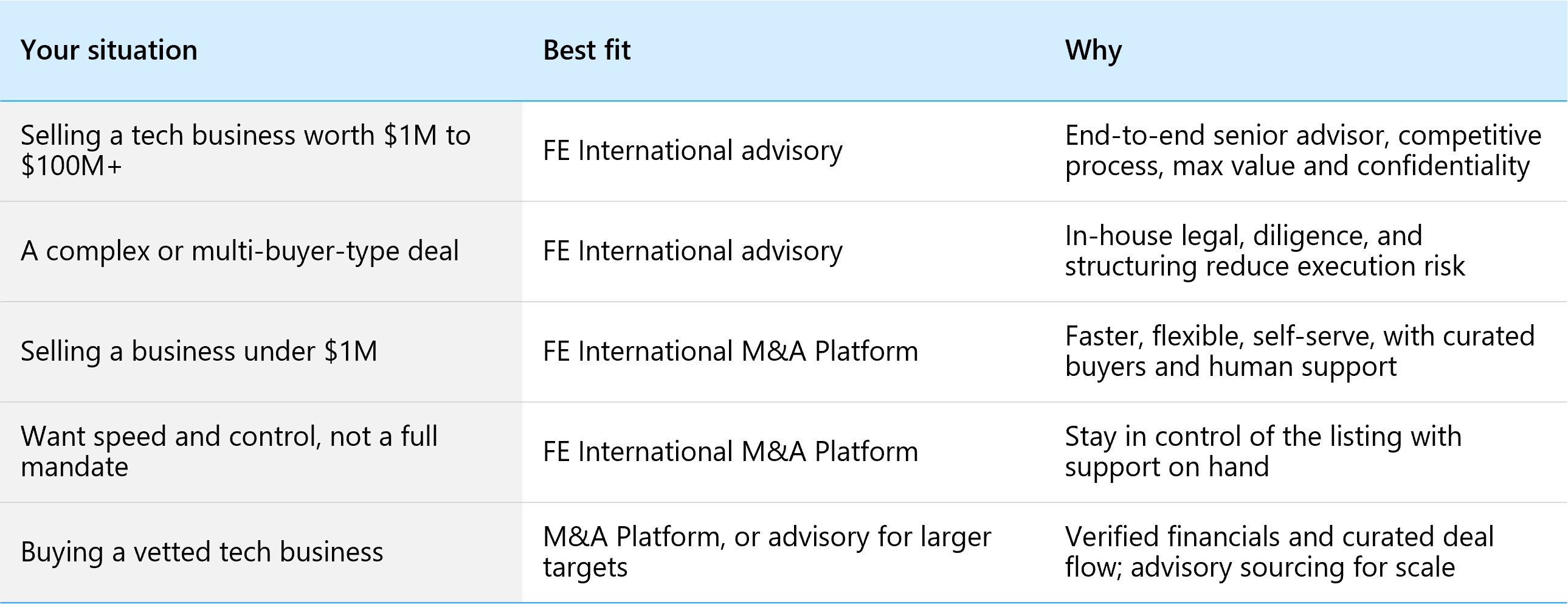
Whichever path fits, the market is on the seller's side this year. Activity is at record levels, technology is leading, and buyers, from private equity to strategic acquirers, are competing for quality businesses. A more selective market is not a headwind for a well-prepared company; it is the reason a strong business, positioned by a team that knows its vertical, stands out and commands attention. The founders who do best in 2026 will be the ones who match their business to the right process and go to market ready.
The Bottom Line
FE International and Quiet Light Brokerage solve different problems. A brokerage lists a business and supports the sale. FE International runs the sale for you and brings an investment banking arm, vertical-specific teams, a vetted global buyer network, in-house diligence and legal, and a 94.1% close rate to the table, then backs it up with an M&A Platform for the smaller end of the market. For sellers and buyers alike, that means one firm with the right tool for every size of deal.
Across the dimensions that decide a sale, the comparison points the same way for a $1M+ technology business: a dedicated senior advisor over a self-managed listing, eight vertical teams over a narrower focus, a vetted global buyer network over inbound traffic, in-house diligence and legal over referrals, and a published 94.1% close rate over an unstated one. For businesses under $1M, FE International still has the answer in the M&A Platform, so the choice is rarely either-or.
If your technology business is worth $1M or more, start with a free, no-obligation valuation from a senior FE International advisor, or learn more about selling with the advisory practice. If your business is under $1M, or you are a buyer looking for vetted opportunities, explore the FE International M&A Platform. Either way, 2026 is a strong year to make your move, and the right partner makes the difference between a sale and the best possible sale.