
.png)
.png)
Global M&A deal value hit an estimated $4.9 trillion in 2025, up roughly 40% from the prior year, according to Bain & Company's 2026 M&A Report. Technology accounted for roughly 30% of that total, per Harvard Law School Forum on Corporate Governance. For founders of SaaS, e-commerce, and content businesses, that creates real opportunity: buyer appetite for quality digital assets remains strong and increasingly sophisticated.
But opportunity only converts into outcome when you pick the right path to market. Two names come up frequently when founders research how to sell: FE International and Flippa. They sound similar at first glance. Both facilitate the sale of online businesses. Both connect sellers with buyers. The similarities, however, end there. The two platforms operate on fundamentally different models, serve different segments of the market, and produce meaningfully different outcomes for sellers.
This guide breaks down FE International vs Flippa across every dimension that matters to a seller: service model, fees, buyer quality, confidentiality, deal support, and post-close transition. The goal is to give you enough concrete information to decide which approach fits your business, your goals, and your expectations for how a sale should be managed.
Two Fundamentally Different Approaches to Selling a Business
The core distinction is structural. FE International is a full-service M&A advisory firm, founded in 2010, that assigns a dedicated senior advisor to every engagement. The firm has completed over 1,500 transactions with a combined value exceeding $50 billion. It operates with a 94.1% success rate and maintains offices in New York, San Francisco, Miami, London, Mumbai, and Warsaw.
Flippa, launched in 2009, is an open online marketplace. Sellers create listings, set prices, and manage most of the sales process themselves. Flippa offers optional broker support on higher-value listings (typically above $100,000), but the standard experience is self-serve. The platform reports over 600,000 registered buyers and lists everything from domain names to seven-figure SaaS businesses.
Here is the simplest way to think about it: FE International is your advisory team. Flippa is your listing platform. One manages the entire transaction on your behalf; the other gives you the tools to do it yourself.
For founders who have built a business worth $100,000 to $100 million, the difference between these two models has real financial consequences.
FE International operates as a full-service M&A advisory with a 94.1% success rate across 1,500+ transactions, while Flippa functions as a self-serve marketplace where sellers manage most of the process independently.
What You Actually Get: Advisory vs Self-Serve
The practical differences between an advisory and a marketplace become apparent as soon as you start the process. With FE International, the engagement begins with a free, no-obligation valuation conducted by a senior advisor. That valuation is not generated by an algorithm; it draws on the firm's proprietary database of 1,500+ completed transactions and considers dozens of factors specific to your business model, growth trajectory, and competitive position.
If both sides agree to move forward, FE's team then prepares a professional Confidential Information Memorandum (CIM), a detailed document that presents your business to prospective buyers. The CIM is a critical piece of the process. Buyers at the PE firm and family office level expect one. A well-prepared CIM positions the business in context, highlights the metrics that drive value, and addresses the questions a serious acquirer will have.
On Flippa, the seller writes their own listing description. There is no CIM unless the seller creates one independently or pays for a separate service. The seller also sets their own asking price, often using Flippa's AI-powered valuation tool. That tool references platform transaction data, which can be helpful for smaller deals, but it lacks the depth and deal-specific nuance of an advisor-led valuation informed by institutional transaction experience.
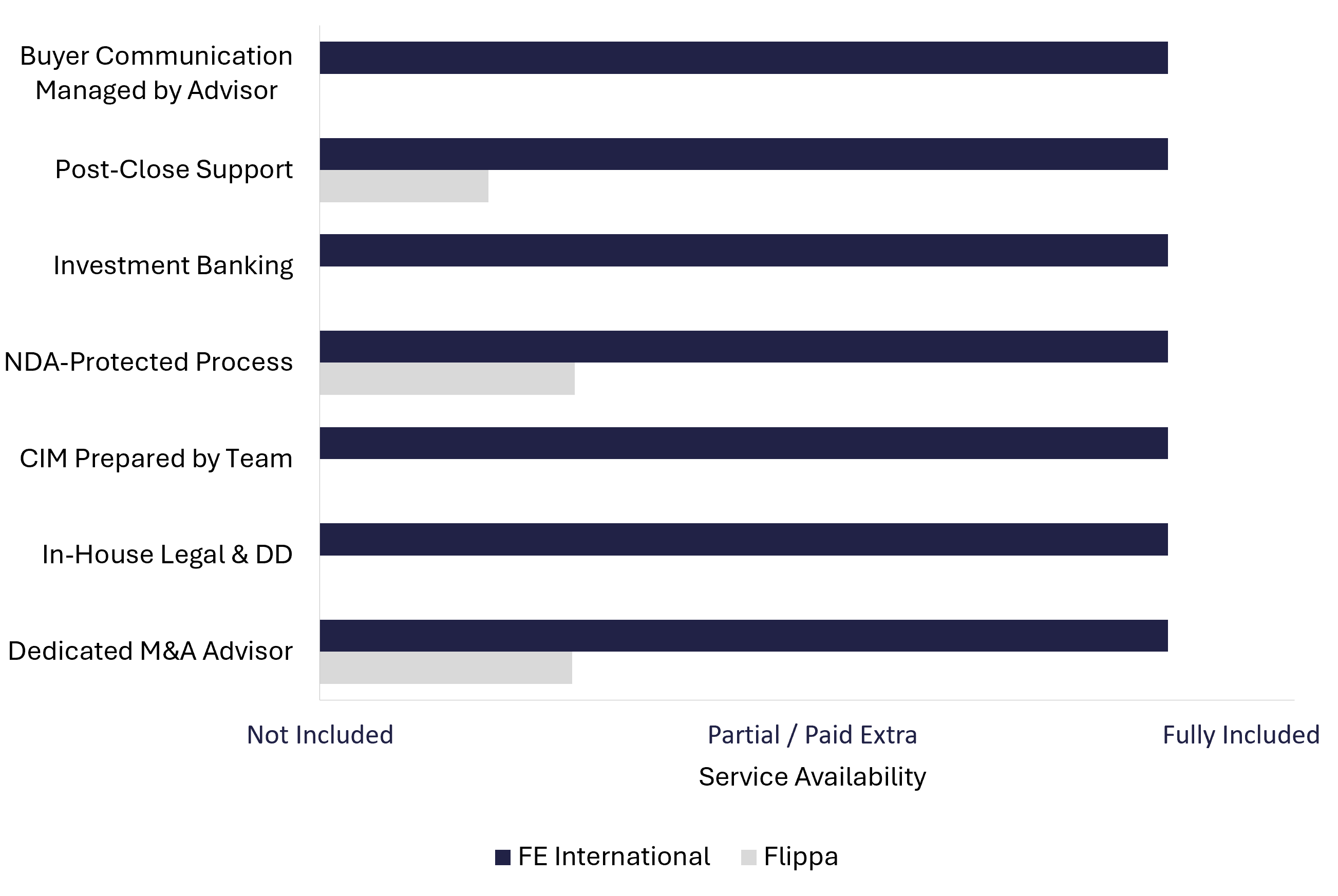
With FE International, the advisor manages all buyer communication, negotiation, and deal coordination. You never negotiate alone. The firm's in-house legal team drafts the Letter of Intent, purchase agreements, and handles the closing paperwork. Due diligence is managed internally by FE's financial and legal team. Post-close transition support is included in the engagement.
On Flippa, the seller handles buyer inquiries directly (unless they pay for the optional broker service). Negotiation, due diligence, and legal documentation are the seller's responsibility. If a seller wants professional support in those areas, they need to hire external attorneys and accountants, which adds cost and coordination complexity.
How Fees and Costs Actually Compare
Fee structures are often the first thing sellers compare, but raw percentages can be misleading without context on what is included.
FE International charges zero upfront fees. There is no listing fee, no retainer, and no charge for the initial valuation. The firm operates on a success-aligned commission model, meaning it only gets paid when the deal closes. The commission is structured on a sliding scale based on deal size, and it covers the full scope of advisory services: valuation, CIM preparation, buyer outreach, negotiation, legal documentation, due diligence support, and post-close transition.
Flippa charges an upfront listing fee ranging from $29 to $699, depending on the package and asking price. This fee is non-refundable, meaning sellers pay regardless of whether the business sells. On top of the listing fee, Flippa charges a mandatory success fee when the business sells. According to Flippa's pricing page, success fees start at 3% and scale with the transaction value. Sellers who opt for the brokered service (available for listings above $100,000) pay an additional $999 fee plus the standard success fee.

The crucial point: FE International's commission includes services that Flippa does not. On Flippa, if a seller wants professional due diligence support, legal drafting, or a quality CIM, those are additional out-of-pocket costs. When you total the effective cost of a well-supported sale through Flippa (listing fee + success fee + external legal + external DD + CIM preparation), the gap narrows considerably, but the seller does significantly more work.
Side-by-Side Fee Comparison
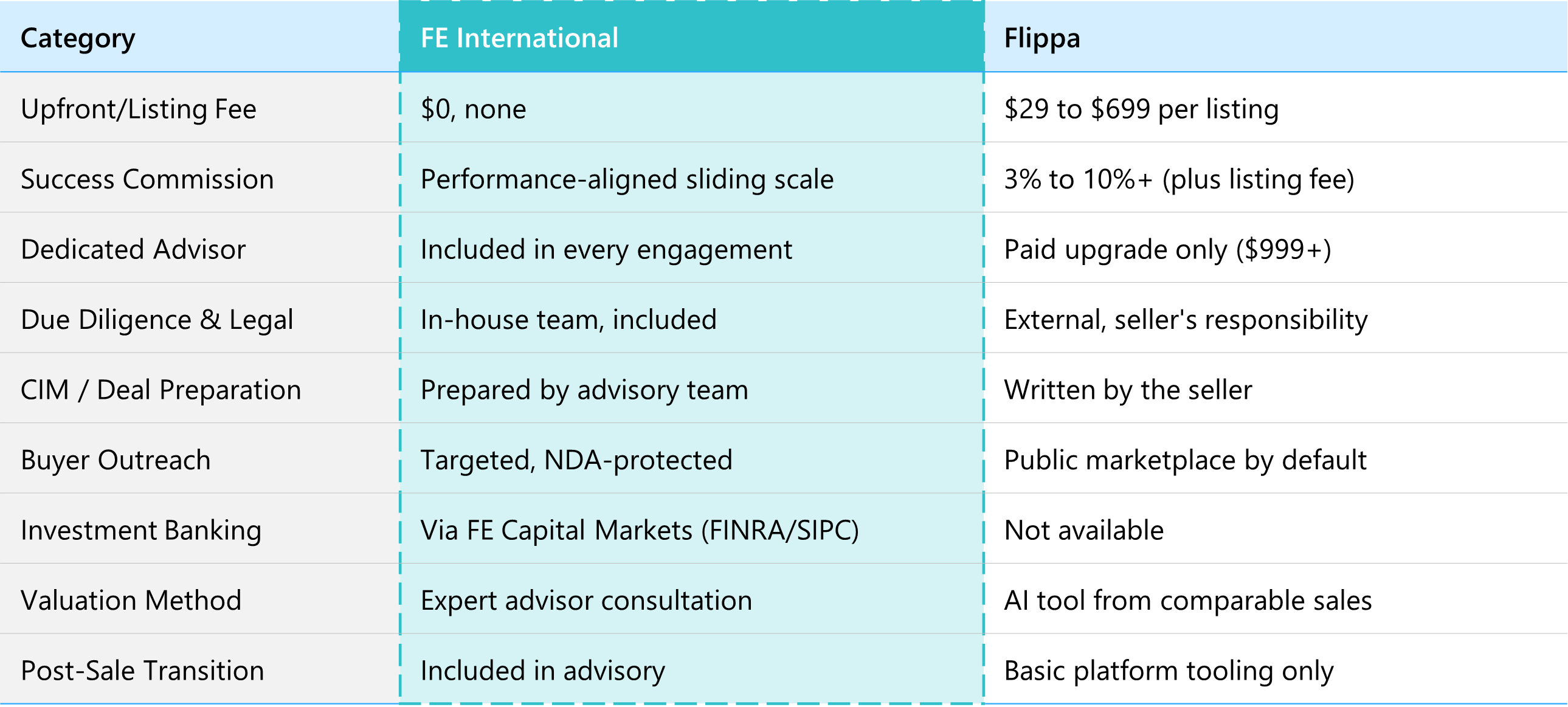
FE International's fee covers the full spectrum of M&A advisory services at no upfront cost to the seller. Flippa's lower percentage comes with listing fees, limited support, and the expectation that sellers will self-manage most of the process or pay separately for professional help.
Buyer Quality and Confidentiality: Why It Matters More Than You Think
One of the least discussed but most consequential differences between the two platforms is buyer quality and how confidentiality is handled.
FE International maintains a pre-vetted network of over 80,000 qualified investors, including PE firms, family offices, strategic acquirers, and serial entrepreneurs. Every potential buyer goes through a vetting process before receiving any confidential business information. Non-disclosure agreements (NDAs) are signed before the buyer sees the CIM or learns identifying details about the business.
This matters for practical reasons. If employees, customers, or competitors learn that a business is for sale, it can destabilize operations and erode value. A confidential process protects the seller's leverage and the business's health during what can be a months-long transaction.
Flippa, by contrast, is a public marketplace by default. Listing titles, financial summaries, and business details are visible to anyone browsing the platform. Flippa does offer a paid confidentiality option (included in the Premium listing package at $699), but the platform's standard operating model is open. Anyone can register as a buyer, and there is no pre-qualification screening for standard listings.
For businesses valued under $50,000, the open marketplace model may be perfectly adequate. For businesses worth $500,000 or more, where the seller has employees, vendor relationships, and a competitive position to protect, the risk of a public listing is real and difficult to undo.
Industry Specialization: Generalist Marketplace vs Vertical Expert
FE International has built dedicated vertical teams across seven technology sectors: SaaS, Fintech, AI, EdTech, E-commerce, Cybersecurity, and Agency. Each team includes advisors with specific expertise in that vertical's valuation drivers, buyer landscape, and deal structure norms. This specialization produces more accurate valuations and better buyer matching.
The firm publishes annual market reports across each of these verticals, providing data-driven insights into valuation trends and M&A activity. When a seller engages FE, they work with an advisor who understands their specific business model and the pool of buyers most likely to pay a premium for it. You can explore FE International's approach to SaaS business valuation and e-commerce business valuation in their published guides.
Flippa is a generalist marketplace. It lists businesses across every category, from content blogs and Amazon FBA stores to SaaS platforms and mobile apps. That breadth is a strength for buyers who want variety, but it means the platform does not provide the specialized market intelligence, buyer targeting, or valuation insight that comes from deep vertical focus.
Why This Comparison Matters Now: The State of Tech M&A in 2026
The macro environment reinforces the importance of choosing the right partner. According to PwC's 2026 TMT outlook, global technology deal values rose approximately 50% in 2025, with AI-related transactions driving a significant share of the increase. Bain's analysis found that 2025 was the second-highest M&A year on record, with total deal value reaching an estimated $4.9 trillion. Tech M&A specifically grew 77% in deal value, fueled by acquisitions of AI-related assets.
.png)
For small and mid-market technology businesses, this means buyers are active and capital is available, but they are also more selective. TD Securities' M&A outlook notes that while mega-deals drove the headline growth, smaller and mid-sized transactions remained more cautious, with well-prepared businesses standing out. That preparation gap is exactly where a full-service advisory creates the most value.
.png)
Across these high-growth verticals, FE International has dedicated specialist teams positioned to match sellers with the specific buyers driving acquisitions in their sector.
Investment Banking: A Capability Most Marketplaces Cannot Offer
In August 2024, FE International launched FE Capital Markets, LLC, a FINRA-registered investment banking broker-dealer. FE Capital Markets is a member of SIPC and is authorized to advise on public M&A transactions and private capital placements. This is confirmed on FINRA's public registry of regulated broker-dealer firms.
What does this mean for sellers? It means FE International can advise on larger, more complex transactions that require regulatory compliance, including structured deals involving equity rollovers, earnouts tied to future performance, and private placements. It also means the advisory is held to the fiduciary and compliance standards enforced by FINRA and the SEC.
Flippa is not a registered broker-dealer and does not offer investment banking services. For transactions under $1 million that involve a straightforward asset sale, this distinction may not matter. For larger deals with more complex structures, the regulatory infrastructure behind FE Capital Markets provides a level of deal sophistication and investor protection that a marketplace platform cannot replicate.
The Deal Process: What Selling Actually Looks Like on Each Platform
Understanding the step-by-step process helps clarify what each option demands of the seller.
With FE International
Step 1: Free valuation and initial consultation. A senior advisor assesses your business and provides a data-backed valuation at no cost and with no obligation. Details on the full process are available in FE International's guide on how to sell your online business with FE International.
Step 2: Engagement and CIM preparation. If you decide to proceed, FE's team prepares the CIM, sets up a secure deal room, and handles pre-listing due diligence. You pay nothing upfront.
Step 3: Targeted buyer outreach. The advisor identifies and approaches pre-qualified buyers, PE firms, family offices, and strategic acquirers, all under NDA. No information is shared before confidentiality agreements are signed.
Step 4: Negotiation, due diligence, and close. FE's advisory and legal team manages multiple qualified offers, creates competitive tension, negotiates terms, manages the due diligence process, drafts all legal documentation, and guides the deal to close.
With Flippa
Step 1: Choose a listing package ($29 to $699) and pay the non-refundable listing fee.
Step 2: Write your own listing description and set your asking price. Optionally use Flippa's AI valuation tool.
Step 3: Your listing goes live on the public marketplace. Buyers browse, ask questions, and make offers. You manage all buyer communication yourself (unless you pay for the brokered service at $999+).
Step 4: Negotiate and close. You handle negotiations, arrange your own legal documentation, manage due diligence (or pay for Flippa's optional DD reports), and coordinate the asset transfer through escrow.

Which Option Fits Your Situation
Both platforms serve a purpose, and the right choice depends on the specifics of your business and your goals for the sale.
FE International is the stronger fit for:
Businesses valued above $100,000 where the owner wants a managed, confidential sales process. SaaS, e-commerce, and content businesses with recurring revenue, documented financials, and growth potential. Founders who want professional valuation, buyer targeting, and negotiation support without paying upfront fees. Sellers who need investment banking capabilities for complex deal structures.
Flippa may work for:
Smaller digital assets (under $50,000) where a quick, self-serve listing is sufficient. Domain names, starter websites, or early-stage projects without significant revenue history. Experienced sellers who are comfortable managing buyer communication, negotiation, and legal documentation on their own.
There is no single right answer for every seller. The question is whether the value of professional advisory support, from valuation through close, outweighs the cost of the commission. For businesses with meaningful value at stake, the data strongly suggests it does. FE International's 94.1% success rate reflects a process designed to get deals done at the best possible terms.
The Bottom Line: Your Exit Deserves More Than a Listing
Selling a business you have built is one of the most significant financial decisions you will make. The platform or advisor you choose shapes not just the price, but the terms, the tax structure, the buyer quality, the confidentiality of the process, and the transition after the sale.
FE International vs Flippa is not a contest between two equivalent options. It is a choice between a full-service, advisor-led M&A process with 15 years of institutional experience and a self-serve marketplace that puts the work (and the risk) on the seller.
For founders with a technology business worth $100,000 or more, the case for professional advisory is supported by the numbers: 1,500+ completed transactions, a 94.1% success rate, $50 billion+ in combined deal value, dedicated vertical teams, in-house legal and due diligence, and FINRA-registered investment banking capabilities via FE Capital Markets.
If you are considering an exit, the first step is understanding what your business is worth. Request a free, no-obligation valuation from FE International and speak with a senior advisor who specializes in your sector. There is no cost, no commitment, and no listing fee. We only succeed when you do.