
The global HR technology market reached USD 43.66 billion in 2025 and is projected to nearly double by 2034. Within that broader market, the pre-employment testing software segment alone is valued at over USD 3 billion, growing at close to 9% annually. For founders who have built products in this space, those numbers represent more than a trend. They represent a real opportunity to exit at a premium.
This is the story of Evalart, a bootstrapped pre-employment assessment platform built in Latin America, serving over 1,000 customers with a near-perfect satisfaction score. In April 2024, Evalart was acquired by Noosa Labs, a Miami-based SaaS holding company, in a competitive sale process managed by FE International. Here is how the deal came together, what made the business attractive, and what other SaaS founders can learn from it.
What Evalart Built: A Pre-Employment Testing Platform for Latin America
Evalart was founded in 2017 by G. Cateriano with a straightforward premise: give employers a better way to evaluate candidates before hiring them. The platform offered an extensive library of tests covering programming, aptitude, knowledge, personality, and psychometric assessments. Employers could also create fully custom tests tailored to specific roles.
Two things set Evalart apart in a crowded pre-employment testing market. First, the platform was purpose-built for the Latin American market, offering assessments in both Spanish and English, with features designed for the region's hiring workflows. Second, the business operated on a dual pricing model: recurring subscription plans for regular users and pay-as-you-go options for companies with occasional hiring needs. This flexibility helped Evalart serve everyone from small startups to larger enterprises without forcing them into a single pricing tier.
According to Capterra and GetApp, the platform also included advanced features like webcam proctoring, cheat detection, API integrations, and detailed candidate reporting. For a bootstrapped product, the feature depth was notable.
The Numbers Behind the Business
The deal summary tells a compelling story about what a well-run, small SaaS business can look like at the time of exit:
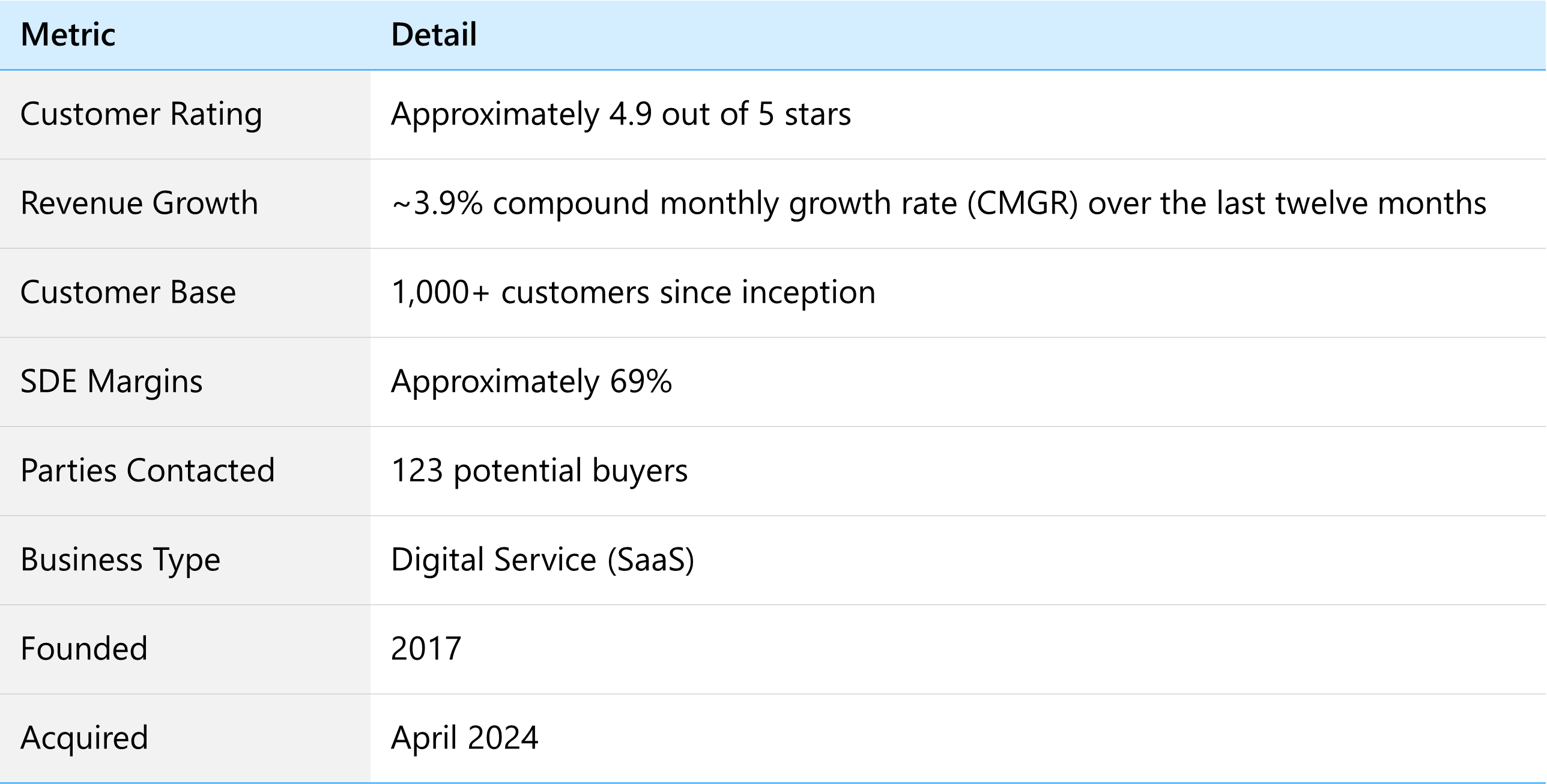
A 69% SDE margin is strong by any standard, but particularly so for a bootstrapped SaaS serving a regional market. Combined with steady monthly revenue growth and a customer satisfaction score that most SaaS companies would envy, Evalart was the kind of business that attracts serious buyer attention.
.png)
Why the Founder Decided to Sell
After seven years of building Evalart, Cateriano reached a point familiar to many bootstrapped founders. The business was profitable, the product was mature, and the customer base was loyal. But scaling further, particularly into new geographies or upmarket segments, would require resources and expertise beyond what a solo founder operation could realistically provide.
As Cateriano noted at the time of the acquisition, the decision was about aligning with a buyer who could "propel its future growth in the market." This is a pattern we see often at FE International: founders who are not burned out or desperate, but who recognize that the next phase of their product's life needs different capabilities. Selling at that point, rather than waiting until growth stalls, typically leads to better outcomes for everyone involved.
The Sale Process: 123 Parties, 1 Strategic Match
FE International served as the exclusive sell-side M&A advisor on the transaction. The sale process is worth examining because it illustrates how a structured, advisor-led approach works in practice, even for smaller SaaS deals.
Broad Outreach, Targeted Results
The FE team contacted 123 potential buyers. That number might seem high for a business of Evalart's size, but broad outreach is precisely what generates competitive tension, and it underscores why working with an advisor who has a network of 80,000+ pre-qualified investors matters. A founder running this process alone would struggle to reach even a fraction of that buyer pool.
Why Competitive Offers Matter
Having two competitive offers on the table is valuable for several reasons. It validates the asking price, gives the seller leverage in negotiations, and often surfaces better deal terms beyond just the headline number. Even when one offer is clearly stronger, the existence of a second offer keeps the winning bidder honest on price, structure, and timeline.
Thomas Smale, CEO and Founder of FE International, noted that the HR tech sector's resilience and projected growth trajectory made for attractive investment opportunities, and the Evalart transaction was a strong example of that dynamic in action.
The Buyer: Why Noosa Labs Was the Right Fit
Noosa Labs, founded in 2021 and based in Miami, specializes in acquiring and growing small, profitable SaaS businesses, typically with less than $1 million in annual recurring revenue. The company is led by Pascal Levy-Garboua, a veteran tech entrepreneur with over 20 years of experience, including co-founding VirtuOz (acquired by Nuance Communications) and serving as the first outside executive at Checkr, now a $5 billion company.
For Noosa Labs, the Evalart acquisition checked several boxes simultaneously. It provided entry into both the Latin American market and the HR technology vertical, two areas with significant growth tailwinds. Levy-Garboua's stated plan was to enhance Evalart's user experience, integrate generative AI tools, and develop tailored solutions for mid-sized and larger customers.
This kind of buyer-seller fit is what separates a good exit from a great one. Cateriano was not simply cashing out. He was handing the business to an operator with the specific skills and resources needed to take Evalart to its next stage. That continuity matters to customers, employees, and ultimately to the legacy of what the founder built.
.png)
What Made Evalart Attractive to Buyers: Lessons for SaaS Founders
Not every SaaS business generates competitive offers. Evalart did, and the reasons why offer a useful playbook for founders thinking about their own exit.
Exceptional Customer Satisfaction
A 4.9 out of 5 customer rating is rare. It signals product-market fit, reliable support, and a product that genuinely solves a problem. For buyers, high satisfaction scores translate directly to lower churn risk, which is one of the most important metrics in SaaS valuation. When customers love a product, they stick around, and that recurring revenue becomes significantly more predictable.
Strong and Consistent Margins
A ~69% SDE margin tells a buyer that the business is not just generating revenue but doing so efficiently. High margins in a bootstrapped SaaS typically mean low customer acquisition costs, minimal overhead, and a product that does not require heavy ongoing investment to maintain. For an acquirer like Noosa Labs, those margins create immediate room to reinvest in growth without needing to restructure the business first.
Growing in a Growing Market
Evalart was not operating in a stagnant category. The global talent assessment market is valued at USD 29.4 billion in 2025 and is projected to reach $57 billion by 2035, growing at a CAGR of 9.4%. In Latin America specifically, the HR technology market is expected to nearly double by 2033, reaching over $2.1 billion. When a business is growing in a market that is also growing, the risk profile for a buyer drops significantly.
Flexible Pricing That Expanded the Addressable Market
By offering both recurring subscriptions and pay-as-you-go plans, Evalart removed a common barrier to adoption. Companies with irregular hiring patterns could still use the platform without committing to a monthly subscription, while power users benefited from the predictability of recurring plans. This dual model expanded the total addressable market and demonstrated thoughtful product strategy.
Key takeaway: Buyers pay premiums for businesses that combine strong unit economics with market tailwinds. Evalart's near-perfect customer rating, 69% SDE margins, and position in a fast-growing HR tech market made it exactly the kind of acquisition target that generates competitive interest.
What This Deal Tells Us About the HR Tech M&A Landscape
The Evalart acquisition reflects several broader trends shaping HR technology M&A right now.
First, small SaaS businesses in the HR tech space are increasingly attractive acquisition targets. The global HR technology market is projected to grow at over 10% annually through 2031, reaching nearly $78 billion. That growth is creating a steady pipeline of acquirers, from strategic buyers looking to expand their product suite to holding companies like Noosa Labs that specialize in buying and scaling profitable niche products.
Second, Latin America is an increasingly interesting market for technology acquisitions. The region's HR tech market alone is growing at nearly 7% annually, driven by digital transformation, the nearshoring boom, and a growing emphasis on formalized hiring practices. For a buyer like Noosa Labs, acquiring a platform with an established footprint in the region was a faster path to market than building from scratch.
Third, the rise of serial SaaS acquirers has been a positive development for founders of smaller businesses. Companies like Noosa Labs are specifically designed to acquire, operate, and grow SaaS products in the sub-$1M ARR range. This was once a segment of the market that was harder to exit cleanly, since most traditional acquirers focused on larger targets. Today, founders of profitable micro-SaaS and small SaaS businesses have more exit options than at any point in the past decade.
.png)
The Role of an M&A Advisor in a Small SaaS Exit
One of the most common questions founders of smaller SaaS businesses ask is whether they actually need an M&A advisor. The Evalart deal offers a clear answer.
Reaching 123 potential buyers is not something a founder can realistically do while continuing to run the business. FE International's network, built over 1,500+ completed transactions, gives sellers access to a buyer pool that would take years to build independently. More importantly, the advisor manages the entire process: valuation, prospectus preparation, buyer vetting, negotiations, due diligence, legal documentation, and escrow. For a solo founder like Cateriano, that operational lift would have been overwhelming to handle alone.
The result speaks for itself. FE International generated significant market interest, produced competitive offers, and closed the transaction with a buyer that had both the resources and the strategic intent to grow the business. That is the value an experienced advisor brings to the table.
A Clean Exit, a Clear Playbook
The Evalart acquisition is a textbook example of what a well-executed SaaS exit looks like. A founder who built a profitable, loved product over seven years. A structured sale process that contacted 123 buyers and produced competitive offers. A strategic acquirer with the resources and intent to grow the business further. And an M&A advisor with the experience and network to bring it all together.
For SaaS founders considering their own exit, the Evalart story reinforces a few timeless principles: build something customers genuinely love, maintain strong unit economics, sell from a position of strength rather than desperation, and work with an advisor who knows the market.
If you are thinking about selling your SaaS, e-commerce, or content business, get a free, confidential valuation from FE International. With over 1,500+ successful transactions and a 94.1% success rate, our team can help you understand what your business is worth and plan the right exit strategy for your goals.